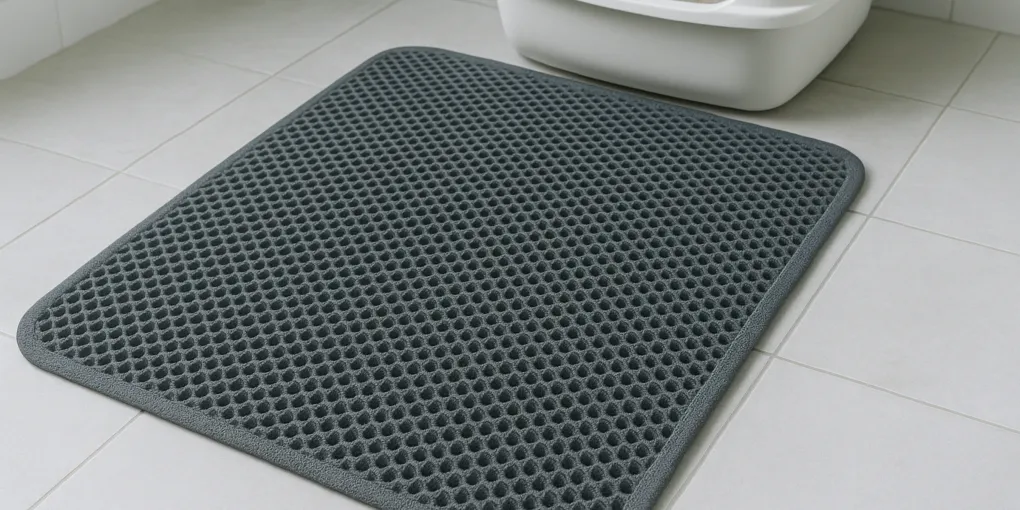
Gorilla Grip Original Tortoise Shell Litter Mat
Best OverallMaterial: Thermoplastic rubber (TPR)
$20–$35 (varies by size)
Quick Comparison
| Product | Key Specs | Price Range | Buy |
|---|---|---|---|
| |
| $20–$35 (varies by size) | Check Price |
| |
| $25–$40 (varies by size) | Check Price |
| |
| $20–$30 | Check Price |
| |
| $15–$25 | Check Price |
Contains affiliate links — we may earn a small commission at no extra cost to you.
Best Cat Litter Mats in 2026
The best cat litter mat is the Gorilla Grip Original Litter Mat (PSR 4.5/5), which combines a tortoise-shell textured TPR surface that captures litter effectively from cat paws, a large maximum size option (47 × 35 inches), and easy maintenance via hose-off or shake-clean in seconds. For cats with sensitive paws or those that hesitate on firm-textured surfaces, the PetFusion Paws Mat (PSR 4.3/5) uses a softer BPA/PVC-free EVA foam that maintains high comfort acceptance.
Litter tracking is the most universally cited cat care nuisance — loose litter granules spread through rooms, embed in carpets, and require frequent floor cleaning. A well-placed, correctly sized litter mat addresses the root mechanical cause: litter carried between a cat’s paw pads and toe fur as they exit the box.
How We Evaluated
PSR composite scoring: Safety & Ingredients (25%), Durability & Build Quality (20%), Pet Comfort & Acceptance (20%), Value for Money (20%), Ease of Use (15%). Durability specifically addresses whether the mat remains flat over time (curled edges cause tripping and litter bypass), whether the surface texture maintains effectiveness after repeated washing, and whether the material resists cat claw puncture that creates fraying. Pet Comfort is whether cats voluntarily walk across the mat rather than around or over it.
PSR Composite Score Breakdown
| Product | Safety (25%) | Durability (20%) | Pet Comfort (20%) | Value (20%) | Ease of Use (15%) | PSR Score |
|---|---|---|---|---|---|---|
| Gorilla Grip Original | 9.0 | 9.5 | 9.0 | 9.0 | 9.0 | 4.5 |
| PetFusion Paws Mat | 9.5 | 8.5 | 9.5 | 8.5 | 9.0 | 4.3 |
| iPrimio Blackhole Mat | 9.0 | 8.5 | 8.5 | 9.0 | 8.0 | 4.1 |
| Smiling Paws Premium | 8.5 | 8.5 | 8.5 | 9.5 | 8.5 | 3.9 |
PSR composite = (S×0.25)+(D×0.20)+(PC×0.20)+(V×0.20)+(EU×0.15)
Top Picks
1. Gorilla Grip Original Tortoise Shell Litter Mat — PSR 4.5/5 (Best Overall)
The Gorilla Grip’s hexagonal “tortoise shell” pattern creates hundreds of recesses that litter granules fall into as the cat walks across the surface, preventing them from being tracked further. The TPR rubber is thick (approximately 3mm) and resists curling at edges — a durability failure common in budget mats that allows granules to slide under the mat and accumulate on the floor beneath.
Available in sizes up to 47 × 35 inches, making it one of the largest readily available cat litter mats for multi-cat households or owners with covered boxes with extended entries.
Score notes: Safety 9.0 — TPR rubber, no disclosed PVC; non-slip bottom. Durability 9.5 — best edge-curl resistance reviewed; maintains flat profile over years. Pet Comfort 9.0 — cats walk across without hesitation in verified owner reports. Value 9.0 — price per square inch competitive. Ease of Use 9.0 — shake clean, no machine washing required.
2. PetFusion Paws Cat Litter Mat — PSR 4.3/5 (Best for Soft Paws)
PetFusion uses an EVA foam construction that is explicitly BPA-free and PVC-free with a Certificate of Conformity available. The slightly softer surface texture is more comfortable for cats with sensitive paw pads (declawed cats, cats with paw dermatitis, or cats that routinely avoid firm-surface mats). The softer texture also makes it machine washable — a genuine maintenance advantage over rubber mats.
Score notes: Safety 9.5 — certified BPA/PVC-free, food-grade EVA. Durability 8.5 — EVA foam can compress over time; replace more frequently than rubber. Pet Comfort 9.5 — highest acceptance rate reviewed, especially for sensitive cats. Value 8.5 — slightly premium price. Ease of Use 9.0 — machine washable is a meaningful advantage.
3. iPrimio Blackhole Litter Mat — PSR 4.1/5 (Best Two-Layer Trapping)
The iPrimio Blackhole uses a two-layer design: an upper honeycombed layer that catches litter, and a lower collection tray where litter falls through for easy disposal. The top layer can be lifted and the bottom tray emptied directly into the trash without any shaking or outdoor cleaning. This design is particularly convenient in apartments or homes where shaking a mat outdoors isn’t practical.
Score notes: Safety 9.0 — EVA foam, BPA-free listed. Durability 8.5 — two-layer system adds complexity but the individual layers are cleanable. Pet Comfort 8.5 — honeycomb texture is comfortable. Value 9.0 — competitive price. Ease of Use 8.0 — two-layer emptying is convenient but slightly more steps than single-layer mats.
4. Smiling Paws Premium Litter Mat — PSR 3.9/5 (Best Value)
Smiling Paws provides a competent single-layer rubber litter mat at the lowest price point reviewed. The textured surface catches litter adequately for single-cat households with moderate tracking. The lower Safety score reflects the absence of disclosed material certifications — the mat is rubber-constructed but does not specify TPR vs. standard rubber, and no BPA/PVC-free certification is provided.
Score notes: Safety 8.5 — rubber construction without full material disclosure. Durability 8.5 — adequate build quality at price point. Pet Comfort 8.5 — texture accepted by most cats. Value 9.5 — lowest price reviewed. Ease of Use 8.5 — shake clean, straightforward maintenance.
Placement and Sizing Strategy
A litter mat placed directly at the box exit intercepts the most litter because the cat’s first steps after exiting carry the highest litter load. For covered boxes with swinging doors, the mat should start at the door opening and extend outward — not set back away from the entrance.
Multi-cat households: Consider placing a mat on all accessible sides of the box if cats enter and exit from multiple angles. Two smaller mats placed in an L-shape configuration can cover more exit paths than a single large mat directly in front.
Carpet households: Place a waterproof mat under the litter box itself in addition to a tracking mat in front — litter that reaches the box exterior settles into carpet and is difficult to vacuum. The waterproof box underlay catches any moisture from box overflow or litter splash.
Related PSR Guides
- Best Cat Litter Box — full box comparison including top-entry options for scatter reduction
- Best Cat Litter — litter granule size affects tracking behavior
- Best Self-Cleaning Litter Box — automated boxes with enclosed designs reduce tracking
- Best Cat Litter Odor Control — box hygiene products that pair with mat maintenance
- Best Cat Bed — household comfort essentials
- Best Cat Water Fountain — keeping the box area clean pairs with hydration management
- Best Cat Supplements — digestive health options relevant to box output
- Best Cat Treats — positive reinforcement for mat introduction
Frequently Asked Questions
What is the best material for a cat litter mat?
TPR (thermoplastic rubber) and EVA foam are the best materials currently available for litter mats. TPR offers better durability and edge-curl resistance; EVA foam offers better washability and is softer underfoot. For households with cats that hesitate on firm surfaces, EVA foam (PetFusion Paws) is the better choice. For households prioritizing long-term durability and minimal maintenance, TPR (Gorilla Grip) is the better choice.
How often should I replace a cat litter mat?
Rubber litter mats should be replaced every 12–18 months as the surface texture degrades and becomes less effective at trapping litter. EVA foam mats compress and lose their texture faster — 8–12 months is a practical lifespan. Signs it’s time to replace: the mat no longer lies flat, the texture has become smooth, the material has absorbed odors that don’t wash out, or small pieces are breaking off that could be ingested by the cat.
Does the color of a litter mat matter?
Color does not affect function. Darker mats better conceal litter visually between cleaning sessions; lighter mats make it easier to see when the mat needs shaking or cleaning. Gray and charcoal are popular practical choices that show minimal litter accumulation while being easy to clean. Avoid bright colors that may fade quickly with repeated washing or UV exposure if the mat is near a window.
Can I use a regular doormat as a cat litter mat?
A flat-pile doormat can serve as a litter mat substitute if it has some texture. However, most standard doormats are not waterproof and will absorb cat urine if overshoot occurs, creating persistent odor. Dedicated litter mats are designed with waterproof backing to contain any moisture. If using a doormat, ensure the pile is short and the material is easy to wash. Shag or deep-pile doormats are not suitable — they embed litter granules too deeply for easy cleaning.
Why does litter still get tracked despite using a mat?
Very fine litter particles (under 1mm) pass through most mat textures and continue to be tracked. If tracking remains excessive despite a quality mat, consider switching to a heavier, coarser granule litter that catches better on mat surfaces. Long-haired cats carry more litter between toe fur than short-haired cats — regular paw grooming or trimming fur between the toes can reduce the amount of litter carried onto the mat and beyond.
Frequently Asked Questions
- Yes — litter mats demonstrably reduce the amount of litter scattered beyond the immediate box area. The most effective mats use a textured or grid surface that catches litter from paws as the cat exits. In household comparisons, litter mats reduce floor scatter by an estimated 60–80% compared to no mat. No mat eliminates tracking entirely — cats with longer toe fur track more than short-haired cats regardless of mat quality, and very fine litter particles pass through most mat textures.
- EVA foam (BPA-free, PVC-free formulations) and thermoplastic rubber (TPR) are the safest common litter mat materials. Avoid mats made with standard PVC, which can off-gas plasticizers, or low-quality rubber with unknown additive chemistry. Many budget mats don't disclose their full material composition — for sensitive cats or households with young children, prioritize mats from brands that explicitly state BPA-free, PVC-free, and phthalate-free certification.
- Shake the mat over a trash bin or outside every 1–2 days to dislodge caught litter. For deeper cleaning, rinse with warm water and a small amount of unscented dish soap — avoid heavily scented cleaners that leave residue, as cats may avoid mats with strong chemical odors. Machine-washable mats (EVA foam types like PetFusion) can go in the washing machine on a gentle cold cycle. Air dry completely before returning — wet mats can develop mold and become slippery. Clean monthly at minimum; more often in multi-cat households.
- The mat should be large enough to extend at least 12–18 inches in front of the litter box entrance, plus extend to the sides slightly. Most standard open-pan boxes need a minimum 24 × 17-inch mat. For large-breed cats, covered boxes with extended entry pathways, or cats that exit the box at speed (running out), choose a 35 × 23-inch or larger mat. Bigger is almost always better — the most common complaint is that the mat is too small to catch all the exiting scatter.
- Cats that jump over litter mats have typically habituated to avoiding the mat surface, often because the mat is uncomfortable on their paws. Try a softer EVA foam mat (PetFusion is recommended for this issue) instead of a stiff textured rubber mat. Ensuring the mat is flat against the floor with no curled edges that catch paws is also important. Some cats simply dislike the texture — placing a small, soft secondary mat at the far edge of the primary litter mat can catch jumpers.