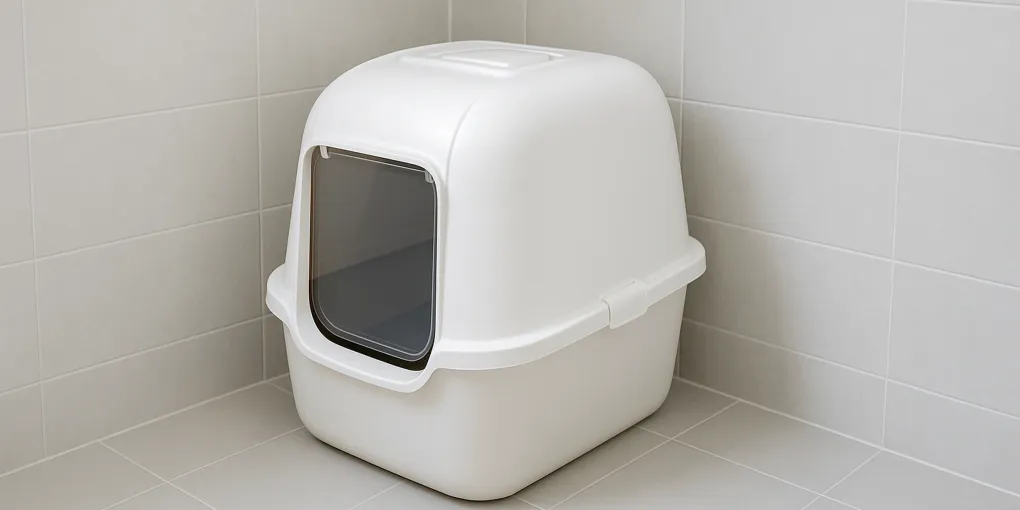
Petmate Open Pan Litter Box (Giant)
Best Overall — Open PanType: Open pan
$15–$25
Quick Comparison
| Product | Key Specs | Price Range | Buy |
|---|---|---|---|
| |
| $15–$25 | Check Price |
| |
| $30–$45 | Check Price |
| |
| $50–$70 | Check Price |
| |
| $30–$45 | Check Price |
Contains affiliate links — we may earn a small commission at no extra cost to you.
Best Cat Litter Box in 2026
The best litter box for most cats is a large open-pan litter box (PSR 4.5/5) — like the Petmate Giant — because it maximizes acceptance, minimizes odor trapping, and offers unrestricted entry for cats of all sizes and ages. For households prioritizing odor containment from a human perspective, the Nature’s Miracle Hooded Box (PSR 4.2/5) provides a practical covered option that still allows adequate ventilation.
The litter box is the single highest-leverage item in feline behavioral health. Inappropriate elimination outside the box is the most common behavioral complaint in cat-owning households and the leading reason cats are surrendered to shelters. The solution is most often environmental — wrong box size, wrong location, inadequate number of boxes, or odor buildup — before it is a medical or behavioral disorder.
How We Evaluated
PSR composite scoring: Safety & Ingredients (25%), Durability & Build Quality (20%), Pet Comfort & Acceptance (20%), Value for Money (20%), Ease of Use (15%). For litter boxes, Safety covers plastic safety certifications (BPA-free), structural stability, and entry accessibility for senior cats (low entry threshold = higher safety score). Pet Comfort is acceptance rate — whether cats voluntarily use the box type, based on verified owner behavioral reports.
PSR Composite Score Breakdown
| Product | Safety (25%) | Durability (20%) | Pet Comfort (20%) | Value (20%) | Ease of Use (15%) | PSR Score |
|---|---|---|---|---|---|---|
| Petmate Open Pan Giant | 9.5 | 8.5 | 9.5 | 9.5 | 9.0 | 4.5 |
| Nature’s Miracle Hooded | 9.0 | 8.5 | 8.0 | 8.5 | 8.5 | 4.2 |
| PetFusion BetterBox | 9.0 | 9.0 | 8.5 | 8.0 | 8.5 | 4.1 |
| Modkat Flip Top-Entry | 9.0 | 8.5 | 7.5 | 7.5 | 8.5 | 4.0 |
PSR composite = (S×0.25)+(D×0.20)+(PC×0.20)+(V×0.20)+(EU×0.15)
Top Picks
1. Petmate Open Pan Litter Box (Giant) — PSR 4.5/5 (Best Overall)
The Petmate Giant Open Pan is the best baseline litter box recommendation for most cats. At 24 × 17 × 6.5 inches, it accommodates cats up to approximately 14–15 lbs comfortably, and the 4-inch entry height allows access for kittens, standard adults, and cats with mild mobility limitations. The polypropylene construction is BPA-free and the smooth interior surface resists litter sticking.
The open design scores highest on Pet Comfort because it eliminates the primary reason cats avoid enclosed boxes: ammonia concentration. Feline olfactory sensitivity means odors that humans consider “faint” inside a covered box are overpowering to the cat using it.
For senior cats: The low entry height (4 inches) is a key advantage for cats with arthritis or hip pain that struggle with high-sided entry. See our guide to best cat supplements for joint health support options alongside box accessibility optimization.
Score notes: Safety 9.5 — BPA-free, no toxic coatings, low entry. Durability 8.5 — standard polypropylene durability, replace every 12–18 months. Pet Comfort 9.5 — open design maximizes cat acceptance. Value 9.5 — lowest cost-per-box reviewed. Ease of Use 9.0 — simplest design, easiest daily maintenance.
2. Nature’s Miracle Hooded Corner Litter Box — PSR 4.2/5 (Best Hooded Box)
Nature’s Miracle’s hooded box includes a carbon filter in the hood and a swinging front door for odor containment. The corner configuration fits naturally into room angles and is efficient with space. The door panel can be removed for cats that refuse to enter past a flap.
The antimicrobial coating on interior surfaces inhibits bacterial growth between cleanings — a documented feature that extends the effective sanitary use window compared to uncoated plastic. Carbon filters should be replaced every 30 days for continued effectiveness.
Score notes: Safety 9.0 — BPA-free, low entry, carbon filter is non-toxic. Durability 8.5 — antimicrobial coating adds longevity. Pet Comfort 8.0 — covered boxes accepted by most cats but rejected by cats with odor sensitivity. Value 8.5 — reasonable price for feature set. Ease of Use 8.5 — filter replacement adds maintenance step.
3. PetFusion BetterBox — PSR 4.1/5 (Best Easy-Clean Surface)
The PetFusion BetterBox uses a non-stick interior liner that prevents litter and waste from adhering to surfaces, dramatically reducing scrubbing effort during full box cleaning. The surface is smoother than standard polypropylene and resists the microscopic scratches that accumulate bacteria and odors in conventional boxes.
The open-top design maintains good acceptance rates, and the size (22.4 × 18 × 6 inches) is adequate for most cats under 15 lbs. The non-stick coating is listed as food-safe and non-toxic, though PetFusion does not disclose the specific coating chemistry in publicly available documentation.
Score notes: Safety 9.0 — listed non-toxic, BPA-free. Durability 9.0 — non-stick surface extends cleaning life. Pet Comfort 8.5 — open design, high acceptance. Value 8.0 — moderate price premium for non-stick feature. Ease of Use 8.5 — significantly faster cleaning than standard plastic.
4. Modkat Flip Top-Entry Litter Box — PSR 4.0/5 (Best for Litter Tracking Reduction)
The Modkat Flip’s top-entry design forces cats to exit through a grated lid surface, stripping the majority of litter from their paws before they return to the floor. This is the most effective mechanical solution to litter tracking reviewed, reducing scatter by an estimated 70–80% compared to open-pan boxes in the same household.
The main limitation is accessibility: top-entry boxes require a jump that is difficult for kittens under 4 months, senior cats with arthritis, and cats recovering from surgery. For able-bodied cats in tracking-sensitive households (white floors, shared living spaces), the Modkat is the most practical engineering solution.
Score notes: Safety 9.0 — BPA-free, stable design. Durability 8.5 — durable construction, lid grate withstands repeated cat weight. Pet Comfort 7.5 — not suitable for kittens, seniors, or mobility-impaired cats. Value 7.5 — premium price. Ease of Use 8.5 — lid opens fully for easy scooping.
Litter Box Placement Strategy
Where you place litter boxes matters as much as which box you choose. Veterinary behavioral guidelines recommend:
- Quiet, low-traffic locations — avoid laundry rooms during cycles, high-traffic corridors
- Multiple floors in multi-story homes — one box per floor prevents a cat from having to travel too far when urgency is high
- Away from food and water bowls — cats instinctively avoid eliminating near food sources
- Not in corners with only one approach angle — cats prefer to see their environment while using the box (predator awareness)
- Not near loud appliances (furnace, HVAC vents, washing machines) that startle cats
Related PSR Guides
- Best Self-Cleaning Litter Box — automated options for busy households
- Best Cat Litter — clumping and non-clumping options to pair with your box
- Best Cat Litter Odor Control — deodorizers and additives for between-clean odor management
- Best Cat Supplements — digestive and urinary health options that affect box output
- Best Wet Cat Food — hydration connection to urinary health
- Best Cat Water Fountain — kidney and urinary tract health through hydration
- Best Dry Cat Food — complete nutrition baseline
- Best Cat Bed — comfort between litter box visits
Frequently Asked Questions
What is the best litter box for a large cat?
For large cats (15+ lbs, Maine Coons, Ragdolls, Savannah cats), the standard commercial “large” litter box is often still too small. Look for open pans at least 24 × 18 inches, or repurpose a large Sterilite storage bin (35–45 gallon) with a U-shaped entry notch cut in one side at an appropriate height. The bin-conversion method is veterinarian-recommended for large-breed cat households and costs under $15.
How often should I replace my cat’s litter box?
Replace plastic litter boxes every 12–18 months. Plastic surfaces develop microscopic scratches over time from cleaning brushes and cat claws — these scratches harbor bacteria and absorbed odors that cannot be removed by washing and contribute to odor buildup that can trigger litter box avoidance. If the box retains odor after thorough cleaning, it is time to replace it regardless of age.
Why does my cat refuse to use the litter box?
The most common reasons for litter box avoidance are: (1) box is too small for the cat’s body length, (2) odor buildup from infrequent cleaning, (3) box is covered and ammonia concentration is too high for the cat’s sensitive nose, (4) litter type was changed without gradual transition, (5) the box is in a stressful or inaccessible location. Medical causes (UTI, crystals, constipation) must be ruled out by a veterinarian if the problem is sudden or accompanied by straining or blood.
Can I put the litter box in a closet?
A closet location is acceptable if: there is consistent ventilation (door left open or a cat door installed), the cat can enter and exit easily without squeezing, and cleaning access is practical. Closet placement without ventilation concentrates odors in an enclosed space, which most cats find aversive. Many commercial “litter box furniture” enclosures are essentially decorative closets — choose ones with adequate internal volume and ventilation openings.
Should I get a self-cleaning litter box?
Self-cleaning litter boxes (like the Litter-Robot) are valuable for households with multiple cats, busy schedules, or owners with mobility limitations that make daily scooping difficult. They do require a cat acceptance period and higher upfront cost. For single-cat households with regular daily scooping habits, a standard open pan box maintained consistently performs comparably to self-cleaning models. See our self-cleaning litter box guide for a full comparison.
Frequently Asked Questions
- The AAFP (American Association of Feline Practitioners) recommends one litter box per cat plus one extra — the n+1 rule. A single-cat household should maintain at least 2 boxes; two cats require at least 3. Multiple boxes in separate locations prevent one cat from guarding access. The n+1 rule also ensures a clean option is always available, since cats will avoid boxes that feel soiled even after single use by a housemate.
- The litter box should be at least 1.5 times the length of the cat from nose to tail base. For a typical 10–12 lb adult cat (approximately 18–20 inches body length), a box at least 27–30 inches long is ideal. Most commercial litter boxes sold as 'large' or 'giant' still run undersized for large-breed cats. Under-sized boxes are the second most common cause of litter box avoidance after scent issues.
- Research and veterinary behavioral consensus slightly favors open, uncovered boxes for most cats. Covered boxes trap ammonia and hydrogen sulfide odors inside — smells that are far more offensive to cats (with 200M+ olfactory receptors) than to humans. That said, some cats strongly prefer the privacy of a covered box. If you use a covered box, cleaning frequency must increase to compensate for odor accumulation. For cats already showing avoidance, transition to an open box first.
- Top-entry boxes (like Modkat) dramatically reduce litter scatter because cats must walk across a grated lid surface when exiting, dislodging most litter back into the box. High-sided open boxes (walls 8+ inches) also reduce scatter. Litter mats placed at the box exit catch residual tracked litter. For cats that dig vigorously and scatter litter far, a covered box often solves the problem entirely by containing litter within the hood.
- Daily: scoop solids and clumps. Weekly: top off litter to maintain 2–3 inch depth. Monthly (or every 2–4 weeks): full empty, wash with unscented mild dish soap and hot water, dry completely before refilling. Avoid bleach, ammonia-based cleaners, or heavily scented products — residual chemical odors cause avoidance. Replace plastic boxes every 12–18 months as scratched surfaces absorb odors and bacteria that cannot be removed by cleaning.