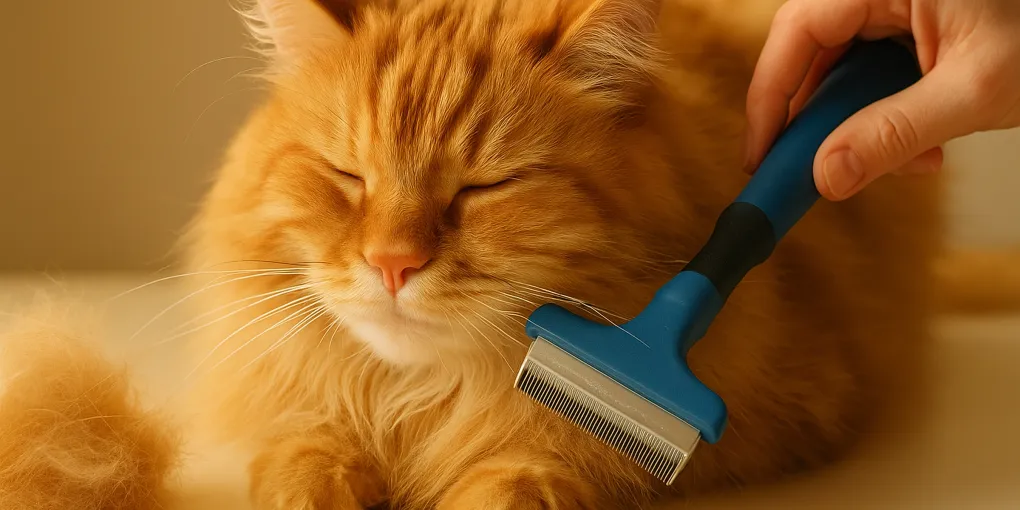
FURminator Deshedding Tool for Cats
Best OverallType: Stainless steel deshedding blade
$25–$45 (varies by size)
Quick Comparison
| Product | Key Specs | Price Range | Buy |
|---|---|---|---|
| |
| $25–$45 (varies by size) | Check Price |
| |
| $8–$14 | Check Price |
| |
| $15–$22 | Check Price |
| |
| $18–$25 | Check Price |
Contains affiliate links — we may earn a small commission at no extra cost to you.
Best Cat Deshedding Tools in 2026
The best cat deshedding tool is the FURminator for Cats (PSR 4.5/5), which removes up to 90% of dead undercoat in a single grooming session with its micro-toothed stainless steel edge and integrated FURejector button for fast, clean hair disposal. For cats with skin sensitivity or those that reject blade-type grooming, the Safari Shedding Comb (PSR 4.3/5) uses rotating rounded pins that remove undercoat without any sharp edges.
Effective deshedding reduces hairball frequency, improves coat condition, and strengthens the human-cat bond through regular positive physical contact. Cats groomed consistently from kittenhood accept handling more readily throughout their lives — grooming tolerance is one of the most consistently validated indicators of overall domestic cat contentment.
How We Evaluated
PSR composite scoring: Safety & Ingredients (25%), Durability & Build Quality (20%), Pet Comfort & Acceptance (20%), Value for Money (20%), Ease of Use (15%). Safety for grooming tools specifically evaluates whether the tool’s tines or blade can contact skin directly (and if so, how safely the edge is designed), material safety (stainless steel vs. coated metals), and ergonomic grip that prevents user slipping. Pet Comfort is whether cats lean into the tool rather than pulling away — measuring relaxation response vs. tension response in verified owner reports.
PSR Composite Score Breakdown
| Product | Safety (25%) | Durability (20%) | Pet Comfort (20%) | Value (20%) | Ease of Use (15%) | PSR Score |
|---|---|---|---|---|---|---|
| FURminator for Cats | 9.0 | 9.5 | 9.0 | 8.5 | 9.0 | 4.5 |
| Safari Shedding Comb | 9.5 | 8.5 | 9.5 | 9.5 | 8.5 | 4.3 |
| Hertzko Slicker Brush | 9.0 | 9.0 | 9.0 | 9.0 | 9.0 | 4.2 |
| GoPets Dematting Comb | 9.0 | 9.0 | 7.5 | 8.5 | 8.5 | 4.0 |
PSR composite = (S×0.25)+(D×0.20)+(PC×0.20)+(V×0.20)+(EU×0.15)
Top Picks
1. FURminator Deshedding Tool for Cats — PSR 4.5/5 (Best Overall)
The FURminator’s stainless steel micro-toothed edge reaches through the topcoat to remove loose undercoat hairs at the root without cutting or pulling guard hairs when used correctly. It comes in short-hair and long-hair variants with different tooth depths — purchasing the correct version for your cat’s coat type is important for optimal results.
The FURejector button pushes collected fur off the blade in a single press, eliminating the need to manually pull fur from between tines and significantly speeding up the grooming session. This quality-of-life feature is a genuine differentiator from manual combs during high-shedding season sessions.
Safe use protocol: 2–3 light strokes per body section, moving with the coat grain. Never scrub or apply downward pressure. Limit sessions to 10–15 minutes. Do not use on the same skin area more than 4–6 passes total per session. Overuse in a single session is the primary cause of reported skin redness.
Score notes: Safety 9.0 — safe when used correctly; overuse potential is managed by user education. Durability 9.5 — stainless blade maintains edge for years with normal use. Pet Comfort 9.0 — cats that tolerate the FURminator often lean into it, suggesting positive sensation. Value 8.5 — premium price for a premium tool. Ease of Use 9.0 — FURejector eliminates the main frustration point.
2. Safari Cat Shedding Comb — PSR 4.3/5 (Best for Sensitive Cats)
The Safari’s rotating pins have rounded tips that spin independently — when a pin contacts a mat or resistance, it rotates rather than pulling, dramatically reducing the sharp tug sensation that makes most cats averse to traditional grooming. This rotating-pin design is the gentlest approach to undercoat removal available and consistently earns the highest Pet Comfort scores for cats with previous grooming trauma or skin sensitivity.
The tradeoff is volume — the Safari removes less undercoat per stroke than the FURminator, requiring more strokes per session for cats with dense undercoats. For short and medium-coated cats, this difference is minimal; for Maine Coons or Norwegian Forest Cats in peak shedding season, it may require two full sessions weekly rather than one.
Score notes: Safety 9.5 — rotating rounded pins, zero sharp-edge skin contact risk. Durability 8.5 — pins maintain rotation after extended use. Pet Comfort 9.5 — highest cat acceptance rate reviewed. Value 9.5 — very affordable. Ease of Use 8.5 — hair releases from pins with light shaking.
3. Hertzko Self-Cleaning Slicker Brush — PSR 4.2/5 (Best Multi-Purpose Grooming)
The Hertzko is a slicker brush (fine bent metal pins in a flat arrangement) with a retractable pin button — pressing the button retracts all pins flush with the pad, releasing collected fur as a single removable mat. This makes the Hertzko one of the fastest tools to clean between strokes.
As a slicker brush, it also provides surface coat detangling and smoothing alongside undercoat removal, making it the best single-tool option for owners who want daily maintenance grooming rather than specialized session deshedding. It works effectively on all coat types from short to long.
Score notes: Safety 9.0 — bent pins are fine but tips are smoothed; standard slicker safety. Durability 9.0 — metal pad construction, retract mechanism is durable. Pet Comfort 9.0 — flat slicker contact is comfortable for most cats. Value 9.0 — competitive price. Ease of Use 9.0 — self-cleaning button is the best quick-clean mechanism reviewed.
4. GoPets Double-Sided Dematting Comb — PSR 4.0/5 (Best for Mat Prevention)
The GoPets double-sided comb has 12 teeth on one side (for light detangling and deshedding) and 20 teeth on the other (for fine work and dense coat separation). For long-haired cats prone to mat development (Maine Coon, Persian, Himalayan), a dematting comb used weekly prevents the minor tangles from progressing to painful mats that require professional grooming or shaving.
The Pet Comfort score is lower than other tools because dematting work, by its nature, involves some resistance from the coat — cats without existing mats may not accept the dematting comb as readily as smoother tools.
Score notes: Safety 9.0 — rounded tips, non-blade construction. Durability 9.0 — stainless teeth, durable handle. Pet Comfort 7.5 — lower acceptance due to resistance when working through thick coats. Value 8.5 — mid-range price for two tools in one. Ease of Use 8.5 — dual-side versatility reduces tool switching.
Deshedding by Coat Type
| Coat Type | Recommended Tool | Frequency |
|---|---|---|
| Short (domestic shorthair, Siamese) | FURminator short-hair OR Hertzko slicker | 1–2x/week, 3x during shedding season |
| Medium (American shorthair, British shorthair) | FURminator OR Safari comb | 2–3x/week |
| Long (Maine Coon, Ragdoll, Persian) | FURminator long-hair + GoPets dematting comb | Daily maintenance; full deshed 3–4x/week |
| Sensitive/rescue cats | Safari rotating comb → Hertzko slicker | Start with Safari; graduate to FURminator if tolerated |
Related PSR Guides
- Best Cat Grooming Brush — full grooming brush comparison for all coat types
- Best Cat Nail Clippers — completing the grooming routine
- Best Cat Treats — reward treats to build positive grooming associations
- Best Cat Supplements — omega-3 supplementation for coat health reduction of shedding
- Best Cat Food for Indoor Cats — diet quality directly affects coat condition
- Best Cat Bed — washable beds to manage shed hair accumulation
- Best Dry Cat Food — protein quality baseline for coat health
- Best Cat Water Fountain — hydration supports skin and coat health
Frequently Asked Questions
Does the FURminator work on cats?
Yes — the FURminator is one of the most effective and widely recommended professional-grade deshedding tools for cats. Used correctly (light strokes with coat grain, limited passes per session), it removes significantly more dead undercoat than standard brushes. Incorrect use (pressing hard, repeated passes on the same area) can cause skin irritation. For cats that tolerate grooming, the FURminator delivers observable results within a single 10-minute session during peak shedding season.
What causes excessive shedding in cats?
Normal seasonal shedding is triggered by changing day length. Excessive shedding beyond seasonal norms often indicates: nutritional deficiency (especially omega-3 fatty acids, zinc, or total protein), chronic stress, hyperthyroidism (common in cats over 8 years), allergies (food or environmental), external parasites (fleas, mites), or underlying skin disease. Sudden marked increase in shedding or patchy hair loss warrants veterinary evaluation.
Can regular brushing reduce cat hairballs?
Yes — regular brushing significantly reduces hairball frequency by removing loose undercoat hair before the cat ingests it during self-grooming. Cats that are regularly deshedded typically produce fewer hairballs than unbrushed cats. Combined with hairball-control fiber supplementation or diet, regular deshedding is one of the most effective interventions for cats with chronic hairball issues.
Is it normal for cats to shed a lot in spring?
Yes — spring is the peak shedding season for most cats, triggered by increasing daylight length signaling the body to shed the winter undercoat. This seasonal transition shed is normal and can produce alarming-seeming hair volumes for 3–6 weeks. Indoor cats on year-round artificial lighting may shed less dramatically in spring and more uniformly year-round. If spring shedding exceeds previous years significantly, consult a veterinarian.
Should I take my cat to a professional groomer for deshedding?
Professional grooming baths with deshedding treatment (high-velocity blow dryer after bathing) remove significantly more dead coat in a single session than at-home tools and are particularly valuable for long-haired cats at the start of shedding season. For most short and medium-coated cats, regular at-home deshedding with a quality tool is sufficient. Professional grooming once or twice yearly as a seasonal “reset” is a reasonable supplement to regular home grooming.
Frequently Asked Questions
- Short-haired cats benefit from deshedding 1–2 times per week year-round, increasing to 3x weekly during peak shedding season (spring and autumn). Long-haired cats (Maine Coon, Ragdoll, Norwegian Forest Cat) typically require daily brushing to prevent mats and reduce hairball frequency. The goal is to remove loose undercoat before it is swallowed during self-grooming — a cat that grooms frequently without brushing support will have higher hairball frequency than one groomed regularly by an owner.
- The FURminator is safe when used correctly. The key safety guidelines are: never press hard or scrub back and forth — light strokes with the grain of the coat are sufficient. Never use on the same area more than 2–3 passes per session. Avoid using on cats with skin conditions, wounds, or very thin coats. FURminator-related skin irritation in cats is almost always due to over-use (too many passes on the same area) rather than the tool itself. For sensitive cats, a rotating-pin comb like the Safari is a gentler alternative.
- Seasonal shedding is normal and peaks in spring (winter coat shed) and autumn (summer coat shed) as cats respond to daylight length changes. Indoor cats with artificial lighting often shed more uniformly year-round rather than in seasonal peaks. Excessive or sudden shedding beyond normal seasonal amounts can indicate: dietary deficiency (especially omega-3 fatty acids, biotin, or overall protein), stress, endocrine disorders (hyperthyroidism in older cats), external parasites (fleas), or skin disease. If shedding is accompanied by bald patches, itching, or skin changes, consult a veterinarian.
- Start with very short sessions (30–60 seconds) in a calm, comfortable location. Use a soft rubber brush or a gentle slicker before introducing a deshedding blade. Pair brushing with treats immediately before, during, and after. Over 2–4 weeks, gradually extend session duration. Cats that have never been brushed as adults often require 4–6 weeks of daily very-short desensitization before tolerating full grooming sessions. Never restrain a struggling cat — end the session calmly and try again later with an even shorter duration.
- No — dog deshedding tools are generally too large and often have different edge geometry for heavier dog coats. Cat-specific tools are sized for smaller body areas, lighter coats, and more sensitive skin. Some tools are marketed for both dogs and cats in separate size variants (FURminator offers cat-specific sizing) — use the cat-sized version only. Applying a large dog brush to a cat's body can cause discomfort and skin abrasion that damages the cat-grooming relationship.