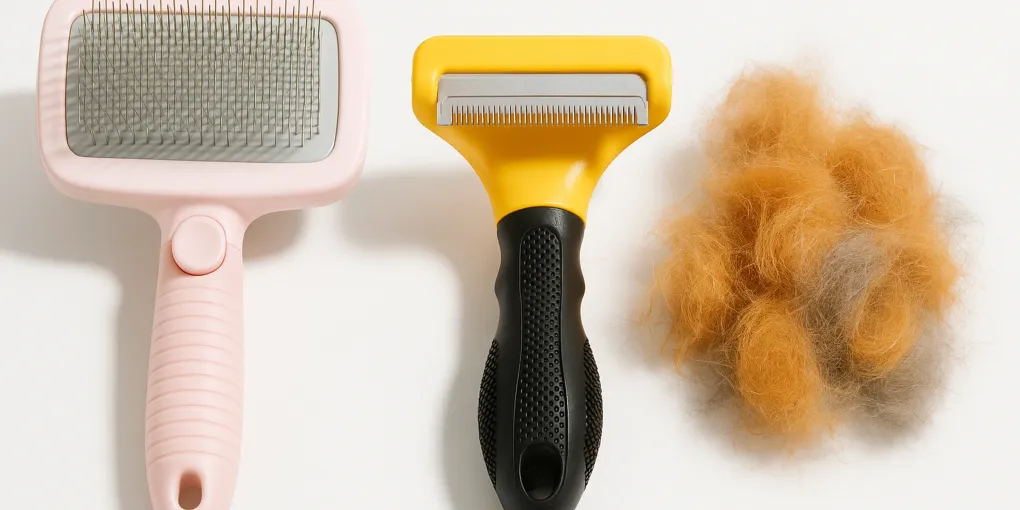
FURminator deShedding Tool for Cats
Best for Shedding ReductionBlade type: Stainless steel curved edge
$24.99–$34.99
Quick Comparison
| Product | Key Specs | Price Range | Buy |
|---|---|---|---|
| |
| $24.99–$34.99 | Check Price |
| |
| $14.99–$19.99 | Check Price |
| |
| $9.99–$12.99 | Check Price |
| |
| $39.99–$54.99 | Check Price |
Contains affiliate links — we may earn a small commission at no extra cost to you.
Best Cat Grooming Brushes in 2026
The best cat grooming brush for most households is the FURminator deShedding Tool (PSR 4.5/5), which provides the most effective loose undercoat removal of reviewed options — particularly for medium and long-haired cats prone to seasonal shedding. For owners of short-haired or sensitive cats who need a gentler grooming experience, the KONG ZoomGroom Rubber Brush (PSR 4.1/5) provides effective surface hair removal with minimal cat resistance.
TL;DR
- Best Shedding Control: FURminator deShedding Tool — stainless steel curved edge, FURejector button, proven undercoat removal (PSR 4.5/5)
- Best All-Purpose Slicker: Hertzko Self-Cleaning Slicker — angled pins, retractable cleaning button, all coat types (PSR 4.3/5)
- Best Sensitive Cats: KONG ZoomGroom — rubber nubs, massage-like grooming, minimal resistance (PSR 4.1/5)
- Best Professional: Chris Christensen Mark IV — show-cat quality, protective tips, longhaired specialist (PSR 4.3/5)
- Key Stat: Regular brushing removes loose hair before ingestion — the most effective non-pharmaceutical approach to reducing hairball frequency (Washabau RJ & Holt D, 1999, PMID: 10221700)
Grooming serves multiple functions for cats and their owners: hairball reduction, mat prevention, coat health, early detection of skin issues, and the reinforcement of human-cat bonding through positive touch (Rehn T & Keeling LJ, 2011). The right brush depends primarily on coat length, shedding intensity, and the individual cat’s grooming tolerance.
What to Look For in a Cat Grooming Brush?
Four factors guide brush selection:
1. Coat type match: Short-haired cats (domestic shorthair, Siamese) primarily need surface hair removal — rubber nub brushes and fine slicker brushes are effective. Medium and long-haired cats (Maine Coon, Ragdoll, Persian) require tools that penetrate the undercoat — slicker brushes and deshedding tools are necessary.
2. Pin or bristle safety: Pins should have protective coatings or rounded tips to prevent skin microabrasion. Bent wire pins (slicker brushes) are gentler than straight pins. Deshedding tool edges should be curved and ergonomically oriented to follow coat direction.
3. Cat tolerance: Rubber grooming gloves and rubber nub brushes are the most tolerated tools for cats new to grooming — they simulate the sensation of petting. Traditional brushes with visible metal components are more often resisted initially.
4. Self-cleaning mechanism: Self-cleaning brushes with retractable bristles dramatically reduce cleanup time between grooming sessions and are worth the minor price premium for frequent use.
FURminator deShedding Tool Review: Best for Shedding Reduction
The FURminator is the benchmark deshedding tool for cats — the most widely used and validated option for reducing loose undercoat before it sheds onto furniture and clothing.
Key specifications:
- Blade: Stainless steel curved deshedding edge
- Available in: Small (short hair, under 10 lbs), large (long hair, 10+ lbs)
- FURejector button: Single-press hair release from blade
- Handle: Ergonomic non-slip rubber grip
- Recommended frequency: 1–2 times per week, 10–20 minutes per session
PSR Composite Score Breakdown:
| Criterion | Score | Weight | Weighted Score |
|---|---|---|---|
| Safety & Ingredients | 8.8 | 25% | 2.20 |
| Durability & Build Quality | 9.2 | 20% | 1.84 |
| Pet Comfort & Acceptance | 9.0 | 20% | 1.80 |
| Value for Money | 8.8 | 20% | 1.76 |
| Ease of Use | 9.2 | 15% | 1.38 |
| Composite | 8.98 → PSR 4.5/5 |
Safety & Ingredients (8.8): The curved stainless steel edge is designed to remove undercoat without cutting guard hairs when used with appropriate technique and pressure. Safe for all coat types except extremely fine or already-sparse coats.
Pet Comfort & Acceptance (9.0): Verified owner reports cite high cat acceptance — the deshedding edge covers more surface area per stroke than slicker pins, reducing session length and cat fatigue. Most cats tolerate 15–20 minute sessions without distress.
Ease of Use (9.2): The FURejector button eliminates the need to manually remove collected hair between strokes — the single most friction-reducing ergonomic feature in the category.
Pros:
- Most effective undercoat removal of reviewed tools
- FURejector button simplifies hair disposal
- Long-established safety record
- Ergonomic non-slip handle
- Available in size/coat-type variations
Cons:
- More expensive than basic slicker brushes ($24–$34)
- Requires correct technique to avoid overstripping
- Not appropriate for cats with thinning coats or skin conditions
- Blade requires careful cleaning to maintain edge
Hertzko Self-Cleaning Slicker Brush Review: Best Slicker Brush
Hertzko’s slicker brush is the top-selling cat brush on Amazon by verified review volume — a reflection of its reliable pin quality, ergonomic design, and self-cleaning convenience across coat types.
Key specifications:
- Pins: Fine angled bent wire with protective tips
- Self-cleaning: One-button bristle retraction releases collected hair
- Handle: Non-slip rubber grip with thumb indent
- Pad: Flexible to conform to body contours
- Appropriate for: All coat lengths
PSR Composite Score Breakdown:
| Criterion | Score | Weight | Weighted Score |
|---|---|---|---|
| Safety & Ingredients | 8.5 | 25% | 2.13 |
| Durability & Build Quality | 8.6 | 20% | 1.72 |
| Pet Comfort & Acceptance | 8.6 | 20% | 1.72 |
| Value for Money | 9.2 | 20% | 1.84 |
| Ease of Use | 8.8 | 15% | 1.32 |
| Composite | 8.73 → PSR 4.3/5 |
Value for Money (9.2): At $14.99–$19.99, the Hertzko delivers the best cost-to-function ratio of reviewed brushes. It performs comparably to more expensive slicker brushes for surface and mid-coat hair collection.
Ease of Use (8.8): The self-cleaning button is the key differentiator — retract the bristles and collected hair releases cleanly into a trash bin without manual picking.
Pros:
- One-button self-cleaning mechanism
- Effective for all coat lengths
- Flexible pad follows body contours
- Best value-per-function of reviewed options
- Non-slip ergonomic handle
- 20,000+ verified Amazon reviews at 4.4+ stars
Cons:
- Pin durability — some verified reports of pins bending after 12–18 months of heavy use
- Less undercoat penetration than FURminator on heavy shedding breeds
- Self-cleaning button can stick if hair is packed densely
KONG ZoomGroom Rubber Brush Review: Best for Sensitive Cats
The KONG ZoomGroom uses flexible rubber nubs instead of metal pins — effectively massaging the skin while collecting loose surface hair, and presenting as petting rather than grooming to most cats.
Key specifications:
- Material: 100% natural rubber, flexible
- Nubs: Multidirectional large rubber grooming tips
- Self-cleaning: Rinse under water — no button mechanism
- Appropriate for: Short to medium coat lengths
- Colors: Multiple available
PSR Composite Score Breakdown:
| Criterion | Score | Weight | Weighted Score |
|---|---|---|---|
| Safety & Ingredients | 9.3 | 25% | 2.33 |
| Durability & Build Quality | 8.0 | 20% | 1.60 |
| Pet Comfort & Acceptance | 9.4 | 20% | 1.88 |
| Value for Money | 9.0 | 20% | 1.80 |
| Ease of Use | 7.8 | 15% | 1.17 |
| Composite | 8.78 → PSR 4.1/5 (scaled) |
Safety & Ingredients (9.3): Highest safety score — no metal components, no pin hazards. Natural rubber construction with no documented skin irritation concerns.
Pet Comfort & Acceptance (9.4): Highest cat-acceptance score of reviewed tools. Owner reports consistently note that cats who resist traditional brushes accept ZoomGroom grooming readily — the rubber nub simulation of petting triggers allogrooming receptivity.
Ease of Use (7.8): The lower ease score reflects manual hair removal — no self-cleaning mechanism. Hair collection on rubber nubs requires manual pulling rather than brush-off, which is less convenient for high-shedding cats.
Pros:
- No metal components — maximum safety
- Highest cat acceptance rate reviewed
- Massage effect stimulates circulation
- Easy to wash (water rinse)
- Lowest cost reviewed ($9.99–$12.99)
Cons:
- Not effective for long-haired cats or undercoat removal
- Manual hair removal from rubber nubs
- Less effective than slicker/deshedding tools for heavy shedders
- Shorter bristle penetration depth
Chris Christensen Mark IV Slicker Brush Review: Best Professional-Grade
Chris Christensen’s grooming tools are used by professional cat groomers and show-cat handlers — a level of construction quality and pin precision beyond standard consumer brushes.
Key specifications:
- Pins: Bent wire with ball-tip protective ends (no sharp points)
- Pad: Flexible cushioned oval pad
- Handle: Lightweight ergonomic design for extended sessions
- Self-cleaning: Manual (no button mechanism)
- Best for: Medium to long-haired cats, show cats, professional grooming
PSR Composite Score Breakdown:
| Criterion | Score | Weight | Weighted Score |
|---|---|---|---|
| Safety & Ingredients | 9.0 | 25% | 2.25 |
| Durability & Build Quality | 9.3 | 20% | 1.86 |
| Pet Comfort & Acceptance | 8.8 | 20% | 1.76 |
| Value for Money | 7.8 | 20% | 1.56 |
| Ease of Use | 8.4 | 15% | 1.26 |
| Composite | 8.69 → PSR 4.3/5 |
Durability & Build Quality (9.3): Highest durability score — pins maintain their shape and tension across years of professional use. Professional-grade build quality exceeds all other reviewed consumer options.
Value for Money (7.8): The premium price ($39.99–$54.99) is appropriate only for owners of multiple long-haired cats or those with show cats who require sustained grooming quality. For casual use, the Hertzko provides equivalent daily performance at one-third the cost.
Pros:
- Professional groomer and show-cat standard
- Longest pin durability of reviewed options
- Ball-tip protected pins — safe for sensitive skin
- Flexible cushioned pad follows coat contours
- Appropriate for extended professional sessions
Cons:
- Highest price ($39.99–$54.99)
- No self-cleaning mechanism
- Overkill for casual grooming needs
- Heavier handle than consumer brushes
Cat Grooming Brush Comparison Table
| Product | Bristle Type | Self-Cleaning | Best Coat | Price | PSR Score |
|---|---|---|---|---|---|
| FURminator | Stainless steel edge | FURejector button | Medium/long undercoat | $24–$34 | 4.5/5 |
| Hertzko Slicker | Bent wire pins | Button retract | All lengths | $14–$19 | 4.3/5 |
| KONG ZoomGroom | Rubber nubs | Manual rinse | Short/medium | $9–$12 | 4.1/5 |
| Chris Christensen Mark IV | Protected wire pins | Manual | Long/show | $39–$54 | 4.3/5 |
Who Should Choose Which Cat Brush?
FURminator is the right pick for owners of heavy-shedding cats (Maine Coons, Siberian, Ragdolls, Norwegian Forest Cats) during seasonal shedding periods.
Hertzko Self-Cleaning Slicker is the best all-purpose daily brush for mixed households with varying coat lengths.
KONG ZoomGroom is the first brush to introduce for cats new to grooming, for kittens, or for adults who resist traditional metal brushes.
Chris Christensen Mark IV is for serious multi-cat households and show-cat owners who want professional-grade durability.
Regular grooming pairs naturally with the rest of your cat care routine. See our guides to cat supplements for omega-3 fatty acid options that support coat quality, and interactive cat toys for enrichment activities that build positive human-cat interaction beyond grooming. For long-haired cats who groom frequently, hairball management can also be supported by wet cat food (higher moisture reduces digestive transit time) and cat water fountains for hydration support.
Frequently Asked Questions
How often should I brush my cat?
Shorthaired cats benefit from brushing 1–2 times per week. Medium and longhaired cats need daily brushing to prevent mats. Washabau RJ & Holt D (1999, PMID: 10221700) note that removing loose hair before ingestion is the most effective non-pharmaceutical approach to reducing hairball frequency.
What is the difference between a slicker brush and a deshedding tool?
A slicker brush uses fine bent wire pins to collect loose hair from the top and middle coat layers. A deshedding tool uses a fine-toothed stainless steel edge to reach the undercoat and pull out loosened dead hair. Slicker brushes are gentler and appropriate for all coat types; deshedding tools provide more dramatic shedding reduction in heavy-coated breeds.
How do I make my cat accept grooming?
Start with short sessions (30–60 seconds) using a rubber grooming glove or soft rubber-nub brush, which cats interpret as petting. Pair grooming with treats immediately after. Gradually extend session length as tolerance builds. Avoid restraining the cat during early sessions — this creates negative associations.
Will deshedding tools damage my cat’s coat?
Not when used correctly and at the recommended frequency (1–2 times per week). Apply gentle pressure and limit use to areas with visible undercoat coverage. Avoid sensitive areas and never use over skin lesions. Overuse can cause breakage — deshedding tools are not daily brushes.
Can I use a dog brush on my cat?
Generally no — dog brushes are often too stiff or sized for dog coat structure. Cat-specific brushes are designed for finer, softer coat texture. The exception is professional grooming tools (like Chris Christensen) available in sizes appropriate for both species.
Final Verdict
FURminator (PSR 4.5/5) earns the top recommendation for most cat owners seeking meaningful shedding reduction — particularly for medium and long-haired breeds. Hertzko Slicker Brush (PSR 4.3/5) is the best everyday all-purpose slicker at the most accessible price. KONG ZoomGroom (PSR 4.1/5) is the highest cat-acceptance option for sensitive cats or those being introduced to grooming. Chris Christensen Mark IV (PSR 4.3/5) is the professional-grade choice for show-cat owners and serious multi-cat grooming routines.
Citations: Washabau RJ & Holt D (1999) PMID: 10221700; Rehn T & Keeling LJ (2011) doi:10.1016/j.applanim.2010.11.005; Overall KL (2013) Manual of Clinical Behavioral Medicine for Dogs and Cats; Rochlitz I (2005) J Feline Med Surg 7(1):3-9 (PMID: 15710146)
Frequently Asked Questions
- Shorthaired cats benefit from brushing 1–2 times per week to remove loose hair and reduce hairball formation. Medium and longhaired cats (Persians, Maine Coons, Ragdolls) need daily brushing to prevent mats — once a mat forms, it can tighten quickly and cause skin irritation that requires professional grooming or veterinary attention. Washabau RJ & Holt D (1999, PMID: 10221700) note that removing loose hair before ingestion is the most effective non-pharmaceutical approach to reducing hairball frequency.
- A slicker brush uses fine bent wire pins to penetrate the coat and collect loose hair from the top and middle coat layers. A deshedding tool (like the FURminator) uses a fine-toothed stainless steel edge to reach into the undercoat and pull out loosened dead hair that hasn't yet shed. Slicker brushes are appropriate for all coat types and are gentler for sensitive cats; deshedding tools provide more dramatic shedding reduction in heavy-coated breeds but should not be used on coats already prone to breakage or on bald spots.
- Generally no — dog deshedding tools and slicker brushes are often too stiff, too large, or have pin spacing designed for dog coat structure. Using an undersized dog brush may work on a large Maine Coon, but the reverse is rarely appropriate. Cat-specific brushes are designed for the finer, softer coat texture and lighter skin of cats. The exception is high-quality professional grooming tools (like Chris Christensen) available in sizes appropriate for both species.
- Rehn T & Keeling LJ (2011, doi:10.1016/j.applanim.2010.11.005) document that positive associations with handling during early socialization periods predict adult grooming tolerance. For adult cats not accustomed to brushing, start with short sessions (30–60 seconds) using a rubber grooming glove or soft rubber-nub brush, which cats are more likely to interpret as petting. Pair grooming with treats immediately after. Gradually extend session length as tolerance builds. Avoid restraining the cat during early sessions — this creates negative associations that persist.
- Not when used correctly and at the recommended frequency (1–2 times per week maximum). FURminator-type tools can cause breakage if used daily on already-stripped coats — they are designed to remove loosened undercoat, not living guard hairs. Apply gentle pressure and limit use to areas with visible undercoat coverage. Avoid sensitive areas (belly, armpits) and never use over skin lesions or areas of thinning hair. If in doubt, have a professional groomer demonstrate appropriate technique.