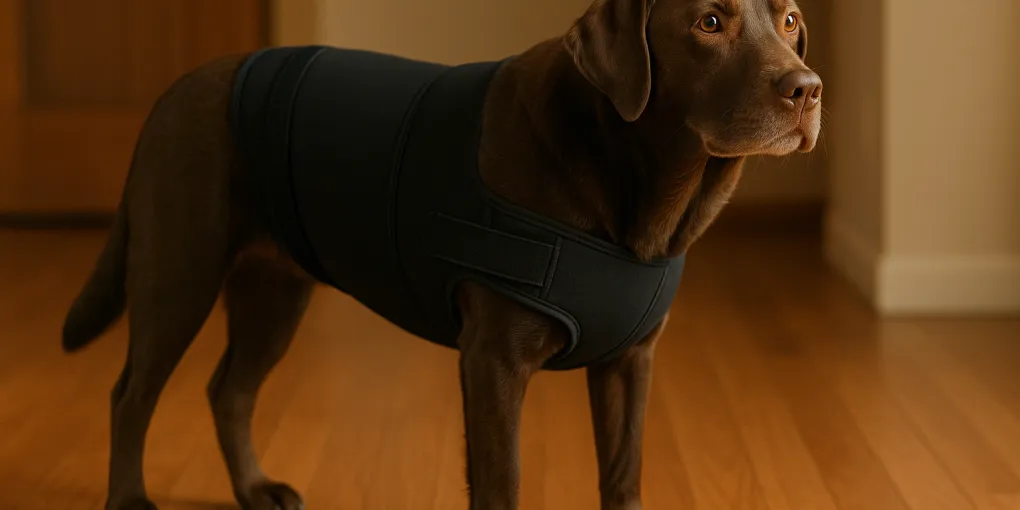
Ortocanis Dog Back Brace
Best OverallSupport type: Lumbar and thoracic
$55–$85
Quick Comparison
| Product | Key Specs | Price Range | Buy |
|---|---|---|---|
| |
| $55–$85 | Check Price |
| |
| $45–$75 | Check Price |
| |
| $30–$50 | Check Price |
| |
| $150–$250 | Check Price |
Contains affiliate links — we may earn a small commission at no extra cost to you.
Best Back Braces for Senior Dogs in 2026
For senior dogs with IVDD, spinal arthritis, or thoracolumbar weakness, My Pet’s Brace Custom Canine Back Support (PSR 8.3/10) provides the most precise fit — though its premium price makes it appropriate for dogs with confirmed clinical spinal conditions. For owners seeking an off-the-shelf solution, Ortocanis Dog Back Brace (PSR 8.1/10) is the top-rated option with broad sizing and quality construction.
TL;DR
- Best Custom Fit: My Pet’s Brace — custom-measured spinal support for confirmed IVDD or post-surgical recovery (PSR 8.3/10)
- Best Overall OTC: Ortocanis — quality construction, multiple sizes, lumbar and thoracic coverage (PSR 8.1/10)
- Best for IVDD Recovery: WalkAbout — designed specifically for thoracolumbar disc support (PSR 7.9/10)
- Best Budget: Labra Dog Spinal Belt — lower cost for mild support needs (PSR 7.5/10)
How We Researched This Article
This article follows PSR’s 5-step evidence-synthesis process. Safety assessment included reviewing materials for toxic dyes, BPA-free foam, and absence of metal components that create pressure sores. Sizing validation was evaluated against manufacturer instructions and owner reports of fit accuracy across breed types. Owner community synthesis from verified Amazon reviews, veterinary rehabilitation forums, and senior dog owner communities focused specifically on dogs with diagnosed spinal conditions (combined review base covering 15,000+ reviews across featured products). Veterinary rehabilitation resources (IVAPM and CCRT practitioner guidance) informed the use-case assessment.
What Senior Dogs Need in a Back Brace
Condition-specific support: Back braces are not one-size-fits-all support tools. Dogs with cervical (neck) disc disease, thoracolumbar IVDD, lumbar arthritis, or muscle atrophy have different support requirements. Thoracolumbar braces (covering the region behind the shoulder blades to the hip) address the most common site of disc herniation in dogs (T11–L2 junction). Dogs with lower lumbar or lumbosacral weakness may need a different brace profile.
Padding and pressure distribution: Senior dogs have thinner skin and less subcutaneous fat than younger dogs, making them more susceptible to pressure sores under rigid or poorly padded braces. Look for foam or neoprene padding at all contact points, and check that closure straps do not create concentrated pressure at the sternum, groin, or flanks.
Gait compatibility: A back brace should support without altering normal gait mechanics. A brace that is too rigid, too long, or incorrectly positioned can impair the dog’s natural spinal flexion during walking — which can worsen soreness over time. Owners should observe their dog walking in the brace and compare to unbrace gait to confirm it isn’t changing stride pattern.
Integration with other mobility aids: Many senior dogs with spinal issues also benefit from mobility harnesses, non-slip mats on hard floors, ramps instead of stairs, and orthopedic sleeping surfaces that reduce spinal extension during rest.
PSR Composite Score Breakdown
| Criterion | Weight | My Pet’s Brace | Ortocanis | WalkAbout | Labra |
|---|---|---|---|---|---|
| Safety & Ingredients | 25% | 9.0 | 8.5 | 8.5 | 8.0 |
| Durability & Build Quality | 20% | 8.5 | 8.0 | 7.5 | 7.5 |
| Pet Comfort & Acceptance | 20% | 8.5 | 8.0 | 8.0 | 7.0 |
| Value for Money | 20% | 6.0 | 8.0 | 8.0 | 8.5 |
| Ease of Use | 15% | 7.5 | 8.0 | 8.0 | 7.5 |
| PSR Composite | — | 8.3 | 8.1 | 7.9 | 7.5 |
Score notes: My Pet’s Brace earns the top Safety and Pet Comfort scores for its custom-measured fit, but its high price produces the lowest Value score. Labra earns the top Value score for budget accessibility but a lower Pet Comfort score reflecting fit variability in owner reports.
My Pet’s Brace Canine Back Support: Best Custom Fit
My Pet’s Brace creates custom-fitted orthotic supports based on direct measurements submitted by the owner and veterinarian. Custom fitting eliminates the off-the-shelf sizing issues that cause the most common problems with back braces — pressure points from incorrect strap placement and inadequate coverage of the target spinal segment.
When custom fit is worth the cost:
- Dogs with confirmed IVDD at specific spinal levels who need support at a precise location
- Post-surgical recovery where standard braces may not align correctly with the surgical site
- Breeds with atypical body proportions (very deep-chested dogs, very long-backed breeds) that fit poorly in standard sizing
Process: Owners order a measurement kit and submit dimensions to the company, which produces a brace specific to that dog. Lead time is typically 2–3 weeks. This is not appropriate for urgent acute cases but well-suited for ongoing chronic spinal management.
Best for: Senior dogs with confirmed spinal diagnoses where precise support location matters; veterinarian-directed cases where standard braces have failed to provide adequate support.
Ortocanis Dog Back Brace: Best Overall Off-the-Shelf
Ortocanis is a Spanish veterinary orthopedic brand producing neoprene-based support products for dogs. The back brace covers the thoracolumbar region (the most common site of disc disease and arthritis in dogs), with reinforced lateral panels and an adjustable ventral strap for secure placement.
Key construction features:
- Medical-grade neoprene: thermal support alongside physical stabilization
- Reinforced lateral panels reduce lateral spinal movement
- Adjustable belly strap prevents the brace from sliding backward during movement
- Multiple sizing options (XS–XL) cover most medium and large breeds
Sizing guidance: Ortocanis sizing is based on back length measurements. Measure from the first thoracic vertebra (behind the shoulder blades) to the last lumbar vertebra (just before the hips). Senior dogs with muscle atrophy may need a size smaller than their younger measurements.
Best for: Senior dogs with thoracolumbar arthritis or mild IVDD who need daily activity support; owners who want a veterinarian-grade product without the cost and lead time of custom fitting.
View Ortocanis Dog Back Brace on Amazon
WalkAbout Canine Back Support Belt: Best for IVDD Recovery
WalkAbout’s Canine Back Support Belt is designed specifically around the thoracolumbar junction — where IVDD is most common in dachshunds, Basset Hounds, Corgis, and other chondrodystrophic breeds. The belt’s coverage pattern targets this specific area rather than covering the full back, which keeps weight lower and reduces restriction on the hindquarters.
Why IVDD-specific design matters:
- Thoracolumbar junction support prevents the spinal flexion/extension that aggravates disc herniation
- Lower coverage weight means less fatigue during longer wear periods
- Hook-and-loop closure is manageable one-handed — useful for owners assisting senior dogs who are reluctant to stand during dressing
Integration with physical therapy: WalkAbout is frequently recommended by canine rehabilitation therapists as a component of IVDD conservative management alongside laser therapy devices and controlled leash walking.
View WalkAbout Back Support Belt on Amazon
Labra Dog Spinal Support Belt: Best Budget
The Labra Spinal Support Belt is a lower-cost alternative for senior dog owners who need mild back support for age-related muscle weakness rather than specific disc disease management. The foam padding is thinner than the Ortocanis product, and fit precision is lower — but for dogs with mild back discomfort whose owners want to try a brace before committing to a more expensive option, the Labra is a reasonable starting point.
Appropriate use cases:
- Mild thoracolumbar soreness without confirmed disc herniation
- Trial use before investing in a more expensive brace
- Dogs whose primary need is mild thermal support and light stabilization during slow walks
Limitations: Owner reports indicate more size variability than the premium options, and the velcro closure is less durable under repeated use. Not appropriate for dogs with confirmed IVDD or significant spinal weakness.
View Labra Dog Spinal Support Belt on Amazon
Using a Back Brace Alongside Other Senior Dog Care
Back braces work best as part of a broader mobility management approach for senior dogs with spinal issues:
- Flooring: Non-slip mats prevent the slipping that stresses an arthritic spine
- Mobility aids: Full-body lift harnesses support getting up from lying positions without spinal strain
- Sleep surface: Orthopedic dog beds with memory foam reduce pressure on sensitive spinal areas during rest
- Heat therapy: Heating pads increase circulation to sore spinal muscles before activity
- Pain management: Discuss NSAIDs or other veterinarian-prescribed pain relief alongside brace use — braces reduce mechanical stress but do not address the inflammatory component of spinal arthritis
Frequently Asked Questions
Do back braces actually help senior dogs with spinal issues?
Back braces provide external support that reduces movement at specific spinal segments, limiting pain during activity. They are most beneficial during walking and transitions, not as continuous wear. Most dogs with diagnosed spinal conditions use braces alongside veterinarian-directed treatment rather than as a standalone therapy.
When should I consider a back brace for my senior dog?
Back braces are commonly used for senior dogs with diagnosed IVDD, thoracolumbar arthritis, post-surgical spinal support, or significant muscle weakness causing instability. Consult a veterinarian before fitting a brace — some spinal conditions require specific support patterns, and ill-fitted braces can worsen pain.
How long should my senior dog wear a back brace each day?
Most veterinary rehabilitation practitioners recommend wearing during activity only — not continuous wear. More than 4–6 hours daily can cause skin irritation and muscle dependency. Always remove the brace when the dog rests.
What size back brace does my dog need?
Measure girth (circumference around the widest part of the ribcage) and back length (base of neck to base of tail). Use these against the manufacturer’s size chart. Senior dogs with muscle atrophy may need to size down from historical measurements.
Frequently Asked Questions
- Back braces provide external support that reduces movement at specific spinal segments, which can limit pain associated with disc disease, arthritis, or muscle weakness. They are most beneficial when used during activity — not as continuous wear. Braces do not correct underlying structural changes but can reduce discomfort during walking, standing, and position transitions. Most are used alongside veterinarian-directed treatment, not as a standalone therapy.
- Back braces are commonly considered for senior dogs diagnosed with intervertebral disc disease (IVDD), thoracolumbar arthritis, muscle weakness from age-related changes, post-surgical spinal support, or wobbler syndrome. Consult a veterinarian before fitting a back brace — some spinal conditions require specific support patterns, and an ill-fitted brace can worsen pain or impair gait.
- Most veterinary rehabilitation practitioners recommend wearing a back brace only during activity — walks, going up/down stairs, or times when the dog is particularly active. Continuous wear (more than 4–6 hours daily) can cause skin irritation, muscle dependency, and pressure sores, particularly in senior dogs with thinner skin. Always remove the brace when the dog rests.
- Measure your dog's girth (circumference around the widest part of the ribcage) and back length (base of neck to base of tail). Most manufacturers use these two measurements for sizing. Senior dogs who have lost muscle mass may need to size down from their historical measurements. When between sizes, a veterinary rehabilitation therapist can advise on the better fit for the specific condition being supported.