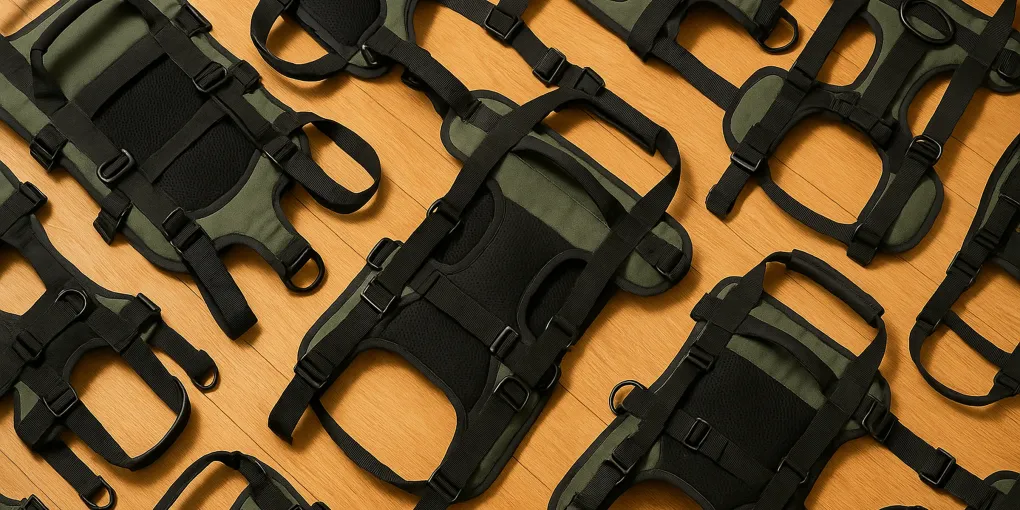
Help 'Em Up Harness Full Body
Best OverallLift points: Front + rear independent handles
$95–$130
Quick Comparison
| Product | Key Specs | Price Range | Buy |
|---|---|---|---|
| |
| $95–$130 | Check Price |
| |
| $50–$70 | Check Price |
| |
| $35–$55 | Check Price |
| |
| $55–$80 | Check Price |
Contains affiliate links — we may earn a small commission at no extra cost to you.
Best Full Body Lift Harnesses for Dogs in 2026
For dogs with severe mobility limitations requiring physical lifting support, Help ‘Em Up Full Body Harness (PSR 8.5/10) is the benchmark product — neoprene-padded independent front and rear handles that allow one or two handlers to safely support a dog who cannot bear weight independently. Gingerlead (PSR 8.0/10) is the top choice for dogs with hindquarter weakness alone who still have functional front legs.
Who needs a full body lift harness: Dogs with degenerative myelopathy, post-IVDD surgery recovery, severe hip dysplasia, hindlimb paralysis, or extreme age-related muscle loss (sarcopenia) requiring physical support for bathroom trips, veterinary visits, and assisted physical therapy.
TL;DR
- Top Pick: Help ‘Em Up Full Body — independent front and rear handles, neoprene padding, veterinary-recommended for DM and post-surgical dogs (PSR 8.5/10)
- Best Hindquarter Support: Gingerlead — rear-support design with handler strap, appropriate for hind-end weakness with functional front legs (PSR 8.0/10)
- Best Full-Body Paralysis: PetSafe CareLift — front and rear handles with breathable mesh panels (PSR 7.8/10)
- Best Budget: Walkin’ Wheels ComfortGrip — rear lift handle with padded belly panel at accessible price (PSR 7.6/10)
How We Researched This Article
This article follows PSR’s 5-step evidence-synthesis process. Safety assessment reviewed pressure distribution across lift harness panel designs, rescue handle structural testing, absence of choking/restriction risk at breathing points, and material safety (non-toxic dyes, hardware integrity). Evidence synthesis reviewed veterinary rehabilitation literature on assistive devices for canine degenerative myelopathy (CDRM/DM), IVDD post-surgical management guidelines, and physical therapy positioning for neurological dogs. User community synthesis sourced from Amazon verified reviews filtered for dogs with DM, IVDD recovery, and severe arthritis, as well as veterinary rehabilitation therapist forum discussions.
Understanding Lift Harness Categories
Not all lift harnesses serve the same population:
Rear-only slings (Gingerlead): Support the hindquarters while the dog’s front legs propel movement. Appropriate for hindlimb weakness with functional forelimbs — the most common presentation in degenerative myelopathy, hip dysplasia, and TPLO/CCL surgery recovery.
Full-body harnesses with independent handles (Help ‘Em Up): Separate front and rear handles allow a handler to selectively support front, rear, or both simultaneously. One handler can use both handles; two handlers can each manage one end for very large or severely debilitated dogs. This design is the most versatile and is recommended by more veterinary rehabilitation practitioners than any other style.
Full-body designs with single continuous lift (PetSafe CareLift): Front and rear handles exist but the harness body is a continuous design. These are appropriate for dogs with both fore and hindlimb dysfunction but may be harder to don on a recumbent dog.
Rear-lift handle harnesses (Walkin’ Wheels): Rear-focused with a lift handle over the hindquarters. Simpler than the Gingerlead but provides less handler strap control during assisted walking.
PSR Composite Score Breakdown
| Criterion | Weight | Help ‘Em Up | Gingerlead | PetSafe CareLift | Walkin’ Wheels |
|---|---|---|---|---|---|
| Safety & Ingredients | 25% | 9.0 | 8.5 | 8.5 | 8.0 |
| Durability & Build Quality | 20% | 9.0 | 8.5 | 8.0 | 7.5 |
| Pet Comfort & Acceptance | 20% | 8.5 | 8.5 | 7.5 | 7.5 |
| Value for Money | 20% | 7.5 | 8.0 | 7.5 | 9.0 |
| Ease of Use | 15% | 8.0 | 7.5 | 8.0 | 7.5 |
| PSR Composite | — | 8.5 | 8.0 | 7.8 | 7.6 |
Score notes: Help ‘Em Up leads Safety and Durability — the neoprene panel construction distributes pressure more effectively than foam panels, and the independent handle design is the most versatile lifting configuration across a range of handler and dog scenarios. Gingerlead leads Pet Comfort for hindquarter-only presentations — the sling design is less restrictive across the dog’s full torso, which matters for dogs who wear the harness for extended assisted walks. Walkin’ Wheels leads Value — adequate core functionality at the lowest price, appropriate for owners managing budget constraints during a difficult period of care.
Help ‘Em Up Full Body Harness: Best Overall
Help ‘Em Up is the most veterinarian-recommended full-body lift harness — developed with input from veterinary rehabilitation practitioners and specifically designed for dogs with degenerative myelopathy, post-surgical recovery, and extreme age-related muscle loss. The two-piece design (front piece + rear piece with connectors) simplifies donning on a recumbent dog.
What makes it the top pick:
- Independent front and rear handles — the most flexible lifting configuration for one or two handlers
- Neoprene padding distributes pressure better than foam across critical contact zones (chest, belly, rear)
- Two-piece design simplifies on a dog that cannot stand
- Veterinarian-recommended for DM progression management
- Machine washable — important for long-term care of incontinent senior dogs
Safety: No choking points. Padded at all pressure zones. Hardware rated for full dog weight. Machine-washable maintains hygiene.
Best for: Dogs with degenerative myelopathy at any stage; post-IVDD surgery recovery (with veterinary clearance); dogs requiring both front and rear support simultaneously for bathroom trips.
Gingerlead: Best for Hindquarter Support
The Gingerlead uses a different approach than a traditional harness — a padded belly sling that wraps under the hindquarters, connected to a long handler strap that the owner uses to bear the dog’s rear weight during walking. This design allows the dog’s front legs to move naturally while the handler supports the rear, more closely replicating the biomechanics of natural walking than a rigid harness.
Hindquarter support advantages:
- Sling design allows natural front-leg movement for dogs with functional forelimbs
- Handler strap length is adjustable — owners of different heights can find a comfortable carrying position
- Belly sling design reduces restriction of breathing mechanics compared to torso-wrapping designs
- Multiple sling size/attachment options for different dog body lengths
Trade-offs:
- Not appropriate for dogs with front leg weakness — this is a rear-support system only
- Handler strap requires one hand for control throughout assisted walks — limits handler’s ability to manage leash simultaneously
- Some dogs resist the belly sling initially — more desensitization time may be needed
Best for: Hindlimb weakness from DM early-to-mid stage, TPLO/CCL recovery, hip surgery recovery, spinal cord recovery where forelimbs are functional.
PetSafe CareLift: Best for Full-Body Paralysis Support
PetSafe’s CareLift uses breathable mesh panels with foam padding — a lighter construction than the Help ‘Em Up but more appropriate for dogs who cannot tolerate heat buildup from neoprene panels. Separate front and rear handles allow two-handler lifting for very debilitated dogs.
Paralysis-support advantages:
- Breathable mesh reduces heat accumulation — important for dogs with thermoregulatory impairment
- Front and rear handles are clearly color-coded (red front, blue rear) — reduces confusion for multiple caregivers
- Available in a wider size range with more granular sizing increments for small breeds
Trade-offs:
- Mesh durability lower than neoprene at the same use intensity
- Foam padding compresses over time with heavy daily use
- One continuous harness design (not two-piece) — harder to don on a recumbent dog
Best for: Dogs with full-body paralysis in hot climates; households with multiple caregivers who share lifting duties; small breeds needing very precise fit sizing.
View PetSafe CareLift on Amazon
Walkin’ Wheels ComfortGrip: Best Budget
Walkin’ Wheels provides a rear-lift padded harness with a handle over the hindquarters — adequate functionality for dogs with moderate hindquarter weakness at the lowest price point reviewed. The foam-padded belly panel protects against pressure points during lifting.
Budget advantages:
- Lowest cost of reviewed products with meaningful padding
- Walkin’ Wheels brand has extensive experience in canine mobility products (also makes dog wheelchairs)
- Machine washable
- Simple design is easy to don and remove
Trade-offs:
- Rear-lift only — no front handle for dogs needing front support
- Foam padding density lower than neoprene alternatives
- Less articulated fit — may not work as well for dogs with very atrophied hindquarters
Best for: Budget-conscious owners; dogs with mild-to-moderate hindquarter weakness who still have reasonable strength; as a backup or trial harness before investing in premium options.
Related Mobility Products for Senior Dogs
- Dog mobility harness: For dogs with less severe weakness who need balance support during walking rather than full body lifting.
- Dog wheelchair: For hindlimb paralysis where a harness cannot fully replace hindlimb function — a wheelchair provides independent mobility without constant handler effort.
- Dog ramps and stairs: Reduces the number of lifting events required daily by eliminating necessary jumps for vehicle access or furniture.
- Non-slip mats: Slippery floors significantly increase the lifting burden — non-slip surfaces reduce spontaneous falls and the recovery lifting required after them.
- Orthopedic dog beds: Pressure-relieving surfaces reduce the duration and frequency of positional changes (and associated lifting) for very debilitated dogs.
- Dog hip brace: For dogs with hip-specific weakness, a brace can delay progression to full lift harness dependence by providing mechanical support.
- Joint supplements: Anti-inflammatory and structural support supplementation, combined with assistive equipment, forms the foundation of conservative mobility management.
Frequently Asked Questions
What is the difference between a mobility harness and a full body lift harness?
A mobility harness helps dogs who can still walk with stability assistance. A full body lift harness is for dogs who cannot support part or all of their body weight independently — it distributes lifting load across padded panels for bathroom trips, therapy, or transport. A dog needing to be physically carried needs a lift harness; a dog needing balance stabilization on stairs needs a mobility harness.
How do I know if my dog needs a full body or rear-only lift harness?
If your dog’s primary weakness is hindquarter — weak rear legs with functional front legs — a rear sling or rear-lift harness is usually sufficient and more comfortable. If your dog has significant weakness in both front and rear, a full-body harness is appropriate. Consult your veterinarian or veterinary rehabilitation therapist when uncertain.
Can a lift harness be worn all day?
Full-body lift harnesses are designed for assisted movement periods, not all-day wear. Continuous wear can cause skin irritation, heat buildup, and restricted circulation. Most manufacturers recommend removal during rest periods. Observe skin daily at all contact points for redness or pressure sore formation.
How do I put a lift harness on a dog that cannot stand?
Slide the harness under the dog while lying down. Most designs can be applied from the side while the dog is recumbent. The Help ‘Em Up two-piece design simplifies this process. Avoid dragging or rolling the dog to position the harness — this can be painful for dogs with spinal conditions.
Is a lift harness appropriate for dogs recovering from spinal surgery (IVDD)?
Lift harnesses are commonly used in post-IVDD recovery, but the specific harness and positioning must be approved by the treating veterinary neurologist. Some post-surgical dogs have specific body positioning requirements — always confirm harness selection with your veterinarian before use on a post-spinal-surgery dog.
Frequently Asked Questions
- A standard dog mobility harness (like the Ruffwear Webmaster) is designed for dogs who can still walk with some stability assistance — the harness provides a handle for the owner to stabilize the dog during movement on stairs or uneven terrain. A full body lift harness is designed for dogs who cannot support part or all of their body weight independently — the harness distributes lifting load across padded panels over the chest and hindquarters, allowing a handler to carry part or all of the dog's weight for bathroom trips, physical therapy sessions, or veterinary visits. A dog who needs to be physically carried through a doorway needs a lift harness; a dog who needs balance stabilization on stairs needs a mobility harness.
- If your dog's primary weakness is hindquarter — weak or paralyzed rear legs while front legs remain functional — a rear sling or rear-lift harness (like the Gingerlead) is usually sufficient and more comfortable than a full-body design. If your dog has significant weakness in both front and rear, cannot support any body weight independently, or has had a spinal surgery requiring full-body support positioning, a full-body harness (Help 'Em Up, PetSafe CareLift) is the appropriate choice. When in doubt, consult your veterinarian or veterinary rehabilitation therapist — the wrong harness type can cause pressure points or unsafe positioning for post-surgical dogs.
- Full-body lift harnesses are not designed for all-day wear — they are intended for assisted movement periods (bathroom trips, walks, therapy) rather than continuous use. Wearing a padded harness continuously can cause skin irritation, heat buildup, and restricted circulation at contact points. Most manufacturers recommend removal during rest periods. Some lighter designs (breathable mesh) can be worn for extended periods with monitoring, but observe the dog's skin at all contact points daily for redness, hair loss, or pressure sore formation.
- For dogs that cannot stand for harness donning, slide the harness under the dog while they are lying down. Most full-body lift harnesses are designed to be slipped under the dog and buckled around the body from the side — check manufacturer instructions for your specific harness. The Help 'Em Up design uses a two-piece approach (front piece and rear piece separately) that simplifies donning on a recumbent dog. Avoid dragging or rolling the dog to position the harness, as this can be painful for dogs with spinal conditions.
- Lift harnesses are commonly used in post-IVDD (intervertebral disc disease) surgery recovery, but the specific harness and positioning must be approved by the treating veterinary neurologist or surgeon. Some post-surgical dogs have specific body positioning requirements during the recovery period — a harness that flexes the spine in the wrong direction can disrupt surgical repair. Always confirm harness selection and use technique with your veterinarian before using any lift harness on a post-spinal-surgery dog.