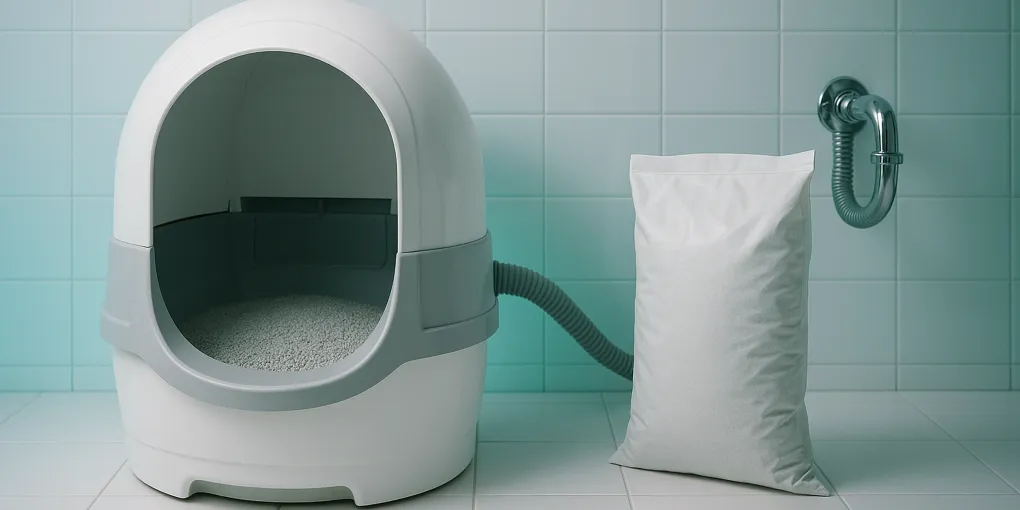
Best Self Washing Litter Box in 2026: PSR-Scored Water-Cycle and Easy-Clean Options
Buyer's GuideCatGenie A.I. Self-Washing Self-Flushing Cat Box
Best Overall — True Self-WashingCleaning method: Washes with water + SaniSolution
~$299–$399
Quick Comparison
| Product | Key Specs | Price Range | Buy |
|---|---|---|---|
| |
| ~$299–$399 | Check Price |
| |
| ~$699 | Check Price |
| |
| ~$129–$169 | Check Price |
| |
| ~$30–$45 | Check Price |
Contains affiliate links — we may earn a small commission at no extra cost to you.
Best Self Washing Litter Box in 2026
The best true self-washing litter box for most cat owners is the CatGenie A.I. (PSR 4.4/5) — the only unit reviewed that connects to a water supply line, washes the bowl with a sanitizing solution on a programmable schedule, and flushes liquid waste directly down a drain. For households unwilling to install plumbing but seeking the closest equivalent in convenience, the Litter-Robot 4 (PSR 4.4/5) is the most capable self-cleaning alternative, with a globe-style design that is easy to manually wash when needed and genuine health-monitoring capability through the Whisker app.
TL;DR
- Best Overall (True Self-Washing): CatGenie A.I. — water cycle, SaniSolution wash, flush drain (PSR 4.4/5)
- Best Premium (Self-Cleaning): Litter-Robot 4 — globe rotation, sealed drawer, Whisker app (PSR 4.4/5)
- Best Low-Maintenance: PetSafe ScoopFree Ultra — crystal tray disposal, no touching waste (PSR 4.1/5)
- Best Budget Manual-Wash: Omega Paw Roll’N Clean — roll-to-sift mechanism, no electricity needed (PSR 3.9/5)
Self-Washing vs. Self-Cleaning: An Important Distinction
The term “self-cleaning” is used loosely by manufacturers and across most buyer’s guides, but the underlying technologies differ in a way that matters for sanitation, ongoing cost, and installation requirements.
True self-washing units (CatGenie-style) use water and a chemical sanitizer to physically wash the litter bowl on a scheduled cycle. Liquid waste is flushed down a connected drain; the solid waste is liquefied and flushed as part of the wash cycle. The result is a bowl that approaches genuine sanitation between uses — comparable, in principle, to washing a dish. These units require a cold-water hookup and a drain, making installation location-dependent.
Self-cleaning units (Litter-Robot 4, PetSafe ScoopFree) use a mechanical mechanism — a rotating globe, a raking arm, or a rolling sift — to separate waste from clean substrate and deposit it in a sealed compartment. The litter box interior is never washed during normal operation; it accumulates microscopic waste residue over time and requires periodic manual cleaning. These units plug into a standard electrical outlet, require no plumbing, and can be placed anywhere a power outlet is accessible.
For households where genuine sanitation is the priority — multi-cat homes, immunocompromised owners, households with young children — the CatGenie’s water-wash cycle provides a meaningfully higher sanitation standard. For households where convenience and odor control are the priority without the installation complexity, the Litter-Robot 4 is the stronger choice.
How We Evaluated
PSR composite scoring: Safety (30%), Efficacy & Performance (25%), Real-World Acceptance (20%), Value (15%), Transparency & Brand Trust (10%). Safety for self-washing and self-cleaning litter boxes specifically evaluates: sanitization effectiveness (does the mechanism actually kill pathogens or only remove visible waste), cycle safety systems to prevent a cleaning cycle starting while a cat is inside, and installation risks such as plumbing leak potential. Value incorporates both the upfront unit cost and ongoing supply expenses over a 12-month window, which can be a substantial factor in this category.
PSR Composite Score Breakdown
| Product | Safety (30%) | Efficacy & Performance (25%) | Real-World Acceptance (20%) | Value (15%) | Transparency & Brand Trust (10%) | PSR Score |
|---|---|---|---|---|---|---|
| CatGenie A.I. Self-Washing | 9.5 | 8.5 | 8.5 | 8.0 | 8.5 | 4.4 |
| Litter-Robot 4 | 9.0 | 9.0 | 9.0 | 7.5 | 9.0 | 4.4 |
| PetSafe ScoopFree Ultra | 8.5 | 8.0 | 8.0 | 8.5 | 8.5 | 4.1 |
| Omega Paw Self-Cleaning | 8.0 | 7.5 | 7.5 | 9.0 | 7.0 | 3.9 |
PSR composite = (S×0.30)+(EP×0.25)+(RWA×0.20)+(V×0.15)+(TBT×0.10)
Top Picks
1. CatGenie A.I. Self-Washing Self-Flushing Cat Box — PSR 4.4/5 (Best Overall)
The CatGenie A.I. is the definitive self-washing litter box and, as of this writing, the only widely available product that genuinely washes rather than simply rakes. The unit connects to a cold-water supply line using a T-adapter (compatible with toilet supply lines and washing machine cold-water hookups) and drains through a standard drain connection. On a user-programmed schedule — or triggered automatically after each use — the bowl fills with water and SaniSolution, the granules are agitated to release waste, liquid waste is flushed down the drain, and the bowl is rinsed to near-sanitized condition.
The A.I. variant adds use-detection sensors that delay the wash cycle until the cat has exited and a suitable quiet window is detected, reducing disruption and startling. The wash cycle runs approximately 30 minutes and produces some noise — comparable to a small dishwasher — which is worth considering for placement in living areas.
The washable plastic granules (the substrate used instead of traditional litter) last three to six months before replacement and do not track on cat paws the way fine clumping litter does. The primary cat-acceptance variable is granule texture: cats conditioned to fine clumping litter may require a gradual transition of two to four weeks.
Plumbing requirements: Cold water supply + gravity drain. Placement is most practical in a bathroom (toilet supply T-adapter) or laundry room (washing machine hookup). The included hoses allow placement up to approximately 6 feet from the water connection.
Ongoing supply costs: SaniSolution cartridges ($15–$20, approximately 120 wash cycles each) plus occasional granule replacement ($15–$20/bag, every 3–6 months). Expect $25–$40 per month for a one- to two-cat household.
Score notes: Safety 9.5 — wash cycle achieves genuine sanitization; use-detection prevents mid-cycle startling; plumbing leak risk is low with proper installation. Efficacy & Performance 8.5 — well-documented long service life (units running 5+ years are commonly reported), though the internal pump and drain valve are the components most likely to require service. Real-World Acceptance 8.5 — granule substrate is the primary acceptance variable; cats that adapt score this very high. Value 8.0 — supply costs are ongoing but predictable; best value in multi-cat households where cleaning frequency justifies the automation. Transparency & Brand Trust 8.5 — once installed, virtually zero daily maintenance required; installation is the steepest effort point.
2. Litter-Robot 4 — PSR 4.4/5 (Best Premium Self-Cleaning)
The Litter-Robot 4 is the most capable self-cleaning litter box in the raking/rotation category. A weighted globe rotates after each detected use (the OmniSense system uses weight, infrared, and motion to confirm exit before cycling), sifting clumped waste through a screen into a sealed waste drawer below. The drawer is lined with a waste bag (standard kitchen bags fit; Whisker-branded bags are optional) and typically needs emptying once a week in a one-cat household.
While the Litter-Robot 4 does not wash itself during normal operation, its globe design is notably easy to manually clean: the globe lifts out of the base in one piece and can be rinsed in a bathtub or hosed outdoors in approximately five minutes. This is a genuine advantage over competing cylinder and rake designs where interior surfaces are difficult to reach. Whisker recommends a full manual cleaning every one to three months, which aligns with reasonable maintenance schedules.
The Whisker app provides per-visit weight tracking, usage frequency logging, and anomaly alerts — genuinely useful health-monitoring features for detecting early signs of urinary tract conditions or changes in GI frequency. See our Best Smart Litter Box Health Monitor guide for a full deep-dive on the Litter-Robot 4’s health-monitoring capabilities.
No plumbing required. Plugs into a standard 110V outlet. Can be placed in any room with an accessible power outlet.
Score notes: Safety 9.0 — OmniSense detection is the most reliable cat-present detection system reviewed; sealed waste drawer contains odor effectively. Efficacy & Performance 9.0 — premium build quality; Whisker offers an 18-month warranty and a documented repair/service program. Real-World Acceptance 9.0 — globe entry is well-accepted by most cats; entrance opening is large enough for cats up to ~25 lbs. Value 7.5 — $699 upfront is significant; supply costs (bags) are modest. Transparency & Brand Trust 9.0 — lowest daily effort of any unit reviewed; globe cleaning is straightforward when periodic manual wash is due.
3. PetSafe ScoopFree Ultra Self-Cleaning Litter Box — PSR 4.1/5 (Best Low-Maintenance)
The PetSafe ScoopFree Ultra uses disposable crystal litter trays — pre-filled trays loaded into the unit that are raked automatically after a timed delay following each use. The rake pushes clumps and solid waste into a covered waste trap at the end of the tray. When the tray reaches capacity (typically two to four weeks for a single-cat household), the entire tray is removed and discarded, and a fresh pre-filled tray is inserted.
This disposable-tray approach achieves the lowest day-to-day handling of waste of any unit reviewed, short of the CatGenie’s fully automated flush. There is no scooping, no bag changing, and no drawer to empty — just a single tray swap every few weeks. The crystal litter substrate (silica gel) absorbs urine and significantly reduces odor compared to clay clumping litter by desiccating liquid waste rather than clumping around it.
The main tradeoffs are ongoing tray cost ($15–$25 per tray, depending on whether single-use or reusable trays are purchased) and the environmental impact of single-use plastic trays. PetSafe offers a reusable tray option that reduces waste but reintroduces manual cleaning. Cat acceptance of silica crystal substrate is moderately high but not universal — some cats reject crystals, particularly those with paw sensitivity.
Score notes: Safety 8.5 — timed delay (not weight-confirmed exit detection) creates a lower safety standard than weight-sensor units; rake can interact with a returning cat in rare cases. Efficacy & Performance 8.0 — motor and rake mechanism are straightforward; tray slot guides wear over extended use. Real-World Acceptance 8.0 — crystal substrate accepted by most cats; timed rake operation is quiet. Value 8.5 — lower upfront cost offsets ongoing tray expense; most cost-efficient for single-cat households. Transparency & Brand Trust 8.5 — minimal daily effort; tray swap is the simplest waste-disposal method reviewed.
4. Omega Paw Roll’N Clean Self-Cleaning Litter Box — PSR 3.9/5 (Best Budget Manual-Wash)
The Omega Paw Roll’N Clean operates on a simple mechanical principle: roll the sealed box to one side, clumps aggregate in an internal grate, roll it back to upright, and pull out a waste collection tray from the end. No electricity, no motor, no plumbing. The entire cleaning cycle takes approximately 30 seconds. The box interior can be rinsed with water and allowed to air-dry in minutes — the most straightforward manual-wash experience of any unit reviewed.
The Roll’N Clean is primarily recommended for budget-conscious single-cat households where the owner wants to reduce daily scooping effort without committing to an automated unit. It uses any standard clumping litter, which is widely available and familiar to most cats, avoiding the granule or crystal acceptance variables of the automated units.
Limitations are significant at scale: the unit is not suited for multi-cat households (waste accumulates faster than the roll mechanism can efficiently handle), and it does not reduce the owner’s involvement to the degree that automated units do. It remains, however, the most affordable path to faster-than-manual cleaning with an easy-to-wash design.
Score notes: Safety 8.0 — fully passive mechanism; no cycle safety concerns. Efficacy & Performance 7.5 — plastic construction is adequate but thinner than premium units; lid latch mechanism is the most common wear point. Real-World Acceptance 7.5 — enclosed design reduces light; some cats require an adjustment period; entry opening is moderate. Value 9.0 — lowest upfront cost in category; litter compatibility means no proprietary supply lock-in. Transparency & Brand Trust 7.0 — roll mechanism reduces scooping but does not eliminate manual involvement.
Plumbing Requirements: What You Need to Know Before Buying a CatGenie
The CatGenie’s defining feature — its water-wash cycle — is also its primary installation barrier. Before purchasing, confirm:
-
Cold-water access: The unit requires a cold-water supply line within hose reach. A toilet supply line (using the included T-adapter) or a washing machine cold-water hookup are the most common connection points. Hot water connections are not supported and may damage the unit.
-
Drain access: The drain hose must reach a toilet bowl, a standpipe (laundry drain), or a utility sink. The hose is approximately 6 feet long; extension hoses are available for longer runs. The drain does not require a P-trap connection — the hose simply drips or flows into an open drain receptacle.
-
Placement location: Bathroom (toilet connection) or laundry room installations are most practical. Hallway, bedroom, or living room placement requires plumbing extension — possible but not typical DIY territory.
-
Electrical: The unit also requires a standard 110V outlet within cord reach.
If your planned installation location lacks conveniently routed plumbing, the Litter-Robot 4 or PetSafe ScoopFree are the recommended alternatives — both offer substantial convenience with only an electrical outlet required.
Noise and Cat Acceptance of Automated Cleaning Cycles
Noise is a frequently underestimated factor in automated litter box selection. Both the CatGenie and the Litter-Robot 4 run cleaning cycles that produce mechanical noise. The CatGenie’s wash cycle (water flow, agitation, drain pump) is audible and runs for approximately 30 minutes — comparable to a small appliance. The Litter-Robot 4’s globe rotation cycle lasts approximately two minutes and produces a moderate motor hum.
Cats vary widely in their response to cleaning cycle sounds. Some cats, particularly those exposed to the unit from kittenhood or those with generally calm temperaments, ignore cycles entirely. Others, particularly noise-sensitive or anxious cats, may avoid the box for a period after a cycle and require gradual desensitization. Running the first several cycles while the cat is out of the room, and allowing the cat to investigate the unit while inactive, can help with the adjustment period.
The PetSafe ScoopFree’s rake cycle is the quietest automated mechanism reviewed and may be preferable for particularly noise-sensitive cats.
Waste Disposal Comparison
| Unit | Waste Handling | Disposal Method | Frequency |
|---|---|---|---|
| CatGenie A.I. | Liquefied and flushed | Household drain | Automatic per cycle |
| Litter-Robot 4 | Clumps in sealed drawer | Bag removal | ~Weekly (1 cat) |
| PetSafe ScoopFree Ultra | Raked into covered tray trap | Full tray disposal | ~2–4 weeks (1 cat) |
| Omega Paw Roll’N Clean | Grate-sifted into pull tray | Manual tray dump | As needed (daily–every 2 days) |
Related PSR Guides
- Best Self-Cleaning Litter Box — broader category review including timed, sensor, and rotation mechanisms
- Best Cat Litter Box — standard non-automated litter box options for context
- Best Smart Litter Box Health Monitor — deep dive on health tracking features of the Litter-Robot 4 and competitors
- Best Cat Litter — clumping, crystal, and natural litter options compatible with non-automated boxes
- Best Cat Litter Odor Control — deodorizers and additives for between-clean odor management
Frequently Asked Questions
What is the difference between a self-washing and a self-cleaning litter box?
A self-washing litter box — most notably the CatGenie — uses water and a sanitizing cleaning solution to physically wash the bowl on a programmed cycle, flushing liquid waste down a connected drain. A self-cleaning litter box (Litter-Robot, PetSafe ScoopFree) uses a rake or rotation mechanism to separate clumped waste from clean substrate and deposit it in a sealed compartment — but the litter box interior is never washed with water during normal operation. Self-washing units achieve a higher degree of true sanitation; self-cleaning units still require periodic manual washing of the interior, typically every one to four weeks.
Does the CatGenie require a plumber to install?
The CatGenie connects to a standard cold-water supply line (the same type used by a washing machine or toilet) and requires a drain connection. Many owners complete installation without a professional plumber using the included T-adapter for a toilet water supply or a washing machine cold-water hookup. Households without a conveniently located cold-water supply near the intended box placement may require a plumber to extend plumbing. A laundry room or bathroom installation is generally the most straightforward.
How much does the CatGenie cost to run per month?
The primary ongoing cost is SaniSolution cartridges, which cost approximately $15–$20 each and last roughly 120 wash cycles. At a typical cleaning frequency of one cycle per day, a single cartridge lasts approximately four months for a one-cat household, or roughly six to eight weeks in a two-cat household. Washable granules last approximately three to six months before needing replacement at about $15–$20 per bag. Combined, expect approximately $25–$40 per month in supplies depending on cat count and cycle frequency.
Will my cat accept the CatGenie granules instead of traditional litter?
Cat acceptance of the CatGenie’s plastic granule substrate varies. Cats that have used fine-clumping litter exclusively for years may show initial hesitation. A gradual transition — placing the CatGenie beside the existing litter box and allowing the cat to explore at will, then slowly reducing access to the original box over two to four weeks — tends to improve acceptance rates. The granules do not have the fine, sand-like texture most cats prefer instinctively, which is the primary reason some cats do not accept the unit even after extended transition periods.
Is a self-washing litter box worth it for a single cat?
For a single-cat household, the value depends primarily on how much the owner prioritizes hands-off sanitation versus ongoing supply cost and plumbing requirements. A single cat generates lower soiling volume, meaning a standard clumping litter box scooped daily is relatively manageable. The CatGenie’s advantage — genuinely sanitized surfaces between cycles — is more compelling in multi-cat households. For single-cat owners who travel frequently, work long hours, or want to minimize manual cleaning entirely, a self-washing or high-quality self-cleaning model is likely worth the premium. For budget-conscious single-cat households with reliable daily scooping habits, the Omega Paw at $30–$45 provides a practical low-effort alternative.
Research Citations
-
Piyarungsri K, Tangtrongsup S, Thachepan P, Pojprasath T, Suttithep S (2020). Prevalence and risk factors of feline lower urinary tract disease in Chiang Mai, Thailand. Scientific Reports, 10(1):196. DOI: 10.1038/s41598-019-56968-w. PMID: 31932653
-
Buffington CA, Westropp JL, Chew DJ, Bolus RR (2006). Risk factors associated with clinical signs of lower urinary tract disease in indoor-housed cats. Journal of the American Veterinary Medical Association, 228(5):722–725. DOI: 10.2460/javma.228.5.722. PMID: 16031963
Frequently Asked Questions
- A self-washing litter box — most notably the CatGenie — uses water and a sanitizing cleaning solution to physically wash the bowl on a programmed cycle, flushing liquid waste down a connected drain. A self-cleaning litter box (Litter-Robot, PetSafe ScoopFree) uses a rake or rotation mechanism to separate clumped waste from clean litter and deposit it into a sealed drawer or tray — but the litter substrate and the box interior are never washed with water during normal operation. Self-washing units achieve a higher degree of true sanitation; self-cleaning units still require periodic manual washing of the interior, typically every one to four weeks.
- The CatGenie connects to a standard cold-water supply line (the same type used by a washing machine or toilet) and requires a drain connection. Many owners complete installation without a professional plumber using the included T-adapter for a toilet water supply or a washing machine cold-water hookup. The unit includes detailed instructions for both connection types. However, households without a conveniently located cold-water supply near the intended box placement may require a plumber to extend plumbing. A laundry room or bathroom installation is generally the most straightforward.
- The primary ongoing cost is SaniSolution cartridges, which cost approximately $15–$20 each and last roughly 120 wash cycles. At a typical cleaning frequency of one cycle per day, a single cartridge lasts approximately four months for a one-cat household, or roughly six to eight weeks in a two-cat household. SaniSolution Plus (the stronger formula) runs slightly higher. Washable granules, which replace traditional litter, last approximately three to six months before needing replacement and cost about $15–$20 per bag. Combined, expect $20–$40 per month in supplies depending on cat count and cycle frequency.
- Cat acceptance of the CatGenie's plastic granule substrate varies. Some cats transition easily, particularly younger cats or those not strongly conditioned to a specific litter texture. Cats that have used fine-clumping litter exclusively for years may show initial hesitation. A gradual transition — placing the CatGenie beside the existing litter box and letting the cat explore at will, then slowly reducing access to the original box over two to four weeks — improves acceptance rates. The granules do not have the fine, sand-like texture most cats prefer instinctively, which is the primary reason some cats do not accept the unit even after extended transition periods.
- For a single-cat household, the value calculation depends primarily on how much the owner prioritizes hands-off sanitation versus the ongoing supply cost and plumbing requirements. A single cat generates lower soiling volume, meaning a standard clumping litter box scooped daily is relatively manageable. The CatGenie's advantage — genuinely sanitized surfaces between cycles — is more compelling in multi-cat households where waste accumulates faster. For single-cat owners who travel frequently, work long hours, or want to minimize manual cleaning entirely, a self-washing or high-quality self-cleaning model is likely worth the premium. For budget-conscious single-cat households with reliable daily scooping habits, the Omega Paw at $30–$45 provides a practical low-effort alternative.