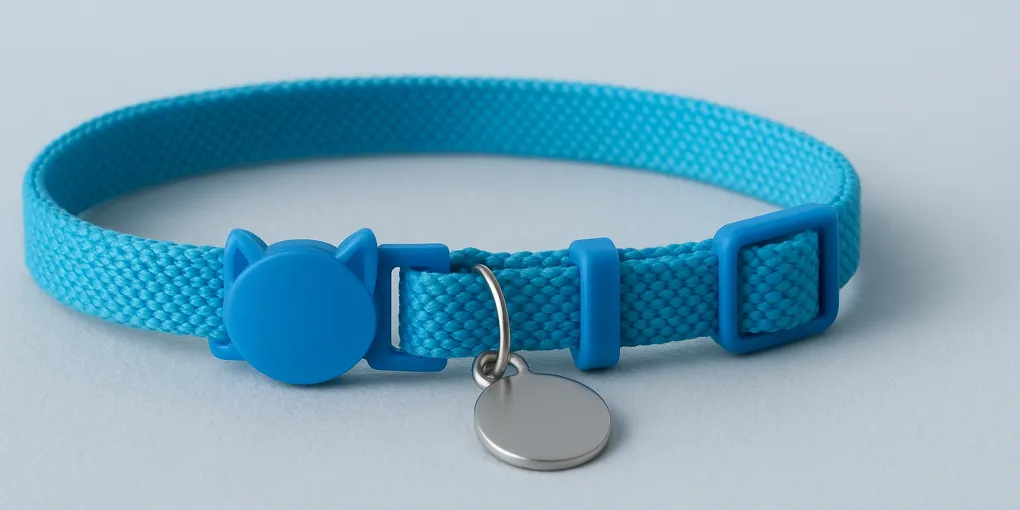
Rogz Safeloc Breakaway Cat Collar
Best OverallBreakaway: Yes — Safeloc buckle
$8–$14
Quick Comparison
| Product | Key Specs | Price Range | Buy |
|---|---|---|---|
| |
| $8–$14 | Check Price |
| |
| $7–$12 | Check Price |
| |
| $12–$18 | Check Price |
| |
| $8–$13 | Check Price |
Contains affiliate links — we may earn a small commission at no extra cost to you.
Best Cat Collars in 2026
The best cat collar is the Rogz Safeloc Breakaway Collar (PSR 4.5/5), which combines a tested breakaway mechanism, reflective thread woven into the nylon webbing for visibility, and a durable 3/8-inch profile that fits most adult cats without excessive bulk. For prioritizing daily comfort and soft-touch feel, the Blueberry Pet Soft Breakaway Collar (PSR 4.3/5) uses a softer nylon finish that causes less fur disturbance at the contact points.
A non-negotiable baseline: All cat collars reviewed here are breakaway-only. We do not review or recommend non-breakaway, snap-buckle-free, or elastic-only cat collars. Collar strangulation and limb entrapment is a documented, preventable cause of injury and death in cats — the breakaway mechanism is the minimum safety standard.
How We Evaluated
PSR composite scoring: Safety & Ingredients (25%), Durability & Build Quality (20%), Pet Comfort & Acceptance (20%), Value for Money (20%), Ease of Use (15%). Safety for collars first verifies breakaway mechanism presence — any collar without a functional breakaway buckle would score 0 on Safety. Within breakaway-equipped collars, reflectivity, material safety (no toxic dyes, no metal components that could cause contact dermatitis), and documented break-force specifications differentiate scores.
PSR Composite Score Breakdown
| Product | Safety (25%) | Durability (20%) | Pet Comfort (20%) | Value (20%) | Ease of Use (15%) | PSR Score |
|---|---|---|---|---|---|---|
| Rogz Safeloc Breakaway | 9.5 | 9.0 | 9.0 | 9.0 | 9.0 | 4.5 |
| Blueberry Pet Soft | 9.0 | 8.5 | 9.5 | 9.0 | 9.0 | 4.3 |
| Mollypaws Reflective | 9.5 | 8.5 | 8.5 | 9.0 | 8.5 | 4.2 |
| GoTags Embroidered | 9.0 | 8.5 | 8.0 | 8.5 | 8.5 | 4.1 |
PSR composite = (S×0.25)+(D×0.20)+(PC×0.20)+(V×0.20)+(EU×0.15)
Top Picks
1. Rogz Safeloc Breakaway Cat Collar — PSR 4.5/5 (Best Overall)
Rogz is a South African outdoor pet gear brand with a focus on tested safety hardware. The Safeloc buckle is the core differentiator: the breakaway release has published tensile testing showing consistent release at 4–6 lbs of lateral force, within the optimal range for preventing routine slip-off while still releasing in entanglement scenarios. The reflective thread woven into the collar fabric maintains visibility without a separate reflective strip that can peel or wear off.
Available in multiple widths and sizes for cats from kitten to large breed, with a fully adjustable length range that accommodates 8–16-inch neck circumferences in one size.
Score notes: Safety 9.5 — tested breakaway mechanism, reflective, no known toxic dyes. Durability 9.0 — robust nylon construction, hardware maintains function after repeated releases. Pet Comfort 9.0 — soft nylon finish, well-tolerated in verified owner reports. Value 9.0 — competitive price for feature set. Ease of Use 9.0 — easy adjustment, standard ID tag ring.
2. Blueberry Pet Soft Adjustable Breakaway Collar — PSR 4.3/5 (Best for Comfort)
Blueberry Pet uses a slightly softer nylon than standard utility webbing, which reduces the stiffness that can cause fur matting at the collar contact zone — a common complaint from owners of long-haired cats. The collar comes in an extensive color and pattern range, making it the most aesthetically versatile option reviewed.
The breakaway buckle is a standard plastic quick-release mechanism without published force specification — verified owner reports suggest it functions appropriately in real-world escapes and entanglements, but without formal testing data the Safety score is slightly lower than Rogz.
Score notes: Safety 9.0 — breakaway buckle present, soft materials, but no published break-force data. Durability 8.5 — soft nylon shows more wear than utility webbing over time. Pet Comfort 9.5 — highest comfort rating, especially for long-haired cats. Value 9.0 — low price. Ease of Use 9.0 — easy clip, standard D-ring.
3. Mollypaws Reflective Breakaway Collar — PSR 4.2/5 (Best Nighttime Visibility)
Mollypaws produces a full 360° reflective collar using a reflective nylon base rather than sewn-on strips, meaning the entire collar surface reflects headlight or flashlight illumination at night. This is the most practical safety feature for cats with outdoor access in the evening or early morning hours, dramatically increasing driver visibility in road-adjacent environments.
Score notes: Safety 9.5 — best nighttime visibility of options reviewed, breakaway mechanism confirmed. Durability 8.5 — reflective nylon base holds up well. Pet Comfort 8.5 — lightweight, standard nylon feel. Value 9.0 — low price. Ease of Use 8.5 — basic adjustment, standard ring.
4. GoTags Personalized Embroidered Cat Collar — PSR 4.1/5 (Best for ID Without Tags)
GoTags embroiders owner contact information (phone number, cat name) directly into the collar webbing during manufacturing. This eliminates ID tag jingling noise (which can stress noise-sensitive cats) and the risk of tags catching on objects or being lost. For indoor cats that rarely wear collars, an embroidered contact number ensures identification if the collar is found without the cat.
The limitation is that embroidered text cannot be updated if you change phone numbers or move — a new collar is required for any contact information change.
Score notes: Safety 9.0 — breakaway present, no toxic materials. Durability 8.5 — embroidering is durable but text may fade over years. Pet Comfort 8.0 — similar to standard nylon. Value 8.5 — moderate price for customization value. Ease of Use 8.5 — no tag attachment needed.
Collar vs. Microchip: Both Are Required
A collar ID provides immediate visible identification — a neighbor, vet clinic, or shelter can read a phone number instantly without equipment. A microchip provides permanent, tamper-proof identification that persists if a collar is lost. These serve complementary functions and are not substitutes for each other.
Microchipping is a 10-second procedure performed at most veterinary clinics. The AVMA recommends microchipping all cats and dogs regardless of indoor/outdoor status. Ensure the microchip is registered in a searchable national registry (AAHA Universal Pet Microchip Lookup covers major registries).
Related PSR Guides
- Best Cat Harness and Leash — harness-based walking options for cats with outdoor access
- Best Cat GPS Tracker — tech layer for locating outdoor cats
- Best Cat Treats — positive reinforcement for collar introduction training
- Best Cat Carrier for Travel — transport safety paired with ID
- Best Cat Grooming Brush — maintaining coat health under collar contact zone
- Best Cat Bed — comfort essentials for all cats
- Best Cat Supplements — overall health maintenance
- Best Flea Treatment for Cats — flea collars are NOT recommended (see guide)
Frequently Asked Questions
What type of cat collar is safest?
A breakaway collar with a quick-release buckle that releases at 4–8 lbs of lateral force is the safest collar type for cats. Elastic “safety” collars are not equivalent — they can stretch enough for a limb to become caught and then contract, trapping the limb. Full breakaway buckle collars are the only type recommended by veterinary safety organizations including the AVMA and ASPCA.
Should cats wear a collar with a bell?
Bells on cat collars are a common method used to give wildlife (particularly birds) a warning of the cat’s approach. From a comfort perspective, most cats habituate to collar bells within a few days. A bell does not harm the cat. If nighttime bell noise disrupts the household, the bell can be removed from the collar D-ring without affecting collar function. For cats with sound sensitivities or early-stage hearing issues, monitor for stress response to bell noise.
How do I put a collar on a cat for the first time?
Place the collar on a flat surface near the cat and allow investigation. Then gently place around the neck for 5–10 seconds while delivering a treat, then remove. Repeat over 2–3 days increasing duration. On the first full-time wearing, supervise and provide treats and play immediately after. Most cats accept the collar fully within 3–7 days of gradual introduction. Never force a collar onto a struggling cat — this creates negative association that significantly extends the habituation period.
Can a collar cause hair loss in cats?
Poorly fitted collars (too tight) or very stiff materials can cause localized fur thinning at the collar contact zone — particularly under the chin and behind the ears. Ensuring proper two-finger fit and using a soft material collar (Blueberry Pet’s soft nylon range) minimizes this risk. Check the contact zone weekly for any redness, bare patches, or irritation. Matting in long-haired cats at the collar line is expected and resolvable with regular gentle brushing.
What size collar does my cat need?
Measure your cat’s neck circumference with a soft tape measure and add 1 inch for fit allowance. Most adult cats measure 9–13 inches; kittens 6–9 inches. Most collars in the 3/8-inch-wide category fit 8–12 inches of adjustment range. For large-breed cats (Maine Coon, Ragdoll), verify the maximum adjustment range before ordering — some standard collars max out at 11 inches, which is tight for large breeds.
Frequently Asked Questions
- Indoor cats benefit significantly from wearing a collar with an ID tag or embroidered contact information. If a cat escapes through a door, window, or during a move, a collar is the fastest way for a finder to return them. Even for indoor-only cats, a collar and tag can be the difference between a quick reunion and weeks of searching. Microchipping (the permanent complement to collar ID) is recommended for all cats, indoor or outdoor — but a collar ID remains the faster initial identification method.
- A breakaway collar has a buckle designed to release under tension — typically 4–8 lbs of pull force — when a cat's leg, jaw, or body becomes entangled. Non-breakaway collars are documented to cause strangulation and limb entrapment injuries. A breakaway mechanism is non-negotiable for cat collar safety: the AVMA and ASPCA both recommend only breakaway collars for cats. The trade-off is that the collar can release and be lost if the cat pushes through undergrowth — outdoor cats may lose collars more often.
- The two-finger rule is standard: you should be able to slide exactly two fingers comfortably between the collar and the cat's neck. Tighter than this creates pressure sores and restricts movement; looser than this allows the collar to slip off or a paw or jaw to become caught in the gap. Check collar fit monthly as cats change weight seasonally. Kittens require more frequent fitting checks as they grow rapidly.
- Many cats initially resist collars and may paw at them, shake their head, or try to scratch them off. This habituation period typically lasts 1–3 days. Starting with a very lightweight collar in the kitten period (8–12 weeks) produces adult cats that accept collars without issue. For adult cats being introduced to a collar for the first time, use short sessions (30 minutes initially) and pair the collar with treats and positive interaction. Persistent distress (hiding, reduced appetite, excessive pawing) after one week warrants trying a narrower or lighter collar.
- Yes — a properly fitted breakaway collar can be worn 24/7. Check the fit weekly and inspect the collar surface for signs of irritation (bare patches, redness, matting). Remove the collar for grooming sessions, baths, and veterinary procedures as needed. Soft nylon and polyester collars generally cause less neck fur matting than heavier or stiffer materials. Replace collars annually or when hardware shows wear that might affect breakaway function.