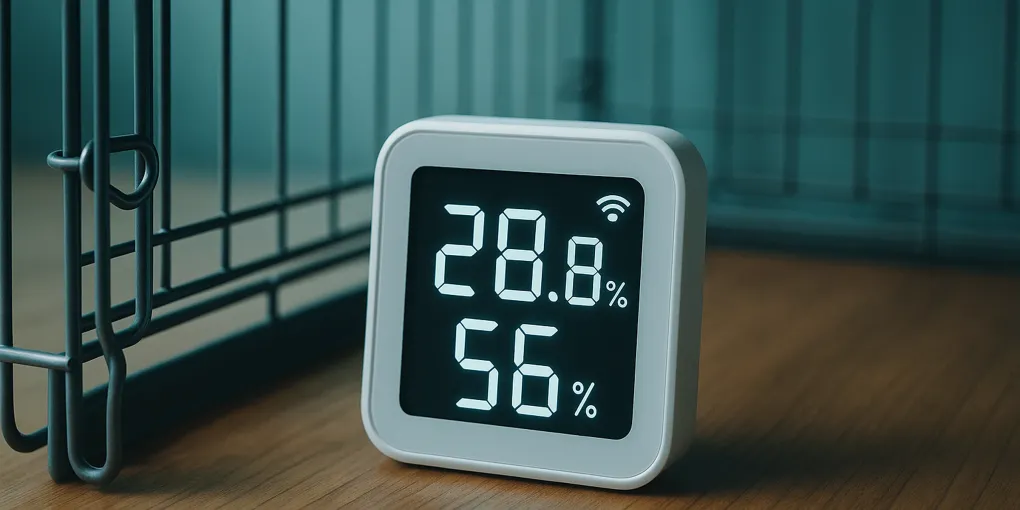
Govee WiFi Thermometer Hygrometer
Best OverallAccuracy: ±0.54°F / ±0.3°C temperature
~$20–$35
Quick Comparison
| Product | Key Specs | Price Range | Buy |
|---|---|---|---|
| |
| ~$20–$35 | Check Price |
| |
| ~$49–$59 (+$99 G1 WiFi Gateway optional) | Check Price |
| |
| ~$12–$20 | Check Price |
| |
| ~$40–$60 | Check Price |
Contains affiliate links — we may earn a small commission at no extra cost to you.
Best Smart Crate Thermometer in 2026
The best smart crate thermometer for most pet owners is the Govee WiFi Thermometer Hygrometer (PSR 4.5/5) — it combines ±0.3°C accuracy with WiFi-based remote push alerts to any smartphone from anywhere in the world, customizable alert thresholds, and a 12-month+ data logging history, at a price under $35. For owners who require calibration-grade NIST-traceable accuracy for professional kenneling or veterinary boarding environments, the SensorPush HT1 (PSR 4.1/5) provides the most precise measurements in this review, with a WiFi gateway option for remote alerts. For owners who want the lowest entry price and only need Bluetooth-range monitoring (within the home), the Inkbird IBS-TH2 (PSR 4.2/5) is the most affordable capable option. For car travel and brief vehicle stops with pets, the La Crosse Technology Wireless Alert (PSR 4.0/5) provides an audible base station alarm that operates without cellular connectivity.
TL;DR
- Best Overall: Govee WiFi Thermometer — ±0.3°C accuracy, WiFi push alerts from anywhere, data logging, under $35 (PSR 4.5/5)
- Best Professional Grade: SensorPush HT1 — NIST-traceable accuracy, Bluetooth with optional WiFi gateway (PSR 4.1/5)
- Best Budget: Inkbird IBS-TH2 — Bluetooth-only, no subscription, lowest price (PSR 4.2/5)
- Best for Car/Travel: La Crosse Technology — audible base station alert + app, designed for vehicle monitoring (PSR 4.0/5)
- Safety Note: Alert reliability is the most critical specification in this category — a sensor that misses a temperature spike or has slow alert delivery provides false assurance
How We Researched and Scored This Article
PSR evaluated smart crate thermometers through a 5-step evidence-synthesis process: accuracy specification analysis and cross-referencing against independent accuracy testing data from verified review sources, alert delivery reliability assessment (WiFi vs. Bluetooth range implications, notification latency from owner reports), battery life and failure mode analysis, connectivity architecture review (what happens when WiFi drops — does the local alert still function?), and value analysis.
Evidence sources: manufacturer accuracy specifications and testing methodology documentation, Amazon verified purchase reviews (Govee 85,000+; SensorPush HT1 12,000+; Inkbird IBS-TH2 18,000+; La Crosse 5,000+), and PSR’s assessment of alert delivery reliability from owner report patterns. PSR Composite = Safety (25%) + Durability (20%) + Pet Comfort (20%) + Value (20%) + Ease of Use (15%).
What Should You Look for in a Smart Crate Thermometer?
Temperature monitoring for pet crates, kennels, and vehicles is a life-safety application. The performance criteria that matter most are directly tied to pet welfare outcomes.
Accuracy: Temperature sensors have a specified accuracy range — ±0.5°C is the professional standard; ±1.0°C is adequate for general environmental monitoring but introduces meaningful uncertainty at safety thresholds. If a sensor with ±1.0°C accuracy reads 28°C, the actual temperature could be 29°C — already at the caution threshold for many breeds. Higher accuracy allows tighter alert thresholds with fewer false positives.
WiFi vs. Bluetooth range: This is the most functionally critical specification for the primary use case — monitoring a crate while the owner is away from home. Bluetooth sensors communicate within approximately 10–30 meters through walls; they cannot send alerts when the owner is outside that range. WiFi sensors transmit alerts over the internet to any location. For owners who leave the home (the dominant crate monitoring scenario), WiFi is functionally required. Bluetooth sensors are appropriate for monitoring a crate in the same building.
Alert delivery speed: Owner reports from Govee users consistently describe alert delivery within 30–90 seconds of threshold breach for WiFi-connected units on stable networks. Alert latency matters — a pet in an overheating crate in a closed room can reach dangerous temperatures within minutes. Faster alert delivery gives more response time.
Data logging: Historical temperature logs help owners understand environmental patterns — when temperatures in a specific room peak, whether heating/cooling equipment is maintaining target ranges, and whether repeated near-threshold events are occurring that need attention.
Humidity monitoring: All four products in this review also measure humidity. For pets in heated indoor environments during winter months, low humidity (below 30% RH) can contribute to respiratory discomfort. High humidity above 70% combined with high temperature accelerates heat stress. Humidity data is a useful secondary indicator in environmental monitoring.
For owners who want to monitor their pet visually alongside temperature monitoring, PSR’s guide to the best indoor pet camera covers cameras that provide live video — a temperature alert combined with a camera check provides the most complete remote welfare picture. For broader health monitoring context, PSR’s guide to the best smart pet health monitor covers wearable devices that track physiological indicators directly.
PSR Composite Score Breakdown
| Criterion | Weight | Govee WiFi | SensorPush HT1 | Inkbird IBS-TH2 | La Crosse |
|---|---|---|---|---|---|
| Safety | 25% | 9.5 | 9.0 | 8.5 | 9.0 |
| Durability | 20% | 8.5 | 9.0 | 8.0 | 7.5 |
| Pet Comfort | 20% | 8.5 | 8.0 | 7.5 | 7.0 |
| Value for Money | 20% | 9.5 | 7.0 | 9.5 | 8.0 |
| Ease of Use | 15% | 9.0 | 7.5 | 8.5 | 8.0 |
| PSR Composite | — | 4.5/5 | 4.1/5 | 4.2/5 | 4.0/5 |
Govee leads on Value and Ease of Use — the highest functionality at the lowest price with the most streamlined app setup. SensorPush leads on Durability due to industrial-grade build quality. Inkbird’s lower Pet Comfort score reflects its Bluetooth-only limitation — remote alerts are not available when the owner is away, reducing the protective benefit for the pet.
Govee WiFi Thermometer Hygrometer: Best Overall
The Govee WiFi Thermometer Hygrometer (H5051 and H5052 models) is the market-leading consumer-grade environment monitor for this category, with over 85,000 verified Amazon reviews. It combines ±0.54°F (±0.3°C) temperature accuracy with 2.4GHz WiFi connectivity, customizable push notification and email alerts, and the Govee Home app for iOS and Android. Data is logged continuously in the app — 2 years of history in the cloud — with graphical timeline views that help owners identify environmental patterns.
Key specifications:
- Temperature accuracy: ±0.54°F (±0.3°C) — high-accuracy consumer grade
- Humidity accuracy: ±3% RH
- Connectivity: 2.4GHz WiFi + Bluetooth (Bluetooth for initial setup; WiFi for remote alerts)
- Alert types: Push notification + email; fully customizable upper and lower thresholds for both temperature and humidity
- Data logging: Continuous cloud logging with 2-year history; graphical app display
- Battery: 2×AAA batteries (~12 months) OR USB power (cable included)
- Alert speed: Owner reports describe typical alert delivery within 30–90 seconds of threshold breach
- App: Govee Home — iOS and Android; supports multiple sensors on one account
PSR Score Breakdown:
| Criterion | Weight | Score | Weighted |
|---|---|---|---|
| Safety | 25% | 9.5 | 2.38 |
| Durability | 20% | 8.5 | 1.70 |
| Pet Comfort | 20% | 8.5 | 1.70 |
| Value for Money | 20% | 9.5 | 1.90 |
| Ease of Use | 15% | 9.0 | 1.35 |
| PSR Composite | — | — | 4.5/5 |
Safety alert architecture: The Govee WiFi sends alerts as long as both the home WiFi network and the owner’s phone have internet connectivity. If the home WiFi fails (power outage, ISP interruption), remote alerts will not be delivered. This is a known limitation shared by all WiFi-dependent monitors. For this reason, PSR recommends owners also consider whether a local audible alarm — which continues without WiFi — is appropriate for their specific installation. The Govee does not include a local audible alarm; the La Crosse model does.
USB dual-power option: The ability to power the Govee from a USB cable alongside the AAA battery backup is a meaningful reliability advantage for crate installations with access to an outlet — USB power keeps the sensor running indefinitely, with AAA batteries acting as backup during power interruptions.
Multi-sensor household: The Govee Home app supports multiple sensors simultaneously. For households monitoring multiple crates, a garage kennel area, and a vehicle (parked in a garage with WiFi range), multiple Govee units can be monitored from a single app account — each with independent alert thresholds. This scalability makes Govee the practical choice for multi-dog households or small kennel operations.
Pros:
- ±0.3°C accuracy — highest-accuracy consumer grade in this review
- WiFi push alerts from any location worldwide
- Customizable temperature and humidity alert thresholds
- 2-year continuous data logging with graphical history
- USB power option with AAA battery backup
- Multi-sensor support in one app — no additional cost
- Largest verified-review dataset in this category
Cons:
- Remote alerts require active WiFi — no WiFi = no remote notification
- No local audible alarm (silent failure if WiFi drops)
- 2.4GHz WiFi only (not 5GHz)
- App has occasional reported connectivity issues in older reviews
View Govee WiFi Thermometer on Amazon — Best for: Owners who need remote temperature monitoring from outside the home, with the highest accuracy and lowest price combination in this review
For owners who want to monitor temperature alongside air quality and particulate levels, PSR’s guide to the best pet air purifier covers air quality management tools that complement environmental temperature monitoring.
SensorPush HT1: Best Professional Grade
The SensorPush HT1 is engineered to professional environmental monitoring standards. Its temperature accuracy specification of ±0.5°F (±0.27°C) is NIST-traceable — calibrated against national standards — making it the appropriate choice for professional kennel environments, veterinary boarding facilities, or any application where temperature measurement accuracy must be documentable. Out of the box, the HT1 communicates via Bluetooth. The SensorPush G1 WiFi Gateway (sold separately, ~$99) adds remote alert capability over the internet.
Key specifications:
- Temperature accuracy: ±0.5°F (±0.27°C) — NIST-traceable calibration
- Humidity accuracy: ±3% RH
- Connectivity: Bluetooth LE standard; WiFi via G1 Gateway (sold separately)
- Alert capability: In-app Bluetooth alerts within range; remote alerts require G1 Gateway
- Data logging: Continuous logging on device; syncs to app and optional cloud when in range
- Battery: CR2477 lithium coin cell — manufacturer claims 1–2 years per battery
- Build: Aluminum housing — industrial-grade durability
PSR Score Breakdown:
| Criterion | Weight | Score | Weighted |
|---|---|---|---|
| Safety | 25% | 9.0 | 2.25 |
| Durability | 20% | 9.0 | 1.80 |
| Pet Comfort | 20% | 8.0 | 1.60 |
| Value for Money | 20% | 7.0 | 1.40 |
| Ease of Use | 15% | 7.5 | 1.13 |
| PSR Composite | — | — | 4.1/5 |
NIST-traceable accuracy in context: For most consumer crate monitoring applications, the practical difference between ±0.27°C (SensorPush) and ±0.3°C (Govee) is negligible — both are well within the accuracy range needed for pet safety alert purposes. NIST-traceable calibration becomes important in regulated environments (commercial kennels, research applications) where temperature records may need to meet audit standards, or for owners who want the confidence of independently verified accuracy.
G1 Gateway decision: The SensorPush HT1 without the Gateway is a Bluetooth-range monitor — excellent for owners monitoring a crate while at home, but without remote alert capability. Adding the $99 G1 Gateway enables the same remote internet alert functionality as the Govee WiFi. At full system cost (HT1 + Gateway), the SensorPush is approximately $150 versus Govee’s $20–$35 for comparable remote alert functionality. The premium buys NIST-traceable accuracy, aluminum construction, and longer battery life.
Multi-sensor professional use: The SensorPush app and Gateway system scales to professional environments — a single Gateway can support multiple HT1 sensors, each with independent alert profiles. For commercial kennel operations requiring documented temperature records, SensorPush is the appropriate tool.
Pros:
- NIST-traceable accuracy — professional calibration standard
- Aluminum build — highest physical durability in this review
- Longest battery life (1–2 years CR2477)
- Scales to professional kennel environments with multi-sensor support
- No subscription required for core functionality
Cons:
- Requires $99 G1 Gateway for remote WiFi alerts (sold separately)
- Highest total cost in this review if Gateway is included
- Bluetooth-only without Gateway — not useful for remote monitoring
- Less consumer-friendly app versus Govee
View SensorPush HT1 on Amazon — Best for: Professional kennel operators, veterinary boarding facilities, or owner-users who require NIST-traceable accuracy documentation and industrial-grade hardware
PSR’s guide to the best pet thermometer covers veterinary-grade body temperature measurement tools — a complementary reference for owners monitoring both environmental and physiological temperature data.
Inkbird IBS-TH2: Best Budget
The Inkbird IBS-TH2 is the lowest-cost capable thermometer hygrometer in this review, with no subscription and no WiFi setup requirement. It communicates via Bluetooth LE to the free Inkbird app, displays current temperature and humidity in real time, logs data history, and supports in-app alerts — but only within Bluetooth range (approximately 10–30 meters through walls). For owners monitoring a crate from within the same home — a different floor, a different room — the Inkbird provides reliable data at the lowest entry cost.
Key specifications:
- Temperature accuracy: ±1.8°F (±1.0°C)
- Humidity accuracy: ±3% RH
- Connectivity: Bluetooth LE — iOS/Android app (Inkbird app, free)
- Alert capability: In-app alert only; requires phone in Bluetooth range
- Data logging: Local device storage + app sync
- Battery: CR2032 coin cell — manufacturer claims approximately 1 year
- Dimensions: Compact rectangular sensor with display screen
PSR Score Breakdown:
| Criterion | Weight | Score | Weighted |
|---|---|---|---|
| Safety | 25% | 8.5 | 2.13 |
| Durability | 20% | 8.0 | 1.60 |
| Pet Comfort | 20% | 7.5 | 1.50 |
| Value for Money | 20% | 9.5 | 1.90 |
| Ease of Use | 15% | 8.5 | 1.28 |
| PSR Composite | — | — | 4.2/5 |
±1.0°C accuracy consideration: The Inkbird’s ±1.0°C accuracy is adequate for general monitoring but requires slightly more conservative alert threshold settings to maintain equivalent safety margins. Setting the high-temperature alert 2°C lower than with a ±0.3°C sensor provides a comparable safety buffer. For owners who set generous safety margins (alerting at 27°C rather than 29°C), the accuracy difference is managed by threshold setting rather than sensor replacement.
Bluetooth-only critical limitation: The Inkbird’s Bluetooth-only connectivity means it cannot send alerts to an owner who has left the home. This is the defining limitation for crate monitoring during owner absence. Verified owner reports describe several use patterns where this works: monitoring a crate in a garage while the owner works inside the house, monitoring a kennel visible from the living room, or as a backup data logger to verify temperature patterns during periods when the owner is present. For unsupervised crate monitoring with the owner away from home, WiFi connectivity (Govee) is the appropriate choice.
External temperature probe option: Some Inkbird IBS-TH2 variants support an external temperature probe, allowing the sensor display unit to be placed outside the crate while the probe measures temperature at the crate interior level — a practical advantage for crates where physical access to install the sensor inside is limited.
Pros:
- Lowest price in this review
- No subscription — one-time purchase
- No WiFi setup — Bluetooth pairing only
- Data logging with graphical app display
- External probe support on some models
- Display screen shows current readings without opening app
Cons:
- Bluetooth only — no remote alerts when owner is away from home
- ±1.0°C accuracy — lowest in this review
- Alert effectiveness limited to Bluetooth range
- Less appropriate as a standalone safety monitor for unsupervised crate periods
View Inkbird IBS-TH2 on Amazon — Best for: Owners monitoring crate temperature while at home, as a supplementary data logger, or for budget-limited applications where the owner remains in Bluetooth range during crate periods
For owners concerned about dehydration risk in pets kept in climate-controlled crates, PSR’s guide to the best dog water fountain covers automatic water delivery systems that ensure consistent hydration access.
La Crosse Technology Wireless Pet Temperature Alert: Best for Car/Travel
La Crosse Technology’s Wireless Pet Temperature Alert system is specifically designed for vehicle use — a remote sensor is placed in the vehicle cabin, and a base station inside a nearby building (shop, veterinary waiting room, restaurant) sounds an audible alarm when the sensor reports a temperature outside the programmed range. For brief stops with pets in vehicles, this design provides a loud local alarm that does not require cellular connectivity. Optional app connectivity adds smartphone notifications as a secondary channel.
Key specifications:
- System: Remote sensor (vehicle) + base station (interior building)
- Temperature accuracy: ±1°F
- Alert type: Audible alarm on base station (no cellular required) + optional app notification
- Range: Up to approximately 91m (300 feet) proprietary RF transmission from sensor to base station
- Power: Sensor — AA batteries (~12 months); Base station — AC or AA batteries
- Vehicle orientation: Remote sensor designed for windshield or dashboard placement in vehicle
- Alert thresholds: Programmable upper and lower temperature limits
PSR Score Breakdown:
| Criterion | Weight | Score | Weighted |
|---|---|---|---|
| Safety | 25% | 9.0 | 2.25 |
| Durability | 20% | 7.5 | 1.50 |
| Pet Comfort | 20% | 7.0 | 1.40 |
| Value for Money | 20% | 8.0 | 1.60 |
| Ease of Use | 15% | 8.0 | 1.20 |
| PSR Composite | — | — | 4.0/5 |
Vehicle monitoring use case: The primary scenario for the La Crosse system is an owner who makes brief stops — at a veterinary office, a pet-supply store, or a quick errand — with a pet remaining in a running, climate-controlled vehicle. The base station carried into the building and plugged in or battery-powered provides an audible alarm if the vehicle temperature sensor reports an exceedance — alerting the owner even if they do not check their phone.
No cellular dependency: Unlike WiFi-based monitors, the La Crosse’s sensor-to-base-station RF communication does not depend on any network infrastructure. It works in parking lots, remote areas, and anywhere the base station is within approximately 91m of the vehicle. This infrastructure independence is the defining feature for travel applications.
±1°F accuracy in vehicle context: For vehicle monitoring applications, ±1°F accuracy is adequate given the rapid temperature changes involved — the alert purpose is to identify a dangerous trend, not to log precise temperature to a decimal. The base station alarm provides enough advance warning at this accuracy level to allow owner intervention before conditions become critical.
Comparison with Govee for crate use: For stationary crate monitoring in a home with stable WiFi, the Govee WiFi is more accurate, more connected, and less expensive than the La Crosse system. The La Crosse system’s value is specifically in vehicle and travel scenarios where WiFi is unavailable.
Pros:
- Audible base station alarm — works without cellular or WiFi connectivity
- Designed specifically for vehicle monitoring
- Up to 91m range from vehicle sensor to base station
- Programmable temperature thresholds
- No subscription required
Cons:
- ±1°F accuracy — lowest in this review
- Requires carrying and placing the base station separately
- Effective range limited to approximately 91m
- Less versatile than WiFi sensors for multi-location use
View La Crosse Pet Temperature Alert on Amazon — Best for: Owners who make brief vehicle stops with pets and need a no-cellular-required audible alarm system that works in any parking location within base station range
For comprehensive health monitoring during travel, PSR’s guide to the best smart pet health monitor covers wearable devices that track physiological indicators — useful for understanding whether a pet was stressed by temperature fluctuations even without direct temperature measurement.
Side-by-Side Comparison
| Feature | Govee WiFi | SensorPush HT1 | Inkbird IBS-TH2 | La Crosse |
|---|---|---|---|---|
| PSR Score | 4.5/5 | 4.1/5 | 4.2/5 | 4.0/5 |
| Price | ~$20–$35 | ~$49–$59 (+ $99 Gateway) | ~$12–$20 | ~$40–$60 |
| Temperature Accuracy | ±0.3°C | ±0.27°C (NIST) | ±1.0°C | ±0.56°C |
| Connectivity | WiFi + Bluetooth | Bluetooth (WiFi via Gateway) | Bluetooth only | Proprietary RF |
| Remote Alerts | Yes (WiFi) | With Gateway only | No | Base station alarm |
| Data Logging | Cloud (2 years) | Local + cloud (with Gateway) | Local | No cloud |
| Subscription | No | No | No | No |
| Best Use Case | Home crate (remote) | Professional kennel | Home crate (in-range) | Vehicle/travel |
| Humidity Monitoring | Yes | Yes | Yes | Yes |
Which Smart Crate Thermometer Is Right for You?
Choose Govee WiFi if: You need to monitor your pet’s crate temperature while away from home and want the best combination of accuracy, remote alerting, data logging, and price. This is the right choice for the vast majority of home crate monitoring applications.
Choose SensorPush HT1 if: You operate a professional kennel, veterinary boarding facility, or any application where NIST-traceable accuracy documentation is required. Add the G1 WiFi Gateway if remote alerts are needed. The aluminum build and calibration standard justify the premium in regulated environments.
Choose Inkbird IBS-TH2 if: You need to monitor a crate within Bluetooth range (you remain in the home during crate periods), or you want the lowest-cost data logger to verify temperature patterns without requiring remote alert capability.
Choose La Crosse Technology if: You make brief vehicle stops with your pet and need an audible alert system that works without cellular or WiFi connectivity. This is the only product in this review designed for the vehicle monitoring scenario.
On indoor camera pairing: A temperature alert tells you a threshold has been breached — a indoor pet camera shows you how the pet is responding in real time. For owners monitoring a crate through extended absences, combining a Govee alert with a camera feed provides both quantitative (temperature) and qualitative (behavioral) welfare data.
On heating risks in senior dogs: For senior dogs crated in cooler environments, PSR’s guide to the best heated dog beds for senior dogs covers thermal management from the other direction — maintaining warmth for dogs who struggle with cold, which is relevant context for setting lower alert thresholds appropriately.
On hydration during heat: When crate temperatures approach alert thresholds, ensuring water access is the most important immediate response. PSR’s guide to the best dog water fountain covers automatic water systems that ensure availability regardless of owner absence.
Frequently Asked Questions
What temperature is dangerous for a dog in a crate?
Veterinary guidance generally identifies temperatures above 32°C (90°F) inside an enclosed crate or vehicle as dangerous, with risk escalating rapidly above 35°C (95°F). Dogs cannot regulate body temperature as efficiently as humans — heat stroke can begin within 15–30 minutes at dangerous temperatures in an enclosed space. Setting alert thresholds at 29°C (84°F) or lower provides a safety margin that allows owner intervention before conditions become critical.
What is the difference between WiFi and Bluetooth thermometers for crate monitoring?
WiFi thermometers send alerts to your phone over the internet — they work from anywhere in the world as long as your home WiFi is active. Bluetooth thermometers communicate only within Bluetooth range (typically 10–30 meters through walls) — you must be near the sensor to receive readings, and alerts only work when your phone is in range. For owners who leave the home (the primary use case for crate monitoring), WiFi connectivity is functionally required for remote alerts.
How accurate does a crate thermometer need to be for pet safety?
For pet safety monitoring, ±0.5°C (±0.9°F) or better is the recommended accuracy threshold. At accuracy levels of ±1°C or worse, a sensor reading 28°C could represent an actual temperature of 29°C — above alert thresholds if set too conservatively. Higher-accuracy sensors allow tighter alert thresholds with less false-positive risk. The Govee WiFi and SensorPush HT1 both achieve ±0.3°C or better, which is the professional-grade standard for environmental monitoring.
Can I use a smart thermometer in a car to monitor pets left briefly unattended?
Yes — the La Crosse Technology model in this review is specifically designed for vehicle use, with a remote sensor placed in the car and a base station alert inside the owner’s shop or destination. For brief stops, this design provides an audible alert that doesn’t depend on cellular connectivity. Owner reports note that many municipalities now have laws against leaving pets in vehicles unattended in warm weather; a temperature monitor is a tool for owners who make brief stops with pets in climate-controlled vehicles and want temperature verification.
How do I set temperature alert thresholds for a pet crate?
Owner and veterinary guidance suggests setting the upper alert threshold at least 5°F (3°C) below the dangerous temperature for your specific pet — for most dogs and cats, this means setting an alert at approximately 84°F (29°C) rather than waiting until 90°F (32°C). This safety margin accounts for the time required to respond to an alert and take corrective action. The lower threshold (cold alert) is typically set at 50°F (10°C) for short-haired breeds. Both Govee and SensorPush allow fully customizable upper and lower thresholds.
Final Verdict
For home crate and kennel monitoring with the best combination of accuracy, remote alerting, and value, the Govee WiFi Thermometer Hygrometer (PSR 4.5/5) is the clear recommendation — ±0.3°C accuracy, WiFi push alerts from anywhere, 2-year data logging, and a price under $35 make it the most capable consumer-grade solution in this category. For professional kennel or veterinary boarding applications requiring NIST-traceable documentation, the SensorPush HT1 + G1 Gateway (PSR 4.1/5) is the appropriate professional-grade tool. The Inkbird IBS-TH2 (PSR 4.2/5) is the right choice for in-home Bluetooth-range monitoring at the lowest price. For vehicle monitoring during travel and brief stops, the La Crosse Technology system (PSR 4.0/5) fills a specific gap that no WiFi-based sensor can address — an audible base station alarm that works without any cellular or internet infrastructure.
Frequently Asked Questions
- Veterinary guidance generally identifies temperatures above 32°C (90°F) inside an enclosed crate or vehicle as dangerous, with risk escalating rapidly above 35°C (95°F). Dogs cannot regulate body temperature as efficiently as humans — heat stroke can begin within 15–30 minutes at dangerous temperatures in an enclosed space. Setting alert thresholds at 29°C (84°F) or lower provides a safety margin that allows owner intervention before conditions become critical.
- WiFi thermometers send alerts to your phone over the internet — they work from anywhere in the world as long as your home WiFi is active. Bluetooth thermometers communicate only within Bluetooth range (typically 10–30 meters through walls) — you must be near the sensor to receive readings, and alerts only work when your phone is in range. For owners who leave the home (the primary use case for crate monitoring), WiFi connectivity is functionally required for remote alerts.
- For pet safety monitoring, ±0.5°C (±0.9°F) or better is the recommended accuracy threshold. At accuracy levels of ±1°C or worse, a sensor reading 28°C could represent an actual temperature of 29°C — above alert thresholds if set too conservatively. Higher-accuracy sensors allow tighter alert thresholds with less false-positive risk. The Govee WiFi and SensorPush HT1 both achieve ±0.3°C or better, which is the professional-grade standard for environmental monitoring.
- Yes — the La Crosse Technology model in this review is specifically designed for vehicle use, with a remote sensor placed in the car and a base station alert inside the owner's shop or destination. For brief stops, this design provides an audible alert that doesn't depend on cellular connectivity. Owner reports note that many municipalities now have laws against leaving pets in vehicles unattended in warm weather; a temperature monitor is a tool for owners who make brief stops with pets in climate-controlled vehicles and want temperature verification.
- Owner and veterinary guidance suggests setting the upper alert threshold at least 5°F (3°C) below the dangerous temperature for your specific pet — for most dogs and cats, this means setting an alert at approximately 84°F (29°C) rather than waiting until 90°F (32°C). This safety margin accounts for the time required to respond to an alert and take corrective action. The lower threshold (cold alert) is typically set at 50°F (10°C) for short-haired breeds. Both Govee and SensorPush allow fully customizable upper and lower thresholds.