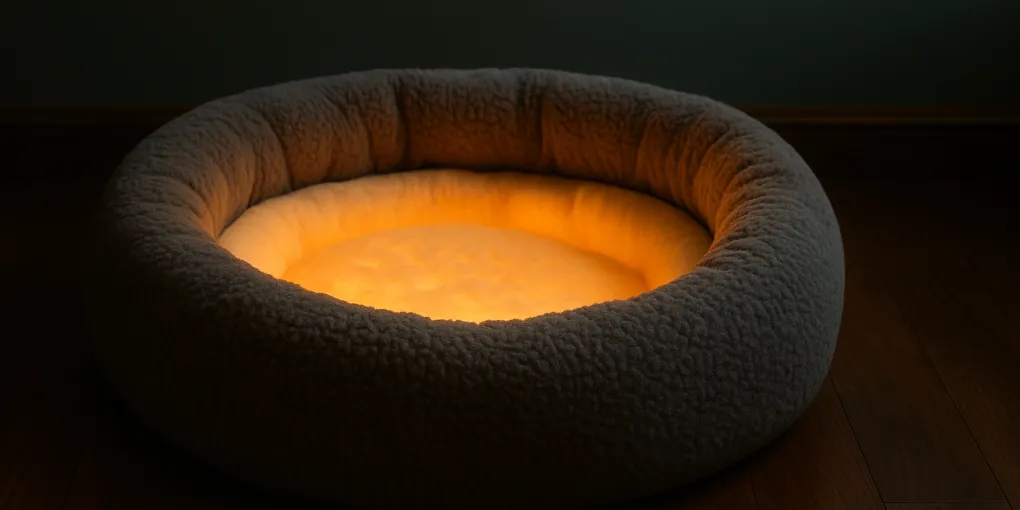
K&H Pet Products Self-Warming Dog Bed
Best Self-Warming (No Electric)Heat source: Reflective thermal core (no electric)
$35–$55
Quick Comparison
| Product | Key Specs | Price Range | Buy |
|---|---|---|---|
| |
| $35–$55 | Check Price |
| |
| $55–$79 | Check Price |
| |
| $25–$35 | Check Price |
| |
| $18–$28 | Check Price |
Contains affiliate links — we may earn a small commission at no extra cost to you.
Best Heated Dog Beds for Senior Dogs in 2026
Cold weather worsens arthritic joint stiffness in senior dogs — a properly designed heated bed provides measurable comfort benefits for aging dogs. K&H Self-Warming Dog Bed (PSR 8.6/10) is the top safety pick — no electricity means no cord chewing hazard, and the reflective thermal design is gentle and reliable. For dogs who need active heat, K&H Lectro-Soft Outdoor Heated Pet Bed (PSR 8.1/10) is the gold standard in thermostatically controlled electric dog beds.
TL;DR
- Safest Option: K&H Self-Warming — no electric, reflective heat, no cords to chew (PSR 8.6/10)
- Best Electric Heated: K&H Lectro-Soft — thermostatically controlled, matches dog body temp (PSR 8.1/10)
- Best Cordless Electric: Snuggle Safe Disc — microwave-charged, no cord during use, 10+ hr warmth (PSR 7.9/10)
- Best Budget Electric: RIOGOO Heating Pad — auto-shutoff, machine washable, lowest price (PSR 7.3/10)
How We Researched This Article
Safety documentation reviewed CPSC recall database and CPSC burn-related incident reports for electric pet products. Thermostat performance verified from manufacturer technical documentation. Owner community synthesis from verified Amazon reviews (combined 60,000+). Cold-weather arthritis management context from published veterinary rehabilitation literature on heat therapy for canine OA.
What Makes a Heated Dog Bed Safe for Senior Dogs
Thermostat reliability: The most critical safety factor for electric heated beds is whether the heating element is thermostatically controlled. Products that heat to a fixed temperature then shut off are inherently safer than continuous-heat pads. The K&H Lectro-Soft’s internal thermostatic system actively adjusts heat output to match the dog’s body temperature — it cannot overheat to dangerous levels during normal use.
Maximum surface temperature: Senior dogs with reduced mobility, diabetes, or peripheral circulatory problems are at higher risk of contact burns than young healthy dogs. No heated pet product should exceed 45°C (113°F) surface temperature for continuous contact.
Cord chew resistance: Senior dogs with cognitive dysfunction or anxiety sometimes chew cords. Chewing through a powered cord is an electrocution risk. Self-warming (no cord) or chew-resistant cord designs eliminate this hazard.
Dog’s ability to move off the heat: A dog that cannot move away from a heat source (e.g., severely arthritic dogs with limited mobility) can develop contact burns. Always size heated products appropriately and ensure the dog has easy access to a non-heated area adjacent to the heated bed.
PSR Composite Score Breakdown
| Criterion | Weight | K&H Self-Warming | K&H Lectro-Soft | Snuggle Safe | RIOGOO Pad |
|---|---|---|---|---|---|
| Safety & Ingredients | 25% | 9.5 | 9.0 | 8.5 | 7.5 |
| Durability & Build Quality | 20% | 8.5 | 8.5 | 8.0 | 7.0 |
| Pet Comfort & Acceptance | 20% | 8.5 | 9.0 | 7.5 | 7.5 |
| Value for Money | 20% | 9.0 | 8.0 | 8.5 | 9.0 |
| Ease of Use | 15% | 9.5 | 8.0 | 7.5 | 8.5 |
| PSR Composite | — | 8.6 | 8.1 | 7.9 | 7.3 |
Score notes: K&H Self-Warming earns top Safety for zero electrical risk, and top Ease of Use for requiring no setup or maintenance. K&H Lectro-Soft earns top Pet Comfort for its superior heat therapy but scores lower on Ease (requires cord management) and Value (higher price). RIOGOO scores lower on Durability and Safety due to shorter market history and less robust thermostat documentation.
K&H Self-Warming Dog Bed: Best Overall (Safest)
The K&H Self-Warming Lounge Sleeper uses a patented multi-layer construction with an inner reflective layer that captures and returns the dog’s own body heat — no electricity required. This eliminates the two main safety risks of electric heated beds: cord chewing and thermostat failure.
Why this is the safest senior dog bed:
- Zero electrical risk — no cords to chew, no risk of electrocution
- Self-regulating by nature — heat output is proportional to the dog’s own body heat, so it cannot overheat
- Machine-washable cover — critical for senior dogs with incontinence
- Low-profile design with bolster sides provides security and easy entry/exit
Safety: No CPSC recalls. No electrical components. Verified non-toxic materials.
Best for: Senior dogs in households with cord-chewing risk; dogs with moderate arthritis who maintain their own body heat; owners who prefer passive-safety products.
View K&H Self-Warming Dog Bed on Amazon
K&H Lectro-Soft Heated Pet Bed: Best Electric Option
The K&H Lectro-Soft is the veterinary community’s preferred electric heated pet bed. Its internal thermostat is designed to maintain the pad at just above the dog’s body temperature — it cannot heat significantly above 38–40°C (101–104°F) under normal use. The outdoor-rated version is also safe for indoor use and offers chew-resistant cord protection.
Thermostat technology matters:
- Standard electric pads heat to a fixed temperature; if the dog’s body blocks airflow, they can overheat
- Lectro-Soft responds to the heat sink created by the dog’s body weight — it heats more when the dog is off it and self-regulates when the dog is on it
Best for: Senior dogs in cold environments who need reliable active warming; very thin, underweight, or hypothyroid senior dogs who struggle to maintain body temperature.
View K&H Lectro-Soft Heated Bed on Amazon
Snuggle Safe Pet Bed Warmer: Best Cordless Electric
Snuggle Safe is a hard plastic disc that heats in a microwave and provides 10+ hours of gentle warmth with no cords during use. The maximum surface temperature is limited to 52°C/126°F by the product design. It is widely used by veterinary clinics and rescue organizations for post-surgical warming of recovering dogs.
Limitations to note:
- Requires re-heating in microwave every 8–10 hours
- The disc itself is a hard surface — requires placement under a soft bedding layer
- Not suitable as a standalone bed — it’s a warming insert
RIOGOO Electric Heating Pad: Best Budget
RIOGOO provides an auto-shutoff electric heating pad at the most accessible price point. Machine-washable cover, 10W power, and a temperature controller with 6 settings. The auto-shutoff feature activates if the pad reaches its temperature limit. This is an entry-level product with less documentation on thermostat reliability than K&H.
View RIOGOO Heating Pad on Amazon
Frequently Asked Questions
Are heated dog beds safe for senior dogs?
Well-designed heated dog beds are safe when used correctly. Products with thermostatically controlled heating (K&H Lectro-Soft) that adjust to the dog’s body temperature are safer than constant-heat pads. The dog must be able to move off the heat source freely, cords must be chew-resistant, and maximum surface temperature must not exceed 52°C.
What temperature should a senior dog bed heating pad reach?
Safe senior dog heating pads should not exceed 40–45°C (104–113°F) surface temperature — close to canine body temperature. Products heating significantly above body temperature risk burns, especially for dogs with reduced mobility.
Do self-warming beds actually work for arthritic senior dogs?
Self-warming beds work best for dogs who rest in one place and maintain body heat. For very old or underweight dogs who have difficulty maintaining body temperature, an electrically heated pad provides more reliable warmth.
Should I leave a heated dog bed on overnight?
Self-warming beds are safe indefinitely. For electric heated beds, use products with a thermostat designed for continuous use (K&H Lectro-Soft). Continuous-heat pads without thermostats should not be left unattended overnight.
Are heated beds good for dogs with arthritis?
Heat therapy can provide symptomatic relief for arthritic dogs by promoting blood flow and reducing pain perception in surrounding tissues. A gentle heated bed is a useful comfort measure, particularly during cold weather when arthritic symptoms are often more pronounced.
Frequently Asked Questions
- Well-designed heated dog beds are safe when used correctly. Products with thermostatically controlled heating (K&H Lectro-Soft) that adjust to the dog's body temperature are safer than constant-heat pads. Key safety requirements: the dog must be able to move off the heat source freely, the cord must be chew-resistant, and the maximum surface temperature must not exceed 52°C/126°F. Dogs with diabetes, circulatory problems, or reduced sensation should be monitored closely with any heated product.
- Safe senior dog heating pads should not exceed 40–45°C (104–113°F) surface temperature — close to canine body temperature (38.3–39.2°C / 101–102.5°F). Products that heat significantly above body temperature risk burns, especially for dogs with reduced mobility who cannot easily move away from excessive heat.
- Self-warming beds (like K&H Self-Warming) use a reflective inner layer that reflects the dog's own body heat back, creating a warm microclimate without electricity. They work best for dogs who rest in one place and maintain body heat. For very old or underweight senior dogs who have difficulty maintaining body temperature, an electrically heated pad provides more reliable warmth.
- Self-warming beds (no electricity) are safe to leave on indefinitely. For electric heated beds, use products with a thermostat that automatically maintains a set temperature — continuous-heat pads (without thermostats) should not be left unattended overnight. K&H Lectro-Soft and similar thermostatically controlled products are designed for continuous use.
- Heat therapy can provide symptomatic relief for dogs with arthritis by promoting blood flow to muscles and joints and reducing pain perception in surrounding tissues. Veterinary physiotherapists use therapeutic heat as part of multimodal OA management. A gentle heated bed can be a useful comfort measure, particularly during cold weather when arthritic symptoms are often more pronounced.