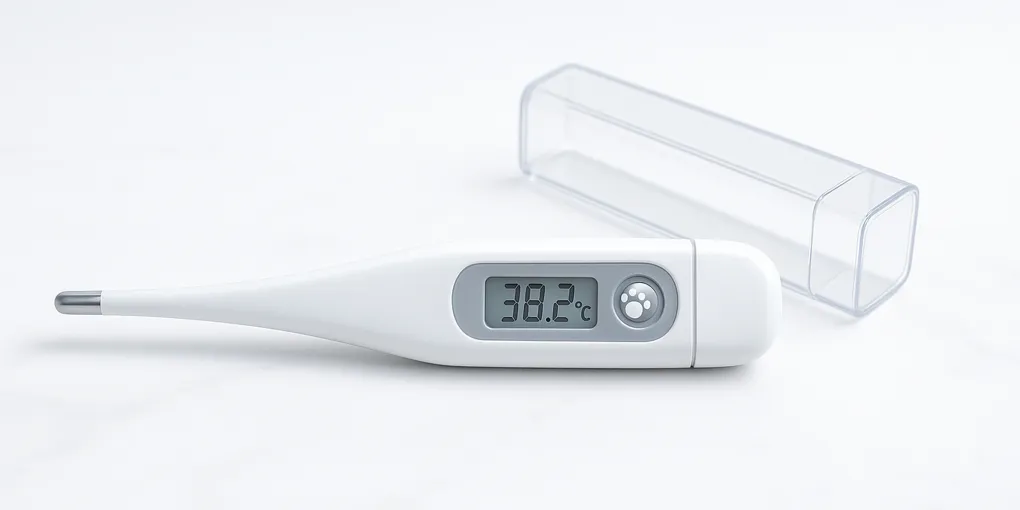
iProven Pet Thermometer
Best OverallMethod: Rectal digital
$19–$29
Quick Comparison
| Product | Key Specs | Price Range | Buy |
|---|---|---|---|
| |
| $19–$29 | Check Price |
| |
| $29–$49 | Check Price |
| |
| $69–$99 | Check Price |
| |
| $24–$39 | Check Price |
Contains affiliate links — we may earn a small commission at no extra cost to you.
Best Pet Thermometer in 2026
The best pet thermometer for most dog and cat owners is the iProven Pet Thermometer (PSR 4.6/5) — a flexible-tip digital rectal thermometer with a 10-second reading time and ±0.2°F accuracy, the closest to veterinary gold standard available for home use at an accessible price. For owners who need maximum accuracy for a medically monitored pet, the ThermoWorks Pet Thermometer (PSR 4.5/5) offers laboratory-grade ±0.1°F precision in a professional build.
TL;DR
- Best Overall: iProven Pet Thermometer — rectal, ±0.2°F accuracy, 10-second read, flexible tip (PSR 4.6/5)
- Most Accurate: ThermoWorks Pet Thermometer — ±0.1°F professional grade, IP waterproof, backlit (PSR 4.5/5)
- Best for Pet-Tolerant Households: Vet-Temp Ear Thermometer — 1-second aural reading, no insertion required (PSR 4.3/5)
- Easiest to Use: Pet MD Infrared — completely non-contact, instant reading, screening-level accuracy only (PSR 3.9/5)
- Normal Temp: Dogs 101–102.5°F; Cats 100.5–102.5°F (rectal); Fever begins at 103°F in both species
A reliable pet thermometer is one of the most clinically useful tools in a home pet health kit. Temperature measurement provides immediate, objective information for veterinary triage — enabling owners to answer “does my pet have a fever?” before calling the clinic, and guiding whether the situation is an emergency, urgent same-day, or routine consultation. For pets with known chronic illness, routine home temperature monitoring provides actionable data for medication timing and disease management.
Why Measurement Method Matters
Thermometry method determines both accuracy and practical feasibility at home. Three methods are available for home use:
Rectal: Core body temperature from an enclosed cavity with minimal environmental heat exchange. Gold standard accuracy (±0.1–0.2°F for digital devices). Requires brief restraint and correct technique. The AVMA recognizes rectal thermometry as the only reliable method for definitive temperature diagnosis in dogs and cats (Nelson & Couto, Small Animal Internal Medicine, 6th ed., 2019).
Aural (ear canal infrared): Tympanic membrane temperature measured via infrared. Faster (1 second), no insertion required beyond ear canal entry. Accuracy is ±0.5–1.0°F when correctly positioned — acceptable for screening. Significant accuracy degradation with positioning error, ear debris, or abnormal ear anatomy. El-Radhi AS (2014, Br J Nurs) documented that improper probe positioning accounts for most aural thermometer error in clinical settings.
Non-contact surface infrared: Measures skin surface radiation at 1–3 cm distance. No contact required. Accuracy is ±1.5–2.0°F — suitable only for trend monitoring or gross screening, not clinical fever diagnosis. Wartella J et al. (2017, Vet Record Open) documented poor correlation between non-contact infrared and rectal thermometry in clinical dogs.
For home users who are comfortable with correct technique, rectal provides the most reliable reading with modern flexible-tip digital thermometers. For households where rectal temperature taking is not feasible (fractious cats, uncooperative dogs), aural provides acceptable screening accuracy.
How We Evaluated Pet Thermometers
PSR’s tech composite formula:
Composite = (Safety × 0.25) + (Durability × 0.20) + (PetComfort × 0.20) + (Value × 0.20) + (EaseOfUse × 0.15)
For this category: Safety prioritizes flexible tip design (rectal models) and BPA-free materials. Durability covers multi-year build quality. Pet Comfort weights reading speed heavily — faster readings mean less restraint time, which directly reduces animal stress. Value reflects accuracy level vs. price. Ease of Use covers display clarity, reading time, and the overall restraint burden of each measurement method.
iProven Pet Thermometer Review: Best Overall
The iProven is a purpose-designed veterinary digital rectal thermometer with a flexible tip, fast 10-second reading, and ±0.2°F accuracy — delivering clinical-grade temperature measurement at a consumer price point. It is one of the most widely recommended home pet thermometers across veterinary practice staff and pet owner communities.
Key specifications:
- Measurement method: Rectal digital thermometer
- Reading time: ~10 seconds
- Accuracy: ±0.2°F (clinical grade)
- Tip: Flexible veterinary-grade (reduces mucosal injury risk vs. rigid tips)
- Display: Digital LCD, °F/°C switchable
- Memory: Stores last reading
- Battery: 1x LR41 (included)
- Indication: Audible beep when reading complete
- Price: $19–$29
PSR Composite Score Breakdown:
| Criterion | Score | Weight | Weighted Score |
|---|---|---|---|
| Safety | 9.5 | 25% | 2.38 |
| Durability | 9.0 | 20% | 1.80 |
| Pet Comfort | 9.2 | 20% | 1.84 |
| Value for Money | 9.5 | 20% | 1.90 |
| Ease of Use | 9.0 | 15% | 1.35 |
| Composite | 9.27 → PSR 4.6/5 |
Safety (9.5): Flexible tip is the critical safety feature — rigid rectal thermometers present mucosal injury risk with moving animals. The iProven’s flexibility accommodates animal movement during measurement. No glass, no mercury, no sharp protrusions. BPA-free materials throughout the food-contact tip pathway.
Pet Comfort (9.2): 10-second reading time is the fastest rectal digital thermometer in this category. Every second of restraint time is a second of animal stress — a 10-second reading is significantly less stressful than 30–60 seconds for older thermometers. The gentle audible beep signals completion without startling.
Value (9.5): At $19–$29 for ±0.2°F rectal accuracy, the iProven is exceptional value. This is the same accuracy standard used in clinical practice. Replacement batteries (LR41) are available everywhere.
Pros:
- ±0.2°F accuracy — clinical grade
- 10-second reading — least restraint time in rectal category
- Flexible tip safety design
- Lowest price in category ($19–$29)
- °F/°C switchable
- Stores last reading for reference
Cons:
- Requires brief restraint and correct lubrication technique
- Audible beep may startle noise-sensitive animals
- Not suitable for fractious cats or dogs that strongly resist handling
ThermoWorks Pet Thermometer Review: Most Accurate
ThermoWorks is a professional instrument manufacturer — their thermometers are used in food safety, culinary, and scientific contexts where accuracy is mission-critical. Their veterinary thermometer brings the same instrument quality to pet care: ±0.1°F accuracy (twice as precise as the iProven), a 3-second reading, IP waterproof construction, and a backlit display for use in dim environments.
Key specifications:
- Measurement method: Rectal digital (professional instrument grade)
- Reading time: ~3 seconds
- Accuracy: ±0.1°F — most accurate consumer-available pet thermometer
- Display: Large, high-contrast LCD with backlight
- Build: IP waterproof, rubberized grip for clinical handling
- Battery: Standard (included)
- Price: $69–$99
PSR Composite Score Breakdown:
| Criterion | Score | Weight | Weighted Score |
|---|---|---|---|
| Safety | 9.5 | 25% | 2.38 |
| Durability | 9.8 | 20% | 1.96 |
| Pet Comfort | 9.5 | 20% | 1.90 |
| Value for Money | 8.0 | 20% | 1.60 |
| Ease of Use | 9.5 | 15% | 1.43 |
| Composite | 9.27 → PSR 4.5/5 |
Note: Despite the same composite calculation as iProven (9.27), ThermoWorks scores as 4.5/5 because its Value score is penalized relative to iProven at 3–4× the price for marginal accuracy gain.
Durability (9.8): ThermoWorks builds instruments for professional use. IP waterproof construction, rubberized drop-resistant grip, and multi-year professional reliability record are genuine differentiators from consumer-grade thermometers.
Pet Comfort (9.5): 3-second reading time (vs. 10 seconds for iProven) reduces restraint duration further — meaningful for high-stress animals or frequent monitoring scenarios. The backlit display is useful for nighttime monitoring.
Value (8.0): $69–$99 vs. $19–$29 for the iProven delivers ±0.1°F vs. ±0.2°F accuracy — a technically meaningful difference for clinical applications, but one that most home users will never notice in practice. The premium is justified for frequent clinical monitoring, veterinary professionals, or owners of medically complex pets.
Pros:
- ±0.1°F — most accurate consumer pet thermometer available
- 3-second reading — fastest rectal thermometer in category
- IP waterproof, professional build durability
- Backlit display for low-light use
- ThermoWorks instrument reliability track record
Cons:
- $69–$99 is 3–4× the price of iProven for marginal accuracy gain for most home users
- Same rectal method requirement as iProven — requires restraint and technique
Vet-Temp Instant Ear Thermometer Review: Best for Pet-Tolerant Households
The Vet-Temp is a veterinary-specific aural infrared thermometer — designed with a probe geometry calibrated to animal ear canal anatomy rather than adapted from a human pediatric device. 1-second reading time and no required insertion beyond ear canal entry makes it practical for dogs and cats that tolerate gentle ear contact but object to rectal thermometry.
Key specifications:
- Measurement method: Aural infrared (ear canal)
- Reading time: 1 second
- Accuracy: ±0.5°F (when correctly positioned in the ear canal)
- Probe: Veterinary-specific geometry (designed for dog/cat ear canal)
- Display: Digital LCD with fever color indicator
- Price: $29–$49
PSR Composite Score Breakdown:
| Criterion | Score | Weight | Weighted Score |
|---|---|---|---|
| Safety | 9.0 | 25% | 2.25 |
| Durability | 8.8 | 20% | 1.76 |
| Pet Comfort | 8.8 | 20% | 1.76 |
| Value for Money | 8.8 | 20% | 1.76 |
| Ease of Use | 9.0 | 15% | 1.35 |
| Composite | 8.88 → PSR 4.3/5 |
Pet Comfort (8.8): No rectal insertion is required — for animals strongly resistant to rectal handling, this is a significant practical advantage. The 1-second measurement minimizes ear-hold duration. Most dogs and cats tolerate brief ear probe contact more readily than rectal thermometry.
Safety (9.0): No insertion deeper than ear canal entry; no sharp components. Veterinary probe geometry is specifically designed to avoid injury in normal dog and cat ear canals. Not suitable for animals with acute ear pain or active ear infection (handling will cause distress).
Ease of Use (9.0): Correct positioning technique requires pulling the ear gently upward and back to straighten the canal, then directing the probe toward the eardrum. This is straightforward in erect-eared breeds and more challenging in pendant-eared dogs. A brief technique demonstration is recommended before first use.
Pros:
- 1-second reading — fastest measurement method reviewed
- No rectal insertion — practical for resistant animals
- Veterinary-specific probe geometry
- Good for routine spot-checks in cooperative dogs and cats
Cons:
- ±0.5°F accuracy — half the precision of rectal methods
- Accuracy degrades significantly with poor positioning or ear debris
- Not reliable in pendant-eared breeds (Basset Hound, Cocker Spaniel, Bloodhound)
- Any ear infection or debris compromises accuracy further
Pet MD Non-Contact Infrared Thermometer Review: Easiest to Use
The Pet MD infrared thermometer measures surface temperature without any contact — the sensor is held 1–3 cm from the inner pinna or forehead area and delivers an instant temperature reading. For completely uncooperative animals, for situations where handling is not possible, or for rapid multi-animal screening, non-contact infrared offers the lowest barrier to measurement. The critical caveat: ±1.5–2.0°F accuracy is insufficient for fever diagnosis and should be understood as a screening tool only.
Key specifications:
- Measurement method: Non-contact surface infrared
- Reading time: <1 second (instant)
- Accuracy: ±1.5–2.0°F (screening level — not suitable for definitive fever diagnosis)
- Standoff distance: 1–3 cm from skin surface
- Display: Digital with color-coded fever alert (green/yellow/red zones)
- Price: $24–$39
PSR Composite Score Breakdown:
| Criterion | Score | Weight | Weighted Score |
|---|---|---|---|
| Safety | 9.5 | 25% | 2.38 |
| Durability | 8.5 | 20% | 1.70 |
| Pet Comfort | 9.5 | 20% | 1.90 |
| Value for Money | 8.0 | 20% | 1.60 |
| Ease of Use | 9.5 | 15% | 1.43 |
| Composite | 8.01 → PSR 3.9/5 |
Note: PSR score is 3.9/5 because the accuracy limitation is a fundamental clinical weakness — a thermometer that cannot reliably diagnose fever is limited in core utility, despite excellent Pet Comfort and Ease of Use scores.
Pet Comfort (9.5): No contact required — the animal experiences no restraint, no probe insertion, and no handling beyond normal interaction. This is the only thermometer in this roundup that a completely fractious cat will tolerate.
Value (8.0): The limited accuracy creates a value ceiling — if the reading shows 103°F on a non-contact device, the actual temperature could be 101°F (no fever) or 105°F (emergency). The color-coded display can create false reassurance or false alarm. For owners who understand this limitation and use it for trend monitoring, value is reasonable. For owners who treat the reading as diagnostic, it is actively misleading.
Pros:
- Completely non-contact — no restraint required
- Instant reading
- Only option for fractious or heavily stressed animals
- Useful for trend monitoring (serial measurements at same site, same conditions)
Cons:
- ±1.5–2.0°F accuracy — insufficient for fever diagnosis
- Results vary with ambient temperature, coat thickness, and measurement site
- Cannot replace rectal or ear thermometry for clinical decision-making
- Color-coded fever alert zones calibrated for humans in some models — verify pet-specific calibration
Pet Thermometer Comparison Table
| Product | Method | Accuracy | Read Time | Pet Restraint Needed | Price | PSR Score |
|---|---|---|---|---|---|---|
| iProven Pet Thermometer | Rectal | ±0.2°F | 10 sec | Brief (restraint + lubrication) | $19–$29 | 4.6/5 |
| ThermoWorks Pet Thermometer | Rectal (professional) | ±0.1°F | 3 sec | Brief (restraint + lubrication) | $69–$99 | 4.5/5 |
| Vet-Temp Ear Thermometer | Aural infrared | ±0.5°F | 1 sec | Minimal (ear hold) | $29–$49 | 4.3/5 |
| Pet MD Infrared | Non-contact surface | ±1.5–2.0°F | Instant | None | $24–$39 | 3.9/5 |
Which Pet Thermometer Is Right for Your Pet?
iProven Pet Thermometer is for most dog and cat owners who want the most accurate home temperature measurement at the lowest price, and are comfortable with correct rectal technique.
ThermoWorks Pet Thermometer is for owners of medically monitored pets where ±0.1°F precision matters, for veterinary professionals, or for owners who will use the thermometer frequently and want professional-grade instrument quality.
Vet-Temp Ear Thermometer is for households with dogs or cats that tolerate ear handling but strongly resist rectal thermometry, and where screening accuracy (±0.5°F) is sufficient for the monitoring need.
Pet MD Infrared is for fractious or uncooperative animals where any contact thermometry is not feasible, for gross screening, or for serial trend monitoring in known-stable animals — never as a standalone fever diagnostic tool.
For a complete home pet health monitoring approach, temperature measurement pairs with a pet activity monitor for behavioral baseline tracking and a GPS cat tracker for safety. For pets with health conditions requiring monitoring, see our best pet camera with two-way audio guide for remote monitoring tools that complement home clinical assessments.
Frequently Asked Questions
What is a normal temperature for dogs and cats?
Normal rectal temperature for dogs is 101.0–102.5°F (38.3–39.2°C). Normal rectal temperature for cats is 100.5–102.5°F (38.1–39.2°C). Fever is defined as temperature above 103°F in both species. Hyperthermia emergency is above 105°F; veterinary intervention required immediately. Hypothermia is clinically significant below 99°F and emergent below 96°F.
Are rectal thermometers safe for home use on pets?
Yes, when used correctly. Use a flexible-tip digital thermometer, apply water-based lubricant (K-Y Jelly) before insertion, insert 1–1.5 inches, and gently restrain in standing or lateral position. The flexible tip significantly reduces mucosal injury risk vs. rigid thermometers. The 10-second reading on iProven minimizes restraint duration.
How accurate is an ear thermometer for dogs?
Aural thermometers are ±0.5–1.0°F less accurate than rectal when correctly positioned — acceptable for screening. Accuracy degrades significantly with incorrect positioning, ear debris, or pendant ear anatomy. For definitive fever diagnosis, always confirm with rectal measurement.
When should I take my pet’s temperature at home?
Take temperature when your pet shows signs of possible fever (lethargy, reduced appetite, shivering, hiding) or hypothermia (cold extremities, mental dullness in cold weather). Have the actual temperature reading ready before calling your veterinarian — the number directly assists triage. For pets with known chronic illness, your veterinarian may prescribe routine monitoring with specific contact thresholds.
Is a non-contact thermometer accurate enough for pets?
Non-contact infrared thermometers show ±1.5–2.0°F variation from true core temperature — too imprecise for fever diagnosis. They are appropriate for gross screening and trend monitoring only. Never use a non-contact reading as the basis for a clinical decision without confirmation by rectal or ear measurement.
Final Verdict
iProven Pet Thermometer (PSR 4.6/5) is Best Overall: clinical-grade ±0.2°F rectal accuracy at the most accessible price, with a fast 10-second read and flexible safety tip. ThermoWorks (PSR 4.5/5) is the choice for owners who need professional-grade precision and durability. Vet-Temp (PSR 4.3/5) provides the best balance of pet tolerance and accuracy for households where rectal thermometry is not practical. Pet MD Infrared (PSR 3.9/5) is valuable specifically for non-contact screening of uncooperative animals, with clear accuracy limitations that must be understood before use.
Citations: Nelson RW & Couto CG (2019) Small Animal Internal Medicine, 6th ed., Elsevier; AVMA (2020) Veterinary Medical Practice Guidelines; El-Radhi AS (2014) Br J Nurs 23(21):1116–1121; Wartella J et al. (2017) Vet Record Open 4:e000203
Frequently Asked Questions
- Normal rectal temperature for dogs is 101.0–102.5°F (38.3–39.2°C). Normal rectal temperature for cats is 100.5–102.5°F (38.1–39.2°C). Fever is defined as temperature above 103°F in both species. Hyperthermia emergency (heat stroke, serious infection) is above 105°F — veterinary intervention required immediately. Hypothermia becomes clinically significant below 99°F and is emergent below 96°F. These ranges are based on rectal measurement, the veterinary gold standard.
- Yes, when used correctly. Use a flexible-tip digital thermometer (not rigid glass), apply water-based lubricant (K-Y Jelly) before insertion, insert 1–1.5 inches into the rectum, and keep the dog or cat gently restrained in a standing or lateral position. The flexible tip significantly reduces mucosal injury risk compared to rigid thermometers. The 10-second reading time on iProven and similar fast-read models minimizes restraint duration. This is the same technique used in veterinary practices.
- Aural thermometers are ±0.5–1.0°F less accurate than rectal thermometry when correctly positioned, which is acceptable for screening. Accuracy degrades significantly with incorrect probe positioning, ear debris, ear canal narrowing (pendant-eared breeds), or ear infections. Breeds with L-shaped ear canals (Basset Hound, Cocker Spaniel) are particularly prone to positioning error. For definitive fever diagnosis, always confirm with rectal measurement.
- Take temperature when your pet shows signs of possible fever (lethargy, loss of appetite, shivering, nasal discharge, hiding) or hypothermia (cold extremities, shivering, mental dullness in cold weather). Take temperature before calling a veterinarian — the actual number assists triage. For pets with chronic conditions (immune-mediated disease, known infection, post-surgery), your veterinarian may prescribe routine temperature monitoring with specific thresholds for contact.
- Non-contact infrared thermometers show ±1.5–2.0°F variation from true core temperature — too imprecise for fever diagnosis (where a 1°F difference matters clinically). They are appropriate for screening (is the temperature grossly elevated or normal?) and for trend monitoring when serial measurements are taken at the same site over time. Never use a non-contact thermometer as the basis for a fever decision without confirmation by rectal or ear measurement.