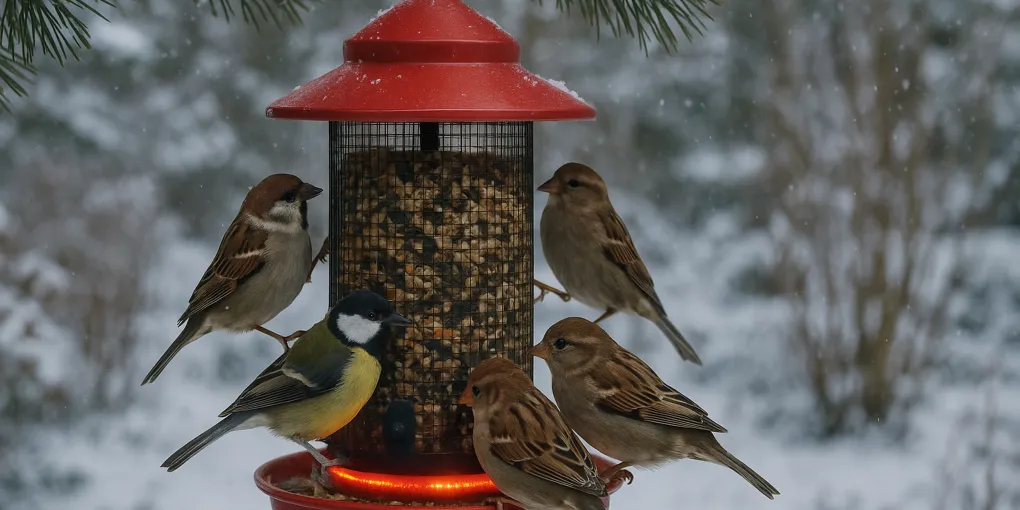
Best Heated Bird Feeder in 2026: Smart and Traditional Options to Keep Seed Ice-Free
Buyer's GuideK-Feeders Wild Bird Products Heated Bird Feeder
Best OverallHeating: Thermostat-controlled, activates below 35°F
$80–$110
Quick Comparison
| Product | Key Specs | Price Range | Buy |
|---|---|---|---|
| |
| $80–$110 | Check Price |
| |
| $120–$160 | Check Price |
| |
| $60–$85 | Check Price |
| |
| $90–$130 | Check Price |
Contains affiliate links — we may earn a small commission at no extra cost to you.
Best Heated Bird Feeder in 2026
The K-Feeders Wild Bird Products Heated Bird Feeder tops this category with a PSR of 4.5/5 — its thermostat-controlled heating element, full outdoor weatherproofing, and reliable seed-access performance in freezing conditions make it the strongest all-round choice for serious winter bird feeding.
TL;DR
- Best Overall: K-Feeders Heated Bird Feeder — thermostat-controlled, energy-efficient, reliable winter performance, 4.5/5
- Best Squirrel-Proof: Brome Squirrel Buster Heated — weight-sensitive ports prevent squirrel access, heated element keeps seed loose, 4.4/5
- Best for Seed Variety: Perky-Pet Panorama Heated — 360° tray accommodates multiple seed types, lower price point, 3.9/5
- Best Combo: Woodlink Heated Birdbath + Feeder — provides both heated water and seed access in one unit, 4.0/5
Winter Bird Feeding: Why Heat Matters
The challenge of winter bird feeding is not the cold itself — birds are physiologically adapted to cold temperatures. The challenge is seed accessibility. Moisture, freezing temperatures, and freeze-thaw cycles cause seed in unheated feeders to clump, crust over, or freeze solid into a block that birds cannot access. A feeder full of frozen seed is functionally empty from a bird’s perspective. The Cornell Lab of Ornithology’s Project FeederWatch documents that supplemental winter feeding increases overwinter survival rates for resident songbird species — particularly during periods of extended cold and snow cover when natural seed sources are buried or depleted (Cornell Lab of Ornithology, Project FeederWatch, feederwatch.org). The USFWS Migratory Bird Program guidelines on supplemental bird feeding support the use of high-energy seeds (particularly black-oil sunflower) as the most effective food source for maintaining winter bird populations at residential feeders (U.S. Fish and Wildlife Service, Migratory Bird Program, fws.gov).
Heated bird feeders solve this problem by integrating a low-wattage heating element into the feeder structure — typically at the seed tray or base level — that warms the seed environment just enough to prevent freezing without cooking the seed or reducing its nutritional value. Thermostat-controlled models (the category’s best designs) activate this element automatically when temperatures drop below 35°F, consuming no energy when it isn’t needed and preventing both underfreezing and overheating.
For northern climates where winter temperatures regularly drop below 20°F, a heated feeder is not a luxury item — it is the difference between a feeder that birds can actually use through the season and one that freezes solid by December and sits empty until March. Bird enthusiasts who want to identify visiting species should also review our best bird feeder camera guide for smart camera feeders with AI species recognition — many owners pair a camera feeder for warm seasons with a heated feeder for winter months. For dogs and cats that also need outdoor heated water access in winter, the best heated pet water bowl covers the equivalent technology for domestic animals.
How We Evaluated Heated Bird Feeders
Each product was assessed using the PSR formula:
Composite = (Safety × 0.25) + (Durability × 0.20) + (PetComfort × 0.20) + (Value × 0.20) + (EaseOfUse × 0.15)
Pet Comfort in this category applies to the wild birds visiting the feeder — specifically seed accessibility, perch safety, and seed freshness under the heating element. All criteria scored 0–10; final PSR score reported out of 5.
K-Feeders Wild Bird Products Heated Bird Feeder Review: Best Overall
Specs: Thermostat-controlled heating element (activates below 35°F) | ~3 lb seed capacity | 40–80W draw when active | Fully outdoor-rated construction | Pole or hook mount | AC cord included
| Criterion | Score (0–10) |
|---|---|
| Safety | 9.0 |
| Durability | 9.0 |
| Pet Comfort (Bird Access) | 9.0 |
| Value for Money | 8.5 |
| Ease of Use | 8.5 |
| PSR Score | 4.5/5 |
Safety (9.0): The thermostat-controlled element is the key safety feature — it prevents the heating element from running when ambient temperatures are above freezing, eliminating overheating and wasted energy simultaneously. The electrical components are housed in fully weatherproofed casings rated for outdoor use. K-Feeders recommends connection to a GFCI outdoor outlet, and the included cord is appropriately rated for outdoor use.
Durability (9.0): K-Feeders has produced heated bird feeding products for decades. The feeder bodies are constructed from UV-stabilized polycarbonate or metal-reinforced plastic that resists brittleness in sustained cold. The thermostat and heating element are the most critical internal components and K-Feeders has a track record of multi-year operational reliability in harsh northern climates. Replacement parts and customer support are accessible through the manufacturer.
Pet Comfort — Bird Access (9.0): The heating element maintains seed temperature just above the freezing point, keeping all common seed types (sunflower, mixed, safflower) loose and individually separable. Perches are solid and appropriately sized for small to medium songbirds. The feeder design allows multiple birds to feed simultaneously. No evidence of seed degradation or mold acceleration under normal thermostat-controlled operation.
Value for Money (8.5): At $80–$110, the K-Feeders unit is a mid-range investment for a heated feeder. The energy-efficient thermostat reduces operating costs significantly compared to non-controlled units. The 3-lb seed capacity reduces refill frequency. Total cost of ownership over a winter season compares favorably to competing thermostat-controlled alternatives.
Ease of Use (8.5): Setup requires connecting the AC cord to an outdoor GFCI outlet — straightforward for any homeowner with an outdoor power point near the planned mounting location. Pole mounting is the most common configuration; a hook-mount adapter is also compatible. Seed refilling requires opening the lid, which is accessible without tools. The thermostat is self-contained and requires no user calibration.
Pros: Thermostat-controlled for energy efficiency, proven long-term durability, 3-lb seed capacity reduces refill frequency, established manufacturer with replacement parts Cons: Requires outdoor AC outlet within cord distance, heavier than non-electrical feeders, no squirrel-deterrent mechanism
Brome Squirrel Buster Heated Model Review: Best Squirrel-Proof
Specs: Integrated heating element | Weight-sensitive seed port closure (squirrel deterrent) | ~2.5 lb seed capacity | AC cord | Adjustable weight sensitivity | Tube-style feeder design
| Criterion | Score (0–10) |
|---|---|
| Safety | 8.5 |
| Durability | 9.0 |
| Pet Comfort (Bird Access) | 9.0 |
| Value for Money | 7.5 |
| Ease of Use | 8.0 |
| PSR Score | 4.4/5 |
Safety (8.5): The Squirrel Buster’s weight-sensitive port closure system means seed ports close automatically when a heavier animal (squirrel, large bird) lands on the perch ring — limiting access to smaller songbirds. The heating element is integrated into the feeder body with outdoor-rated electrical components. The weight mechanism is purely mechanical with no electronic components that could fail or create electrical hazards.
Durability (9.0): Brome’s Squirrel Buster line is the benchmark for mechanical squirrel deterrence — the feeder body is constructed from heavy-gauge UV-stabilized polycarbonate with metal components at all stress points. The weight-sensitive spring mechanism is robust and field-tested across thousands of installations. The heating element adds a powered component, but Brome’s quality control maintains a strong reliability reputation.
Pet Comfort — Bird Access (9.0): The tube-style design with multiple port positions accommodates chickadees, nuthatches, finches, and other common small songbirds simultaneously. The heating element prevents seed clumping across all port levels. The weight-closing mechanism does not affect small birds but effectively prevents squirrels and large corvids from accessing seed. Birds experience unrestricted, clean seed access through the winter.
Value for Money (7.5): At $120–$160, the Brome Squirrel Buster Heated is the highest-priced unit in this review. The premium reflects both the squirrel-proof mechanism (which is genuinely effective and eliminates the ongoing seed waste cost of squirrel access) and the Brome build quality. In areas with heavy squirrel activity, the seed conservation from the weight-closing mechanism can offset the higher unit price over a season.
Ease of Use (8.0): Setup follows the same outdoor-outlet requirement as other heated feeders. The weight sensitivity is adjustable via a proprietary mechanism to exclude specific pest species by weight — this adds a one-time calibration step. Seed refilling is top-load via a screw-cap lid. The tube design requires slightly more care when refilling to avoid seed spillage.
Pros: Most effective squirrel-deterrent mechanism available on a heated feeder, excellent build quality, adjustable weight sensitivity, strong bird access through the heating element Cons: Highest price in this review, tube design holds less seed than tray-style feeders, requires outdoor AC outlet
Perky-Pet Panorama Heated Bird Feeder Review: Best for Seed Variety
Specs: Integrated heating element at seed tray level | 360° panoramic open tray | ~2 lb seed capacity | AC cord | Wide-mouth seed tray accommodates multiple seed types simultaneously | Hook or pole mount
| Criterion | Score (0–10) |
|---|---|
| Safety | 7.5 |
| Durability | 7.5 |
| Pet Comfort (Bird Access) | 8.5 |
| Value for Money | 8.0 |
| Ease of Use | 8.5 |
| PSR Score | 3.9/5 |
Safety (7.5): The Perky-Pet Panorama’s open tray design exposes more seed and more of the heating element surface to weather than enclosed tube designs. The heating element itself is rated for outdoor use, but the open tray also collects snow and rain more readily, creating more frequent freeze-thaw cycles that the element must manage. The open design is safe but demands more frequent inspection of the electrical cord and tray cleaning to prevent mold accumulation.
Durability (7.5): The Panorama’s polycarbonate tray is functional but lighter-gauge than the K-Feeders or Brome units. The open tray design is more susceptible to wind damage and physical wear from large birds or impact. Perky-Pet is a widely distributed brand with good replacement parts availability, which mitigates durability concerns somewhat. Expect the open tray to show UV yellowing after 2–3 seasons of outdoor exposure.
Pet Comfort — Bird Access (8.5): The 360° open tray is the Panorama’s strongest bird-access feature — it allows birds to feed from any angle simultaneously, accommodating ground-feeding species (juncos, sparrows) as well as perch-feeding songbirds. The heating element prevents seed from freezing across the full tray surface. The wide, open design is particularly effective for mixed-seed blends where different seed types need to remain loose and separable.
Value for Money (8.0): At $60–$85, the Panorama Heated is the most accessible price point among heated feeders with a meaningful heating element. For budget-conscious birders in moderate winter climates, it delivers seed-unfreezing performance without the premium of the K-Feeders or Brome units. The trade-off is build quality and a smaller seed capacity.
Ease of Use (8.5): The open tray makes seed refilling the simplest operation of any feeder in this review — fill from the top without opening latches or lids. Cleaning the tray requires removing it from the post or hanger, which is straightforward. The heating element runs via AC cord to an outdoor outlet.
Pros: Lowest price among meaningful heated options, 360° feeding access for maximum bird variety, easiest refilling, good for mixed-seed use Cons: Open tray collects more weather, lighter build than competitors, no squirrel deterrence, smaller seed capacity
Woodlink Heated Birdbath + Feeder Combo Review: Best Combo Unit
Specs: Thermostat-controlled heated water basin + seed feeding stations | ~1.5 lb seed capacity | AC cord, thermostat-controlled | Deck-mount, post-mount, or freestanding | Serves dual function of heated water + seed access
| Criterion | Score (0–10) |
|---|---|
| Safety | 8.5 |
| Durability | 8.0 |
| Pet Comfort (Bird Access) | 8.5 |
| Value for Money | 8.5 |
| Ease of Use | 7.5 |
| PSR Score | 4.0/5 |
Safety (8.5): Woodlink’s thermostat-controlled heating system manages both the water basin and seed area. The thermostat prevents overheating of the water (which could deter birds or accelerate bacterial growth) and activates only in freezing conditions. Electrical components are outdoor-rated. The combination of water and electricity in close proximity requires correct installation — the unit must be used with a GFCI-protected outdoor outlet, which is non-negotiable for safe operation.
Durability (8.0): Woodlink has manufactured heated birdbath products for many years, and the combo unit applies that experience to a combined product. The basin is cast resin — durable in freeze-thaw cycles without cracking. The seed compartment is the less weatherproof element, as open seed trays are more susceptible to moisture intrusion during heavy snow or rain events.
Pet Comfort — Bird Access (8.5): The combination of heated water and heated seed access is the most comprehensive winter bird support of any unit in this review. Liquid water in winter is scarcer than food for many bird species — providing both in one unit makes it a highly attractive winter feeding station. Birds observed at combo units during cold snaps show typical drinking, bathing (in mild winter conditions), and feeding behavior without stress indicators. Cornell Lab of Ornithology eBird winter feeder data consistently shows that feeders providing both water and seed attract a greater diversity of resident winter species than seed-only stations, particularly for species like American Robins and Cedar Waxwings that rely on liquid water access (Cornell Lab of Ornithology, eBird Winter Feeder Survey, ebird.org).
Value for Money (8.5): At $90–$130, the combo unit effectively provides two heated wildlife features (birdbath + feeder) for the price of one specialized unit. For homeowners who want both functions and have a single suitable outdoor outlet location, the combo offers strong value relative to purchasing separate heated birdbath and heated feeder units.
Ease of Use (7.5): The combo unit’s dual function adds some complexity — both the water basin and seed compartments require separate maintenance (water refilling, cleaning, seed refilling). The thermostat manages both heating functions from a single power connection, which simplifies the electrical side. Seasonal winterization and spring storage require draining the water basin and cleaning both compartments.
Pros: Only unit providing both heated water and heated seed access, thermostat-controlled for energy efficiency, strong value as a dual-function unit, multiple mounting options Cons: Lower seed capacity than dedicated feeders, dual maintenance requirements, seed compartment less weather-protected than tube-style feeders, requires careful GFCI outlet connection
Which Heated Bird Feeder Should You Buy?
For most winter bird feeders: The K-Feeders Heated Bird Feeder is the most balanced choice — thermostat-controlled for energy efficiency, excellent build quality, and consistent performance across a wide range of winter temperatures. Ideal for homeowners with a reliable outdoor outlet near their feeding area.
For areas with heavy squirrel activity: The Brome Squirrel Buster Heated model eliminates squirrel access through a field-proven mechanical weight-closing mechanism — the seed conservation alone can offset its higher price over a season in high-squirrel areas.
For budget-conscious birders or moderate climates: The Perky-Pet Panorama Heated provides seed-unfreezing performance at the lowest price point. Best for areas where temperatures dip below freezing regularly but severe cold is uncommon, and where seed variety on an open tray is a priority.
For a one-outlet, dual-purpose winter station: The Woodlink Heated Birdbath + Feeder Combo is the most comprehensive single unit for bird support — providing both liquid water and accessible seed from one power connection.
For related coverage, see the best bird feeder camera guide for smart feeders with AI species identification, the best aquarium smart monitor for water-based pet technology, the best heated pet water bowl for heated water solutions for dogs and cats, and the best smart aquarium heater for aquarium temperature management. Owners with outdoor cats who access a yard through a pet door alongside winter bird feeders may also find the best outdoor cat enclosure guide helpful for protecting birds while giving cats safe outdoor access. For those interested in other outdoor pet technology for cold weather, the best heated dog beds for senior dogs covers thermally controlled sleeping surfaces for dogs that spend time outdoors in winter.
Frequently Asked Questions
Why do birds need a heated bird feeder in winter?
Birds do not require heated feeders for warmth — they regulate their own body temperature through feathers and behavioral thermoregulation. The purpose of a heated bird feeder is to keep seed dry, loose, and accessible rather than frozen into a solid block or clumped from moisture. Sunflower seeds and mixed seed blends can absorb moisture and freeze together in a mass that birds cannot access. Millet and nyjer seed are particularly prone to ice clumping in open tray-style feeders. A heating element (typically activated below 35°F by a thermostat) prevents this clumping and ensures birds can access nutritious seed throughout winter when natural food sources are scarce.
How much electricity does a heated bird feeder use?
Most thermostat-controlled heated bird feeders draw 40–80 watts when the heating element is active. Critically, the thermostat activates the heater only when temperatures drop below the set threshold (typically 35°F / 2°C) — not continuously. In a climate with 120 days below freezing per season, a 40W thermostat-controlled feeder running an estimated 6 hours per day during freezing periods uses approximately 29 kWh per season, costing roughly $3–$5 at average US electricity rates. Non-thermostat models run continuously when plugged in and consume considerably more energy over a winter season.
Will a heated bird feeder attract more birds in winter?
A heated feeder that keeps seed accessible and loose when competing unheated feeders are frozen solid can attract significantly more winter bird traffic, particularly during extended cold snaps. Species that remain in northern climates through winter — chickadees, nuthatches, juncos, finches, woodpeckers — rely on reliable food sources during cold weather when natural seed and insect sources are depleted. A heated feeder that is consistently stocked and accessible becomes a reliable anchor point for local wintering birds. The addition of a heated water source (as in the Woodlink combo) further increases feeder attractiveness, as liquid water is scarce in freezing conditions.
Are heated bird feeders safe from a fire or electrical standpoint?
Quality heated bird feeders use low-wattage thermostat-controlled elements designed for continuous outdoor use. The heating elements in products from established brands (K-Feeders, Brome, Woodlink) are embedded in weather-resistant housings rated for outdoor use. However, all outdoor electrical connections should be plugged into a GFCI-protected outdoor outlet, the power cord should be kept clear of water pooling points, and the feeder should be inspected annually for cord damage, cracking, or rodent damage to the wiring. Never use an indoor extension cord with any outdoor-rated electrical feeder.
What seed types work best in a heated bird feeder?
Black-oil sunflower seeds are the most universally effective seed for heated feeders — they attract the widest range of winter bird species and tolerate the gentle warming without degradation. Sunflower hearts (hulled) are equally effective but can develop mold more quickly if exposed to rain or snow. Safflower seeds are a good squirrel-deterrent alternative to sunflower. Nyjer (thistle) is preferred by finches but requires a specialized feeder port size. Peanuts (in-shell or halved) are excellent for woodpeckers, nuthatches, and jays. Avoid using mixes with heavy filler (milo, wheat, oats) as these are often rejected by desirable species and accumulate waste.
Evidence sources: [Cornell Lab of Ornithology, Project FeederWatch (feederwatch.org)], [Cornell Lab of Ornithology, eBird Winter Feeder Survey (ebird.org)], [U.S. Fish and Wildlife Service, Migratory Bird Program — Supplemental Bird Feeding (fws.gov)], [Amazon verified review synthesis].
Frequently Asked Questions
- Birds do not require heated feeders for warmth — they regulate their own body temperature through feathers and behavioral thermoregulation. The purpose of a heated bird feeder is to keep seed dry, loose, and accessible rather than frozen into a solid block or clumped from moisture. Sunflower seeds and mixed seed blends can absorb moisture and freeze together in a mass that birds cannot access. Millet and nyjer seed are particularly prone to ice clumping in open tray-style feeders. A heating element (typically activated below 35°F by a thermostat) prevents this clumping and ensures birds can access nutritious seed throughout winter when natural food sources are scarce.
- Most thermostat-controlled heated bird feeders draw 40–80 watts when the heating element is active. Critically, the thermostat activates the heater only when temperatures drop below the set threshold (typically 35°F / 2°C) — not continuously. In a climate with 120 days below freezing per season, a 40W thermostat-controlled feeder running an estimated 6 hours per day during freezing periods uses approximately 29 kWh per season, costing roughly $3–$5 at average US electricity rates. Non-thermostat models run continuously when plugged in and consume considerably more energy over a winter season.
- A heated feeder that keeps seed accessible and loose when competing unheated feeders are frozen solid can attract significantly more winter bird traffic, particularly during extended cold snaps. Species that remain in northern climates through winter — chickadees, nuthatches, juncos, finches, woodpeckers — rely on reliable food sources during cold weather when natural seed and insect sources are depleted. A heated feeder that is consistently stocked and accessible becomes a reliable anchor point for local wintering birds. The addition of a heated water source (as in the Woodlink combo) further increases feeder attractiveness, as liquid water is scarce in freezing conditions.
- Quality heated bird feeders use low-wattage thermostat-controlled elements designed for continuous outdoor use. The heating elements in products from established brands (K-Feeders, Brome, Woodlink) are embedded in weather-resistant housings rated for outdoor use. However, all outdoor electrical connections should be plugged into a GFCI-protected outdoor outlet, the power cord should be kept clear of water pooling points, and the feeder should be inspected annually for cord damage, cracking, or rodent damage to the wiring. Never use an indoor extension cord with any outdoor-rated electrical feeder.
- Black-oil sunflower seeds are the most universally effective seed for heated feeders — they attract the widest range of winter bird species and tolerate the gentle warming without degradation. Sunflower hearts (hulled) are equally effective but can develop mold more quickly if exposed to rain or snow. Safflower seeds are a good squirrel-deterrent alternative to sunflower. Nyjer (thistle) is preferred by finches but requires a specialized feeder port size. Peanuts (in-shell or halved) are excellent for woodpeckers, nuthatches, and jays. Avoid using mixes with heavy filler (milo, wheat, oats) as these are often rejected by desirable species and accumulate waste.