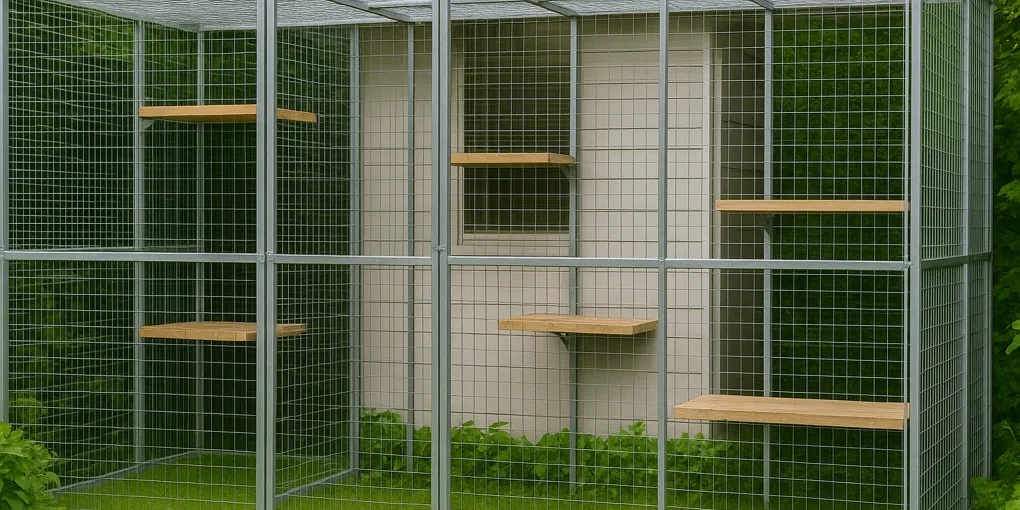
COZIWOW Outdoor Cat Enclosure with Tunnel
Best OverallFrame: Galvanized steel, powder-coated
$120–$200
Quick Comparison
| Product | Key Specs | Price Range | Buy |
|---|---|---|---|
| |
| $120–$200 | Check Price |
| |
| $200–$350 | Check Price |
| |
| $80–$130 | Check Price |
| |
| $50–$80 | Check Price |
Contains affiliate links — we may earn a small commission at no extra cost to you.
Best Outdoor Cat Enclosures in 2026
The best outdoor cat enclosure for most households is the COZIWOW Modular Enclosure with Tunnel (PSR 4.5/5) — galvanized steel powder-coated frame, 1/2-inch mesh for raccoon exclusion, and a roofed design for raptor protection, in a modular format that connects to windows or doors without requiring structural modification. For owners who want to spend time inside the enclosure with their cats, the PawHut Walk-In (PSR 4.3/5) provides full human-entry height and substantial space.
TL;DR
- Best Overall: COZIWOW — galvanized steel, 1/2-inch mesh, roofed, modular (PSR 4.5/5)
- Best Walk-In: PawHut Large — walk-in height, UV-resistant cover, suitable for multiple cats (PSR 4.3/5)
- Best Aesthetic: Aivituvin Wooden — natural fir wood, home-integrated design (PSR 3.8/5)
- Best Portable: Kittywalk Pop-Up — supervised use only; not predator-resistant (PSR 3.5/5)
- Key Stat: Free-roaming cats live an average of 2–5 years vs. 12–18 years for indoor cats; enclosed outdoor access maintains enrichment while preserving indoor-comparable longevity (AAFP)
Catios solve the central paradox of indoor cat ownership: cats benefit cognitively and behaviorally from outdoor stimulation, but free-roaming outdoor access dramatically reduces longevity through vehicle strikes, disease, and predation. Loss SR et al. (2013, PMID: 23446683) estimated that free-roaming cats kill 1.3–4.0 billion birds annually in the US — catios also eliminate wildlife predation, addressing both the cat welfare and wildlife conservation dimensions simultaneously.
What Makes a Safe Outdoor Cat Enclosure?
Four design factors determine whether a catio is truly safe:
1. Mesh gauge: 14-gauge galvanized wire with 1/2-inch openings is the minimum for raccoon exclusion. Raccoons are strong enough to manipulate thinner wire and can squeeze through openings larger than 1/2 inch. Dog-resistant enclosures require heavier 12-gauge or welded wire.
2. Roof: An open-top enclosure provides no protection against hawks and great horned owls, which regularly take adult cats. Any catio used unsupervised must have a complete mesh or solid roof.
3. Door security: Raccoons can manipulate simple slide bolts. Latches requiring opposable-thumb manipulation or combination locks are appropriate for areas with raccoon activity.
4. Non-toxic materials: No CCA-treated lumber in contact areas. Powder-coated metal finishes must be non-toxic after curing.
COZIWOW Modular Enclosure Review: Best Overall
COZIWOW’s modular design is the most flexible freestanding catio system — connect modules together for custom size, and add a tunnel module to connect directly to a window or cat door.
Key specifications:
- Frame: Galvanized steel, powder-coated (rust-resistant)
- Mesh: 1/2-inch galvanized wire — raccoon exclusion rated
- Roof: Included mesh roof — raptor protection
- Size: Multiple configurations; standard unit ~74 × 43 × 66 inches
- Assembly: Tool-free modular connections; pre-assembled panels
PSR Composite Score Breakdown:
| Criterion | Score | Weight | Weighted Score |
|---|---|---|---|
| Safety & Ingredients | 9.2 | 25% | 2.30 |
| Durability & Build Quality | 9.0 | 20% | 1.80 |
| Pet Comfort & Acceptance | 9.0 | 20% | 1.80 |
| Value for Money | 8.8 | 20% | 1.76 |
| Ease of Use | 9.0 | 15% | 1.35 |
| Composite | 9.01 → PSR 4.5/5 |
Safety & Ingredients (9.2): 1/2-inch galvanized mesh with powder coating meets raccoon exclusion standards. Full roof included. No CCA-treated materials. Powder coating is non-toxic after curing. Latch is squeeze-button design — not raccoon-resistant in high-wildlife areas (supplementary latch recommended).
Durability & Build Quality (9.0): Galvanized steel with powder coating resists corrosion significantly better than painted mild steel. Expected lifespan 10+ years with annual inspection of coating integrity.
Pros:
- 1/2-inch mesh — raccoon exclusion
- Full roofed design — raptor protection
- Modular — expandable; connects to windows/doors via tunnel
- Galvanized steel with powder coat — long lifespan
- Tool-free assembly
Cons:
- Latch may benefit from supplementary security in high-raccoon areas
- Platforms not included in base unit (add-ons available)
- Not suitable for permanent installation in high-wind areas without ground anchoring
PawHut Large Walk-In Enclosure Review: Best Walk-In
PawHut’s walk-in format allows owners to enter the enclosure to spend time with their cats — valuable for socialization and maintenance, and for households with multiple cats who need significant floor space.
Key specifications:
- Frame: Powder-coated steel
- Mesh: 1/2-inch wire mesh panels
- Roof: Full mesh roof with UV-resistant waterproof cover
- Internal height: ~72 inches (full human walk-in height)
- Platforms: Multiple internal shelves included
PSR Composite Score Breakdown:
| Criterion | Score | Weight | Weighted Score |
|---|---|---|---|
| Safety & Ingredients | 9.0 | 25% | 2.25 |
| Durability & Build Quality | 8.8 | 20% | 1.76 |
| Pet Comfort & Acceptance | 9.2 | 20% | 1.84 |
| Value for Money | 8.0 | 20% | 1.60 |
| Ease of Use | 7.5 | 15% | 1.13 |
| Composite | 8.58 → PSR 4.3/5 |
Pet Comfort & Acceptance (9.2): Largest floor space of reviewed options. Multiple internal platforms provide the vertical enrichment cats need. Full-height human entry allows positive human-cat interaction inside the enclosure.
Ease of Use (7.5): Assembly requires tools and approximately 2 hours — the most labor-intensive assembly of reviewed options. Not appropriate for renters or those who need frequent relocation.
Pros:
- Walk-in height for human entry
- Multiple built-in platforms
- UV-resistant roof cover
- Largest space of reviewed options
Cons:
- More complex assembly (tools required; ~2 hours)
- Higher price ($200–$350)
- Heavier; less portable than COZIWOW
Aivituvin Wooden Catio Review: Best Aesthetic
Aivituvin’s wooden catio uses natural fir construction with a peaked roof — designed to look like an intentional garden structure rather than an industrial enclosure.
PSR Composite Score Breakdown:
| Criterion | Score | Weight | Weighted Score |
|---|---|---|---|
| Safety & Ingredients | 7.5 | 25% | 1.88 |
| Durability & Build Quality | 7.5 | 20% | 1.50 |
| Pet Comfort & Acceptance | 8.2 | 20% | 1.64 |
| Value for Money | 8.5 | 20% | 1.70 |
| Ease of Use | 8.0 | 15% | 1.20 |
| Composite | 7.92 → PSR 3.8/5 |
Safety & Ingredients (7.5): Wood-frame construction requires annual maintenance (inspection, sealing) — wood rot and warping are realistic concerns in wet climates. Verify treatment uses water-based (non-CCA) sealant. Mesh panels are steel — appropriate gauge for small predator exclusion.
Pros:
- Natural aesthetic integrates with garden environments
- Raised floor keeps cats off wet ground
- Natural wood materials preferred by some cats for climbing texture
Cons:
- Wood requires annual maintenance; shorter lifespan than steel in wet climates
- Verify sealant is non-CCA before purchase
- Less predator-resistant than heavy steel options
Kittywalk Pop-Up Enclosure Review: Best Portable
The Kittywalk pop-up is the right tool for supervised outdoor sessions — it sets up in under 5 minutes and stores flat, but it is not suitable for unattended use.
PSR Composite Score Breakdown:
| Criterion | Score | Weight | Weighted Score |
|---|---|---|---|
| Safety & Ingredients | 6.0 | 25% | 1.50 |
| Durability & Build Quality | 7.0 | 20% | 1.40 |
| Pet Comfort & Acceptance | 8.0 | 20% | 1.60 |
| Value for Money | 8.5 | 20% | 1.70 |
| Ease of Use | 9.5 | 15% | 1.43 |
| Composite | 7.63 → PSR 3.5/5 |
Safety & Ingredients (6.0): Nylon mesh is not raccoon or dog resistant. A determined raccoon or even a medium-sized dog can breach nylon mesh in seconds. For supervised use in raccoon-free environments only.
Ease of Use (9.5): Pop-up setup under 5 minutes; collapses flat for car transport or apartment storage. Best-in-class portability.
Pros:
- Setup under 5 minutes
- Packable — fits in a carry bag
- Good for camping or supervised garden use
- Very lightweight
Cons:
- Nylon mesh NOT predator-resistant — supervised use only
- Not appropriate for unattended outdoor time
- Not weatherproof
Outdoor Cat Enclosure Comparison
| Product | Frame | Mesh | Roof | Predator Resistant | Price | PSR Score |
|---|---|---|---|---|---|---|
| COZIWOW Modular | Galvanized steel | 1/2 inch | Yes | Yes (raccoon) | $120–$200 | 4.5/5 |
| PawHut Walk-In | Powder steel | 1/2 inch | Yes | Yes (raccoon) | $200–$350 | 4.3/5 |
| Aivituvin Wood | Fir wood | Steel mesh | Yes | Partial | $80–$130 | 3.8/5 |
| Kittywalk Pop-Up | Fiberglass | Nylon | Yes | No (supervised only) | $50–$80 | 3.5/5 |
Who Should Choose Which Enclosure?
COZIWOW is the best general-purpose catio — it balances predator safety, durability, and modular flexibility at a competitive price.
PawHut Walk-In suits multi-cat households or owners who want to spend time inside with their cats. Best if permanent placement is possible.
Aivituvin Wooden works well in temperate, low-humidity climates and for owners who prioritize aesthetic integration with their garden or home exterior. Requires annual maintenance commitment.
Kittywalk Pop-Up is appropriate only for supervised outdoor sessions — camping, apartment balcony use with supervision, or introducing a cat to outdoor environments before a permanent catio is installed.
For complementary outdoor enrichment, see our guides to cat harness and leash for supervised outdoor walks, GPS cat tracker for tracking outdoor cats, microchip cat door for cat-door access to the enclosure, and cat carrier for transport to outdoor spaces. For indoor enrichment that complements catio use, see cat trees, window perches, and interactive toys.
Frequently Asked Questions
What is a catio?
A catio (cat patio) is an outdoor enclosure providing cats controlled access to outdoor stimulation — fresh air, sunlight, nature sounds — while preventing predation, disease, and injury. The AAFP endorses enclosed outdoor access as preferred over free-roaming.
How do I protect my cat from predators in an enclosure?
Use 14-gauge or heavier galvanized wire mesh with 1/2-inch openings, a full roof (raptor protection), and a secure latch. Kittywalk and lightweight nylon enclosures are supervised-use only — not predator resistant.
How big does a catio need to be?
Minimum 24 square feet floor space per cat, with vertical elements (platforms, ramps). Height should allow jumping and climbing — 5–6 feet minimum for meaningful enrichment.
Can I leave my cat in a catio unsupervised?
Metal-framed, roofed catios with 14-gauge mesh and secure latches are appropriate for unsupervised use. Nylon mesh pop-ups are for supervised use only.
Does the wood in a catio need special treatment?
Avoid CCA-treated lumber — toxic to cats via contact. Use kiln-dried fir or cedar with water-based sealant. Inspect annually for rot and warping.
Frequently Asked Questions
- A catio (cat patio) is an outdoor enclosure that allows cats to experience fresh air, sunlight, and outdoor stimulation while remaining fully enclosed and protected from predators, vehicles, and disease-carrying stray animals. Catios range from window-box extensions to large freestanding walk-in structures. The AAFP endorses enclosed outdoor access as the preferred alternative to free-roaming for indoor cats.
- Effective predator exclusion requires: (1) 14-gauge or heavier galvanized wire mesh with 1/2-inch openings to exclude raccoons (which can squeeze through 4-inch gaps); (2) A full roof — open-top enclosures do not protect against hawks and great horned owls, which can take adult cats; (3) A secure door latch that cannot be manipulated by raccoons. Kittywalk and lightweight nylon-mesh enclosures are not suitable for unattended use in areas with raccoon, coyote, or large bird of prey populations.
- The ASPCA and feline welfare organizations recommend a minimum of 24 square feet of floor space for one cat — more for multiple cats or cats spending extended daily time in the enclosure. Height should allow the cat to jump and climb; 5–6 feet is the practical minimum for a useful vertical enrichment space. Larger enclosures with platforms, ramps, and perches allow cats to fully express natural jumping and climbing behaviors.
- Metal-framed, roofed catios with 14-gauge or heavier mesh and secure door latches are appropriate for unsupervised use. Nylon mesh pop-up enclosures (like Kittywalk) are for supervised use only — nylon mesh is not breach-resistant against raccoons or dogs. Never leave cats unattended in a pop-up or fabric-panel enclosure.
- Wood framing must not use CCA (chromated copper arsenate) treated lumber — the ASPCA Animal Poison Control lists CCA-treated wood as toxic to cats via contact or splinter ingestion. Untreated or kiln-dried fir, cedar, or pine sealed with water-based stain is appropriate. Inspect annual for warping, rot, and chewing damage. Metal-framed enclosures require less maintenance.