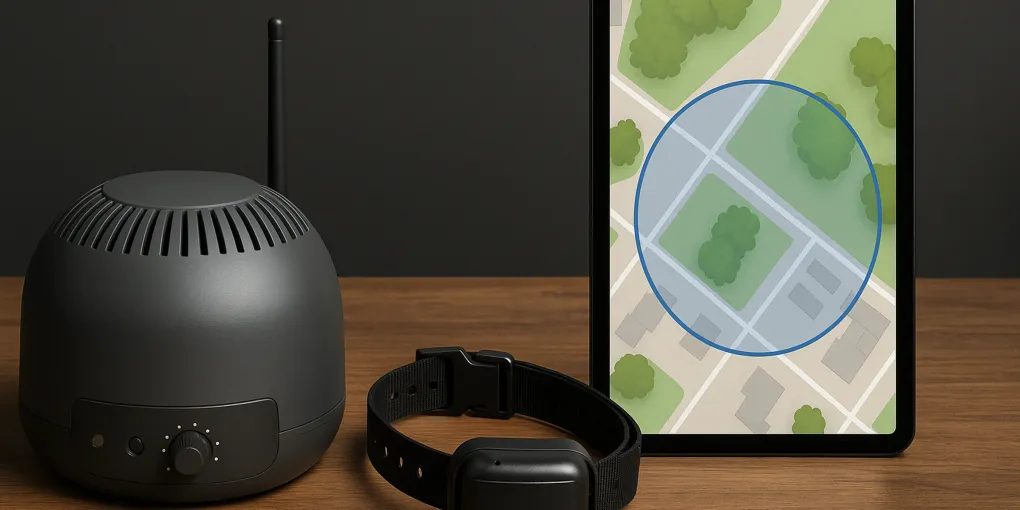
PetSafe Stay & Play Wireless Fence
Best OverallCoverage: Up to ~3/4 acre (circular)
~$299–$349
Quick Comparison
| Product | Key Specs | Price Range | Buy |
|---|---|---|---|
| |
| ~$299–$349 | Check Price |
| |
| ~$89–$149 | Check Price |
| |
| ~$999–$1,099 | Check Price |
| |
| ~$179–$249 | Check Price |
Contains affiliate links — we may earn a small commission at no extra cost to you.
Best Dog Wireless Fence in 2026
The best dog wireless fence for most suburban pet owners is the PetSafe Stay & Play Wireless Fence (PSR 4.6/5) — a radio-signal containment system that creates a circular boundary up to 3/4 acre in size with no digging, no wires, and no installation beyond plugging in the base transmitter and completing the included training program. For households that want GPS-based containment that works across multiple locations — vacation homes, parks, relatives’ yards — the Halo Collar 3 (PSR 4.5/5) is in a different class despite its premium price.
TL;DR
- Best Overall: PetSafe Stay & Play Wireless Fence — no-install, 3/4 acre circular boundary, tone-only mode (PSR 4.6/5)
- Best GPS-Based: Halo Collar 3 GPS Fence — custom shapes, 25 locations, force-free emphasis (PSR 4.5/5)
- Best Value Wired: Extreme Dog Fence Basic System — custom boundary shape, 18 correction levels, lowest cost (PSR 4.4/5)
- Best for Large Properties: SportDOG In-Ground Fence System — expandable to 100 acres, 10 correction levels (PSR 4.3/5)
What Separates a Good Dog Containment System from an Unreliable One
Every dog containment system in this category works on the same principle: a collar-mounted receiver detects when a dog approaches a defined boundary and delivers a warning stimulus — typically a tone or vibration first, then mild static correction if the dog continues. The differences that determine real-world reliability are more subtle.
Boundary stability is the first differentiator. Wireless radio-signal systems can experience interference from large metal structures, terrain changes, and dense building construction. An unstable signal creates unpredictable corrections that confuse dogs during training. In-ground wired systems and GPS systems are more geometrically precise, though GPS systems introduce their own accuracy variable in tree-heavy or urban environments.
Collar fit and contact quality is the most commonly underestimated factor. Reviews from containment system owners consistently show that fit-related failures — collar too loose to make consistent contact, or contact points misaligned — account for more containment failures than any product deficiency. All systems in this review provide detailed fit instructions; following them is not optional.
Training support separates products designed to actually work from products designed to sell. Systems that include structured flag-based training guides, tone-only introductory phases, and explicit guidance on correction level selection produce better outcomes than systems that just ship a collar and assume the owner will figure it out. This connects to why the Halo Collar’s collaboration with professional trainers is reflected in its Pet Comfort score.
PetSafe Stay & Play Wireless Fence — Best Overall
Key Specs
- Coverage: Up to ~3/4 acre circular boundary
- Correction levels: 5 static levels + tone-only mode
- Collar: Waterproof receiver collar, rechargeable
- Setup type: Wireless radio signal (base unit plugs into wall)
- Subscription: None required
PSR Composite Score Breakdown
| Criterion | Weight | Score | Weighted Score |
|---|---|---|---|
| Safety | 25% | 9.3 | 2.33 |
| Durability | 20% | 9.0 | 1.80 |
| Pet Comfort | 20% | 9.2 | 1.84 |
| Value for Money | 20% | 9.0 | 1.80 |
| Ease of Use | 15% | 9.4 | 1.41 |
| Composite | 9.18 → PSR 4.6/5 |
Safety (9.3): PetSafe’s Stay & Play includes a dedicated tone-only mode that allows owners to begin training with audible warnings only before introducing any static correction. The five static levels span a wide enough range that sensitive dogs can be contained effectively at low settings. The rechargeable waterproof collar removes the battery replacement variable from the safety equation — the collar maintains charge status indication so owners know when to recharge. PetSafe provides an explicit guide on collar fit (two-finger gap between contact points and skin) and recommends daily checks for contact point irritation during the first 30 days.
Durability (9.0): The base transmitter is designed for permanent indoor placement and reports of multi-year operation without failure are common in owner reviews. The collar’s waterproof rating holds up to rain and puddles across owner accounts from multiple seasons. Signal range consistency across different terrain types is the most frequently noted durability variable — large metal outbuildings, rolling terrain, and dense landscaping can reduce the usable circular radius below the rated 3/4 acre, but this is a physics constraint rather than a product failure.
Pet Comfort (9.2): The tone-first, static-second training approach produces a less stressful learning experience based on owner-reported behavioral observations during training. Most dogs learn the boundary within two to three weeks of structured training. Owner reports note that dogs who complete the training program properly rarely test the boundary after the initial training period — suggesting effective learning rather than just avoidance of correction. If you also use a dog activity tracker on your dog, you can verify that containment isn’t causing anxiety-driven reductions in activity levels post-training.
Value for Money (9.0): At $299–$349 with no subscription requirement, the PetSafe Stay & Play is the best no-recurring-cost wireless option in this review. Additional receiver collars for multiple dogs are available as accessories. The lack of subscription is a meaningful long-term cost advantage over GPS systems.
Ease of Use (9.4): Setup time is consistently reported at 20–30 minutes: plug in the base unit, set the boundary radius on the transmitter, place boundary flags, and begin the training program. No digging, no wire routing, no professional installation. The highest Ease of Use score in this review.
Pros
- No installation — plug-and-go setup
- Tone-only training mode
- No subscription required
- Rechargeable waterproof receiver collar
- Consistent brand support and replacement parts availability
Cons
- Circular boundary cannot accommodate irregular yard shapes
- Signal may be affected by large metal structures
- 3/4 acre maximum — not suitable for large rural properties
Halo Collar 3 GPS Fence — Best GPS-Based
Key Specs
- Coverage: Up to 25 custom GPS fence zones, any shape, any location
- Correction levels: Primarily audio and vibration feedback; static as last resort
- Collar: GPS + cellular, waterproof, activity tracking built-in
- Setup type: GPS-based smartphone app (no wires)
- Subscription: Required ($9.99–$29.99/mo depending on plan)
PSR Composite Score Breakdown
| Criterion | Weight | Score | Weighted Score |
|---|---|---|---|
| Safety | 25% | 9.4 | 2.35 |
| Durability | 20% | 9.1 | 1.82 |
| Pet Comfort | 20% | 9.3 | 1.86 |
| Value for Money | 20% | 8.0 | 1.60 |
| Ease of Use | 15% | 9.0 | 1.35 |
| Composite | 8.98 → PSR 4.5/5 |
Safety (9.4): The Halo Collar 3’s safety philosophy is genuinely differentiated from other containment systems. The correction hierarchy — audio first, then vibration, then static as a last resort — is designed to minimize stress-based correction. The GPS-based fence stores boundary data on the collar itself, meaning containment persists during brief connection interruptions rather than failing open (which would allow escape) or failing closed (which would randomly correct). The built-in activity tracking also helps owners detect anxiety behavior changes that might indicate training stress.
Durability (9.1): The Halo Collar 3 is a robust piece of hardware — GPS, cellular, accelerometer, correction system, and rechargeable battery in a waterproof collar. Owner reports from multiple climates describe the collar holding up through rain, mud, and light submersion. The subscription dependency is a durability concern of a different kind: if Halo as a company discontinues service, the GPS fence functionality would cease to work even if the hardware is intact. This is a real consideration for long-term ownership.
Pet Comfort (9.3): The highest Pet Comfort score in this review. The audio-primary correction approach produces the gentlest training experience. Owner reports note dogs completing the training program with less boundary-testing behavior and lower stress indicators (vocalization, panting, avoidance) compared to static-primary systems. The ability to use the same collar at a vacation home, a relative’s yard, or a park — with a custom fence drawn from a smartphone — dramatically reduces the stress of travel with dogs. If your dog wears this collar, many of the functions of a dedicated dog activity tracker are built in. The GPS tracking also overlaps with best smart GPS dog collar functionality.
Value for Money (8.0): The lowest Value score in this review. At $999–$1,099 for the collar plus $9.99–$29.99/month for subscription service, the Halo Collar 3 is a premium product priced accordingly. Over three years of ownership with a mid-tier subscription, the total cost of ownership exceeds $1,500. For multi-dog households, that cost multiplies per dog. The value justification is specifically for owners who need GPS-based multi-location containment — for single-location suburban containment, the PetSafe Stay & Play achieves similar results at a fraction of the cost.
Ease of Use (9.0): Drawing a custom GPS fence on the smartphone app is intuitive. Initial GPS calibration requires spending time at the property with the collar, and the training program (based on Cesar Millan’s methodology) is more structured than competitors. The app provides clear guidance, but the learning curve is steeper than wireless radio alternatives.
Pros
- GPS-based custom fence shapes — works at any location
- Up to 25 separate fence zones
- Audio-first correction approach
- Built-in GPS tracking and activity monitoring
- Retains fence data during brief connectivity interruptions
Cons
- Highest price in this review ($999–$1,099)
- Monthly subscription required
- GPS accuracy degrades under heavy tree cover
- Cost multiplies significantly for multi-dog households
Extreme Dog Fence Basic System — Best Value Wired
Key Specs
- Coverage: Custom boundary shape, standard kit covers approximately 500 feet of wire
- Correction levels: Up to 18 adjustable static levels
- Collar: Water-resistant receiver
- Setup type: Wired in-ground (DIY installation)
- Subscription: None
PSR Composite Score Breakdown
| Criterion | Weight | Score | Weighted Score |
|---|---|---|---|
| Safety | 25% | 8.8 | 2.20 |
| Durability | 20% | 9.0 | 1.80 |
| Pet Comfort | 20% | 8.6 | 1.72 |
| Value for Money | 20% | 9.5 | 1.90 |
| Ease of Use | 15% | 7.5 | 1.13 |
| Composite | 8.75 → PSR 4.4/5 |
Safety (8.8): With 18 correction levels — the widest adjustment range in this review — the Extreme Dog Fence allows extremely fine-tuned correction for dogs of different sizes and sensitivities. The wide range means a correction level appropriate for a stubborn 80-lb Rottweiler and a sensitive 12-lb Shih Tzu can both be achieved with the same system using different collars. The water-resistant (not fully waterproof) collar is a minor note — for dogs that swim, verifying submersion tolerance before use is advisable.
Durability (9.0): Once installed correctly, an in-ground wire system is highly durable. The transmitter lives indoors, the wire is buried and protected from weather, and there are no radio signal variables. Wire breaks from lawn aeration, tree root growth, or shovel strikes are the primary failure mode — but the transmitter will indicate a wire break immediately, and splice kits are inexpensive. Owner reports describe functioning systems 5–8 years post-installation. If you’ve also installed an electronic pet door in your home, you have a fully contained in/out system with the Extreme Dog Fence handling the yard perimeter.
Pet Comfort (8.6): The custom boundary shape is the primary Pet Comfort advantage — owners can design the wire path to keep dogs out of garden beds, away from pool areas, or limited to specific yard sections that an irregular-lot household requires. The 18-level correction range allows matching correction intensity to the individual dog. Training guides included with the system are comprehensive.
Value for Money (9.5): The highest Value score in this review. At $89–$149 with no subscription and no professional installation cost (for self-installers), the Extreme Dog Fence offers the most containment for the least money. Expansion wire kits are inexpensive. For straightforward rectangular or L-shaped yard containment where the owner is willing to spend a few hours on installation, the value is unmatched.
Ease of Use (7.5): The lowest Ease of Use score in this review, because installation requires burying wire along the intended boundary. This is not a professional-install requirement — many owners complete a typical suburban yard installation in one afternoon — but it is real work. Renters cannot use this system without landlord permission. For owners in those situations, wireless or GPS options are the practical choice.
Pros
- Lowest cost in this review ($89–$149)
- No subscription
- Custom boundary shapes for irregular lots
- 18 correction levels — widest adjustment range
- No signal interference from terrain or structures
Cons
- Requires wire installation (digging or stapling along boundary)
- Not suitable for renters
- Collar is water-resistant, not fully waterproof
- Wire breaks must be located and repaired
SportDOG In-Ground Fence System — Best for Large Properties
Key Specs
- Coverage: Up to 100 acres with wire expansion kits
- Correction levels: 10 static levels
- Collar: Waterproof, rated for submersion up to 25 feet
- Setup type: Wired in-ground
- Subscription: None
PSR Composite Score Breakdown
| Criterion | Weight | Score | Weighted Score |
|---|---|---|---|
| Safety | 25% | 8.6 | 2.15 |
| Durability | 20% | 9.1 | 1.82 |
| Pet Comfort | 20% | 8.3 | 1.66 |
| Value for Money | 20% | 8.8 | 1.76 |
| Ease of Use | 15% | 7.8 | 1.17 |
| Composite | 8.56 → PSR 4.3/5 |
Safety (8.6): SportDOG’s 10 correction levels provide meaningful adjustability, though the range skews toward higher correction output compared to competitors — it’s designed for hunting dogs and large stubborn breeds, not lap dogs. The fully waterproof collar (25-foot submersion rating) is the best weather protection in this review and suitable for dogs that swim in ponds, lakes, or drainage areas — common in large rural property contexts. Owner reports suggest starting at the lowest effective correction level and adjusting up only as needed.
Durability (9.1): The SportDOG system is engineered for farm and rural use where high-end durability matters. The transmitter handles large-acreage wire loops reliably. The collar’s extreme waterproof rating reflects field-use durability standards. Wire expansion kits let the same transmitter handle property additions without replacing core hardware. Owner reports from farms and ranches with 5–10+ year installations are common.
Pet Comfort (8.3): SportDOG’s Pet Comfort score reflects the orientation toward larger, more correction-tolerant dogs. The system works well for its intended use case — hunting breeds, working dogs, rural properties with livestock hazards — but the correction intensity range and lack of a dedicated vibration-only mode trail the PetSafe and Halo options for sensitive breeds. If monitoring your dog’s stress and wellness alongside their containment, pairing the SportDOG system with a smart pet health monitor helps track any behavioral changes during training.
Value for Money (8.8): At $179–$249 for a system expandable to 100 acres, the SportDOG is exceptional value for large properties. For suburban properties where 1/2 acre of containment is sufficient, the Extreme Dog Fence’s lower price is the better value. SportDOG earns its price point on rural acreage.
Ease of Use (7.8): Wire installation is required, same as Extreme Dog Fence. The SportDOG transmitter and collar programming are slightly more complex than basic wired systems, with more configuration options for multiple dogs and correction patterns. The additional features are genuinely useful for large-property situations but add setup time.
Pros
- Expandable to 100 acres — largest coverage in this review
- Waterproof collar rated to 25-foot submersion
- No subscription required
- Proven track record in farm and rural environments
Cons
- Wire installation required
- Correction range skews high — not ideal for sensitive breeds
- No vibration-only mode
- Overkill for suburban lots under 1 acre
Full Comparison Table
| Product | Badge | Price | Coverage | Setup Type | Subscription | PSR Score |
|---|---|---|---|---|---|---|
| PetSafe Stay & Play Wireless Fence | Best Overall | ~$299–$349 | 3/4 acre circular | Wireless radio | None | 4.6/5 |
| Halo Collar 3 GPS Fence | Best GPS-Based | ~$999–$1,099 | 25 custom GPS zones | GPS/app | $9.99–$29.99/mo | 4.5/5 |
| Extreme Dog Fence Basic System | Best Value Wired | ~$89–$149 | Custom shape, ~500 ft | Wired in-ground | None | 4.4/5 |
| SportDOG In-Ground Fence System | Best for Large Properties | ~$179–$249 | Up to 100 acres | Wired in-ground | None | 4.3/5 |
Which Dog Wireless Fence Is Right for You?
If you rent or want zero installation: PetSafe Stay & Play Wireless Fence. Set up in 30 minutes, remove when you move. The circular boundary limitation is the trade-off.
If you want GPS-based containment that works at multiple locations: Halo Collar 3. Worth the premium if you travel frequently with your dog or have multiple properties. Budget for the monthly subscription and understand GPS accuracy limitations in heavy tree cover.
If you own your home and have an irregular lot or want to save money: Extreme Dog Fence Basic System. Spend a Saturday on installation and you have a custom-shape, subscription-free containment system at the lowest cost in this review.
If you have a large rural property or working dogs: SportDOG In-Ground Fence System. The 100-acre expandability and extreme waterproof collar rating are designed for exactly this use case.
Frequently Asked Questions
How long does it take to train a dog to respect an invisible fence?
Owner reports and manufacturer guidelines consistently point to a 2–4 week training period using flag markers, supervised boundary introductions, and positive reinforcement. Rushing the training period is the primary cause of invisible fence failures. High-energy and working breeds may require additional time.
Do wireless fences work on all property shapes?
Wireless radio-signal fences create a roughly circular boundary. In-ground wired systems allow any custom shape. GPS systems like the Halo Collar 3 allow custom polygon shapes drawn on a smartphone map — the most flexible option for irregular properties.
Is a wireless dog fence humane?
When properly fitted and trained, systems with multiple correction levels including tone-only and vibration modes are used successfully by millions of households. Collar fit is critical: a collar worn too loosely creates inconsistent feedback that is both ineffective and stressful. Follow manufacturer fitting guidelines carefully and begin training with the lowest effective correction level.
Can multiple dogs use the same wireless fence system?
Yes — PetSafe, Extreme Dog Fence, and SportDOG all support additional receiver collars on the same system. The Halo Collar 3 requires a separate collar and subscription for each dog, which significantly increases multi-dog costs.
What happens if the power goes out?
Wireless radio fence transmitters lose their boundary signal during power outages. In-ground wired systems also lose signal. The Halo Collar 3 stores fence data on the collar itself and maintains GPS-based containment during brief connectivity interruptions — making it the most resilient option during power interruptions.
Final Verdict
For most suburban homeowners, the PetSafe Stay & Play Wireless Fence offers the best combination of no-install simplicity, genuine safety features (tone-only mode, waterproof collar), and no ongoing subscription cost. The Halo Collar 3 earns its premium for the specific use case of GPS-based multi-location containment. Budget-conscious homeowners willing to install wire should look at the Extreme Dog Fence — it consistently delivers the most containment per dollar. Large-property rural owners will find the SportDOG system is purpose-built for exactly their needs. Regardless of which system you choose, one point from all four manufacturers deserves emphasis: the training period is not optional, and it is not shortened by a stronger correction setting. Time invested in proper boundary training produces reliable, long-term containment.
Frequently Asked Questions
- Owner reports and manufacturer guidelines consistently point to a 2–4 week training period using flag markers, supervised boundary introductions, and positive reinforcement. Rushing or skipping the training period is the primary cause of invisible fence failures — the correction alone is not a substitute for the dog understanding where the boundary is. High-energy and working breeds may require additional training time beyond the standard window.
- Wireless radio-signal fences (like PetSafe Stay & Play) create a roughly circular boundary centered on the base unit. This works well for open yards but cannot accommodate L-shaped yards, properties with outbuildings in the middle, or lots where you want to exclude specific areas. In-ground wired systems (Extreme Dog Fence, SportDOG) allow any custom shape. GPS systems (Halo Collar 3) allow custom polygon shapes drawn on a smartphone map.
- When properly fitted and trained, containment systems with multiple correction levels — including tone-only and vibration modes — are used successfully by millions of households. Collar fit is critical: a collar worn too loosely will not make consistent contact and may cause repeated corrections as the dog approaches the boundary without receiving consistent feedback, which is both ineffective and stressful. All systems in this review include tone-only and/or vibration-only modes for sensitive dogs.
- Yes. All systems reviewed here support multiple receiver collars on the same transmitter or wire system. PetSafe, Extreme Dog Fence, and SportDOG sell additional collars as accessories. The Halo Collar 3 requires a separate collar (and subscription) for each dog, which significantly increases the cost for multi-dog households.
- Wireless radio fence transmitters (PetSafe Stay & Play) lose their boundary signal immediately if power is cut — dogs are no longer contained. In-ground wired systems (Extreme Dog Fence, SportDOG) also lose signal during power outages. Halo Collar 3 stores fence data on the collar itself and maintains GPS-based containment during brief connectivity interruptions, making it the most power-outage-resilient option in this review.