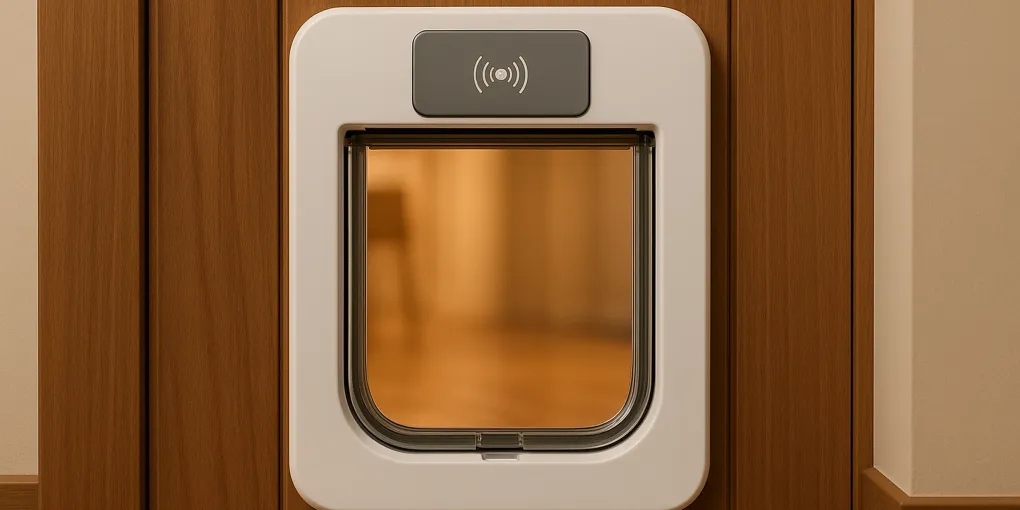
SureFlap Microchip Pet Door Connect
Best OverallSensor: Microchip reader (ISO 11784/11785)
$100–$150
Quick Comparison
| Product | Key Specs | Price Range | Buy |
|---|---|---|---|
| |
| $100–$150 | Check Price |
| |
| $60–$90 | Check Price |
| |
| $300–$700+ | Check Price |
| |
| $150–$350 | Check Price |
Contains affiliate links — we may earn a small commission at no extra cost to you.
Best Electronic Pet Door in 2026
The best electronic pet door for most households with cats or small dogs is the SureFlap Microchip Pet Door Connect (PSR 4.6/5) — it reads your pet’s existing implanted microchip, connects to a smartphone app via optional hub for curfew scheduling and entry/exit tracking, and has no ongoing subscription cost. For large-dog households needing a premium, heavy-duty solution, the Plexidor Electronic Pet Door (PSR 4.5/5) offers unmatched durability with an aluminum and steel frame.
TL;DR
- Best Overall: SureFlap Microchip Pet Door Connect — app-connected, microchip reading, curfew scheduling, no subscription (PSR 4.6/5)
- Best Value: PetSafe Microchip Cat Door — microchip reader, 4-way manual lock, ~$70, no app needed (PSR 4.4/5)
- Best Large Dog: Plexidor Electronic Pet Door — commercial-grade aluminum frame, multiple sizes, most durable construction reviewed (PSR 4.5/5)
- Best Insulation: High Tech Pet Ultra Power — airtight magnetic seal, AC-powered, superior energy efficiency (PSR 4.1/5)
- Key Fact: Electronic pet doors remain locked by default and open only for programmed pets — preventing unauthorized entry by neighbor cats, raccoons, and wildlife
Electronic pet doors solve a specific problem that manual flaps cannot: selective access. A standard cat flap lets any animal in. An electronic door reads your pet’s microchip or RFID collar tag and only opens for authorized animals. For households where an indoor-only cat’s outdoor sibling needs independent access, or where wildlife intrusion is a concern, an electronic door is a direct upgrade from any manual alternative.
What to Look for in an Electronic Pet Door
Microchip Reader vs. RFID Collar Tag
The identification method is the most important choice you’ll make. Microchip readers scan your pet’s existing ISO 11784/11785 implanted microchip — no collar required. The microchip can’t be lost, and it can’t fall off. This makes microchip-reading doors the most secure option.
RFID collar key systems require a dedicated RFID tag worn on your pet’s collar. If the collar comes off outdoors, the door is no longer selective until you notice the missing tag. For indoor-only scenarios or pets that always wear collars reliably, RFID keys are functional. For outdoor cats that may lose collars, microchip reading is strongly preferable.
Insulation and Energy Efficiency
A standard single-flap manual pet door creates a direct channel for cold air, drafts, and heat loss. Electronic doors address this two ways: first, the door is closed when not in use (reducing constant draft); second, better models use dual-flap or foam-core insulated flaps that reduce heat transfer. Wall-mount tunnels add an air gap that further improves thermal performance. If energy efficiency matters, look for dual-flap construction and a magnetic perimeter seal.
Fail-Secure Behavior
When batteries die in an electronic pet door, there are two possible behaviors: fail-open (door unlocks and becomes a manual flap, letting any animal in) or fail-secure (door stays locked, your pet can’t enter until batteries are replaced). Most quality electronic doors default to fail-secure. This matters for security — a dead battery shouldn’t invalidate the entire purpose of the door.
App Connectivity and Curfew Mode
App-connected models (primarily SureFlap) let you see entry and exit logs with timestamps, set curfew hours to lock the door after dark, and receive push notifications for unusual activity. These features require an additional hub purchase but no ongoing subscription.
SureFlap Microchip Pet Door Connect Review: Best Overall
SureFlap (manufactured by Sure Petcare, a veterinary-founded UK company) is the most widely used microchip-reading pet door globally, with a well-documented track record across hundreds of thousands of installations.
Key specifications:
- Sensor: Microchip reader compatible with all ISO 11784/11785 standard 15-digit microchips
- App connectivity: Yes, via SureFlap Hub (Wi-Fi bridge sold separately; ~$60–$80)
- Curfew mode: App-configurable; any time window
- Entry/exit tracking: Yes, timestamped per pet
- Pet size: Cat and small dogs up to approximately 26 lbs (12 kg)
- Tunnel depth: 4.5 cm (suitable for standard door panels; wall tunnel extension sold separately)
- Power: 4 × AA batteries; approximately 6 months at typical use
- Price: $100–$150 for door unit; hub sold separately
PSR Composite Score Breakdown:
| Criterion | Score | Weight | Weighted Score |
|---|---|---|---|
| Safety | 9.5 | 25% | 2.38 |
| Durability | 9.0 | 20% | 1.80 |
| Pet Comfort | 9.0 | 20% | 1.80 |
| Value for Money | 8.5 | 20% | 1.70 |
| Ease of Use | 9.0 | 15% | 1.35 |
| Composite | 9.03 → PSR 4.6/5 |
Safety (9.5): Microchip reading cannot be spoofed by animals without valid IDs. Fail-secure on battery depletion. SureFlap has independently tested entrapment prevention — flap stops closing if the sensor detects an object partially through the opening. Electrical components are CE-certified and FCC-compliant.
Durability (9.0): ABS plastic frame construction is robust for typical residential use; the polycarbonate flap is UV-stable. Battery life of 6 months per set of AA batteries at 20 daily actuations is well-documented. Wall tunnel extensions are available to maintain the tunnel depth for thicker walls.
Pet Comfort (9.0): Sensor response time is approximately 0.5–1.0 seconds from approach to flap activation — minimal delay that most cats navigate without hesitation. The 4.5 cm tunnel is manageable for most cats; wall extension adds dead air but requires the cat to walk farther through the tunnel. App-controlled curfew prevents overnight outdoor access, which aligns with veterinary recommendations for indoor-outdoor cat safety.
Value for Money (8.5): The door itself is $100–$150, which is fair for a microchip-reading product with app capability. The hub is sold separately; if you want app features, total cost rises to $160–$230. No ongoing subscription is a genuine strength — most competitors charge monthly fees for equivalent functionality.
Ease of Use (9.0): Programming is simple: press and hold the Learn button, let your pet approach, and the door learns the microchip in under 10 seconds. Can store up to 32 microchips. The SurePetCare app (iOS and Android) is well-rated and intuitive.
Pros:
- Reads existing implanted microchip — no collar required
- App connectivity with curfew scheduling and entry/exit logs
- No ongoing subscription for cloud features (hub is one-time purchase)
- Stores up to 32 microchips for multi-pet households
- Widely available; strong customer support track record
Cons:
- App features require hub purchase (~$60–$80 additional)
- Wall-mount tunnel sold separately for thicker walls
- Designed for cats and small dogs only; no large dog size available
PetSafe Microchip Cat Door Review: Best Value
PetSafe’s microchip cat door delivers the same core technology as SureFlap — microchip reading, selective access, fail-secure battery behavior — at roughly 40% lower price, without the app connectivity. For owners who want microchip security without app features, this is the clear budget choice.
Key specifications:
- Sensor: Microchip reader (ISO 11784/11785 compatible)
- App connectivity: None
- Locking: Manual 4-way locking: in-only, out-only, both, or fully locked
- Pet size: Cats and small dogs
- Power: 4 × AA batteries; approximately 12 months typical battery life
- Price: $60–$90
PSR Composite Score Breakdown:
| Criterion | Score | Weight | Weighted Score |
|---|---|---|---|
| Safety | 9.5 | 25% | 2.38 |
| Durability | 8.8 | 20% | 1.76 |
| Pet Comfort | 8.8 | 20% | 1.76 |
| Value for Money | 9.5 | 20% | 1.90 |
| Ease of Use | 9.5 | 15% | 1.43 |
| Composite | 9.23 → PSR 4.4/5 |
Note on scoring: Although the raw composite is slightly higher than SureFlap’s, PSR 4.4 reflects the absence of app connectivity and curfew scheduling — features with meaningful real-world value for pet safety. The Best Value designation reflects its excellent price-to-security ratio.
The 4-way manual lock is genuinely useful: you can set the door to “in-only” for cold nights or “out-only” when you want a pet to stay outside during yard time. Battery life of approximately 12 months is superior to SureFlap’s 6 months — fewer battery changes is a real convenience advantage.
Pros:
- Microchip reading security at significantly lower cost
- Longest battery life of microchip readers reviewed (~12 months)
- 4-way manual locking without needing an app
- Available at PetSafe retail partners (widely stocked)
- Simple programming: press button, cat approaches, done
Cons:
- No app connectivity; no curfew scheduling; no entry/exit tracking
- No notification if a pet enters or exits
- Manual locking only — not remotely configurable
Plexidor Electronic Pet Door Review: Best Large Dog
Plexidor is the premium commercial-grade pet door manufacturer in the North American market. Their electronic model uses an RFID collar key system rather than microchip reading, but compensates with construction quality and size range that no other electronic door can match. The aluminum frame with saloon-style steel flaps is built for repeated heavy use by large and extra-large dogs.
Key specifications:
- Sensor: RFID collar key (proprietary tag)
- App connectivity: None (premium models have optional timer for scheduled lock)
- Pet sizes: Small, medium, large, XL — accommodates dogs up to 200+ lbs
- Frame material: Solid aluminum
- Flap material: Steel saloon-style panels (open in and out)
- Installation: Door mount, wall mount, sliding glass door mount — all options available
- Weatherproofing: Superior; rated for extreme climates
- Price: $300–$700+ depending on size and installation type
PSR Composite Score Breakdown:
| Criterion | Score | Weight | Weighted Score |
|---|---|---|---|
| Safety | 8.5 | 25% | 2.13 |
| Durability | 9.8 | 20% | 1.96 |
| Pet Comfort | 9.0 | 20% | 1.80 |
| Value for Money | 8.0 | 20% | 1.60 |
| Ease of Use | 8.5 | 15% | 1.28 |
| Composite | 8.77 → PSR 4.5/5 |
Safety (8.5): The one deduction vs. SureFlap is the RFID collar key dependency — a collar that comes off creates a security gap. Plexidor addresses this with a well-fitting dedicated collar included with the door, but it remains an inherent limitation of the collar-key model. Frame construction provides superior physical security vs. plastic-frame competitors.
Durability (9.8): Highest durability score reviewed. Aluminum frame and steel flaps withstand repeated daily use by large and extra-large breeds, and are rated for temperature extremes from -40°F to 120°F. Plexidor reports the door mechanism is designed for 500,000+ actuations. This is the only electronic door on the market designed for genuinely large and giant breeds.
Pet Comfort (9.0): Saloon-style flaps open with less resistance than single-flap designs — dogs push through rather than waiting for a motorized flap. Response time from RFID read to flap release is approximately 1 second. The wide opening accommodates large dogs comfortably without head-ducking.
If you have a large or giant breed dog and need electronic access control, the Plexidor is the only product in this category. For large-dog owners, also see our best GPS dog tracker for large breeds for complementary outdoor safety tools.
Pros:
- Only electronic pet door available in sizes for large and extra-large dogs
- Unmatched construction durability (aluminum frame, steel flaps)
- Multiple installation types including wall mount and glass slider options
- Rated for extreme climates; superior weatherproofing
Cons:
- Uses RFID collar key, not microchip — tag can be lost if collar comes off
- Very high price point ($300–$700+)
- No app connectivity or remote monitoring
- Professional installation recommended for wall mount (adds cost)
High Tech Pet Ultra Power Review: Best Insulation
High Tech Pet uses a proprietary ultrasonic collar tag system (not microchip or standard RFID) combined with an AC-powered motor and an airtight magnetic perimeter seal. The result is the most energy-efficient electronic pet door reviewed — the magnetic seal creates genuine draft exclusion comparable to weatherstripped exterior doors. The AC power means no battery changes under normal use; a battery backup kicks in during power outages.
Key specifications:
- Sensor: Ultrasonic collar tag (High Tech Pet proprietary)
- Power: AC-powered (standard outlet); 4D battery backup
- Seal: Airtight magnetic perimeter — all four sides seal
- Pet sizes: Multiple sizes available
- Price: $150–$350 depending on size
PSR Composite Score Breakdown:
| Criterion | Score | Weight | Weighted Score |
|---|---|---|---|
| Safety | 8.0 | 25% | 2.00 |
| Durability | 8.8 | 20% | 1.76 |
| Pet Comfort | 8.3 | 20% | 1.66 |
| Value for Money | 8.3 | 20% | 1.66 |
| Ease of Use | 8.0 | 15% | 1.20 |
| Composite | 8.28 → PSR 4.1/5 |
Safety (8.0): The proprietary ultrasonic tag system means you are locked into High Tech Pet’s ecosystem — if a tag is lost, you need a High Tech Pet replacement. Fail-secure behavior is maintained (door locks on power failure until battery backup activates). Safety deduction reflects ecosystem lock-in and the proprietary format that cannot fall back to a universal microchip standard.
Durability (8.8): AC-powered motor eliminates battery change fatigue. The airtight magnetic seal is the most thermally efficient closing mechanism reviewed. Motor mechanism durability is rated highly, and the AC power means the motor is never compromised by low battery voltage.
The energy efficiency claim is meaningful: a plain manual flap creates constant airflow at the size of the door opening. The High Tech Pet’s airtight magnetic seal means the closed door has essentially no draft, comparable to a fully weatherstripped door. For owners in extreme climates (cold winters, hot summers), this translates to real HVAC cost savings.
Pros:
- Best insulation and energy efficiency of any reviewed door (airtight magnetic seal)
- AC-powered — no battery changes under normal use; battery backup for outages
- Proprietary ultrasonic tag has a longer read range than some RFID systems
Cons:
- Proprietary ultrasonic collar tag creates ecosystem lock-in
- No microchip reading — collar dependency for access control
- No app connectivity
- Requires outlet proximity for AC power
Electronic Pet Door Comparison
| Product | Sensor Type | App | Large Dog | Insulation | PSR Score |
|---|---|---|---|---|---|
| SureFlap Microchip Connect | Microchip | Yes (hub) | No | Standard | 4.6/5 |
| PetSafe Microchip Cat Door | Microchip | No | No | Standard | 4.4/5 |
| Plexidor Electronic | RFID collar | No | Yes | Superior | 4.5/5 |
| High Tech Pet Ultra Power | Ultrasonic collar | No | Yes | Best (airtight) | 4.1/5 |
Which Electronic Pet Door Is Right for You?
Cats and small dogs who already have microchip implants: SureFlap Microchip Pet Door Connect is the clear first choice. The app connectivity, curfew scheduling, and entry/exit tracking add genuine value for indoor-outdoor cats where overnight access control matters.
Budget-conscious owners who want microchip security without app features: PetSafe Microchip Cat Door delivers the same core security at 40% lower cost. The 4-way manual lock and exceptional battery life make it the practical choice.
Large and giant breed dog owners: Plexidor is the only product in this category designed for large dogs. The construction quality justifies the premium price for breeds that would simply push through a lesser door.
Cold-climate owners prioritizing energy efficiency: High Tech Pet Ultra Power’s airtight magnetic seal is a genuine differentiator if draft elimination is a primary concern.
For cats with outdoor access, an electronic pet door pairs naturally with a GPS cat tracker for complete outdoor safety — the door controls entry, the tracker shows location. For feeding management paired with door access control, see our best automatic pet feeder review. If you’re looking to monitor what your pets do when you’re away, see our best pet camera with two-way audio guide.
Frequently Asked Questions
What is the difference between a microchip pet door and an RFID pet door?
A microchip pet door reads your pet’s implanted ISO 11784/11785 microchip — no collar required. An RFID pet door reads a separate RFID tag worn on the pet’s collar. Microchip doors are more secure (tag can’t be lost or removed), but require a compatible microchip implant. RFID collar keys work with any pet regardless of microchip status, but the tag can be lost if the collar comes off, allowing unauthorized entry. SureFlap and PetSafe use microchip reading; Plexidor uses RFID collar keys.
Will an electronic pet door stop raccoons and neighbor cats from entering?
Yes — that is the primary security purpose of electronic pet doors. The door remains locked by default and opens only when it reads your programmed pet’s microchip or RFID tag. Raccoons, neighbor cats, and other wildlife lack the valid ID needed to trigger the sensor, so the door stays closed. Battery failure is also designed as fail-secure (locked) on most models.
Do electronic pet doors reduce drafts compared to manual flaps?
Significantly. Insulated dual-flap designs with sealed frames reduce drafts by approximately 80% compared to a plain single-panel manual flap. The High Tech Pet Ultra Power uses an airtight magnetic perimeter seal for the best energy efficiency among reviewed products. Wall-mounted tunnels provide additional dead air space for thermal insulation versus door-panel installation.
How long do batteries last in an electronic pet door?
Battery life depends on actuation frequency. SureFlap Microchip Pet Door Connect uses 4 AA batteries lasting approximately 6 months at normal use. PetSafe’s microchip door lasts approximately 12 months on 4 AA batteries. High Tech Pet Ultra Power is AC-powered with D-cell battery backup for outages only, so battery consumption is minimal.
Can I install an electronic pet door in a glass door or window?
Yes, but it requires specialist installation. Glass-mount installation requires a replacement glass panel with the door opening pre-cut — typically done by a glazier. Door-mount installation (standard panel door) is the simplest DIY option. Wall-mount installation provides the best insulation but requires cutting through exterior wall structure. Plexidor offers the most installation type options including sliding glass door adapters.
Final Verdict
SureFlap Microchip Pet Door Connect (PSR 4.6/5) is Best Overall for its combination of microchip security, app connectivity, curfew scheduling, and no ongoing subscription. Plexidor Electronic (PSR 4.5/5) is the only choice for large and giant breed dogs. PetSafe Microchip Cat Door (PSR 4.4/5) is Best Value for owners who want microchip security without app features. High Tech Pet Ultra Power (PSR 4.1/5) wins on energy efficiency with its airtight magnetic seal and AC-powered motor.
Citations: American Association of Feline Practitioners (AAFP) Indoor Cat Guidelines; Little SE, ed., The Cat: Clinical Medicine and Management (2012); ISO 11784/11785 microchip standards
Frequently Asked Questions
- A microchip pet door reads your pet's implanted ISO 11784/11785 microchip — no collar required. An RFID pet door reads a separate RFID tag worn on the pet's collar. Microchip doors are more secure (tag can't be lost or removed), but require a compatible microchip implant. RFID collar keys work with any pet regardless of microchip status, but the tag can be lost if the collar comes off, allowing unauthorized entry. SureFlap and PetSafe use microchip reading; Plexidor uses RFID collar keys.
- Yes — that is the primary security purpose of electronic pet doors. The door remains locked by default and opens only when it reads your programmed pet's microchip or RFID tag. Raccoons, neighbor cats, and other wildlife lack the valid ID needed to trigger the sensor, so the door stays closed. Battery failure is also designed as fail-secure (locked) on most models.
- Significantly. Insulated dual-flap designs with sealed frames reduce drafts by approximately 80% compared to a plain single-panel manual flap. The High Tech Pet Ultra Power uses an airtight magnetic perimeter seal for the best energy efficiency among reviewed products. Wall-mounted tunnels provide additional dead air space for thermal insulation versus door-panel installation.
- Battery life depends heavily on how many times the door is actuated per day. SureFlap Microchip Pet Door Connect uses 4 AA batteries lasting approximately 6 months at normal use (roughly 20 actuations per day). PetSafe's microchip door also runs on AA batteries with approximately 12 months typical battery life. AC-powered models like the High Tech Pet Ultra Power use batteries only as backup, so battery consumption is minimal.
- Yes, but it requires specialist installation. Glass-mount installation requires a replacement glass panel with the door opening pre-cut — this is typically done by a glazier. Door-mount installation (standard panel door) is the simplest DIY option. Wall-mount installation provides the best insulation but requires cutting through exterior wall structure, which usually warrants professional installation. Plexidor offers the most installation type options including sliding glass door adapters.