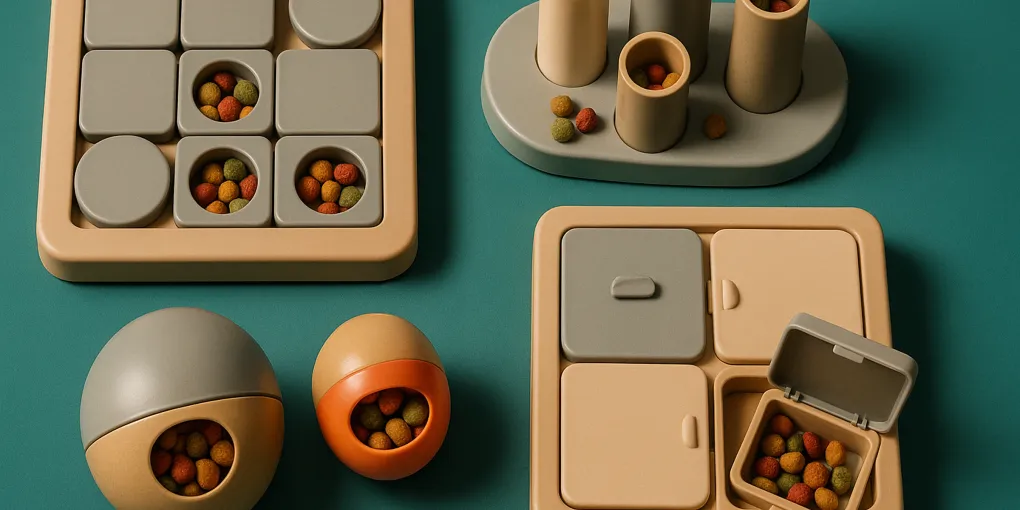
TRIXIE 5-in-1 Activity Center
Best OverallDifficulty: Level 1–2
$25–$35
Quick Comparison
| Product | Key Specs | Price Range | Buy |
|---|---|---|---|
| |
| $25–$35 | Check Price |
| |
| $18–$28 | Check Price |
| |
| $8–$14 | Check Price |
| |
| $22–$32 | Check Price |
Contains affiliate links — we may earn a small commission at no extra cost to you.
Best Cat Puzzle Toys in 2026
The best cat puzzle toy for most indoor cats is the TRIXIE 5-in-1 Activity Center (PSR 4.5/5), which provides five distinct activity types requiring different manipulation techniques — sliding, lifting, pawing, and reaching — in a single BPA-free dishwasher-safe unit appropriate for cats at all experience levels. For cats new to puzzle feeding, the OurPets IQ Treat Ball (PSR 4.0/5) is the correct starting point — a Level 1 rolling dispenser that builds positive puzzle associations before advancing to multi-compartment challenges.
TL;DR
- Best Overall: TRIXIE 5-in-1 Activity Center — 5 activity types, BPA-free, Level 1–2 challenge (PSR 4.5/5)
- Best for Slow Feeding: Catit Senses 2.0 Digger — tube design for single-paw retrieval, excellent portion control (PSR 4.3/5)
- Best for Beginners: OurPets IQ Treat Ball — rolling Level 1 dispenser, best entry point for puzzle-naive cats (PSR 4.0/5)
- Best Advanced: Nina Ottosson Buggin Out — 16 compartments with flip/slide mechanisms (PSR 4.2/5)
- Key Stat: 100% of cats in a 30-cat study showed behavioral improvement after puzzle introduction — including increased activity, reduced inter-cat tension, and reduced anxiety behaviors (Dantas LMS et al., 2016, PMID: 27154446)
Indoor cats are deprived of the cognitive demands of hunting — the stalking, problem-solving, and effort-before-reward structure of natural predatory behavior. Puzzle feeders restore that structure by requiring manipulation to access food. The AAFP and ISFM feline environmental guidelines identify food puzzles as a primary enrichment strategy for indoor cats, addressing the play/predatory opportunity need documented as one of five key environmental requirements for indoor cat welfare (Ellis SL et al., 2013, PMID: 23603504).
What Makes a Good Cat Puzzle Toy?
Three design factors determine whether a cat will engage with a puzzle toy:
1. Appropriate difficulty: Start at Level 1 (open access or rolling dispenser). Cats confronted with too-complex puzzles don’t problem-solve — they walk away and return to begging. A positive first experience is more important than a challenging one.
2. Food-grade materials: Cats eat from puzzle toys. BPA-free, dishwasher-safe materials are non-negotiable for daily use. Check that the bowl opening used for loading doesn’t allow residue to accumulate in areas that can’t be cleaned.
3. Stability during use: Puzzle toys that slide across the floor during use frustrate cats. Rubber feet or sufficient weight prevents displacement during active pawing.
TRIXIE 5-in-1 Activity Center Review: Best Overall
The TRIXIE 5-in-1 provides the widest range of activity types in a single unit, covering the full spectrum from beginner-accessible to intermediate challenge within one product.
Key specifications:
- 5 activity types: sliding tunnels, peg board with lift pegs, rotating disc, hole board, and treat wells
- Material: BPA-free ABS plastic; non-skid base
- Dimensions: approximately 15 × 11 inches
- Dishwasher safe; no adhesives in food-contact zones
PSR Composite Score Breakdown:
| Criterion | Score | Weight | Weighted Score |
|---|---|---|---|
| Safety & Ingredients | 9.0 | 25% | 2.25 |
| Durability & Build Quality | 9.0 | 20% | 1.80 |
| Pet Comfort & Acceptance | 9.2 | 20% | 1.84 |
| Value for Money | 9.0 | 20% | 1.80 |
| Ease of Use | 8.4 | 15% | 1.26 |
| Composite | 8.95 → PSR 4.5/5 |
Pet Comfort & Acceptance (9.2): Multiple activity types ensure that different paw-use preferences are accommodated in one device. Owner reports note that cats who reject single-format puzzles often engage with the 5-in-1 because there’s always one activity type that matches their natural exploratory style.
Ease of Use (8.4): Loading five different compartment types adds loading time compared to single-format puzzles. Cleaning is straightforward for most compartments; the rotating disc requires hand-washing to clear food residue from pivot points.
Pros:
- 5 distinct activity types in one unit
- BPA-free; dishwasher safe
- Non-skid base
- Accommodates kibble and treats of varying sizes
- Good starter-to-intermediate difficulty range
Cons:
- Rotating disc pivot requires manual cleaning
- Larger footprint than single-format puzzles
- Not suitable as a solo unit for very advanced puzzlers
Catit Senses 2.0 Digger Review: Best for Slow Feeding
The Catit Digger uses vertical tubes of varying depths that require cats to use a single paw to retrieve food — the closest analog to fishing prey from a burrow of any mass-market puzzle toy.
Key specifications:
- 5 tubes of varying depths (longest ~4 inches deep)
- Tube diameter: ~1.5 cm — appropriate for single adult cat paw
- Material: BPA-free ABS plastic; top-rack dishwasher safe
- Connects to Catit Senses 2.0 system (modular with other Catit products)
PSR Composite Score Breakdown:
| Criterion | Score | Weight | Weighted Score |
|---|---|---|---|
| Safety & Ingredients | 9.0 | 25% | 2.25 |
| Durability & Build Quality | 8.6 | 20% | 1.72 |
| Pet Comfort & Acceptance | 8.8 | 20% | 1.76 |
| Value for Money | 8.8 | 20% | 1.76 |
| Ease of Use | 8.0 | 15% | 1.20 |
| Composite | 8.69 → PSR 4.3/5 |
Pet Comfort & Acceptance (8.8): The tube format engages strong-paw cats who have mastered rolling dispensers. The varying tube depths create graduated difficulty within a single device. Owner reports note that cats who love to “fish” for toys under furniture particularly take to the Digger format.
Ease of Use (8.0): Tubes are the harder-to-clean format — food residue in deep tubes requires bottle-brush cleaning or top-rack dishwasher cycling. Not the best choice for owners who want minimal cleanup.
Pros:
- Tube format engages fishing/reaching predatory instinct
- Varying depths for graduated challenge
- Integrates with Catit Senses 2.0 system
- Good portion control for dry food feeding
Cons:
- Deep tubes require thorough cleaning
- Small kibble may fall past tube openings and need shaking out
- Single-paw interaction style may not suit all cats
OurPets IQ Treat Ball Review: Best for Beginners
The IQ Treat Ball is the standard Level 1 puzzle toy recommended as the starting point for all cats new to puzzle feeding — the cat bats and rolls the ball, and treats dispense from an adjustable hole.
Key specifications:
- Rolling ball dispenser with adjustable opening
- Material: BPA-free polypropylene; top-rack dishwasher safe
- Diameter: ~3 inches — appropriate for adult cats
- No assembly required
PSR Composite Score Breakdown:
| Criterion | Score | Weight | Weighted Score |
|---|---|---|---|
| Safety & Ingredients | 9.2 | 25% | 2.30 |
| Durability & Build Quality | 8.0 | 20% | 1.60 |
| Pet Comfort & Acceptance | 8.2 | 20% | 1.64 |
| Value for Money | 9.5 | 20% | 1.90 |
| Ease of Use | 9.2 | 15% | 1.38 |
| Composite | 8.82 → PSR 4.0/5 |
Value for Money (9.5): At $8–$14, the IQ Treat Ball is by far the most affordable entry point into puzzle feeding. As a starting tool for building puzzle motivation, it delivers full functional value at minimal cost.
Pet Comfort & Acceptance (8.2): Not all cats engage with rolling dispensers — cats that prefer sitting still tend to bat at stationary puzzles rather than chasing rolling balls. Rolling format suits active, chase-motivated cats better than more deliberate puzzlers.
Pros:
- Best price in category ($8–$14)
- Level 1 — correct starting point for all new puzzle cats
- Dishwasher safe
- Adjustable opening for size control
Cons:
- Single activity type limits long-term engagement
- Not suitable as sole puzzle for cats who advance beyond Level 1
- Rolling format not preferred by all cats
Nina Ottosson Buggin Out Review: Best Advanced Puzzle
Nina Ottosson’s Cat Puzzle is the benchmark advanced puzzle for cats who have mastered simpler formats — 16 compartments accessed via flip-top bugs and sliding mechanisms requiring multi-step problem solving.
Key specifications:
- 16 treat compartments (8 flip-access, 8 slide-access)
- Material: Non-toxic ABS plastic; top-rack dishwasher safe
- Dimensions: ~11 × 8 inches
- Level 2 difficulty — not appropriate as a first puzzle
PSR Composite Score Breakdown:
| Criterion | Score | Weight | Weighted Score |
|---|---|---|---|
| Safety & Ingredients | 8.8 | 25% | 2.20 |
| Durability & Build Quality | 8.6 | 20% | 1.72 |
| Pet Comfort & Acceptance | 8.4 | 20% | 1.68 |
| Value for Money | 8.6 | 20% | 1.72 |
| Ease of Use | 8.0 | 15% | 1.20 |
| Composite | 8.52 → PSR 4.2/5 |
Pet Comfort & Acceptance (8.4): High engagement for advanced-experience cats. Owner reports note that experienced puzzle cats spend 10–20 minutes per session on the Buggin Out vs. 2–5 minutes on simpler formats, significantly extending the cognitive enrichment window.
Ease of Use (8.0): 16 compartments to load and clean. The flip-top bug mechanisms are not dishwasher-resilient in long-term use — owners report hinge softening after extended dishwasher cycling; hand-washing is recommended.
Pros:
- 16 compartments — highest treat-holding capacity
- Two distinct mechanism types (flip + slide) for varied challenge
- Strong engagement for experienced puzzle cats
- Suitable for cats who have mastered Level 1 formats
Cons:
- Not suitable for puzzle-naive cats
- Flip-hinge durability with dishwasher use
- Higher price for a product that requires progression through Level 1 first
Puzzle Toy Comparison Table
| Product | Difficulty | Compartments | Material | Price | PSR Score |
|---|---|---|---|---|---|
| TRIXIE 5-in-1 Activity Center | Level 1–2 | 5 types | BPA-free ABS | $25–$35 | 4.5/5 |
| Catit Senses 2.0 Digger | Level 2 | 5 tubes | BPA-free ABS | $18–$28 | 4.3/5 |
| OurPets IQ Treat Ball | Level 1 | Rolling | BPA-free PP | $8–$14 | 4.0/5 |
| Nina Ottosson Buggin Out | Level 2 | 16 | Non-toxic ABS | $22–$32 | 4.2/5 |
Who Should Choose Which Puzzle?
TRIXIE 5-in-1 is the right choice for most owners — it serves as both a starter unit and a long-term enrichment tool as cats advance through the five activity types.
OurPets IQ Treat Ball is the correct first purchase for cats with no puzzle experience. Spend 2–4 weeks building engagement before adding a multi-compartment option.
Catit Digger suits cats that are intermediate puzzle users who particularly enjoy paw-retrieval type activities. Best paired with a second puzzle of a different format.
Nina Ottosson Buggin Out is for advanced-experience cats who have mastered Level 1 and Level 2 stationary formats and need a higher cognitive challenge.
For complete indoor enrichment, combine puzzle feeding with interactive wand toys, automatic cat toys, cat trees for climbing, cat window perches, and cat scratching posts. For cats needing physical exercise beyond puzzles, see our guide to cat exercise wheels. Pair enrichment with appropriate cat treats for puzzle loading, and see best cat food for indoor cats for diet considerations.
Frequently Asked Questions
Do cats actually use puzzle feeders?
Yes — when introduced correctly. Dantas LMS et al. (2016, PMID: 27154446) found all 30 cats in a study showed measurable behavioral improvements after puzzle introduction. The key is starting at Level 1 and using high-value food to build positive associations.
Are puzzle toys safe for cats?
Most commercial cat puzzle toys use BPA-free, food-grade ABS plastic and are dishwasher safe. Check that openings don’t pose entrapment risk and there are no small detachable parts. Supervise initial use with any new puzzle toy.
How often should I use a puzzle feeder with my cat?
Puzzle feeders can replace regular food bowls for all or part of daily meals. Start with one meal per day and build to full-time puzzle feeding over 2–4 weeks per the ISFM recommendation.
What difficulty level should I start with?
Always start at Level 1 regardless of how food-motivated your cat appears. The positive first experience matters more than an immediate challenge. Move to Level 2 after 2 weeks of confident Level 1 engagement.
Can puzzle toys help with weight management?
Puzzle feeders extend meal duration and increase activity during feeding, which supports weight management as part of a calorie-controlled diet. They are not a substitute for appropriate portion control but are a useful adjunct.
Frequently Asked Questions
- Yes — when introduced correctly. Dantas LMS et al. (2016, PMID: 27154446) found all 30 cats in a study showed measurable improvements in behavior after food puzzle introduction. The key is starting at the easiest level (open trays or rolling balls) and using high-value food or treats to build initial motivation. Frustration from starting at too difficult a level is the primary reason cats appear to reject puzzle feeders.
- Most commercial cat puzzle toys from reputable brands use BPA-free, food-grade ABS plastic and are dishwasher safe. Check that opening sizes do not pose paw entrapment risk for your cat's size, and that there are no small detachable parts. Avoid puzzles with sharp edges or solvent-based adhesives. Supervise initial use with any new puzzle toy.
- Puzzle feeders can replace regular food bowls for all or part of your cat's daily meals. The ISFM recommends puzzle feeding as part of the daily enrichment routine for indoor cats. Starting with one meal per day in a puzzle feeder and building to full-time puzzle feeding over 2–4 weeks is the standard protocol.
- Start at Level 1 (open containers, rolling balls, muffin tins) for 1–2 weeks regardless of how food-motivated your cat appears. The Ohio State University Indoor Pet Initiative difficulty ladder starts all cats at Level 1 to build positive associations with puzzle interaction before introducing resistance. Jumping to Level 2 or 3 before the cat is confident at Level 1 causes avoidance.
- Puzzle feeders extend meal duration and increase physical activity during feeding, which helps with weight management as part of a calorie-controlled diet. They are not a substitute for appropriate caloric restriction in overweight cats, but the increased energy expenditure from puzzle interaction and the slower eating rate (which improves satiety signaling) make puzzle feeding a useful adjunct to feline weight management.