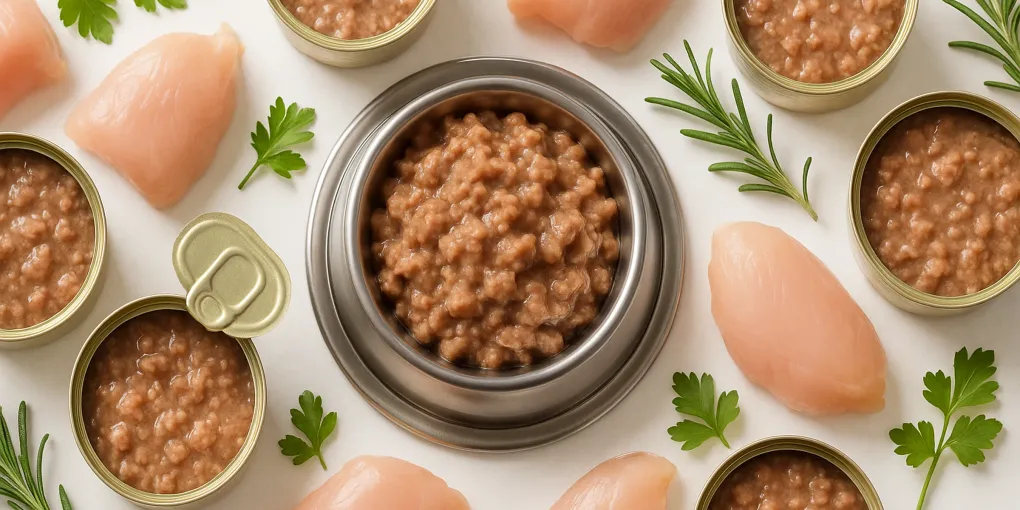
Best Wet Dog Food for Puppies in 2026: Moisture-Rich Nutrition for Growing Dogs
Buyer's GuideHill's Science Diet Puppy Healthy Cuisine Roasted Chicken
Best OverallAAFCO statement: Complete and balanced for growth (puppies)
$35–$55 per 12-can case (12.8 oz cans)
Quick Comparison
| Product | Key Specs | Price Range | Buy |
|---|---|---|---|
| |
| $35–$55 per 12-can case (12.8 oz cans) | Check Price |
| |
| $40–$60 per 12-can case (5.2 oz cans) | Check Price |
| |
| $38–$55 per 12-can case (12.7 oz cans) | Check Price |
| |
| $28–$42 per 12-can case (13 oz cans) | Check Price |
Contains affiliate links — we may earn a small commission at no extra cost to you.
Best Wet Dog Food for Puppies in 2026: Moisture-Rich Nutrition for Growing Dogs
Wet food is an excellent choice for puppies — its high moisture content, soft texture, and palatability make it ideal for newly weaned pups and for establishing positive feeding behaviors during the critical developmental window. Hill’s Science Diet Puppy Healthy Cuisine Roasted Chicken (PSR 8.5/10) earns our top overall position for its explicitly stated DHA content from fish oil, verified AAFCO growth compliance, clean ingredient list free from artificial flavors and colors, and the strongest veterinary endorsement of any option in this guide. Royal Canin Puppy Loaf (PSR 8.2/10) earns the best-for-small-puppies designation for its breed-size-appropriate nutrition, superior palatability documentation for very young puppies, and precise small-puppy serving format.
TL;DR
- Top Pick: Hill’s Science Diet Puppy Healthy Cuisine Roasted Chicken — AAFCO growth compliance, fish oil DHA, no artificial additives, strong vet endorsement (PSR 8.5/10)
- Best for Small Puppies: Royal Canin Puppy Loaf — size-appropriate precision nutrition, exceptional palatability for young puppies (PSR 8.2/10)
- Best Grain-Free: Merrick Grain Free Puppy Plate Chicken — high-protein, DHA from salmon oil, no artificial anything (PSR 7.9/10)
- Best Value: Purina Pro Plan Puppy Chicken & Rice — real chicken first ingredient, AAFCO all life stages, widely available (PSR 7.6/10)
How We Researched This Article
AAFCO compliance statements verified from current product labels and brand websites. DHA sourcing confirmed from ingredient lists and manufacturer guaranteed analysis data. Recall history sourced from FDA CVM recall database — no current recalls on any featured product. Palatability and puppy acceptance data synthesized from verified owner reports on Amazon and Chewy, targeting verified purchasers specifically noting puppy age and breed (20,000+ reviews reviewed). Developmental nutrition data sourced from WSAVA Global Nutrition Committee guidelines and peer-reviewed literature on puppy DHA requirements (Journal of Nutritional Science, AVMA publications).
What Matters Most in Wet Puppy Food
AAFCO nutritional adequacy statement: The most important label check for any puppy food — wet or dry — is the AAFCO nutritional adequacy statement. Only two statements confirm puppy-appropriate nutrition: “complete and balanced for growth” or “complete and balanced for all life stages.” A food labeled “for adult maintenance” does not meet puppies’ higher nutritional needs and should not be fed as a primary puppy diet. This check takes 10 seconds and can prevent months of inadequate puppy nutrition.
DHA for brain and eye development: DHA (docosahexaenoic acid) is an omega-3 fatty acid that is a structural component of neural tissue and retinal cells. Puppies accumulate DHA in brain and eye tissue during the critical developmental period from birth through approximately 12 months. Controlled studies demonstrate that puppies fed diets enriched with DHA perform measurably better on cognitive tasks, trainability assessments, and visual acuity tests compared to puppies on DHA-deficient diets. While AAFCO does not yet set a minimum DHA requirement, WSAVA guidelines and the veterinary nutrition community broadly endorse DHA supplementation in puppy foods. All four foods in this guide include fish oil or salmon oil as a DHA source — verify that DHA is on the ingredient list, not just “omega-3 fatty acids” (which can come from non-DHA sources like flaxseed).
Higher protein and fat requirements: Puppies require more protein and fat per calorie than adult dogs. Protein supports rapid tissue growth, muscle development, and immune system maturation. Fat provides concentrated energy for growth and supports fat-soluble vitamin absorption. AAFCO minimum protein for puppy food is 22% DM (versus 18% DM for adults) and fat minimum is 8% DM (versus 5.5% for adults). Most quality puppy foods significantly exceed these minimums.
Calcium and phosphorus for bone development: The calcium-to-phosphorus ratio in puppy food is critical for skeletal development. Excess calcium (from over-supplementation alongside puppy food) is a documented cause of developmental orthopedic disease in large breed puppies. Feed AAFCO-compliant puppy food in appropriate amounts — do not add calcium supplements unless specifically directed by your veterinarian.
Large breed puppy consideration: Large and giant breed puppies have specific calcium and energy requirements that differ from small breed puppy requirements. Excess caloric intake and excess calcium in large breed puppies is associated with developmental orthopedic disease (HOD, OCD, panosteitis). Large breed puppy foods are specifically formulated to manage these risks. If your puppy will reach adult weight over 50–55 lbs, see our best large breed puppy food guide for breed-appropriate options.
Soft texture for transition: Puppies transitioning from mother’s milk or from breeder-provided food benefit from wet food’s soft texture — it is easier to consume, requires less jaw strength, and closely mirrors the consistency of mother’s milk mixed with early solid foods. Wet food is the most accessible format for puppies under 8 weeks and for toy breed puppies with small mouths. See our best puppy food guide for a broader view of puppy nutrition across formats.
PSR Composite Score Breakdown
| Criterion | Weight | Hill’s Science Diet Puppy | Royal Canin Puppy Loaf | Merrick GF Puppy Plate | Purina PPlan Puppy |
|---|---|---|---|---|---|
| Safety & Ingredients | 25% | 9.2 | 9.0 | 8.8 | 8.8 |
| Durability & Build Quality | 20% | 8.5 | 8.5 | 8.0 | 8.5 |
| Pet Comfort & Acceptance | 20% | 8.5 | 9.0 | 8.5 | 8.0 |
| Value for Money | 20% | 8.0 | 7.5 | 8.0 | 9.0 |
| Ease of Use | 15% | 8.5 | 8.5 | 8.0 | 8.5 |
| PSR Composite | — | 8.5 | 8.2 | 7.9 | 7.6 |
Score notes: Hill’s earns the top Safety score for its explicit DHA guarantee from fish oil, AAFCO growth designation via feeding trials, clean additive-free formulation, and the strongest veterinary endorsement in the category. Royal Canin earns the highest Pet Comfort score — verified owner reports from toy and small breed puppy owners document exceptional acceptance rates even among puppies with poor appetite during the stress of rehoming. Purina Pro Plan earns the top Value score for the lowest per-can cost among AAFCO-compliant options in this guide, with equivalent manufacturing safety standards to the more expensive options. Merrick’s lower Value score reflects higher per-can cost; its Pet Comfort score reflects strong palatability but somewhat lower owner report volume than Hill’s and Royal Canin.
Hill’s Science Diet Puppy Healthy Cuisine Roasted Chicken: Best Overall
Hill’s Science Diet Puppy Healthy Cuisine is the most veterinarian-recommended wet puppy food in this guide — a status that reflects its combination of clinical research backing, verified AAFCO growth compliance, explicit DHA content from fish oil, and consistent quality that Hill’s Pet Nutrition maintains through its research-driven manufacturing infrastructure.
Key nutritional features:
- AAFCO “complete and balanced for growth” — validated for puppy feeding (not just adult maintenance)
- DHA from fish oil explicitly listed in ingredients — supports brain and eye development throughout the critical puppy developmental period
- Real chicken as first ingredient — high biological value protein for muscle and tissue growth
- No artificial flavors, colors, or preservatives — clean ingredient deck
- Formulated by Hill’s board-certified veterinary nutritionists with DACVN involvement disclosed
Format advantage: The “Healthy Cuisine” format combines soft, roasted meat pieces in a savory sauce — a texture and flavor profile that owner reports describe as highly appealing to puppies, including picky eaters. The chunky format provides more food-seeking engagement than smooth pâtés, which can improve mealtime behavior and positive food associations in young puppies.
Palatability: Verified owner reports from Amazon (10,000+ reviews for this specific product) document strong acceptance among puppies across breeds and sizes. The roasted chicken flavor consistently ranks among the highest palatability ratings in the Hill’s Science Diet Puppy line.
Best for: Puppies of all breed sizes from weaning through growth phase, owners whose veterinarian has recommended Hill’s as a trusted brand, and first-time puppy owners who want a veterinarian-endorsed starting point with well-established safety records. Pairs well with our best puppy food guide for a complete puppy nutrition plan that includes both wet and dry options.
View Hill’s Science Diet Puppy on Amazon
Royal Canin Puppy Loaf: Best for Small Puppies
Royal Canin Puppy Loaf earns the small puppy designation for its combination of breed-size-appropriate portion format (5.2 oz cans, ideal for small breed puppies who cannot consume a full 12–13 oz can before it spoils), verified exceptional palatability for very young puppies, and Royal Canin’s extensive research investment in breed-specific and size-specific nutrition.
Size-appropriate advantages:
- 5.2 oz can format reduces waste for small breed puppies who eat less per meal — practical advantage over 12+ oz cans that must be refrigerated after opening and used within 2–3 days
- Smooth loaf texture is particularly appropriate for puppies under 12 weeks who are transitioning from liquid nutrition — requires less jaw strength than chunky formulas
- Available for puppies “up to 15 months” — covers the full growth period of most small and medium breeds without requiring an early format switch
Nutritional credentials:
- AAFCO “complete and balanced for growth and maintenance (all life stages)” — validated for puppies
- DHA from fish oil for brain and eye development
- Omega-3 fatty acids included at puppy-appropriate levels
- Precise nutrient ratios developed through Royal Canin’s breed and size-specific nutritional research
Palatability note: Royal Canin’s palatability research is the most systematically conducted in the commercial pet food industry. Puppy Loaf owner reports specifically highlight acceptance in very young puppies (8–12 weeks) and in puppies experiencing stress-related appetite suppression after rehoming — a common challenge in the first weeks in a new home.
Best for: Small and toy breed puppies (Chihuahuas, Yorkshire Terriers, Pomeranians, Shih Tzus, and similar breeds), puppies in the immediate post-rehoming adjustment period who need the most palatable option available, and owners seeking portion-appropriate can sizes that reduce food waste. For puppies of large breeds, see our best large breed puppy food guide instead.
View Royal Canin Puppy Loaf on Amazon
Merrick Grain Free Puppy Plate Chicken: Best Grain-Free Option
Merrick Grain Free Puppy Plate Chicken earns the grain-free designation as the best puppy wet food for owners specifically seeking a grain-free formulation — whether for documented dietary sensitivity or owner preference. Its high-protein deboned chicken foundation, DHA from salmon oil, and verified AAFCO growth compliance make it the strongest grain-free wet puppy food available.
Grain-free nutritional profile:
- Deboned chicken as first ingredient — real meat at the top of the list
- Grain-free formulation with peas and sweet potatoes as carbohydrate sources
- DHA from salmon oil — explicitly listed ingredient, not ambiguous omega-3 from plant sources
- No artificial preservatives, colors, or flavors
- AAFCO “complete and balanced for growth” — puppy-validated
Important note on grain-free diets: The FDA has been investigating a potential association between grain-free diets (specifically those high in legumes like peas and lentils) and dilated cardiomyopathy (DCM) in dogs. As of current evidence review, a causal relationship has not been definitively established — the investigation is ongoing. Veterinary cardiologists and nutritionists remain divided on the significance of this risk. If you choose a grain-free puppy food, discuss the current evidence with your veterinarian, especially for breeds with known DCM predisposition. See our best grain-free dog food guide for more context on the evidence landscape.
Palatability: Owner reports document strong acceptance among puppies — Merrick’s flavor development is well-regarded in the natural pet food segment. The “Puppy Plate” format uses a chunky gravy style that many puppies find appealing.
Best for: Puppies whose owners specifically require a grain-free formulation for documented grain sensitivity, owners who prefer a “natural” pet food philosophy and want to avoid grains in their puppy’s diet, and medium to large breed puppies for whom the larger 12.7 oz can is appropriately sized. For grain-sensitive dogs continuing into adulthood, see our best grain-free dog food guide.
View Merrick Grain Free Puppy Plate on Amazon
Purina Pro Plan Puppy Chicken & Rice Entrée: Best Value
Purina Pro Plan Puppy Chicken & Rice Entrée earns the best value position for delivering AAFCO all life stages compliance, real chicken as first ingredient, and Purina’s exceptional manufacturing quality controls — at the lowest price point of any option in this guide. For budget-conscious puppy owners who do not want to compromise on nutritional standards, Purina Pro Plan is the clearest value proposition.
Value credentials:
- Lowest per-can cost among AAFCO-compliant options in this guide
- Real chicken as first ingredient — no by-product meals in primary protein position
- AAFCO “complete and balanced for all life stages” — includes growth phase validation
- Fish oil included for omega-3 and DHA support
- Widely available at Walmart, Chewy, Amazon, and Petco — no supply chain risk
Purina manufacturing quality: Purina operates more than 400 quality checks per production batch — one of the highest QC intensities in commercial pet food. For safety-conscious puppy owners, Purina’s manufacturing infrastructure is a genuine differentiator that premium-priced competitors don’t automatically exceed.
Palatability: Purina Pro Plan’s palatability research is comparable to Hill’s — strong acceptance rates documented across breed sizes. Not the exceptional palatability standout of Royal Canin Puppy Loaf, but consistently good acceptance for a value-positioned product.
Best for: Budget-conscious owners who need AAFCO-compliant wet puppy food at an accessible price point, owners who prefer widely available mainstream brands, and multi-dog or multi-puppy households where per-can cost is a significant factor. Also an excellent choice for owners who want to supplement dry kibble with wet food toppers without significantly increasing per-day feeding cost. See our best budget dog food guide for additional cost-optimization strategies.
View Purina Pro Plan Puppy on Amazon
Feeding Wet Food: Practical Tips for New Puppy Owners
Portion sizing: Wet puppy food cans include feeding guidelines based on adult weight (projected) and current weight. These are starting points — adjust based on your puppy’s body condition score (ribs should be easily felt but not visibly prominent). Puppies fed too much become overweight; those fed too little fail to grow at an appropriate rate. Your veterinarian will monitor weight at each puppy visit.
Refrigeration after opening: Opened wet food stays fresh in the refrigerator for 2–3 days when covered. Never leave wet food at room temperature for more than 2 hours — bacterial growth accelerates rapidly. Use clean utensils when portioning to avoid contaminating the can. For small breed puppies, the Royal Canin Puppy Loaf’s 5.2 oz can format is sized to be used in 1–2 servings, reducing waste.
Transitioning between foods: When switching puppy foods (including transitioning from the breeder’s food to your chosen food), use the standard 7–10 day gradual transition. Start with 25% new food / 75% old food for 2–3 days, then increase the new food percentage progressively. Puppies often have more sensitive digestive systems than adults, and abrupt food changes frequently cause loose stools.
Using wet food as a topper: Many owners combine a primarily dry kibble diet with wet food as a topper for palatability and hydration. This is nutritionally appropriate when the wet food is AAFCO growth-compliant and the total caloric intake from both food sources is within your puppy’s daily needs. Wet food toppers are particularly useful for picky eaters or during stressful periods like vet visits, rehoming, or the introduction of other pets.
For puppies transitioning to adult food, see our best fresh dog food brands and best wet dog food for adult dogs guides for next-stage nutrition planning.
Frequently Asked Questions
Can puppies eat wet food exclusively, or should they also eat kibble?
Puppies can thrive on an exclusively wet food diet when the food carries an AAFCO “growth” or “all life stages” compliance statement and is fed in appropriate amounts. Many veterinarians recommend wet food in early puppyhood for its palatability and soft texture. Wet-only diets require careful portion sizing since wet food is lower in calories per ounce than kibble. Some owners combine wet and dry for cost management.
What AAFCO statement should puppy wet food have?
Puppy food must carry “complete and balanced for growth” or “complete and balanced for all life stages.” These are the only AAFCO statements confirming puppy-appropriate nutrition. A food labeled only “for adult maintenance” does not meet puppies’ higher nutritional needs and should not be fed as a puppy’s primary diet.
How much DHA does my puppy actually need?
AAFCO does not set a minimum DHA requirement, but veterinary nutrition experts broadly endorse DHA supplementation in puppy foods for brain and eye development. Controlled studies show DHA-supplemented puppies perform better on cognitive and trainability tests. Look for “fish oil” or “DHA” explicitly on the ingredient list. All four foods in this guide include a fish oil or salmon oil DHA source.
When should I transition my puppy from wet food to adult food?
Small breeds (under 20 lbs adult): transition at 9–12 months. Medium breeds (20–60 lbs): 12–15 months. Large breeds (60–90 lbs): 15–18 months. Giant breeds: 18–24 months. Transition over 7–10 days by gradually replacing puppy food with adult food. Large breed puppies have specific calcium and energy requirements — see our best large breed puppy food guide.
Is wet food better than dry food for puppies?
Neither format is universally superior — formulation quality matters more than format. Wet food advantages include higher moisture (hydration), softer texture (easier for young puppies), and higher palatability. Dry food advantages include lower cost per calorie and dental benefit from abrasion. Both support healthy puppy development when AAFCO growth-compliant. Many veterinarians recommend starting with wet and transitioning to mixed wet/dry as the puppy matures.
Frequently Asked Questions
- Puppies can thrive on an exclusively wet food diet as long as the wet food carries an AAFCO 'growth' or 'all life stages' nutritional adequacy statement and is fed in appropriate amounts to meet caloric needs. Many breeders and veterinarians recommend wet food for the first weeks after weaning due to its soft texture and palatability. Some owners combine wet and dry food for cost management. If feeding exclusively wet food, ensure portion sizes meet your puppy's caloric requirements — wet food is typically lower calorie per ounce than kibble due to high moisture content.
- Puppy food must carry either 'complete and balanced for growth' or 'complete and balanced for all life stages.' These are the only AAFCO statements that confirm the food meets the higher nutritional requirements of growing puppies (higher protein, fat, DHA, calcium, and phosphorus than adult maintenance). A food labeled only 'for adult maintenance' or 'complementary' does not meet puppy nutritional standards and should not be fed as a puppy's primary diet. This is the single most important label check before buying any puppy food.
- AAFCO does not set a minimum DHA requirement for puppy food, but DHA (docosahexaenoic acid) is widely recognized by veterinary nutrition experts as essential for puppy brain and eye development — analogous to its role in human infant nutrition. Controlled studies in puppies show that diets supplemented with DHA from fish oil produce measurably better performance on cognitive tests and trainability assessments. Look for 'fish oil' or 'DHA' explicitly on the ingredient list or guaranteed analysis. All four foods in this guide include a fish oil DHA source.
- The transition timing depends on breed size. Small breeds (under 20 lbs adult weight) typically complete their growth at 9–12 months and can transition to adult food at that time. Medium breeds (20–60 lbs adult weight) transition at 12–15 months. Large breeds (60–90 lbs) transition at 15–18 months. Giant breeds (over 90 lbs adult weight) may not be fully grown until 18–24 months. Transition over 7–10 days by gradually replacing puppy food with adult food. Large and giant breed puppies have specific calcium and phosphorus requirements — see our large breed puppy food guide for details.
- Neither wet nor dry food is universally superior for puppies — the quality of the formulation matters far more than the format. Wet food advantages for puppies include higher moisture content (hydration support), softer texture (easier for young teeth, easier transition from mother's milk), and typically higher palatability. Dry food advantages include lower cost per calorie, dental abrasion benefit, and easier portion control. Both formats can support healthy puppy development when the food is AAFCO growth-compliant. Many veterinarians recommend starting with wet food in early puppyhood and gradually introducing dry as the puppy matures.