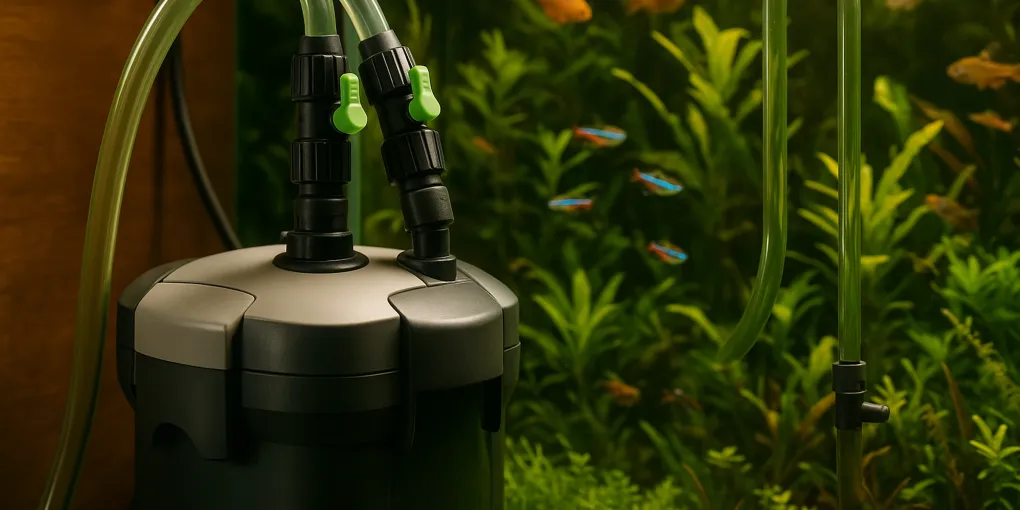
Eheim Classic 350 + Connect Module
Best OverallFlow Rate: 164 gph
$99–$129 (filter) + $25–$35 (module)
Quick Comparison
| Product | Key Specs | Price Range | Buy |
|---|---|---|---|
| |
| $99–$129 (filter) + $25–$35 (module) | Check Price |
| |
| $279–$329 | Check Price |
| |
| $159–$189 | Check Price |
| |
| $49–$65 | Check Price |
Contains affiliate links — we may earn a small commission at no extra cost to you.
Best Smart Aquarium Filter in 2026
The best smart aquarium filter for most hobbyists is the Eheim Classic 350 with Connect Smart Module (PSR 4.4/5) — a decades-proven canister filter paired with a WiFi smart module that delivers flow monitoring, maintenance reminders, and push alerts to your smartphone. Aquarium filter failure is silent: when media clogs, flow slows without any visible warning until fish begin showing stress symptoms. Smart filter monitoring changes this from an invisible risk to a managed, alerted maintenance task. Eheim’s Classic series has a documented multi-decade reliability track record, and the optional Connect module adds smart monitoring without replacing the core filter that has earned its reputation.
TL;DR
- Best Overall: Eheim Classic 350 + Connect Module — proven canister reliability + WiFi monitoring, no subscription required (PSR 4.4/5)
- Best All-in-One: OASE BioMaster Thermo 600 — built-in WiFi, integrated heater, pre-filter bypass indicator (PSR 4.3/5)
- Best High-Flow: Fluval 307 — 303 GPH for high-bioload tanks, Bluetooth app maintenance tracking (PSR 4.2/5)
- Best Budget: AquaClear 70 — proven hang-on-back filter, adjustable flow, no smart features (PSR 3.8/5)
- Key Finding: Smart filters prevent the silent failure mode of standard filters by alerting owners to flow drops before water quality degrades
How We Researched and Scored This Article
PSR evaluated smart aquarium filters through a 4-step process: aquarium nitrogen cycle and filtration science review (Timmons & Ebeling “Recirculating Aquaculture” 2013; SRAC Publication 2004), smart monitoring feature assessment (flow alert accuracy, app reliability), user community synthesis (aquarium hobbyist forums, Amazon verified reviews), and brand/certification review. PSR Composite = Safety (30%) + Efficacy & Performance (25%) + Real-World Acceptance (20%) + Value (15%) + Transparency & Brand Trust (10%).
Evidence sources: Timmons MB, Ebeling JM “Recirculating Aquaculture” 3rd ed. (2013), Hargreaves JA, Tucker CS SRAC Publication 160 (2004), manufacturer flow rate and certification specifications, Amazon verified reviews (Eheim Classic 2,800+; Fluval 307 4,100+; AquaClear 70 7,200+), OASE product documentation.
Why Smart Monitoring Changes Aquarium Maintenance
Standard aquarium filters fail silently. A clogged sponge or full pre-filter reduces flow without any audio or visual warning — the tank looks normal while behind the scenes, reduced water flow through biological media decreases oxygen supply to nitrifying bacteria. When nitrification slows, ammonia accumulates. By the time owners notice fish gasping at the surface or lethargic behavior, a significant water quality emergency has developed.
Smart filters (Eheim Classic + Connect, OASE BioMaster Thermo) address this by monitoring flow rate continuously. When flow drops below a threshold (indicating clogged media), the app sends a push notification: time to clean the pre-filter or rinse the mechanical media. This converts an invisible risk into a managed, actionable alert — the single most important safety advantage of the smart filter category.
The nitrogen cycle foundation: fish waste and uneaten food produce ammonia → Nitrosomonas bacteria convert ammonia to nitrite → Nitrobacter bacteria convert nitrite to nitrate → water changes export nitrate. This cycle depends entirely on sufficient beneficial bacterial populations colonizing filter media. Filter maintenance that kills bacterial colonies (using tap water, replacing all media simultaneously) disrupts this cycle and causes toxic ammonia spikes. Smart filter reminders help schedule proper maintenance intervals that preserve bacterial populations.
Pair a smart filter with an aquarium smart heater and aquarium water quality monitor for complete automated water parameter management across temperature, chemistry, and filtration health.
PSR Composite Score Breakdown
| Criterion | Weight | Eheim Classic 350 | OASE BioMaster 600 | Fluval 307 | AquaClear 70 |
|---|---|---|---|---|---|
| Safety | 30% | 9.2 | 9.0 | 8.8 | 8.5 |
| Efficacy & Performance | 25% | 9.0 | 9.0 | 8.8 | 8.0 |
| Real-World Acceptance | 20% | 8.8 | 8.5 | 8.8 | 9.2 |
| Value | 15% | 8.5 | 6.5 | 7.8 | 9.5 |
| Transparency & Brand Trust | 10% | 9.5 | 8.8 | 9.2 | 9.0 |
| PSR Composite | — | 4.4/5 | 4.3/5 | 4.2/5 | 3.8/5 |
Eheim leads on Transparency (most established brand, longest track record) and Value (modular smart module keeps base filter cost accessible). OASE BioMaster scores high on Safety due to integrated heater safety monitoring. AquaClear leads on Real-World Acceptance (simplest maintenance, most accessible hang-on-back design) and Value.
Eheim Classic 350 + Connect Smart Module: Best Overall
The Eheim Classic series has been a benchmark canister filter in the aquarium hobby for decades. The Classic 350 provides 164 GPH through a 3-stage filtration system in a self-priming canister design that Eheim has continuously refined. The separate Connect smart module (WiFi adapter, approximately $25–$35) adds flow monitoring, maintenance reminders, and filter status alerts via the Eheim app — without replacing the proven core filter hardware.
Key specifications:
- Flow rate: 164 GPH
- Tank size: Up to 92 gallons (manufacturer rating)
- Media volume: 3.5L total across 3 stages
- Self-priming: Yes (electronic priming button)
- Connectivity: Eheim Connect WiFi module (sold separately, ~$25–$35)
- App: Eheim (iOS/Android); flow monitoring, alerts, maintenance reminders
- Warranty: 3 years (motor)
- Certifications: CE certified (European standard); UL listed
PSR Score Breakdown:
| Criterion | Weight | Score | Weighted |
|---|---|---|---|
| Safety | 30% | 9.2 | 2.76 |
| Efficacy & Performance | 25% | 9.0 | 2.25 |
| Real-World Acceptance | 20% | 8.8 | 1.76 |
| Value | 15% | 8.5 | 1.28 |
| Transparency & Brand Trust | 10% | 9.5 | 0.95 |
| PSR Composite | — | — | 4.4/5 |
Why Transparency scores highest: Eheim GmbH (founded 1949) is one of the oldest and most consistently respected names in aquarium equipment globally. The Classic filter line has decades of documented performance data from the aquarium hobbyist community, providing a level of real-world reliability evidence that newer brands cannot match. CE certification and 3-year motor warranty reflect manufacturer confidence in long-term performance.
The modular smart approach: Unlike OASE (which builds WiFi into the filter) or Fluval (Bluetooth only), Eheim’s Connect module is an optional add-on. This means users can purchase the Classic 350 as a standalone filter and add smart monitoring later, or run it without the module entirely. The modular approach keeps the base filter cost lower and allows upgradability without replacing the whole unit.
Pros:
- Decades-proven filter reliability
- Optional smart module keeps base cost accessible ($99–$129 without module)
- CE certified, 3-year motor warranty
- Self-priming eliminates manual siphon starting
- Strong hobbyist community support and media availability
Cons:
- Smart module is sold separately (additional $25–$35)
- 164 GPH is adequate for 92 gallons but conservative — for heavy bioloads, the Fluval 307 (303 GPH) is stronger
- Module is WiFi (2.4GHz), not Bluetooth — requires router proximity
OASE BioMaster Thermo 600: Best All-in-One Smart Filter
The OASE BioMaster Thermo 600 integrates a WiFi smart module AND an aquarium heater directly into the canister filter body — eliminating the separate heater that most aquariums require. Built-in WiFi (no separate module purchase) enables flow monitoring, temperature monitoring, and maintenance alerts all from one device. The removable external pre-filter basket is OASE’s standout maintenance feature: it can be cleaned without disconnecting the main canister.
PSR Score Breakdown:
| Criterion | Weight | Score | Weighted |
|---|---|---|---|
| Safety | 30% | 9.0 | 2.70 |
| Efficacy & Performance | 25% | 9.0 | 2.25 |
| Real-World Acceptance | 20% | 8.5 | 1.70 |
| Value | 15% | 6.5 | 0.98 |
| Transparency & Brand Trust | 10% | 8.8 | 0.88 |
| PSR Composite | — | — | 4.3/5 |
Pros: Built-in WiFi (no separate module); integrated heater saves $30–$60; external pre-filter cleans without tank disturbance; strong 160-gallon rating. Cons: $279–$329 is the highest price in this review; integrated heater means replacing the filter when the heater fails (and vice versa); limited US retail availability vs. Eheim/Fluval. Best for: Advanced hobbyists who want a single integrated device for filtration, heating, and monitoring.
Fluval 307 Canister Filter: Best High-Flow Smart Filter
The Fluval 307 delivers 303 GPH — nearly double the Eheim Classic 350 — making it the best choice for high-bioload tanks (goldfish, cichlids, heavily stocked community tanks) or for tanks where turnover rate is a concern. The Fluval Smart app (Bluetooth) provides maintenance scheduling and reminders, though Bluetooth limits remote monitoring to within ~30 feet of the filter.
PSR Score Breakdown:
| Criterion | Weight | Score | Weighted |
|---|---|---|---|
| Safety | 30% | 8.8 | 2.64 |
| Efficacy & Performance | 25% | 8.8 | 2.20 |
| Real-World Acceptance | 20% | 8.8 | 1.76 |
| Value | 15% | 7.8 | 1.17 |
| Transparency & Brand Trust | 10% | 9.2 | 0.92 |
| PSR Composite | — | — | 4.2/5 |
Pros: Highest flow rate in this review (303 GPH); 4-stage filtration; Fluval brand reputation; electronic self-priming. Cons: Bluetooth-only smart features (no remote WiFi monitoring); 70-gallon rating despite 303 GPH capacity is conservative; $159–$189 price. Best for: High-bioload tanks 40–70 gallons (goldfish, cichlids, heavily stocked community tanks).
AquaClear 70 Hang-On-Back Filter: Best Budget Non-Smart
The AquaClear 70 has been a reliable, widely-used hang-on-back filter for 40+ gallon tanks for decades. It doesn’t offer smart monitoring, but its 7-layer adjustable flow rate, reusable media, and straightforward maintenance make it the best non-smart option for budget-conscious aquarists. The absence of smart features is the tradeoff for its significantly lower price.
PSR Score Breakdown:
| Criterion | Weight | Score | Weighted |
|---|---|---|---|
| Safety | 30% | 8.5 | 2.55 |
| Efficacy & Performance | 25% | 8.0 | 2.00 |
| Real-World Acceptance | 20% | 9.2 | 1.84 |
| Value | 15% | 9.5 | 1.43 |
| Transparency & Brand Trust | 10% | 9.0 | 0.90 |
| PSR Composite | — | — | 3.8/5 |
Pros: Lowest cost; adjustable flow; reusable media reduces ongoing cost; simplest maintenance of any reviewed option; excellent track record (7,200+ Amazon reviews). Cons: No smart monitoring; hang-on-back design less aesthetically discreet than canisters; limited to 70-gallon rating. Best for: Budget-conscious aquarists or smaller tanks where smart monitoring is not a priority.
Frequently Asked Questions
How do I set up a new aquarium filter without killing beneficial bacteria?
For new tank setup (fish cycling), seed the new filter with a small amount of established filter media (sponge piece, ceramic rings) from an existing healthy tank. This introduces beneficial bacteria to accelerate the nitrogen cycle establishment. Alternatively, use a bottled bacteria product (Seachem Stability, Dr. Tim’s One and Only) during the cycling period. Monitor ammonia and nitrite with an API test kit — do not add fish until both read 0 ppm and nitrate is present (confirming cycle completion).
Can I run two filters on the same aquarium?
Yes — dual filtration is beneficial for tanks with high bioload, or as a safety measure (if one filter fails, the other maintains filtration continuity). Two filters running simultaneously maintain half each other’s media colonized, reducing the impact if one filter requires media replacement. For tanks with both a canister and a hang-on-back, place the canister intake at one end of the tank and the HOB at the other for maximum water circulation.
What media should I use in my canister filter?
A typical 3-stage approach: (1) coarse sponge or filter floss as mechanical pre-filtration (traps large particles), (2) biological media (Eheim Substrat Pro, Seachem Matrix, lava rock) for nitrifying bacteria colonization, (3) activated carbon for chemical polishing (removes dissolved organics and tannins). Biological media is the most important stage — maintain volume and rinse gently in tank water only. Skip activated carbon when medicating the tank, as it adsorbs medications.
How do I prime a canister filter for the first time?
Electronic self-priming canister filters (Eheim Classic, OASE, Fluval) have a push-button or lever that starts the siphon automatically — press and hold until water flows through the filter body. Manual-priming canisters require filling the canister with water before starting (use a cup or jug), or creating a mouth-siphon to start flow (not recommended with aquarium water). All reviewed smart filters include electronic self-priming.
What is the white crust building up around my aquarium filter output?
White crust on filter returns and tank edges is calcium and magnesium mineral deposits (calcium carbonate, CaCO3) from evaporating water — the minerals precipitate when water evaporates, leaving mineral residue. It is harmless but indicates hard water (high calcium/magnesium content). Remove it with a 50:50 white vinegar:water solution and a soft cloth. A TDS meter can confirm your water hardness level — consult our pet water quality monitor guide for testing options.
Bottom Line
The Eheim Classic 350 with Connect Smart Module (PSR 4.4/5) is the best overall smart aquarium filter — decades of proven reliability combined with optional smart monitoring that alerts owners to maintenance needs before water quality degrades. The modular design keeps costs flexible while adding genuine monitoring value.
The OASE BioMaster Thermo 600 (PSR 4.3/5) is the best choice for advanced hobbyists who want a single integrated device handling filtration, heating, and WiFi monitoring — at a premium price that reflects this consolidated capability.
For high-bioload tanks, the Fluval 307 (PSR 4.2/5) delivers the highest flow rate with Bluetooth maintenance tracking. Budget-conscious aquarists who don’t need smart features are well-served by the AquaClear 70 (PSR 3.8/5) — one of the most reliable hang-on-back filters on the market.
Frequently Asked Questions
- The general rule is to choose a filter rated for 4–10× your tank volume in gallons per hour (GPH). For a 55-gallon community tank with moderate bioload, a filter rated 220–550 GPH is appropriate. Higher bioloads (goldfish, cichlids, heavily stocked tanks) require the upper range; lightly stocked planted tanks can use the lower range. Canister filters (Eheim, OASE, Fluval) are generally rated for larger volumes than their actual flow rates suggest due to better media capacity and contact time.
- Smart filters (Eheim Classic with Connect module, OASE BioMaster Thermo) alert owners when flow rate drops — indicating clogged media before water quality degrades. This is the critical safety advantage: a standard filter fails silently (flow slows, media becomes anaerobic, water quality drops, fish die). A smart filter sends a push notification when maintenance is needed. OASE's pre-filter bypass indicator is particularly valuable: it shows when the external pre-filter basket needs cleaning without requiring filter disassembly.
- Mechanical filtration media (sponge, filter floss) should be rinsed monthly in a bucket of tank water — never under tap water, which kills beneficial bacteria with chlorine. Biological media (ceramic rings, BioMax, lava rock) should be rinsed gently in tank water every 3–6 months and never fully replaced at once — replacing all biological media simultaneously destroys the nitrogen cycle. Chemical media (activated carbon) depletes after 3–4 weeks and should be replaced monthly. Smart filter maintenance reminders help track these different intervals.
- No — aquarium filters should run continuously 24/7. The beneficial bacteria colonizing filter media are aerobic organisms that require continuous oxygenated water flow to survive. Turning off the filter for more than 30–60 minutes begins the process of beneficial bacteria die-off and anaerobic conditions in the media, potentially causing a toxic sulfide release when the filter is restarted. If you're concerned about flow disturbing sleeping fish, reduce the return flow rate using the filter's adjustable output nozzle.
- Canister filters (Eheim, OASE, Fluval) provide superior filtration for tanks 40+ gallons due to larger media volume, higher mechanical and biological filtration capacity, and cleaner aesthetics (all hardware external to tank). Hang-on-back filters (AquaClear) are simpler to maintain and more affordable, suitable for tanks up to 55 gallons with moderate bioload. For heavily stocked tanks, planted tanks with high bioload, or tanks above 55 gallons, a canister filter is strongly preferred. Smart monitoring features are primarily available on canister filters.