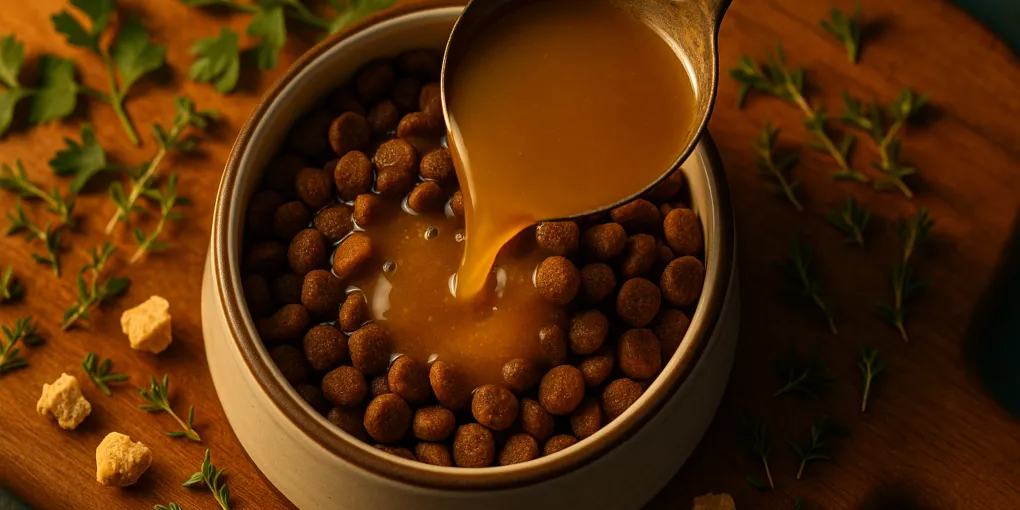
The Honest Kitchen Goat's Milk Bone Broth
Best OverallFormat: Powder (mix with water)
$18–$28 (8 oz)
Quick Comparison
| Product | Key Specs | Price Range | Buy |
|---|---|---|---|
| |
| $18–$28 (8 oz) | Check Price |
| |
| $15–$28 (3.5 oz) | Check Price |
| |
| $28–$45 (30 sachets) | Check Price |
| |
| $10–$16 (12 oz) | Check Price |
Contains affiliate links — we may earn a small commission at no extra cost to you.
Best Food Toppers for Senior Dogs in 2026
For senior dogs with reduced appetite due to smell decline, dental discomfort, medication side effects, or picky eating, The Honest Kitchen Goat’s Milk Bone Broth (PSR 8.8/10) is the top-rated food topper — using goat’s milk and bone broth to simultaneously increase palatability, add moisture for digestive support, and provide natural anti-inflammatory compounds from turmeric. Stella & Chewy’s Meal Mixers (PSR 8.3/10) earn top marks for the freeze-dried raw format, which provides the highest palatability enhancement from protein concentration and natural aroma.
TL;DR
- Top Pick: Honest Kitchen Goat’s Milk Broth — highly palatable powder, low sodium, added goat’s milk digestive support (PSR 8.8/10)
- Freeze-Dried: Stella & Chewy’s Meal Mixers — raw protein concentration drives highest palatability boost (PSR 8.3/10)
- Digestive/Appetite: Purina FortiFlora — probiotic + liver flavor for dogs with digestive-driven appetite issues (PSR 8.0/10)
- Simple Broth: Open Farm Bone Broth — clean single-ingredient broth for minimal-additive toppers (PSR 7.8/10)
How We Researched This Article
This article follows PSR’s 5-step evidence-synthesis process. Safety assessment covered toxic ingredient screening (xylitol, onion, garlic, excess sodium, artificial sweeteners), AAFCO statement verification for toppers with nutritional claims, and sodium content appropriateness for senior dogs with cardiovascular or renal considerations. User community synthesis sourced from Amazon verified purchase reviews (combined 22,000+ reviews) and veterinary nutrition forum discussions on appetite management in senior dogs.
Understanding Appetite Decline in Senior Dogs
Reduced food intake in senior dogs is common but never should be dismissed as “just being old”:
Olfactory decline changes food appeal: Dogs experience their food primarily through smell — a dog who can’t smell their food well finds it less appealing. Age-related olfactory receptor loss is documented in dogs (Kitchener et al.) — warming food to increase aroma and using high-odor toppers like broth and freeze-dried protein directly addresses this mechanism.
Dental pain reduces eating comfort: A dog who associates eating with jaw pain eats less. Dental water additives and dental chews address underlying oral disease, while food toppers that soften kibble (especially broth toppers) make eating more comfortable for dogs with dental sensitivity.
Medication side effects: NSAIDs (the most commonly prescribed senior dog medications for arthritis) cause nausea and GI upset in some dogs. Antibiotics disrupt gut microbiome. Many senior dogs on medications eat less as a direct result. Broth toppers can improve palatability enough to overcome medication-related nausea without requiring food changes.
Kidney disease and toxin accumulation: Advanced kidney disease creates uremic toxins that cause nausea and appetite suppression. Appetite management in CKD dogs requires veterinary guidance — some toppers (high protein, high phosphorus) worsen CKD progression even while improving palatability.
Weight management paradox: Some senior dogs on calorie-restricted diets for joint health resist eating less-palatable food. Toppers that add palatability with minimal caloric addition (diluted broth, a few freeze-dried pieces) improve compliance with appropriate portion sizes.
What Makes a Good Food Topper for Senior Dogs?
Palatability through aroma: High-value toppers work primarily through smell. Bone broth releases amino acids and volatile compounds that activate food-seeking behavior. Freeze-dried raw meat concentrates natural meat aroma to levels far above cooked or kibble-processed food. Choose based on what drives the specific dog’s interest — some seniors respond more to broth, others to meat aroma.
Low sodium for cardiac and renal health: Sodium restriction is often indicated in senior dogs with heart disease or kidney disease. Human bone broth, many commercial pet broths, and some toppers have sodium levels inappropriate for these dogs. Look for products labeled specifically low-sodium or formulated for dogs with renal/cardiac conditions.
No toxic additives: Onion and garlic (toxic to dogs), xylitol (toxic), artificial sweeteners, and grapes/raisins appear in some human foods used as dog toppers. Any topper must be verified free of these ingredients. All four products reviewed are confirmed safe.
Moisture addition: Senior dogs often have reduced thirst drive and subclinical dehydration. Broth toppers add moisture to the diet — a meaningful secondary benefit beyond palatability, supporting kidney function and joint fluid maintenance.
Digestive compatibility: Some senior dogs have sensitive digestive systems — a topper that causes diarrhea or vomiting provides net negative value. Introduce toppers gradually over 5–7 days.
PSR Composite Score Breakdown
| Criterion | Weight | Honest Kitchen Broth | Stella & Chewy’s | FortiFlora | Open Farm Broth |
|---|---|---|---|---|---|
| Safety & Ingredients | 25% | 9.5 | 9.0 | 9.5 | 9.5 |
| Durability & Build Quality | 20% | 9.0 | 9.0 | 9.0 | 8.0 |
| Pet Comfort & Acceptance | 20% | 9.0 | 9.5 | 8.0 | 8.5 |
| Value for Money | 20% | 8.5 | 7.5 | 7.5 | 8.5 |
| Ease of Use | 15% | 8.5 | 8.5 | 9.5 | 9.0 |
| PSR Composite | — | 8.8 | 8.3 | 8.0 | 7.8 |
Score notes: Honest Kitchen Broth earns top marks across Safety (clean, transparent ingredients), Durability (powder format stays shelf-stable), and Pet Comfort (high owner-reported acceptance). Stella & Chewy’s leads in Pet Comfort alone from raw protein aroma concentration — the highest palatability boost but at higher cost. FortiFlora leads Ease of Use with individual sachet portioning and earns high Safety from veterinary-validated formulation. Open Farm Broth is the cleanest single-ingredient option with strong sustainability credentials.
The Honest Kitchen Goat’s Milk Bone Broth: Best Overall
The Honest Kitchen’s goat’s milk bone broth powder combines three palatability and health drivers: goat’s milk (natural prebiotics and easily digestible lactose levels lower than cow’s milk), bone broth (amino acids, gelatin, natural flavor compounds), and turmeric (curcumin with documented anti-inflammatory properties). The powder format provides shelf stability that liquid broths can’t match.
What makes it the top pick:
- Three active ingredients in one product — palatability, digestive support, and anti-inflammatory properties
- Goat’s milk is lower in lactose than cow’s milk and better tolerated by lactose-sensitive dogs
- Powder format: mix with water to control consistency; can be served warm to maximize aroma
- The Honest Kitchen’s ingredient transparency and sourcing standards are among the best in the pet food space
Safety: No xylitol, onion, garlic, or artificial additives. Low sodium appropriate for senior dogs. Human-grade ingredient standards (The Honest Kitchen is one of few pet food brands certified to human-grade standard).
Best for: Senior dogs with reduced appetite from smell decline, dental sensitivity, or medication nausea; dogs needing moisture addition to a dry kibble diet; owners wanting a palatability tool with secondary health benefits.
View Honest Kitchen Goat’s Milk Broth on Amazon
Stella & Chewy’s Meal Mixers Freeze-Dried: Best Freeze-Dried
Stella & Chewy’s Meal Mixers concentrate raw meat protein through freeze-drying — a process that removes moisture without heat, preserving natural volatile aroma compounds that drive dog food palatability. The protein density and natural aroma that result from freeze-drying provide a palatability stimulus significantly stronger than cooked or processed meat products.
Why freeze-dried protein is effective for appetite:
- Freeze-drying preserves the volatile aromatic compounds that trigger food-seeking behavior in dogs
- Protein concentration per gram is high — even small amounts (3–5 pieces on a kibble bowl) create a strong olfactory signal
- The texture contrast between kibble and rehydrated freeze-dried pieces increases food interest
Important safety note for immunocompromised seniors:
- Freeze-dried raw carries a small residual risk of Salmonella and Listeria despite processing
- Senior dogs on immunosuppressive medications (prednisone, cyclosporine) should avoid raw-derived products
- For healthy senior dogs, freeze-dried raw is documented safe
Best for: Healthy senior dogs whose appetite problem responds best to high-protein aroma stimulation; owners of picky eaters who’ve tried broths without sufficient response.
View Stella & Chewy’s Meal Mixers on Amazon
Purina FortiFlora Canine Probiotic Supplement: Best for Digestive Appetite Issues
FortiFlora is specifically designed for dogs whose appetite issues stem from GI disruption — nausea, loose stool, and reduced appetite following antibiotics, illness, or dietary change. The active probiotic (Enterococcus faecium SF68, extensively studied in companion animal gastroenterology) restores gut microbiome balance, while the liver flavor coating provides a palatability stimulus the dog seeks independently.
The unique dual-action mechanism:
- Probiotic action resolves the underlying gut disruption causing nausea-driven appetite suppression
- Liver flavor is intrinsically highly palatable to dogs — dogs often seek out the sachet before it’s mixed in
- Once gut function is restored, the appetite issue often self-resolves without continued supplementation
Veterinary validation:
- FortiFlora is the most extensively studied probiotic for dogs — more published clinical trials than any competing canine probiotic
- Recommended by veterinary internists and gastroenterologists as the first-line probiotic for GI disruption in dogs
Safety: Extensively validated in clinical settings. No documented safety concerns. Individual sachets ensure consistent dosing.
Best for: Senior dogs whose appetite decline follows antibiotics, illness, dietary changes, or concurrent GI symptoms; dogs with documented microbiome disruption.
View Purina FortiFlora on Amazon
Open Farm Bone Broth for Dogs: Best Single-Ingredient Broth
Open Farm’s bone broth uses a minimal ingredient list: grass-fed beef bones, water, and turmeric. For owners who want a broth topper without supplemental additions (no goat’s milk, no added powders) — just clean broth — Open Farm delivers that in a responsible-sourcing context.
Why minimal ingredients matter for some senior dogs:
- Dogs with documented food sensitivities or novel protein diets need precise ingredient control
- A single-source protein broth doesn’t add allergenic risk for dogs on elimination diets
- Open Farm’s traceability standards (farm-to-table ingredient sourcing, published supplier list) provide confidence in ingredient origin
Trade-offs:
- Liquid format requires refrigeration after opening and has shorter use window than powder
- Lower palatability stimulus than freeze-dried raw (concentrated meat aroma) or goat’s milk broth (multi-component sensory profile)
Safety: No xylitol, onion, garlic, or artificial additives. Human-grade sourcing standards. No documented safety incidents.
Best for: Senior dogs with food sensitivities requiring ingredient control; owners prioritizing sourcing transparency and minimal processing.
View Open Farm Bone Broth on Amazon
Pairing Food Toppers with a Complete Senior Dog Care Approach
Food toppers address palatability and nutrient density, but appetite management requires the full picture:
- Senior dog food — high-quality, age-appropriate base diet is the foundation; toppers supplement, not replace
- Dental care — dental pain is a major appetite suppressor; addressing oral health often resolves eating reluctance
- Slow feeder bowls — for dogs who still eat fast but are being transitioned to more thoughtful eating habits
- Elevated bowls — reduced neck and back strain during eating improves comfort for arthritic dogs
- Veterinary evaluation — persistent appetite decline warrants medical investigation; mirtazapine and capromorelin (Entyce) are veterinary-prescribed appetite stimulants for dogs who don’t respond to food-based interventions
Related Senior Dog Care Articles
- Best Senior Dog Food for Large Breeds
- Best Senior Dog Food for Small Breeds
- Best Elevated Dog Bowls for Senior Dogs
- Best Slow Feeder Bowl for Senior Dogs
- Best Probiotic Supplement for Senior Dogs
Frequently Asked Questions
Why do senior dogs lose their appetite?
Appetite decline in senior dogs has several common causes: olfactory decline (reduced smell makes food less appealing), dental pain, medication nausea (especially NSAIDs), kidney or liver disease, cancer, and cognitive dysfunction. A sudden significant decrease in appetite warrants a veterinary visit before assuming it’s age-related.
Are bone broth toppers safe for senior dogs with kidney disease?
Dog-specific bone broths labeled low-sodium are generally safe for early CKD. Dogs with moderate-to-advanced CKD require phosphorus restriction — consult your veterinary nutritionist before adding any broth. Never use human bone broth, which typically contains sodium levels inappropriate for dogs and may contain toxic onion or garlic.
Can a food topper replace nutritionally complete senior dog food?
No — toppers are additions to a complete diet, not replacements. If a dog is eating so little that toppers can’t compensate, consult your veterinarian about prescription appetite stimulants (mirtazapine, capromorelin/Entyce).
How much food topper should I use for a senior dog?
Start conservative — 1–2 tablespoons of broth or a small amount of freeze-dried topper. Account for topper calories in total daily intake to avoid weight gain. Monitor weight monthly — if gaining weight, reduce topper quantity or choose a very low-calorie option like diluted broth.
Is raw freeze-dried food topper safe for senior dogs?
Safe for healthy senior dogs — freeze-dried raw undergoes processing that reduces pathogen load. Senior dogs on immunosuppressive medications should avoid raw-derived products due to residual Salmonella and Listeria risk. Consult your veterinarian if your senior dog is immunocompromised.
Frequently Asked Questions
- Appetite decline in senior dogs has several common causes: decreased sense of smell (olfactory receptor loss is a normal aging change — dogs find food less appealing when they can't smell it well), dental pain (eating becomes uncomfortable), nausea from medications (especially NSAIDs, antibiotics), kidney or liver disease causing nausea and toxin accumulation, cancer, and cognitive dysfunction causing confusion around meal times. A sudden significant decrease in appetite warrants a veterinary visit — it can be an early symptom of serious illness. Toppers are appropriate as an appetite management tool for dogs whose underlying cause has been evaluated.
- Commercial bone broths specifically labeled for dogs and formulated with low sodium are generally safe for dogs with early kidney disease (CKD Stage 1–2). Dogs with moderate-to-advanced CKD (Stage 3–4) require phosphorus restriction — bone broth is not appropriate without veterinary guidance, as even low-phosphorus broths add to dietary phosphorus load. For dogs with known kidney disease, consult your veterinary nutritionist before adding any topper. Never use human bone broth for dogs — most contain sodium levels inappropriate for dogs and may contain onion or garlic powder (toxic).
- No — toppers are designed to be added to a nutritionally complete diet, not replace it. Toppers add palatability, moisture, and targeted nutrients but are not formulated to be complete and balanced on their own. If your senior dog is eating so little that a topper can't compensate, consult your veterinarian — the dog may need an appetite stimulant medication (mirtazapine, capromorelin/Entyce) rather than just a more appealing food.
- Start with a conservative amount — typically 1–2 tablespoons of broth or a small amount of freeze-dried topper for a medium senior dog. Toppers that add significant calories need to be accounted for in total daily intake, especially for senior dogs prone to weight gain that worsens joint disease. A food topper that adds 50–100 kcal to a meal is meaningful for a small senior dog eating 400 kcal/day. Monitor weight monthly — if the dog is gaining weight, reduce topper quantity or choose a very low-calorie option (diluted broth, a few freeze-dried pieces).
- Freeze-dried raw toppers (like Stella & Chewy's Meal Mixers) use high-pressure processing or freeze-drying to reduce pathogen load from raw meat. These are generally safe for healthy senior dogs. Senior dogs with compromised immune systems, current illness, or who are immunosuppressed from medications should avoid raw-derived products due to the small residual risk of Salmonella or Listeria. Consult your veterinarian if your senior dog is on immunosuppressive medications (prednisone, cyclosporine) before using freeze-dried raw toppers.