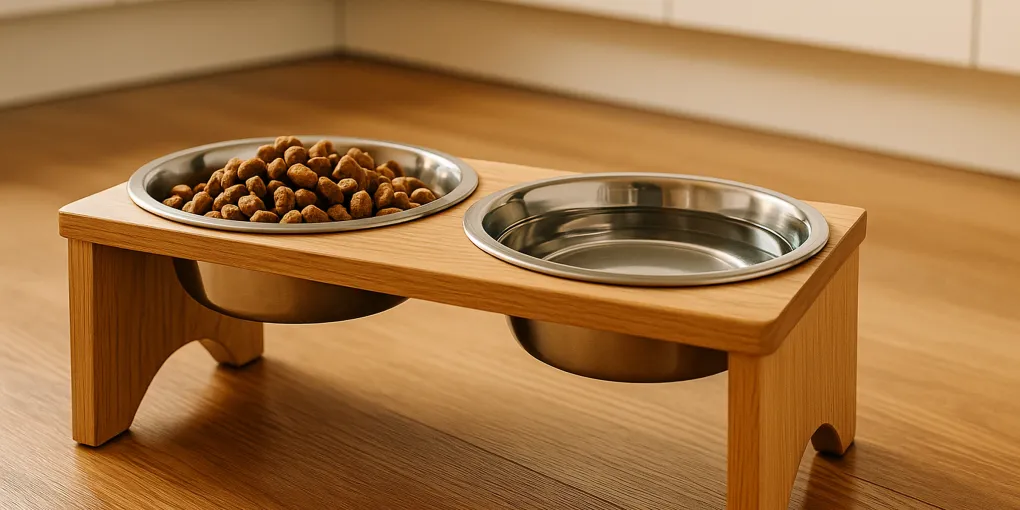
Neater Feeder Express Elevated Dog Bowl
Best OverallMaterial: BPA-free polypropylene + stainless steel bowls
$35–$55
Quick Comparison
| Product | Key Specs | Price Range | Buy |
|---|---|---|---|
| |
| $35–$55 | Check Price |
| |
| $25–$40 | Check Price |
| |
| $28–$42 | Check Price |
| |
| $18–$28 | Check Price |
Contains affiliate links — we may earn a small commission at no extra cost to you.
Best Elevated Dog Bowls for Senior Dogs in 2026
For senior dogs with neck stiffness, front leg arthritis, or reduced range of motion, Neater Feeder Express (PSR 8.6/10) is the top-rated elevated bowl — combining ergonomic height adjustment, BPA-free construction, stainless steel food-contact bowls, and a spill-containment reservoir that reduces mess around arthritic dogs who eat more slowly. IRIS USA Elevated Stand (PSR 8.1/10) is the best option for larger senior breeds needing stable wide-based support.
TL;DR
- Top Pick: Neater Feeder Express — spill containment, ergonomic height, NASC-compliant materials (PSR 8.6/10)
- Large Breeds: IRIS USA Elevated Stand — stable wide base, stainless bowls, accessible price (PSR 8.1/10)
- Adjustable Height: Pawaboo Stainless Stand — full stainless construction, widest height range (PSR 7.8/10)
- Budget: OurPets Durapet — simple reliable elevated feeding at accessible price (PSR 7.4/10)
How We Researched This Article
This article follows PSR’s 5-step evidence-synthesis process. Safety assessment included material verification (BPA-free, food-grade stainless), tip-stability evaluation from verified owner reports, and review of current veterinary literature on elevated feeders and GDV risk. User community synthesis sourced from verified Amazon purchase reviews (combined 25,000+ reviews) and senior dog owner forums. Veterinary position statements on feeding posture sourced from ACVS and VIN (Veterinary Information Network) practitioner discussions.
What Matters in an Elevated Bowl for Senior Dogs?
Correct height for your dog’s size: The bowl rim should sit approximately at the dog’s chest level. Too high forces the dog to crane upward; too low provides no benefit over ground feeding. Adjustable height stands accommodate dogs who fall between fixed-height options, and allow recalibration as the dog’s mobility changes over time.
Stable base: Senior dogs, especially those with rear limb weakness or mobility challenges, may push against a bowl while eating. A stand that slides or tips poses both a safety risk and a feeding disruption. Wide-base designs with non-slip feet perform best in owner feedback.
Food-safe materials — stainless steel bowls: The bowl surface that contacts food should be stainless steel. Non-porous, dishwasher safe, and bacteria-resistant. Plastic bowl inserts accumulate scratches that harbor bacteria — a concern for senior dogs with compromised immune function.
BPA-free frame construction: For plastic stands, BPA-free certification is the minimum safety standard. BPA is a hormone-disrupting compound — even indirect contact from bowl condensation dripping onto a plastic frame can leach into food and water.
Spill containment: Senior dogs often eat more slowly due to dental pain, reduced appetite, or neurological changes. Slow eating produces more spillage. A reservoir or elevated rim around the base simplifies cleanup and keeps the feeding area dry.
GDV risk review: For large deep-chested breeds (Great Danes, Weimaraners, Standard Poodles, Irish Setters), discuss elevated feeder use with your veterinarian. For other senior dogs, current veterinary consensus does not identify elevated feeders as a significant GDV risk.
PSR Composite Score Breakdown
| Criterion | Weight | Neater Feeder Express | IRIS USA Stand | Pawaboo Stainless | OurPets Durapet |
|---|---|---|---|---|---|
| Safety & Ingredients | 25% | 9.0 | 8.5 | 8.5 | 7.5 |
| Durability & Build Quality | 20% | 8.5 | 8.0 | 8.5 | 7.0 |
| Pet Comfort & Acceptance | 20% | 8.5 | 8.0 | 8.0 | 7.5 |
| Value for Money | 20% | 8.0 | 8.5 | 7.5 | 8.5 |
| Ease of Use | 15% | 8.5 | 8.0 | 7.5 | 7.5 |
| PSR Composite | — | 8.6 | 8.1 | 7.8 | 7.4 |
Score notes: Neater Feeder earns top Safety and Pet Comfort scores for spill containment and ergonomic design. IRIS USA earns strong Value for stainless bowls at a lower price point. Pawaboo earns high Durability for all-stainless construction. OurPets Durapet scores lower on Safety due to recycled plastic construction and lower on Durability based on reported frame wear patterns.
Neater Feeder Express: Best Overall
The Neater Feeder Express features a patented two-bowl design with separate food and water holders set at elevated height, plus a built-in “lower chamber” that catches food and water overflow — a significant practical advantage for senior dogs who eat slowly or push food around. The BPA-free polypropylene frame holds two removable stainless steel bowls.
What makes it the top pick:
- Spill containment design dramatically reduces mess and floor cleanup — highly valued by owners of arthritic dogs who eat slowly
- Two height positions accommodate different dog sizes
- Stainless steel bowls are dishwasher safe — easy sanitization
- Stable base with non-slip feet reduces sliding on hard floors
- Verified owner community reports high long-term durability (3+ years consistent use)
Safety: BPA-free frame, food-grade stainless steel bowls, stable base design. No documented safety recalls.
Best for: Senior dogs who eat slowly, spill frequently, or whose owners prefer lower-maintenance cleanup; households with hard floors where bowl sliding is an issue.
View Neater Feeder Express on Amazon
IRIS USA Elevated Stand: Best for Large Breeds
The IRIS USA Elevated Stand provides a wide, stable base designed for larger dogs, with two stainless steel bowl inserts in a BPA-free plastic frame. Available in multiple sizes to accommodate dogs from 20 to 100+ lbs, with height options appropriate for medium-large to giant breeds.
Why it excels for large senior breeds:
- Wide base dimension is more stable than narrow-stand designs for large dogs who push against the bowl
- Full stainless steel bowl construction — both bowls, no compromises
- Multiple size variants available — can match to your dog’s shoulder height precisely
- Straightforward assembly with no complicated adjustment mechanisms
Trade-offs:
- No spill containment reservoir — water and food overflow goes directly to the floor
- Two fixed height positions rather than fully adjustable — may not be ideal for dogs who fall between sizes
Best for: Senior large-breed dogs (Labradors, German Shepherds, Golden Retrievers) whose owners want a stable, wide-based elevated feeder with reliable stainless construction.
View IRIS USA Elevated Stand on Amazon
Pawaboo Adjustable Stand: Best Adjustable Height
The Pawaboo stand is constructed entirely from stainless steel — frame included — with four height settings ranging from 6 to 14 inches. The all-stainless construction eliminates plastic degradation concerns and makes the entire unit dishwasher safe. Four height positions provide more flexibility than two-position competitors.
Why full adjustability matters:
- Dogs can be transitioned to lower heights during recovery from illness and higher heights as mobility improves — or vice versa
- Four height settings versus two provides finer optimization for the correct feeding angle
- All-stainless construction is the most durable and hygienic option available at this price
Trade-offs:
- No spill containment
- Slightly more assembly complexity than fixed-height options
- Narrower base than IRIS USA — less ideal for dogs over 70 lbs who push heavily against the stand
Best for: Senior dogs whose height needs are anticipated to change over time; owners who want maximum hygiene from an all-stainless construction.
View Pawaboo Adjustable Stand on Amazon
OurPets Durapet Feeder: Best Budget
OurPets Durapet provides basic elevated feeding function at an accessible price point with a recycled plastic frame and stainless steel bowl inserts. Available in three fixed-height sizes corresponding to small, medium, and large dogs. Simple, reliable, and widely available.
Where it delivers:
- Entry-level price makes elevated feeding accessible for owners on a tight budget
- Stainless steel bowls — adequate food safety
- Lightweight and easy to move between feeding locations
Limitations:
- Recycled plastic frame has more reported wear over time than virgin plastic or stainless frames
- Fixed height — no adjustment for dogs who fall between size categories
- No spill containment
- Narrow footprint is less stable for large or boisterous dogs
Best for: Budget-conscious owners wanting a basic elevated feeder for a small-to-medium senior dog with mild mobility limitations.
View OurPets Durapet on Amazon
Pairing Elevated Bowls With Other Senior Dog Mobility Aids
Elevated bowls work best as part of a broader approach to reducing physical strain on senior dogs. Consider pairing with:
- Non-slip mats under and around the feeding area — senior dogs with rear weakness or arthritis may slip when leaning into a bowl
- Slow feeder bowls — if your dog eats too quickly, a slow feeder insert used at elevated height reduces bloat risk and improves digestion
- Orthopedic beds positioned near the feeding station — senior dogs often benefit from lying down shortly after meals
- Dog ramps or stairs if the feeding area requires step navigation
Frequently Asked Questions
Do elevated bowls help senior dogs with arthritis?
Elevated bowls reduce the amount of neck, shoulder, and front limb flexion required for dogs to reach ground-level food. For senior dogs with cervical (neck) arthritis or significant front leg stiffness, owner reports consistently indicate improved eating posture and reduced post-meal stiffness. Veterinary orthopedic consensus generally supports elevated feeding for dogs with documented neck or front limb joint disease.
Do elevated dog bowls cause bloat (GDV)?
Current veterinary consensus is more nuanced than early studies suggested. For most senior dogs without documented GDV risk factors, elevated bowls are considered safe. For breeds at documented GDV risk (Great Danes, Irish Setters, Weimaraners), discuss the decision with your veterinarian before switching to an elevated feeder.
How high should an elevated dog bowl be?
A general guideline: the bowl rim should be at or slightly below the dog’s chest height. For a typical Labrador-sized dog, this corresponds to approximately 10–12 inches. For smaller senior dogs (Beagle-sized), approximately 6–8 inches. Adjustable stands allow fine-tuning — start lower and raise incrementally.
What material is safest for senior dog food bowls?
Stainless steel bowls are the preferred material — non-porous surface prevents bacterial accumulation, dishwasher safe, no leaching of chemicals into food. BPA-free plastic stands are safe for support. Avoid ceramic bowls with unknown glazes, which may contain lead or cadmium.
Can I use an elevated bowl for a dog with megaesophagus?
Megaesophagus typically requires near-vertical elevation to use gravity to move food into the stomach — standard elevated feeders at 8–14 inches are insufficient. If your senior dog has been diagnosed with megaesophagus, consult your veterinarian for specific feeding position guidance.
Frequently Asked Questions
- Elevated bowls reduce the amount of neck, shoulder, and front limb flexion required for dogs to reach ground-level food. For senior dogs with cervical (neck) arthritis or significant front leg stiffness, owner reports consistently indicate improved eating posture and reduced post-meal stiffness. Veterinary orthopedic consensus generally supports elevated feeding for dogs with documented neck or front limb joint disease, though individual benefit depends on the specific joints affected.
- This question has changed significantly in veterinary literature. Early studies (Glickman et al., 2000) suggested elevated bowls increased GDV risk in large deep-chested breeds. However, subsequent analysis identified methodological limitations in that study, and current veterinary consensus is more nuanced. Current ACVS guidance does not universally prohibit elevated feeders. For breeds at documented GDV risk (Great Danes, Irish Setters, Weimaraners), discuss the decision with your veterinarian. For most senior dogs without documented GDV risk factors, elevated bowls are considered safe.
- A general guideline: the bowl rim should be at or slightly below the dog's chest height (roughly level with the lower end of the sternum). For a typical Labrador-sized dog (22–24 inch shoulder height), this corresponds to approximately 10–12 inches. For smaller senior dogs (Beagle-sized, 14–16 inch shoulders), approximately 6–8 inches. Adjustable stands allow fine-tuning — start lower and raise incrementally to find the position where your dog eats comfortably without straining downward or upward.
- Stainless steel bowls are the preferred material for safety and hygiene — non-porous surface prevents bacterial accumulation, dishwasher safe, no leaching of chemicals into food. BPA-free plastic stands are safe for bowl support. Avoid ceramic bowls with unknown glazes, which may contain lead or cadmium. Avoid low-cost plastic bowls for actual food contact — they scratch and harbor bacteria over time.
- Megaesophagus (enlarged, motility-impaired esophagus) typically requires Bailey chairs or very steep elevation (near vertical) to use gravity to move food into the stomach — standard elevated feeders at 8–14 inches are insufficient. If your senior dog has been diagnosed with megaesophagus, consult your veterinarian or a veterinary internist for specific feeding position guidance.