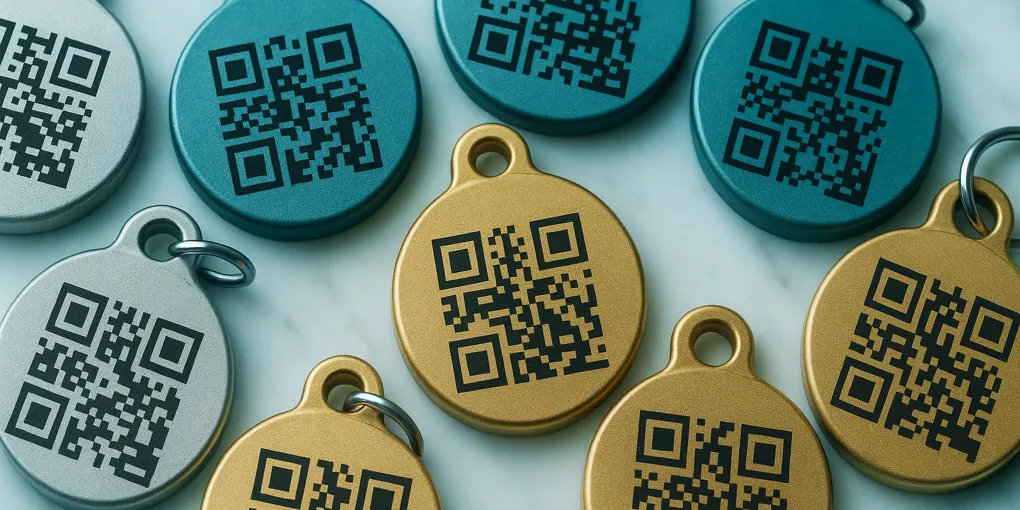
PetHub Digital ID Tag + QR Code
Best OverallTechnology: QR code + NFC tap
~$20–$30 (no subscription)
Quick Comparison
| Product | Key Specs | Price Range | Buy |
|---|---|---|---|
| |
| ~$20–$30 (no subscription) | Check Price |
| |
| ~$99 (+$99/year subscription) | Check Price |
| |
| ~$25–$35 (Tile Premium optional) | Check Price |
| |
| ~$50–$70 (handset + 2 tags) | Check Price |
Contains affiliate links — we may earn a small commission at no extra cost to you.
Best NFC Pet ID Tag in 2026
The best smart pet ID tag for most owners is the PetHub Digital ID Tag + QR Code (PSR 4.5/5) — its QR code works with any smartphone camera without requiring the finder to download an app, linking directly to the owner’s contact profile and activating a lost-pet alert system. For dogs who already wear a Fi GPS collar, the Fi Series 3 Smart Tag NFC (PSR 4.1/5) adds NFC tap capability to the existing GPS location data in a single integrated system. For owners who want Bluetooth proximity detection to locate a pet within a home or immediate area, the Tile Mate Pet Tag (PSR 4.2/5) leverages the massive Tile crowdfind network for last-known-location data at a low price point. For cats who spend time outdoors and need a physically robust short-range homing tag that requires no smartphone, the TabCat Button Tag (PSR 3.9/5) uses radio frequency direction-finding — a technology that works independently of cellular infrastructure and finder app availability.
TL;DR
- Best Overall: PetHub Digital ID Tag — QR scan by any smartphone, owner contact profile, lost pet alert (PSR 4.5/5)
- Best GPS-Linked Tag: Fi Series 3 NFC — integrates NFC identification with Fi’s real-time GPS collar data (PSR 4.1/5)
- Best Bluetooth Location Tag: Tile Mate Pet — Bluetooth proximity + Tile crowdfind network (PSR 4.2/5)
- Best for Cats: TabCat Button Tag — radio frequency homing, no smartphone needed, physically robust (PSR 3.9/5)
- Key Distinction: Smart ID tags are passive identification tools — they do NOT provide real-time GPS location. They accelerate recovery by enabling any finder to contact the owner immediately without visiting a shelter
How We Researched and Scored This Article
PSR evaluated smart pet ID tags through a 5-step evidence-synthesis process: recovery effectiveness analysis (does the tag require the finder to have a specific app, and does it provide owner contact without friction), technology durability and weather resistance assessment, subscription cost analysis over 24 months, app reliability and community network size evaluation, and verified owner review synthesis.
Evidence sources: manufacturer product specifications, NFC and QR code technology documentation, Amazon verified purchase reviews (PetHub 8,000+; Tile Mate 25,000+; Fi 3,000+; TabCat 2,500+), and PSR analysis of lost-pet recovery workflow for each tag technology type. PSR Composite = Safety (25%) + Durability (20%) + Pet Comfort (20%) + Value (20%) + Ease of Use (15%).
What Should You Look for in a Smart Pet ID Tag?
Smart pet ID tags represent a significant evolution from traditional engraved metal tags. The core question for any smart ID tag is: how much friction does a finder face to contact the owner? A tag that requires downloading a specific app before displaying contact information is meaningfully less effective than one that any smartphone camera can read instantly.
Technology types and recovery effectiveness:
- QR code: Any smartphone camera reads the code and opens the owner contact page — no app required, works on any device. The lowest-friction finder experience.
- NFC tap: Any modern NFC-enabled smartphone (iPhone 7+, most Android) taps the tag and opens the contact page — no app required. Slightly less universal than QR (older or budget phones may lack NFC), but seamless on supported devices.
- Bluetooth beacon: The Tile or similar network requires the finder to have the Tile app installed (or the Tile background scanning active) to detect the pet’s tag. Less effective for lost-pet discovery by a random member of the public; more effective for owner-initiated proximity search within Tile network range.
- Radio frequency homing: TabCat’s proprietary RF handset provides directional signal strength toward the tag — no smartphone required at all. Effective for owner-led searching within ~122m range; not useful for a finder who discovers a lost pet.
Subscription cost analysis: Over 24 months, a “free” tag with a premium subscription can cost more than a higher-upfront-cost tag with no subscription. PetHub and TabCat have no mandatory subscription. Tile’s core functionality is free; Premium adds extra features. Fi’s GPS features require an ongoing subscription — the NFC tag component alone without the GPS collar is a different value proposition.
Weight and wear for cats vs. dogs: Cat ID tags require lighter, lower-profile designs than dog tags. TabCat’s button tag design is among the lightest in this category and is specifically engineered for cat collars. PetHub’s smallest tag options are suitable for cats; the Fi collar system is designed for dogs and is likely too large for most cats.
For owners who want full real-time GPS location capability rather than proximity detection, PSR’s guide to the best GPS cat tracker for indoor-outdoor use covers dedicated GPS collar devices. Smart ID tags and GPS trackers serve complementary functions — a pet wearing both has the best chance of recovery at any distance. The best electronic pet door covers microchip-gated doors that prevent unauthorized pets from entering or exiting, reducing the risk of a pet escaping undetected.
PSR Composite Score Breakdown
| Criterion | Weight | PetHub QR Tag | Fi Series 3 NFC | Tile Mate Pet | TabCat Button |
|---|---|---|---|---|---|
| Safety | 25% | 9.5 | 9.0 | 8.5 | 8.0 |
| Durability | 20% | 9.0 | 8.5 | 8.0 | 7.5 |
| Pet Comfort | 20% | 9.0 | 8.0 | 8.0 | 8.5 |
| Value for Money | 20% | 8.5 | 7.0 | 8.5 | 8.0 |
| Ease of Use | 15% | 9.0 | 8.0 | 8.5 | 7.0 |
| PSR Composite | — | 4.5/5 | 4.1/5 | 4.2/5 | 3.9/5 |
PetHub leads on Safety because its QR code requires zero app installation by the finder — the lowest-friction recovery path in this review. Fi’s lower Value score reflects the mandatory ongoing GPS subscription cost. TabCat scores well on Pet Comfort for its lightweight cat-optimized design but lower on Ease of Use because the proprietary RF handset adds a learning curve.
PetHub Digital ID Tag + QR Code: Best Overall
The PetHub Digital ID Tag is a metal collar tag with a QR code that any smartphone camera can scan without downloading any app. Scanning opens the pet’s owner contact profile — stored on PetHub’s platform — which includes phone numbers, address, veterinary contact, and any relevant medical information the owner chooses to include. When a finder scans the tag, PetHub notifies the owner immediately that someone scanned their pet’s tag and provides the scanner’s approximate location.
Key specifications:
- QR code + NFC chip: Dual technology — works with any smartphone camera (QR) or NFC tap (NFC)
- No app required for finder: QR scan or NFC tap opens contact page directly in browser
- Owner notification: Push notification when tag is scanned; scanner’s approximate location shared with owner
- Profile contents: Owner phone, secondary contact, veterinary info, medical notes (owner-customizable)
- Materials: Stainless steel tag with QR code overlay; weatherproof options available
- Subscription: Free tier provides basic contact profile; premium tier adds additional features
- Lost pet network: PetHub partners with shelters — lost pet alerts can be broadcast to local shelters and rescues
PSR Score Breakdown:
| Criterion | Weight | Score | Weighted |
|---|---|---|---|
| Safety | 25% | 9.5 | 2.38 |
| Durability | 20% | 9.0 | 1.80 |
| Pet Comfort | 20% | 9.0 | 1.80 |
| Value for Money | 20% | 8.5 | 1.70 |
| Ease of Use | 15% | 9.0 | 1.35 |
| PSR Composite | — | — | 4.5/5 |
Recovery workflow analysis: The PetHub tag’s core advantage is the zero-friction finder experience. Any person who finds a dog or cat wearing a PetHub tag can scan the QR code with their phone’s camera and immediately see the owner’s contact information — no app download, no account creation, no Bluetooth pairing. Owner notification with scanner location then allows the owner to respond in real time. Verified owner reports describe successful recoveries where finders scanned the tag and the owner was notified within minutes.
Dual QR + NFC: The dual technology approach addresses the two most common “scanner” phone types: QR codes work on every smartphone with a camera (including older devices), while NFC works without even opening the camera app on supported devices. This redundancy maximizes the probability that any random finder can access the contact information with their specific device.
Lost pet shelter network: PetHub’s integration with shelter databases adds a layer of recovery capability that goes beyond what individual GPS or Bluetooth tags provide. If a pet is taken to a shelter by a finder who does not scan the tag, PetHub’s active lost-pet alert system notifies partner shelters in the owner’s geographic area that the pet is missing.
Pros:
- Zero finder friction — any smartphone camera reads the QR code
- Instant owner notification when tag is scanned
- Dual QR + NFC technology redundancy
- Shelter database integration for lost pet alerts
- Free tier available with no mandatory subscription
Cons:
- QR code surface can show wear over extended outdoor use (non-metal engraved versions)
- Premium features require subscription for full lost-pet network access
- No real-time GPS location capability
- Requires owner to keep profile contact information current
View PetHub Digital ID Tag on Amazon — Best for: All pet owners who want the highest-probability lost-pet recovery path without subscription costs — the no-app-required QR scan is the most universally accessible finder experience in this category
For health monitoring data that complements identification technology, PSR’s guide to the best smart pet health monitor covers wearable devices that track physiological indicators alongside location.
Fi Series 3 Smart Tag NFC: Best GPS-Linked Tag
The Fi Series 3 represents a different approach to smart identification: the NFC tag functions as a complement to Fi’s GPS collar system rather than a standalone ID tag. Scanning the NFC chip opens the pet’s Fi profile, which includes owner contact information and — for Fi GPS collar subscribers — the pet’s real-time GPS location at the time of the scan. A finder scanning the tag sees not just who to call, but exactly where the pet was last located by GPS.
Key specifications:
- NFC chip: Tap-to-scan with any NFC-enabled smartphone (iPhone 7+, most Android)
- Fi GPS collar integration: Requires Fi Series 3 GPS collar (sold separately, ~$149) + subscription
- GPS connectivity: 4G LTE real-time location tracking
- Subscription: Required for GPS features (~$99/year)
- Profile: Owner contact + GPS location history accessible via tap
- Compatibility: Fi collar designed for dogs; not recommended for cats
PSR Score Breakdown:
| Criterion | Weight | Score | Weighted |
|---|---|---|---|
| Safety | 25% | 9.0 | 2.25 |
| Durability | 20% | 8.5 | 1.70 |
| Pet Comfort | 20% | 8.0 | 1.60 |
| Value for Money | 20% | 7.0 | 1.40 |
| Ease of Use | 15% | 8.0 | 1.20 |
| PSR Composite | — | — | 4.1/5 |
NFC + GPS combined capability: The Fi system’s value proposition is that a finder scanning the NFC tag gets both contact information and the GPS location logged by the collar — a more complete recovery picture than contact information alone. For Fi GPS collar users, the NFC tag adds negligible additional cost and provides a recovery path that works even if the GPS signal has not updated recently.
NFC vs. QR for finders: Unlike PetHub’s QR code (readable by any camera), NFC requires an NFC-enabled device. Older smartphones, basic feature phones, and some budget Android devices may not have active NFC capability. In practice, most smartphones in use in 2026 support NFC, but the QR code’s universal compatibility is a broader safety net.
Total cost of ownership: The Fi Series 3 GPS collar plus the annual subscription represents a significantly higher total investment than a standalone smart tag. This evaluation covers the NFC identification component specifically — the GPS collar is a separate purchase decision covered in PSR’s guide to the best GPS cat tracker for indoor-outdoor use (cross-species reference for GPS technology), and for dogs, dedicated GPS dog tracker guides.
Pros:
- NFC tap integrates identification with real-time GPS data from Fi collar
- No additional hardware cost if already a Fi GPS collar subscriber
- Finder sees both contact info and last GPS location in one tap
- Strong Fi community and app support
Cons:
- Requires Fi GPS collar purchase AND subscription — high total cost
- NFC only (no QR code fallback for older phones)
- Designed for dogs only — not appropriate for cats
- Value score limited by mandatory subscription requirement
View Fi Series 3 Smart Tag on Amazon — Best for: Existing Fi GPS collar subscribers who want to add NFC identification capability to their existing GPS tracking setup — negligible incremental value for non-Fi users
Tile Mate Pet Tag: Best Bluetooth Location Tag
The Tile Mate Pet Tag is a Bluetooth LE beacon attached to a pet’s collar. When a pet goes missing, the owner can use the Tile app to see the tag’s last known location (where the phone last had Bluetooth contact with the tag) and activate Community Find — a background-scanning feature that detects the tag’s Bluetooth signal when any Tile app user comes within range, updating the last-known location map anonymously. With over 35 million Tile devices in the network, the crowdfind capability is the Tile Mate’s primary recovery tool.
Key specifications:
- Technology: Bluetooth LE (Low Energy) — range ~60–120m in open air
- Network: Tile Community Find — 35+ million devices globally
- Last known location: Map shows where owner’s phone last connected with tag
- Community Find: Anonymous background detection when any Tile user passes within range
- Sound alert: Tag plays audible tone when owner rings it from app
- Subscription: Free tier (basic features); Tile Premium (~$30/year) adds smart alerts and unlimited location history
- Water resistance: IP57 (splash/rain resistant; not designed for submersion)
- Battery: 1-year non-replaceable battery (full Tile replacement at end of life)
PSR Score Breakdown:
| Criterion | Weight | Score | Weighted |
|---|---|---|---|
| Safety | 25% | 8.5 | 2.13 |
| Durability | 20% | 8.0 | 1.60 |
| Pet Comfort | 20% | 8.0 | 1.60 |
| Value for Money | 20% | 8.5 | 1.70 |
| Ease of Use | 15% | 8.5 | 1.28 |
| PSR Composite | — | — | 4.2/5 |
Community Find as a recovery tool: The Tile network’s recovery effectiveness depends on network density in the owner’s geographic area. In urban areas with high Tile user density, Community Find is a meaningful recovery mechanism — when a neighbor or passerby with the Tile app installed walks near the lost pet, the tag’s location is silently updated on the owner’s map. In rural areas with low Tile user density, the network is less useful. Owner reports from urban areas describe positive recovery outcomes; rural users describe limited Community Find effectiveness.
Tile Mate for cats: The Tile Mate is one of the lightest Bluetooth tracker options at approximately 7.5 grams — within the acceptable weight range for cat collars. Verified owner reports from cat owners describe successful collar attachment, though the rectangular form factor is noted as less ideal than circular designs for smaller cat collars. For cats specifically, the TabCat’s lighter and more compact button design is more comfortable for extended wear.
One-year battery note: The Tile Mate uses a non-replaceable battery rated for approximately one year. At end of battery life, the unit is replaced rather than having its battery swapped. Tile’s reTile program offers discounted replacements, but this is a recurring cost element to factor into total ownership cost.
Pros:
- 35+ million device Tile crowdfind network — largest Bluetooth recovery network
- Affordable entry price and optional subscription (free tier useful)
- IP57 water resistance
- Audible tone for close-range finding
- Lightweight — suitable for cats and dogs
Cons:
- Bluetooth range only (~60–120m) — not GPS location
- Community Find effectiveness depends on local Tile network density
- Non-replaceable 1-year battery
- Requires finder to have Tile app installed for community location updates
View Tile Mate Pet Tag on Amazon — Best for: Urban pet owners who want Bluetooth proximity detection and access to the largest crowdfind network at a low entry price, for both cats and dogs
For owners who want electronic pet door access control alongside identification technology, PSR’s guide to the best electronic pet door covers doors that read microchip or collar-based identification for access authorization.
TabCat Pet Tracker Button Tag: Best for Cats
TabCat uses radio frequency homing rather than GPS, Bluetooth, or QR code technology. The system consists of a proprietary handheld device and lightweight button tags worn on the pet’s collar. When the pet is missing and within approximately 122 meters, the handset guides the owner toward the tag using directional signal strength indication — stronger beeping as the owner moves toward the correct direction, with an accuracy indicator that narrows as proximity increases. No smartphone required; no app required; no network dependency.
Key specifications:
- Technology: Proprietary radio frequency (RF) homing — no GPS, no Bluetooth, no cellular
- Range: Up to approximately 122m in open area; reduced by walls and obstacles indoors
- Handset: Proprietary TabCat handset (included) — directional signal strength display
- Tag weight: ~6 grams per tag — among the lightest in this category, designed for cats
- Tags: System supports up to 4 tags on one handset
- Subscription: None — no app, no network, no ongoing cost
- Cat suitability: Specifically engineered for cats; lightweight button form factor
PSR Score Breakdown:
| Criterion | Weight | Score | Weighted |
|---|---|---|---|
| Safety | 25% | 8.0 | 2.00 |
| Durability | 20% | 7.5 | 1.50 |
| Pet Comfort | 20% | 8.5 | 1.70 |
| Value for Money | 20% | 8.0 | 1.60 |
| Ease of Use | 15% | 7.0 | 1.05 |
| PSR Composite | — | — | 3.9/5 |
Why RF homing for cats: Cats present specific challenges for GPS and Bluetooth trackers — they frequently hide in confined spaces (under decking, in dense undergrowth, inside wall cavities) that block GPS signal and limit Bluetooth effective range. TabCat’s RF homing uses signal strength rather than line-of-sight geometry, allowing the owner to follow signal strength into dense terrain where GPS apps would show a static last-known location. Owner reports from cat owners describe finding cats hiding under structures and in dense hedgerows where GPS-based trackers had ceased updating.
No-smartphone recovery path: Unlike every other product in this review, TabCat requires no smartphone, no app, and no finder cooperation. The owner activates the handset and physically searches toward the signal — a self-contained recovery system. This independence from cellular infrastructure, app availability, or finder behavior is a meaningful advantage for cats that hide in rural or low-connectivity environments.
122m range limitation: TabCat is a local homing device — it is effective within a street or yard radius, not for locating a pet that has traveled several kilometers. For wide-range location tracking, a GPS collar device is the appropriate tool. TabCat is specifically positioned for helping owners find cats who are hiding nearby and not responding to calls.
Handset learning curve: Owner reports describe an initial learning period with the directional homing interface. The signal strength beeping system requires practice to interpret accurately — distinguishing left-right directionality from forward-backward requires moving around the search area to triangulate. New users report the system becomes intuitive after 2–3 practice sessions.
Pros:
- Lightest tag in this review (~6 grams) — ideal for cat collar wear
- No smartphone, no app, no network dependency
- No subscription — one-time purchase
- Effective in signal-blocking environments (under decking, dense hedges)
- Supports up to 4 tags on one handset (multi-cat households)
Cons:
- 122m maximum range — not for wide-area searches
- Proprietary handset required (not smartphone-based)
- Learning curve for directional homing interpretation
- No owner-contact-profile capability for finders who discover the pet
View TabCat Pet Tracker on Amazon — Best for: Cat owners whose cats hide outdoors in areas with poor cellular or Bluetooth coverage, and who want a lightweight RF homing system with no subscription cost
For dog activity and health monitoring that complements identification technology, PSR’s guide to the best dog activity tracker covers wearable monitors that track movement and rest patterns.
Side-by-Side Comparison
| Feature | PetHub QR Tag | Fi Series 3 NFC | Tile Mate Pet | TabCat Button |
|---|---|---|---|---|
| PSR Score | 4.5/5 | 4.1/5 | 4.2/5 | 3.9/5 |
| Price (hardware) | ~$20–$30 | ~$99+ (collar) | ~$25–$35 | ~$50–$70 |
| Subscription | Free tier / optional premium | Required (~$99/year) | Free tier / optional Premium | None |
| Technology | QR + NFC | NFC + 4G LTE GPS | Bluetooth LE | Radio frequency |
| Finder App Required | No | NFC-capable phone | Yes (Tile app) | No (handset only) |
| Real-Time Location | No | Yes (GPS) | No (last known) | No (local homing) |
| Range | N/A (identification only) | GPS — unlimited | ~60–120m Bluetooth | ~122m RF |
| Cat Appropriate | Yes (small tag options) | No | Yes (lightweight) | Yes (designed for cats) |
| Shelter Integration | Yes | No | No | No |
Which Smart Pet ID Tag Is Right for You?
Choose PetHub Digital ID Tag if: You want the most universally accessible lost-pet recovery tool — any finder with any smartphone can scan the QR code without an app and immediately contact you, and you receive instant notification with the finder’s location. The no-mandatory-subscription model makes it the best overall value.
Choose Fi Series 3 NFC if: You are already a Fi GPS collar subscriber and want to add NFC identification capability at minimal additional cost. The combined GPS + NFC tap experience is the most comprehensive finder information set in this review, but the value only holds for existing Fi users.
Choose Tile Mate if: You want Bluetooth proximity detection combined with the largest crowdfind network, at a low entry price with no mandatory subscription. Most effective in urban areas with high Tile user density. Also appropriate for cats given the lightweight design.
Choose TabCat if: You have cats that hide in outdoor areas with poor cellular or Bluetooth coverage, and you want a self-contained RF homing system that works without a smartphone and has no ongoing subscription cost. The best physical search tool in this review for hiding cats.
On layering technologies: Owner reports suggest the most robust lost-pet protection combines a microchip (permanent, shelter-readable identification) with a smart ID tag (immediate finder contact capability) and optionally a GPS or Bluetooth tracker for location data. Each technology addresses a different failure mode in the recovery chain. PSR’s guide to the best indoor pet camera covers monitoring tools that can detect when a pet has accessed a door or exit point — a useful preventive tool before a pet goes missing. For dogs specifically, the best dog activity tracker provides continuous location and movement data alongside identification.
Frequently Asked Questions
What is the difference between an NFC pet tag, a QR code tag, and a GPS tracker?
An NFC pet tag uses near-field communication chip technology — a finder taps their NFC-enabled smartphone to the tag to retrieve the pet’s owner contact information. A QR code tag uses a printed code that any smartphone camera can scan without any special hardware. A GPS tracker is a separate device entirely — it actively transmits the pet’s real-time location to an app using cellular or satellite communication. NFC and QR tags are passive identification tools; GPS trackers are active location tools requiring batteries and usually a subscription.
Do NFC pet tags work if the finder doesn’t have a specific app installed?
QR code tags work with any smartphone camera without any app installation — the camera app or built-in QR reader opens the owner’s contact page automatically. NFC tags work with any NFC-enabled smartphone (most modern Android and iPhone 7+ devices) without requiring a specific app — the phone’s native NFC reader handles the tap. Tags that require the finder to download a specific app before accessing the contact information create a meaningful recovery barrier and are less effective for lost-pet scenarios.
How durable are smart pet ID tags for active dogs?
Metal-encased QR and NFC tags (like PetHub’s stainless option) withstand outdoor activity reliably, though the QR code surface can show wear over 12–18 months of continuous outdoor use. Protective overlay options extend QR code legibility significantly. Bluetooth tags like Tile Mate are designed to IP57 water resistance standards, suitable for rain but not extended submersion. TabCat radio frequency tags are among the most physically robust designs — the button tag form factor has minimal exposed components.
Is a smart ID tag a replacement for a microchip?
Smart ID tags and microchips serve complementary rather than duplicate functions. A microchip provides permanent, unfalsifiable identification that requires a shelter or vet scanner to read — it cannot be removed, lost, or damaged like a collar tag. A smart ID tag is readable by any member of the public without special equipment and provides direct owner contact information without requiring a shelter visit. Microchipping is widely recommended as the baseline; smart ID tags accelerate recovery by enabling any finder to contact the owner immediately.
What happens if my pet’s tag gets wet?
QR code tags with standard label printing can degrade over time with repeated wetting and drying. Metal tags with laser-etched QR codes are more durable against moisture. NFC chip tags are generally sealed and water-resistant by design. Tile Mate carries IP57 water resistance. TabCat radio frequency tags are built for outdoor use. For dogs who swim frequently, a NFC chip tag or laser-etched QR tag in a stainless steel enclosure is more durable than a printed-label alternative.
Final Verdict
For the broadest lost-pet recovery capability at the lowest total cost, the PetHub Digital ID Tag + QR Code (PSR 4.5/5) is the clear recommendation — any finder with any smartphone can scan the QR code and contact the owner in seconds, with no app download required and a free tier that covers the core recovery workflow. For owners who already use the Tile ecosystem and want Bluetooth proximity detection with access to a massive crowdfind network, the Tile Mate (PSR 4.2/5) is a strong complementary tool at a low entry price. Fi GPS collar subscribers should add the Fi Series 3 NFC tag (PSR 4.1/5) to their existing setup. And for cat owners dealing with a hiding outdoor cat in areas with poor connectivity, the TabCat Button Tag (PSR 3.9/5) provides a self-contained RF homing capability that no smartphone-based system can replicate.
Frequently Asked Questions
- An NFC pet tag uses near-field communication chip technology — a finder taps their NFC-enabled smartphone to the tag to retrieve the pet's owner contact information. A QR code tag uses a printed code that any smartphone camera can scan without any special hardware. A GPS tracker is a separate device entirely — it actively transmits the pet's real-time location to an app using cellular or satellite communication. NFC and QR tags are passive identification tools; GPS trackers are active location tools requiring batteries and usually a subscription.
- QR code tags work with any smartphone camera without any app installation — the camera app or built-in QR reader opens the owner's contact page automatically. NFC tags work with any NFC-enabled smartphone (most modern Android and iPhone 7+ devices) without requiring a specific app — the phone's native NFC reader handles the tap. Tags that require the finder to download a specific app before accessing the contact information create a meaningful recovery barrier and are less effective for lost-pet scenarios.
- Metal-encased QR and NFC tags (like PetHub's stainless option) withstand outdoor activity reliably, though the QR code surface can show wear over 12–18 months of continuous outdoor use. Protective overlay options extend QR code legibility significantly. Bluetooth tags like Tile Mate are designed to IP57 water resistance standards, suitable for rain but not extended submersion. TabCat radio frequency tags are among the most physically robust designs — the button tag form factor has minimal exposed components.
- Smart ID tags and microchips serve complementary rather than duplicate functions. A microchip provides permanent, unfalsifiable identification that requires a shelter or vet scanner to read — it cannot be removed, lost, or damaged like a collar tag. A smart ID tag is readable by any member of the public without special equipment and provides direct owner contact information without requiring a shelter visit. Microchipping is widely recommended as the baseline; smart ID tags accelerate recovery by enabling any finder to contact the owner immediately.
- QR code tags with standard label printing can degrade over time with repeated wetting and drying. Metal tags with laser-etched QR codes are more durable against moisture. NFC chip tags are generally sealed and water-resistant by design. Tile Mate carries IP57 water resistance. TabCat radio frequency tags are built for outdoor use. For dogs who swim frequently, a NFC chip tag or laser-etched QR tag in a stainless steel enclosure is more durable than a printed-label alternative.