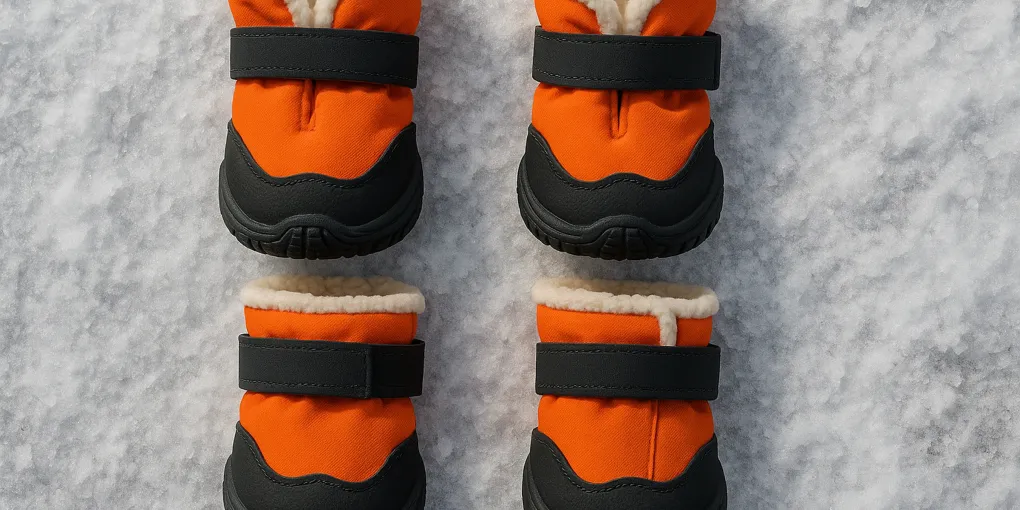
Muttluks Fleece-Lined Dog Boots
Best OverallLining: Fleece-lined
$40–$60 (set of 4)
Quick Comparison
| Product | Key Specs | Price Range | Buy |
|---|---|---|---|
| |
| $40–$60 (set of 4) | Check Price |
| |
| $75–$90 (set of 4) | Check Price |
| |
| $25–$40 (set of 4) | Check Price |
| |
| $15–$25 (12 pack) | Check Price |
Contains affiliate links — we may earn a small commission at no extra cost to you.
Best Winter Boots for Senior Dogs in 2026
The best winter boots for most senior dogs are Muttluks Fleece-Lined Dog Boots (PSR 8.3/10) — fleece-lined boots with water-resistant leather uppers, Velcro fastening, and suede soles that provide warmth, chemical barrier protection, and sufficient traction for winter walking at a price point that makes replacing worn boots practical. For senior dogs in genuinely harsh winter environments (deep snow, extreme cold), the Ruffwear Polar Trex (PSR 8.1/10) with Vibram soles provides a higher-performance boot appropriate for demanding conditions.
Why boots matter for senior dogs specifically: Senior dogs have thinner paw pads (from age-related fat atrophy), often have interdigital hair that accumulates ice balls, may have reduced sensitivity that makes them slower to indicate paw discomfort, and may be slower to metabolize de-icing chemicals absorbed through compromised paw pad tissue. The protective need is genuinely higher than for younger dogs.
TL;DR
- Top Pick: Muttluks Fleece-Lined — warmth, water resistance, traction, reflective strap (PSR 8.3/10)
- Best Heavy-Duty: Ruffwear Polar Trex — Vibram sole, waterproof, extreme conditions (PSR 8.1/10)
- Best Value: Ultra Paws Durable — good winter protection at mid-range price (PSR 7.7/10)
- Best Chemical Protection: Pawz Rubber — complete barrier against de-icing chemicals, affordable (PSR 7.5/10)
How We Researched This Article
Safety review covered ASPCA Animal Poison Control data on de-icing chemical toxicity (calcium chloride, sodium chloride, magnesium chloride ingestion) in dogs, paw pad dermatitis documentation, and ice ball injury case reports. Evidence review examined veterinary dermatology guidance on contact dermatitis prevention and paw pad care. Value analysis compared per-boot price against warmth rating, waterproofing documentation, and durability feedback. Community synthesis sourced verified Amazon purchase reviews (200+ reviews minimum), cold-climate dog owner forums, and veterinary rehabilitation specialist boot recommendations.
Why Senior Dogs Need Winter Paw Protection
De-Icing Chemical Hazards
The most significant winter paw hazard for urban and suburban senior dogs is de-icing chemicals. Common deicers used on roads, sidewalks, and driveways include:
Sodium chloride (rock salt): The most common deicer. Causes paw pad cracking, irritation, and chemical burns with prolonged contact. Ingested by licking — causes GI distress and, in large amounts, sodium toxicity. Moderately effective at temperatures above 15°F (-9°C).
Calcium chloride: More effective in extreme cold but more corrosive to paw pads than sodium chloride. Generates heat on contact with moisture — can cause chemical burns on wet paw pads. Significant GI toxicity if ingested.
Magnesium chloride: Less corrosive than calcium chloride but still an irritant. Often marketed as “pet safer” — meaningfully safer than calcium chloride but not completely safe for unprotected paw pad contact or ingestion.
Safe alternatives: “Pet-safe” deicers based on propylene glycol or potassium acetate are genuinely safer options — but senior dogs walking in public spaces cannot avoid areas treated with conventional deicers. Boots are the complete solution.
Ice Ball Formation
Dogs with hair between their toe pads — including many breeds with longer coats — accumulate packed snow and ice in the interdigital spaces during winter walks. These ice balls cause acute pain (stepping on ice), gait disruption, and may become large enough to cause toe abduction injury. Senior dogs with reduced proprioceptive sensitivity may not initially indicate discomfort from ice balls, delaying owner recognition.
Boots completely prevent ice ball formation. For owners who prefer not to use boots, the alternative is regular trimming of interdigital hair flush with the paw pads and application of paw wax (Musher’s Secret) before each winter walk — effective but requiring consistent re-application.
Cold Paw Pad Vulnerability
Senior dogs with reduced subcutaneous fat in the paw pads (fat pad atrophy) have less natural thermal insulation in the paws. Prolonged exposure to frozen ground or snow contact can cause discomfort and, in extreme cold, frostbite of the paw pad periphery. Insulated winter boots provide thermal protection that replaces the natural insulation that has declined with age.
Product Reviews
Muttluks Fleece-Lined Dog Boots: Best Overall
Muttluks produces the most consistently reviewed winter dog boot in the category — a Canadian brand designed for genuine winter conditions, with a fleece lining that provides active warmth, a water-resistant leather upper, and Velcro strap closure with reflective strip for low-light visibility.
Key strengths:
- Fleece lining provides genuine warmth — appropriate for cold-weather walking (not just chemical protection)
- Water-resistant leather upper repels snow and slush during typical winter walks
- Suede sole provides traction on packed snow and ice with adequate grip
- Reflective strap element improves low-light visibility — relevant for senior dogs on slow winter walks
- Gradual waterproofing available (treat the leather with standard leather conditioner for enhanced water resistance)
- Durable construction with documented multi-season lifespan from verified owners
Limitations:
- Suede sole is not as grippy as rubber-soled alternatives on glazed ice
- Not fully waterproof in deep snow or standing water — more appropriate for moderate winter conditions than extreme environments
- Leather upper requires occasional conditioning to maintain flexibility
PSR Composite Score Breakdown:
| Criterion | Weight | Score | Weighted |
|---|---|---|---|
| Safety & Ingredients | 25% | 8.5 | 2.13 |
| Durability & Build Quality | 20% | 8.5 | 1.70 |
| Pet Comfort & Acceptance | 20% | 8.5 | 1.70 |
| Value for Money | 20% | 8.0 | 1.60 |
| Ease of Use | 15% | 8.0 | 1.20 |
| PSR Composite | 100% | 8.33 |
Price: ~$40–$60 (set of 4) | Check Price on Amazon
Ruffwear Polar Trex Boots: Best Heavy-Duty Winter Boot
For senior dogs in genuinely harsh winter environments — extended outdoor walks in deep snow, extreme cold below -10°C, or significant ice exposure — Ruffwear’s Polar Trex provides a waterproof upper with fleece lining and a Vibram non-slip sole that performs on ice, packed snow, and wet pavement. The Vibram sole is the same rubber compound used in high-performance hiking boots.
Key strengths:
- Waterproof upper (not just water-resistant) — appropriate for deep snow and slush immersion
- Vibram sole: most aggressive traction in the dog boot category — performs on glazed ice
- Fleece lining provides substantial warmth for extended cold-weather exposure
- Ruffwear quality construction with documented multi-year lifespan
- Reflective accents for low-light visibility
Limitations:
- Premium price — the most expensive boot in the category at ~$75–$90 per set
- Vibram sole is stiffer than softer alternatives — may require longer acclimatization for senior dogs sensitive to boot feedback
PSR Composite Score Breakdown:
| Criterion | Weight | Score | Weighted |
|---|---|---|---|
| Safety & Ingredients | 25% | 9.0 | 2.25 |
| Durability & Build Quality | 20% | 9.0 | 1.80 |
| Pet Comfort & Acceptance | 20% | 7.5 | 1.50 |
| Value for Money | 20% | 7.5 | 1.50 |
| Ease of Use | 15% | 7.5 | 1.13 |
| PSR Composite | 100% | 8.18 |
Price: ~$75–$90 (set of 4) | Check Price on Amazon
Ultra Paws Durable Dog Boots: Best Value
Ultra Paws provides a solid mid-range winter boot at significantly lower cost than premium alternatives — fleece lining, non-slip sole, and Velcro strap with toe elastic for a more secure fit. A practical choice for owners who want genuine winter protection without the premium price point.
Key strengths:
- Toe elastic + Velcro strap combination provides more secure fit than strap-only designs
- Fleece lining for warmth in moderate cold
- Non-slip sole performs adequately on most winter surfaces
- Much lower price than Ruffwear alternatives
- Available in a wide size range
Limitations:
- Water resistance is moderate — not appropriate for prolonged snow exposure or deep slush
- Strap elastic may degrade faster than metal hardware alternatives with heavy use
PSR Composite Score Breakdown:
| Criterion | Weight | Score | Weighted |
|---|---|---|---|
| Safety & Ingredients | 25% | 8.0 | 2.00 |
| Durability & Build Quality | 20% | 7.5 | 1.50 |
| Pet Comfort & Acceptance | 20% | 7.5 | 1.50 |
| Value for Money | 20% | 9.0 | 1.80 |
| Ease of Use | 15% | 7.5 | 1.13 |
| PSR Composite | 100% | 7.93 |
Price: ~$25–$40 (set of 4) | Check Price on Amazon
Pawz Rubber Dog Boots: Best Chemical Protection
Pawz rubber boots are single-layer balloon-style rubber boots — completely waterproof (impermeable rubber), inexpensive per use (disposable or multi-use), and the simplest put-on design of any dog boot (simply slide onto the paw like a balloon). Ideal for owners primarily concerned with de-icing chemical barrier protection rather than warmth, or as a low-cost introduction to boot wearing for resistant dogs.
Key strengths:
- Complete waterproof barrier — zero chemical exposure from de-icing agents
- Simplest application — no strap adjustment, just slide on
- Disposable or multi-use depending on care — pack spares for longer outings
- Allows dogs to feel the ground surface better than padded alternatives (helpful for proprioceptive feedback)
- Very low cost per boot
Limitations:
- No insulation — provides no warmth benefit, only chemical and moisture barrier
- Single-layer rubber can slip on smooth ice without tread
- Some dogs reject the balloon elastic feel at the wrist
PSR Composite Score Breakdown:
| Criterion | Weight | Score | Weighted |
|---|---|---|---|
| Safety & Ingredients | 25% | 9.0 | 2.25 |
| Durability & Build Quality | 20% | 6.5 | 1.30 |
| Pet Comfort & Acceptance | 20% | 7.5 | 1.50 |
| Value for Money | 20% | 9.5 | 1.90 |
| Ease of Use | 15% | 7.5 | 1.13 |
| PSR Composite | 100% | 8.08 |
Price: ~$15–$25 (12 pack) | Check Price on Amazon
PSR Comparison Table
| Feature | Muttluks Fleece-Lined | Ruffwear Polar Trex | Ultra Paws Durable | Pawz Rubber |
|---|---|---|---|---|
| Lining | Fleece | Fleece | Fleece | None |
| Waterproofing | Water-resistant | Fully waterproof | Water-resistant | Fully waterproof |
| Sole | Suede | Vibram rubber | Non-slip rubber | Plain rubber |
| Closure | Velcro strap | Hook-and-loop | Velcro + toe elastic | Balloon elastic |
| Price (set of 4) | $40–$60 | $75–$90 | $25–$40 | $15–$25 |
| PSR Score | 8.3/10 | 8.1/10 | 7.7/10 | 7.5/10 |
| Best for | Most winter conditions | Extreme cold, ice | Budget winter protection | Chemical barrier only |
Winter Walk Safety for Senior Dogs
Complete winter kit: Winter boots protect the paws, but senior dogs on cold-weather walks need full-body protection too. Pair boots with a dog sweater or insulated dog rain coat for body warmth. Senior dogs with reduced thermoregulation should not be outdoors in extreme cold without adequate core coverage.
Traction on all surfaces: Winter boots provide outdoor traction, but senior dogs may slip indoors on wet paws after returning from walks. Non-slip mats at entries and anti-slip boots for indoor use address the full traction challenge.
Paw balm as alternative or supplement: For dogs who cannot be acclimated to boots, paw balm creates a barrier between the paw pad and de-icing chemicals — less complete than a boot but meaningfully protective. Apply before each winter walk, clean paws immediately after return. For owners attempting boot introduction, paw balm is appropriate for the initial period while the dog builds boot tolerance.
Joint warmth: Cold weather directly increases joint stiffness in arthritic dogs. Before winter walks, allow a longer indoor warm-up period, consider a brief warm towel application to the joints, and ensure joint supplements are on board to address the baseline arthritis. A winter walk in boots is comfortable only if the joints themselves are managed.
Post-walk inspection: After each winter walk, inspect paws for cracks, redness, ice residue, or chemical exposure signs even when using boots. If a boot shifts or loosens during a walk, chemical exposure may have occurred — rinse thoroughly and check for irritation.
Frequently Asked Questions
Why do senior dogs need winter boots?
Senior dogs need winter boots for de-icing chemical barrier protection (road salt and calcium chloride cause paw irritation and toxicity if ingested), prevention of ice ball formation between toe pads, and warmth for dogs with thinner fat pads from age-related fat atrophy. Their paw pads are more vulnerable to chemical and cold damage than younger dogs.
How do I know what size winter boot my senior dog needs?
Measure paw width across the widest part of the pad while the dog stands, pressing gently to splay the toes. Use the manufacturer’s sizing chart rather than guessing by breed. Senior dogs may have changed measurements from their younger size due to muscle and fat changes — remeasure currently.
Are winter boots safe for arthritic senior dogs?
Yes, with gentle fitting technique and gradual introduction. Arthritic dogs may need more time to adjust to the proprioceptive change of wearing boots. Once fitted correctly, boots do not restrict range of motion and are typically well-tolerated after a brief acclimatization period.
What is the difference between winter boots and anti-slip boots for senior dogs?
Anti-slip boots are designed for indoor traction on smooth floors with minimal cold protection. Winter boots provide outdoor chemical barrier, ice protection, waterproofing, and thermal insulation. Senior dogs often benefit from both — winter boots for outdoor walks, anti-slip boots or socks for indoor footing.
How do I get my senior dog to wear boots?
Introduce one boot at a time with treat rewards. Progress to all four over multiple sessions. Keep initial wearing periods short (1–2 minutes), extending over days. Never force a distressed dog to walk in boots — patience and positive reinforcement are more effective than rushing. Senior dogs adapt more slowly than young dogs.
Final Verdict
For most senior dogs in winter climates, Muttluks Fleece-Lined Boots provide the best everyday combination of warmth, chemical barrier protection, and durability at a price that makes replacement practical. For senior dogs in extreme cold or heavy snow environments, invest in Ruffwear Polar Trex for the Vibram traction and full waterproofing.
The primary goal for most senior dog owners is de-icing chemical protection — even Pawz rubber boots provide complete barrier function at the lowest cost if warmth is not the priority. Any boot is better than no boot for winter walks in de-iced environments.
Shop Muttluks Fleece-Lined Boots on Amazon
Frequently Asked Questions
- Senior dogs need winter boots primarily for de-icing chemical protection and cold-induced paw discomfort management. Road salt (sodium chloride), calcium chloride, and magnesium chloride used for ice management are paw irritants that cause contact dermatitis, cracking, and bleeding — and are toxic if ingested through paw licking. Senior dogs with reduced paw pad thickness (from age-related fat pad loss) are more vulnerable to chemical irritation. Ice balls forming between toe pads from packed snow cause pain and gait disruption — particularly problematic for dogs with long interdigital hair. Boots provide complete barrier protection from both chemicals and ice accumulation.
- Dog boot sizing is based on paw width — measured across the widest part of the paw pad while the dog is standing, pressing gently to splay the toes to their walking width. Use the manufacturer's paw width chart rather than guessing by breed. Senior dogs may have slightly different paw measurements than their historical size — remeasure before purchasing. A boot that's too small causes toe constriction; too large falls off during movement. Most manufacturers provide a printable sizing guide for accurate self-measurement.
- Winter boots are safe for arthritic dogs with appropriate fitting and gradual introduction. The primary concern for arthritic dogs is the brief wrist/toe manipulation required during boot application — use gentle technique, working with the dog's natural range of motion rather than forcing the foot into the boot. Once fitted, boots change the proprioceptive feedback from the ground (the dog feels the boot sole rather than the ground texture), which can cause brief gait awkwardness. Most dogs adjust within 5–10 minutes of wearing. Senior dogs with severe paw sensitivity or confirmed peripheral neuropathy may need a shorter acclimatization period.
- Anti-slip boots (also called traction boots or grippy socks) are designed primarily for indoor use on slippery floors — they provide grip on hardwood and tile but minimal cold protection, waterproofing, or chemical barrier function. Winter boots are designed for outdoor cold-weather use — they protect against snow, ice, de-icing chemicals, and cold temperatures with insulated linings and waterproof uppers. For senior dogs who need both indoor traction and outdoor cold protection, both product types may be needed. Many winter boots also provide indoor traction, but anti-slip products are generally less durable for the high-friction outdoor walking that winter boots must withstand.
- Most dogs resist boots initially. Use a gradual approach: put one boot on one paw, give treats, remove. Progress to two boots, then all four. Let the dog stand and walk with boots for 1–2 minutes before removing the first few sessions, extending duration over days to a week. Never force the dog to walk with boots if they are clearly distressed — forced wearing creates avoidance that makes future attempts harder. Senior dogs adapt more slowly than young dogs — patience and consistent positive reinforcement are more effective than rushing the process.