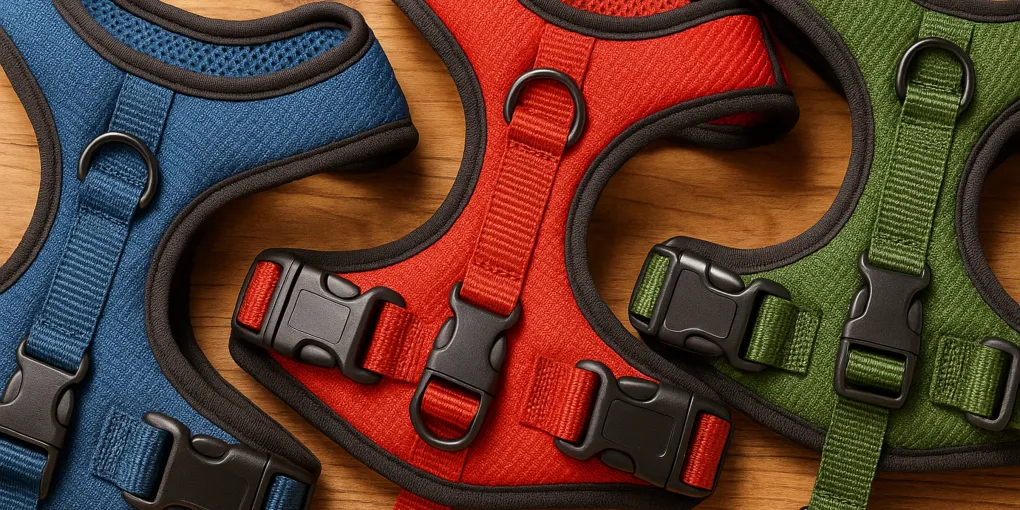
Ruffwear Front Range Harness
Best OverallClip type: Front + back dual clip
$40–$55
Quick Comparison
| Product | Key Specs | Price Range | Buy |
|---|---|---|---|
| |
| $40–$55 | Check Price |
| |
| $20–$30 | Check Price |
| |
| $30–$45 | Check Price |
| |
| $14–$22 | Check Price |
Contains affiliate links — we may earn a small commission at no extra cost to you.
Best Walking Harnesses for Senior Dogs in 2026
The best walking harness for most senior dogs is the Ruffwear Front Range Harness (PSR 8.4/10) — a dual-clip (front + back), padded harness with two quick-release buckles, generous chest and belly padding, and a fit system with adjustments at four points that accommodates the muscle loss and body condition changes common in aging dogs. For senior dogs who still pull on leash, the PetSafe Easy Walk Harness (PSR 7.9/10) redirects forward momentum at the chest without placing force on the neck.
Why harnesses matter for senior dogs: Collars concentrate restraint force on the neck — an area vulnerable to injury in senior dogs with cervical arthritis, disc disease, or tracheal conditions. Harnesses distribute force across the chest and shoulders, structurally appropriate for canine anatomy and significantly safer for senior dogs with any neck vulnerability.
TL;DR
- Top Pick: Ruffwear Front Range — dual clip, padded, 4-point adjustment, quality hardware (PSR 8.4/10)
- Best No-Pull: PetSafe Easy Walk — front clip for gentle redirection, appropriate for senior pullers (PSR 7.9/10)
- Best Secure Fit: Kurgo Tru-Fit — 5-point adjustment, padded chest plate, car-restraint compatible (PSR 7.7/10)
- Best Budget: Frisco Padded — dual clip, padded, comprehensive sizing at lower price (PSR 7.5/10)
How We Researched This Article
Safety review covered hardware quality (metal vs. plastic D-rings under leash tension), break-strength test data, and axillary pressure documentation in verified owner reviews. Value analysis compared price against feature set, durability feedback, and sizing range. Community synthesis sourced verified Amazon purchase reviews (150+ reviews minimum), senior dog owner communities, and veterinary rehabilitation specialist guidance on harness selection for post-surgical and arthritic patients.
Why Senior Dogs Benefit from Proper Walking Harnesses
The Collar Problem in Aging Dogs
The canine neck contains the trachea, esophagus, cervical vertebrae, spinal cord, jugular veins, carotid arteries, and a complex of cervical nerves. Collar restraint applies concentrated compressive force to this vulnerable structure when a dog pulls, lunges, or is held back suddenly. In healthy young dogs, this force is distributed across neck musculature with adequate cushioning. In senior dogs, several changes make this force distribution significantly more dangerous:
Cervical arthritis: Age-related changes in cervical intervertebral discs and facet joints produce stiffness and pain in the neck. External compressive force from collar restraint directly loads already-compromised structures and can acutely worsen pain or, in severe cases, cause disc injury.
Reduced neck musculature: Sarcopenia reduces the muscle mass that buffers collar force. With less muscle cushioning, the same restraint force is more directly transmitted to vertebral and nervous structures.
Tracheal conditions: Tracheal collapse — progressive weakening of the tracheal cartilage rings — is common in small and toy breeds and increases in severity with age. Collar pressure directly contributes to tracheal collapse progression. Small breed senior dogs with any history of honking cough (the hallmark of tracheal collapse) should be on harnesses, not collars, immediately.
Pressure Distribution in Well-Fitted Harnesses
A properly fitted harness distributes leash tension across the sternum, pectoral muscles, and the caudal cervical/cranial thoracic area — structures designed to bear load as part of normal locomotion. The dog’s center of mass is in the chest-shoulder area, which is biomechanically appropriate for restraint force application.
Axillary pressure point: The most common harness fit problem in senior dogs is excessive axillary (armpit) pressure from straps that pass through the armpit area. Senior dogs with reduced subcutaneous fat and potential axillary nerve sensitivity develop pressure sores, chafing, and nerve irritation more readily than younger dogs. Well-designed harnesses for senior dogs have padded belly straps and a chest panel that elevates the axillary straps away from direct skin contact.
Front vs. back clip: Back-clip harnesses attach the leash at the back, which is comfortable but allows the dog to pull freely (the leash attachment is behind the dog’s center of mass). Front-clip harnesses attach at the chest, which redirects the dog toward the owner when they pull — an effective no-pull mechanism that works through gentle physics rather than discomfort.
Product Reviews
Ruffwear Front Range Harness: Best Overall
Ruffwear’s Front Range is the most comprehensively designed walking harness in its class — dual clip points (front chest for no-pull use, back for standard walking), four-point adjustment system that accommodates senior dogs’ altered body proportions, and padded chest and belly contact areas that protect dogs with reduced subcutaneous fat cushioning.
Key strengths:
- Four adjustment points accommodate the changed body proportions of senior dogs (reduced muscle mass, changed girth-to-neck ratio)
- Dual clip: front for no-pull management, back for standard relaxed walks — versatility for different walking scenarios
- Padded chest plate and belly band — appropriate for dogs with thin coats and reduced fat cushioning
- Two quick-release buckles — fast removal if the dog becomes distressed or needs emergency access
- Metal D-ring on back clip — tested break strength appropriate for large breeds
- Reflective trim for low-light visibility — relevant for senior dogs who may need slow evening walks
Limitations:
- Overhead-on design (loops over the dog’s head) — not ideal for dogs with severe neck arthritis who resist head extension; those dogs benefit from step-in designs
- Higher price point than basic harnesses
- The belly strap may require careful positioning to avoid axillary chafing in deep-chested breeds
PSR Composite Score Breakdown:
| Criterion | Weight | Score | Weighted |
|---|---|---|---|
| Safety & Ingredients | 25% | 8.5 | 2.13 |
| Durability & Build Quality | 20% | 9.0 | 1.80 |
| Pet Comfort & Acceptance | 20% | 8.5 | 1.70 |
| Value for Money | 20% | 8.0 | 1.60 |
| Ease of Use | 15% | 8.5 | 1.28 |
| PSR Composite | 100% | 8.51 |
Score notes: Durability rated 9.0 — Ruffwear uses industrial-grade materials with documented multi-year lifespan in active use. Safety rated 8.5 for metal back D-ring, quick-release buckles, and padded contact surfaces.
Price: ~$40–$55 | Check Price on Amazon
PetSafe Easy Walk Harness: Best No-Pull Option
The PetSafe Easy Walk uses a front-clip design with a martingale-style chest loop that gently tightens across the chest (not the neck) when the dog pulls, redirecting them to the side. The most widely used no-pull harness in veterinary behavior practice — recommended in positive reinforcement training protocols as an alternative to prong collars and choke chains, which are particularly inappropriate for senior dogs.
Key strengths:
- Front-clip design effectively reduces pulling without discomfort — appropriate for senior dogs with reduced tolerance for restraint pressure
- Simple 4-buckle design with clear fitting instructions
- Quick-release at the shoulders for easy on/off
- No force is applied to the neck at any point
- Budget-friendly relative to premium harnesses
Limitations:
- Minimal padding compared to Ruffwear — not ideal for dogs with prominent sternum or very thin coat
- Chest loop can cause axillary rubbing if fitted incorrectly — careful fitting essential
- Back clip is not included — front clip only limits versatility
PSR Composite Score Breakdown:
| Criterion | Weight | Score | Weighted |
|---|---|---|---|
| Safety & Ingredients | 25% | 8.5 | 2.13 |
| Durability & Build Quality | 20% | 7.5 | 1.50 |
| Pet Comfort & Acceptance | 20% | 8.0 | 1.60 |
| Value for Money | 20% | 9.0 | 1.80 |
| Ease of Use | 15% | 8.0 | 1.20 |
| PSR Composite | 100% | 8.23 |
Price: ~$20–$30 | Check Price on Amazon
Kurgo Tru-Fit Smart Harness: Best Secure Fit
Kurgo’s Tru-Fit is designed with five adjustment points — more than any other standard walking harness — allowing precise fit for dogs with unusual body proportions, post-surgical weight changes, or the muscle loss patterns of aging. It is also car-restraint tested (crash-tested with a load-rated back clip), which is relevant for senior dogs who travel to veterinary appointments.
Key strengths:
- 5-point adjustment — most adjustment points in category — accommodates varied senior dog body proportions
- Car-crash tested back clip — appropriate for vehicle travel
- Padded chest plate reduces sternum pressure during leash tension
- Three quick-release buckles — fast on/off
Limitations:
- 3 buckles to manage — more complex fitting process than 2-buckle harnesses
- Higher price for 5-point adjustment feature; less relevant if dog has standard proportions
PSR Composite Score Breakdown:
| Criterion | Weight | Score | Weighted |
|---|---|---|---|
| Safety & Ingredients | 25% | 8.5 | 2.13 |
| Durability & Build Quality | 20% | 8.5 | 1.70 |
| Pet Comfort & Acceptance | 20% | 8.0 | 1.60 |
| Value for Money | 20% | 7.5 | 1.50 |
| Ease of Use | 15% | 7.5 | 1.13 |
| PSR Composite | 100% | 8.06 |
Price: ~$30–$45 | Check Price on Amazon
Frisco Padded Dog Harness: Best Budget
Frisco’s budget padded harness covers the core requirements — front and back clip, padded contact surfaces, and a size range from XS to 3XL — at a significantly lower price than premium options. A practical choice for owners who need a functional harness without premium features.
PSR Composite Score Breakdown:
| Criterion | Weight | Score | Weighted |
|---|---|---|---|
| Safety & Ingredients | 25% | 7.5 | 1.88 |
| Durability & Build Quality | 20% | 7.5 | 1.50 |
| Pet Comfort & Acceptance | 20% | 7.5 | 1.50 |
| Value for Money | 20% | 9.5 | 1.90 |
| Ease of Use | 15% | 8.0 | 1.20 |
| PSR Composite | 100% | 7.98 |
Price: ~$14–$22 | Check Price on Amazon
PSR Comparison Table
| Feature | Ruffwear Front Range | PetSafe Easy Walk | Kurgo Tru-Fit | Frisco Padded |
|---|---|---|---|---|
| Clip | Dual (front + back) | Front only | Back (crash-tested) | Dual |
| Adjustment points | 4 | 4 | 5 | 2 |
| Chest padding | Yes | Minimal | Yes | Yes |
| Quick-release | 2 buckles | 4 buckles | 3 buckles | 2 buckles |
| Price range | $40–$55 | $20–$30 | $30–$45 | $14–$22 |
| PSR Score | 8.4/10 | 7.9/10 | 7.7/10 | 7.5/10 |
| Best for | Most senior dogs | Pullers, budget | Unusual proportions, car travel | Budget |
Complete Senior Dog Walking Setup
Harness + ramp: If your senior dog has difficulty stepping into cars or onto furniture, a dog ramp or stairs reduces the jumping that compresses arthritic joints. A harness with a back clip allows guiding the dog up a ramp safely — grip the back clip handle (if present) for gentle guidance without pulling the neck.
Non-slip footing: Senior dogs with proprioceptive deficits may slip on smooth floors before, during, or after walks. Non-slip mats at doorways and anti-slip boots provide traction support that works alongside a well-fitted harness.
Joint support for walking: Senior dogs who still walk regularly should be on joint supplements and ideally omega-3 fatty acids to support joint health and reduce inflammation associated with exercise. Regular low-impact walking is one of the most beneficial activities for arthritic dogs — a well-fitted harness makes this possible more comfortably.
When mobility support is needed: If your senior dog is beginning to show rear-leg weakness or requires lifting assistance, a standard walking harness is insufficient — a dedicated mobility harness with a handle for physical lifting support is the appropriate next step. The two product categories serve different functional needs.
Outdoor warmth: For cold-weather walks, a well-fitted harness worn over a dog sweater or under a dog rain coat requires harness clips to be accessible through or over the outer garment layer. Look for harnesses with clip placement that remains accessible when wearing outer garments.
Frequently Asked Questions
Why is a harness better than a collar for senior dogs?
Collars place full restraint force on the neck when the dog pulls — compressing the trachea, cervical spine, and jugular veins. Senior dogs with cervical arthritis, disc disease, or tracheal conditions are particularly vulnerable to neck injury from collar-based restraint. Harnesses distribute force across the chest and shoulders, which is structurally appropriate and avoids neck loading entirely.
What harness features matter most for arthritic senior dogs?
Key features: step-in or quick-on designs that minimize limb threading; padded contact surfaces at chest and belly; multiple adjustment points to accommodate muscle loss; quick-release buckles for rapid removal. Avoid harnesses with tight axillary loops that restrict shoulder movement in arthritic dogs.
How do I measure my senior dog for a harness?
Measure chest girth (around the widest part of the rib cage, behind the front legs) and neck circumference. Chest girth is the critical measurement. Senior dogs with muscle loss may need a smaller size than their historical size — remeasure before purchasing. Ensure 2 fingers fit between the harness and the dog’s skin at all points when fitted.
Can a walking harness help a senior dog who is starting to need support?
Standard walking harnesses provide leash attachment but no physical lift support. Dogs who need help standing or walking (rear-end weakness, significant mobility impairment) need a dedicated mobility harness with a handle for assisted ambulation. Walking harnesses are appropriate for dogs who can still walk independently but benefit from better leash attachment.
How do I get my senior dog comfortable wearing a new harness?
Introduce gradually — place near the dog’s feeding area, then drape over the back without fastening, then fasten incrementally over multiple sessions. Senior dogs resist new experiences more than young dogs. Use high-value treats throughout. Never force a resisting senior dog — forced introduction creates lasting negative associations.
Final Verdict
For most senior dogs, the Ruffwear Front Range Harness provides the best combination of quality, comfort, and versatility — dual clip points, four-point adjustment for aging body proportions, and padded contact surfaces for dogs with reduced subcutaneous fat. For senior dogs who pull on leash and need gentle redirection, the PetSafe Easy Walk provides effective front-clip management at a more accessible price.
Moving from collar to harness is one of the simplest and most protective changes you can make for your senior dog’s neck health — particularly for small breeds with tracheal collapse risk, and for any dog with cervical arthritis or disc disease history.
Shop Ruffwear Front Range on Amazon
Frequently Asked Questions
- Collars place the full restraint force on the neck when the dog pulls or is startled — compressing the trachea, jugular veins, and cervical spine. Senior dogs with cervical arthritis, intervertebral disc disease, or tracheal conditions (common in small breeds) are particularly vulnerable to neck injury from collar-based restraint. A harness distributes leash force across the chest and shoulders — a structurally more appropriate load distribution that avoids the neck. For senior dogs who still pull (despite reduced energy), front-clip harnesses redirect movement rather than applying neck force.
- The most important features for arthritic senior dogs are: (1) Step-in or overhead-on design that minimizes limb threading — step-in designs allow the dog to walk into the harness without foreleg lifting; (2) Padded contact surfaces at the chest and belly to avoid pressure sores from reduced subcutaneous fat cushioning; (3) Multiple adjustment points to accommodate muscle loss and body condition changes; (4) Quick-release buckles that allow fast removal if the dog becomes distressed. Avoid harnesses with tight axillary (armpit) loops that restrict shoulder movement in arthritic dogs.
- Measure chest girth (around the widest part of the rib cage, behind the front legs) and neck circumference. Chest girth is the critical measurement for harness sizing. For senior dogs with significant muscle loss, measure currently rather than using historical size — body condition changes significantly with age. When fitting, the harness should allow 2 fingers flat between the harness and the dog's skin at any point. A too-tight chest strap restricts respiratory movement; a too-loose strap allows the harness to slide sideways and create axillary rubbing.
- Standard walking harnesses provide no meaningful lift or physical support — they are designed for leash attachment during walks, not for assisting dogs with significant mobility impairment. Dogs who need physical support to walk (difficulty standing, significant rear-end weakness, post-surgical recovery requiring assisted ambulation) need a dedicated [mobility harness or rear-support harness](/blog/best-dog-mobility-harness-senior-dogs) rather than a walking harness. Walking harnesses are appropriate for dogs who can walk independently but benefit from better leash attachment and neck pressure avoidance.
- Introduce the harness gradually — start by placing it near the dog's feeding area for a few days so the dog becomes accustomed to it as a neutral object. Then drape it over the dog's back without fastening, rewarding with treats. Gradually progress to fastening one buckle, then both, then a short walk. Senior dogs resist new experiences more than young dogs — patience and positive association prevent the lasting resistance that forms when a harness is forced on a reluctant dog.