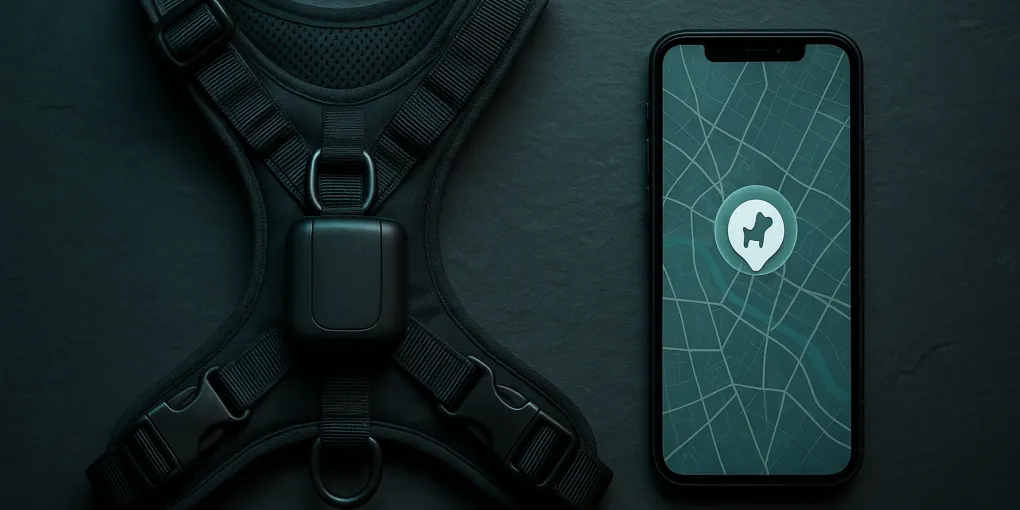
Fi Series 3 GPS Dog Tracker
Best OverallNetwork: LTE-M + Fi Community
~$149 + $9.99/mo
Quick Comparison
| Product | Key Specs | Price Range | Buy |
|---|---|---|---|
| |
| ~$149 + $9.99/mo | Check Price |
| |
| ~$49.99 + $5/mo | Check Price |
| |
| ~$99 + $10/mo | Check Price |
| |
| ~$79 + $9.95/mo | Check Price |
Contains affiliate links — we may earn a small commission at no extra cost to you.
Best Dog GPS Harness in 2026
The best dog GPS tracker for most owners is the Fi Series 3 (PSR 4.6/5) — a LTE-M GPS tracker with a 3-month battery life, IP68 waterproofing, built-in step and activity monitoring, and access to the Fi Community Network that extends location detection in urban and suburban areas. Its combination of category-leading battery life and reliable GPS accuracy make it the clear Best Overall at $149 plus a $9.99/month subscription. For owners who want the lowest total cost of ownership, the Tractive GPS Dog Tracker (PSR 4.3/5) delivers solid real-time GPS at the lowest subscription rate in the category at $5/month.
TL;DR
- Best Overall: Fi Series 3 — 3-month battery, IP68, LTE-M + community network (PSR 4.6/5)
- Best Budget GPS: Tractive — lowest subscription ($5/mo), solid 4G LTE accuracy (PSR 4.3/5)
- Best Health Monitoring: Whistle GO Explore — behavior-level activity detection, 20-day battery (PSR 4.4/5)
- Best Style: Link AKC — LED safety light, premium design, Alexa integration (PSR 4.2/5)
What Separates a Good GPS Dog Tracker from a Marketing Device
The GPS dog tracker market is crowded with devices that promise real-time location but differ significantly in the factors that matter during an actual escape event.
Battery life is the most underrated safety feature. A GPS tracker that’s dead because the owner forgot to charge it last night provides zero safety value. The Fi Series 3’s 3-month battery changes the product’s relationship with the owner entirely — it becomes a passive safety layer that requires occasional attention rather than a daily or weekly charging obligation. Tractive’s 30-day power-save mode (with the caveat that real-time tracking reduces this to 2–5 days) requires more active management.
Network coverage determines real-world accuracy. All four products are cellular trackers, meaning their accuracy depends on the cellular network available in your area. LTE-M (Fi) and 4G LTE (Tractive, Whistle, Link AKC) both provide good suburban and rural coverage, but coverage maps vary. Before purchasing, check whether AT&T or T-Mobile coverage is stronger in your area — Whistle and Link AKC depend on AT&T specifically, which may underperform in some regions.
Activity monitoring adds health value beyond GPS. The Whistle GO Explore’s accelerometer tracks licking, scratching, eating, and drinking patterns — behaviors that can indicate allergies, anxiety, or early illness. This converts the GPS tracker from a recovery tool into a daily health monitoring tool, which justifies its subscription cost for owners who also consult their vet about behavioral changes.
Total cost of ownership matters more than device price. The cheapest device in this review (Tractive at $49.99) combined with its lowest subscription ($5/mo) totals $169.88 in year one and $60/year thereafter. The most expensive combination (Fi at $149 + $119.88/year) totals $268.88 year one. Over three years, the difference is meaningful — especially for owners deciding between GPS and other smart pet tools like a dog smart feeder or a pet camera treat dispenser.
1. Fi Series 3 GPS Dog Tracker — Best Overall
Key Specs
- Network: LTE-M cellular + Fi Community Bluetooth network
- Battery life: Up to 3 months (standard mode)
- Waterproof rating: IP68
- Activity monitoring: Step count, rest, distance
- Harness: Clip attachment; collar version also available
- Weight: ~38g
| Criterion | Weight | Score | Weighted |
|---|---|---|---|
| Safety | 25% | 9.0 | 2.250 |
| Durability | 20% | 9.5 | 1.900 |
| Pet Comfort | 20% | 9.0 | 1.800 |
| Value for Money | 20% | 8.5 | 1.700 |
| Ease of Use | 15% | 9.5 | 1.425 |
| Composite | 9.075 | ||
| PSR Score | 4.6/5 |
Safety (9.0/10): The Fi Series 3’s safety score reflects its dual-network approach: LTE-M cellular provides primary GPS location, while the Fi Community Network — built on Bluetooth receivers at millions of Fi-user homes — provides secondary passive detection when a lost dog passes near any Fi user. This layered approach means a dog that escapes into a residential neighborhood has both GPS and community detection working simultaneously. IP68 rating means total waterproofing for swimming and submersion, eliminating failure risk in rain or water features.
Durability (9.5/10): Owner reports spanning 2+ years of daily outdoor use consistently describe the Fi Series 3 surviving rough play, swimming, trail runs, and the general wear of active dogs without failure. The IP68 housing is robust; no reported issues with charging port corrosion even after repeated swimming exposure. The 3-month battery cycle means the device is handled less frequently than competitors, which reduces wear from repeated charging contacts.
Pet Comfort (9.0/10): At 38g, the Fi Series 3 is light enough for dogs over 10 lbs without creating a noticeable harness load imbalance. The clip design attaches flush to harness webbing without dangling hardware that could catch on brush or fencing. Owner reports of dogs ignoring the device within the first few minutes of wearing it are common. For owners who also use a dog activity tracker for detailed behavioral monitoring, the Fi’s step-count data provides a complementary data point.
Value for Money (8.5/10): At $149 device plus $9.99/month, the Fi is not the cheapest option but delivers the highest functional value per dollar when battery life is factored in. A dog that escapes at 2:00 AM and is found at 6:00 AM via GPS — a scenario described in multiple owner reviews — represents a return on investment that exceeds years of subscription costs in a single event.
Ease of Use (9.5/10): The Fi app is polished, intuitive, and well-maintained with regular feature updates. Geo-fencing setup takes under 5 minutes. The LED indicator on the device confirms connectivity without requiring the app. The 3-month battery cycle means charging is an infrequent task rather than a daily routine. Lost Dog Mode, activated from the app, increases tracking frequency during an active escape event.
Pros:
- 3-month battery eliminates daily charging obligation
- Fi Community Network adds secondary detection layer
- IP68 waterproofing for swimming and submersion
- Polished app with geo-fencing and Lost Dog Mode
Cons:
- Highest device cost in the review ($149)
- Subscription required for all features
- Activity monitoring less detailed than Whistle GO Explore
2. Tractive GPS Dog Tracker — Best Budget GPS
Key Specs
- Network: 4G LTE cellular (global SIM)
- Battery life: 2–5 days (real-time mode) / up to 30 days (power-save mode)
- Waterproof rating: IP67
- Activity monitoring: Distance, active minutes, sleep quality
- Weight: ~35g (lightest in review)
| Criterion | Weight | Score | Weighted |
|---|---|---|---|
| Safety | 25% | 9.0 | 2.250 |
| Durability | 20% | 8.5 | 1.700 |
| Pet Comfort | 20% | 8.5 | 1.700 |
| Value for Money | 20% | 9.5 | 1.900 |
| Ease of Use | 15% | 8.5 | 1.275 |
| Composite | 8.825 | ||
| PSR Score | 4.3/5 |
Safety (9.0/10): Tractive’s 4G LTE coverage provides reliable GPS tracking in suburban and rural environments with good carrier coverage. The global SIM is a practical safety feature for owners who travel internationally with their dogs — no need to source a local tracker for European travel. IP67 provides rain and splash protection with limited submersion capability (1 meter for 30 minutes). The safety limitation is battery management: real-time mode depletes the battery in 2–5 days, and owners who forget to charge after an active-tracking period may find the device depleted during a subsequent escape event.
Durability (8.5/10): The Tractive housing is compact and holds up well to normal dog-life wear. The global SIM card is sealed inside the unit and requires no owner management. Some owner reports note charging port wear after 12–18 months of daily charging cycles in real-time mode — a concern worth noting for high-activity dogs that keep the tracker in real-time mode continuously. The device itself has a multi-year track record with no widespread hardware failure reports.
Pet Comfort (8.5/10): At 35g, the Tractive is the lightest device in this review — a meaningful advantage for smaller dogs (10–20 lbs) or dogs that are weight-sensitive to harness attachments. The compact form factor allows attachment to a wider range of harness D-ring sizes. For owners also managing a dog GPS fence system as a boundary layer, the Tractive provides a cost-effective live-tracking companion.
Value for Money (9.5/10): The Tractive delivers the lowest total cost of ownership in this review. At $49.99 device plus $5/month subscription, the 2-year total is $169.88 — compared to $388.76 for the Fi at the same period. For owners who primarily need GPS escape-recovery and are comfortable with manual charging management, the Tractive represents exceptional value. The subscription cost savings alone ($4.99/month versus Fi) fund a separate indoor pet camera within 10 months.
Ease of Use (8.5/10): The Tractive app is well-designed with geo-fencing, location history, and real-time tracking mode accessible from the home screen. Power-save vs. real-time mode switching requires manual app action — a minor friction point compared to the Fi’s more automatic power management. Battery status is clearly displayed in the app.
Pros:
- Lowest subscription cost ($5/mo) in the category
- Lightest device (35g) — best for smaller dogs
- Global SIM for international travel
- Clean, intuitive app with geo-fencing
Cons:
- Battery life in real-time mode (2–5 days) requires active charging management
- No community detection network like Fi
- Activity monitoring less detailed than Whistle
3. Whistle GO Explore GPS — Best Health Monitoring
Key Specs
- Network: AT&T/T-Mobile LTE
- Battery life: Up to 20 days
- Waterproof rating: IP67
- Activity monitoring: Walking, running, licking, scratching, eating, drinking, rest
- Monthly health reports: Yes
- Weight: ~45g
| Criterion | Weight | Score | Weighted |
|---|---|---|---|
| Safety | 25% | 9.0 | 2.250 |
| Durability | 20% | 8.5 | 1.700 |
| Pet Comfort | 20% | 9.0 | 1.800 |
| Value for Money | 20% | 8.5 | 1.700 |
| Ease of Use | 15% | 9.0 | 1.350 |
| Composite | 8.800 | ||
| PSR Score | 4.4/5 |
Safety (9.0/10): Whistle’s dual-network LTE coverage (AT&T and T-Mobile) provides broad U.S. geographic reach. The 20-day battery life is a meaningful safety improvement over Tractive’s real-time mode, as it requires less frequent user intervention to maintain operational status. The health monitoring layer adds a second dimension of safety: owner reports note that Whistle alerts for increased licking or scratching behavior have identified early allergy episodes and paw injuries before they were visually noticed. This behavior-detection capability is a safety feature distinct from GPS — it’s an early warning system for health issues.
Durability (8.5/10): The Whistle GO Explore has a multi-year presence in the U.S. market with a consistent hardware track record. IP67 rating covers normal dog life including swimming. The 20-day battery cycle means a moderate charging frequency — roughly monthly, which is manageable without creating owner fatigue. Some reports note the rubber housing develops surface wear after extended outdoor use, though structural integrity is maintained.
Pet Comfort (9.0/10): The Whistle’s accelerometer-based behavior tracking adds value to the pet-wear experience — it converts the device from a passive location beacon to an active health sensor. Owner reports consistently describe this feature as the primary reason they chose Whistle over Fi or Tractive. For owners also using a smart pet health monitor, Whistle’s behavioral data layer complements biometric health data meaningfully.
Value for Money (8.5/10): At $99 device plus $10/month, Whistle’s 2-year total is $339 — comparable to Fi but with the added value of behavior-level health monitoring. For owners who would otherwise pay separately for a basic activity tracker and a GPS tracker, the Whistle consolidates both functions. The monthly health report generated by the app adds veterinary-conversation value that neither Fi nor Tractive offers.
Ease of Use (9.0/10): The Whistle app is one of the most polished in the category, with clear dashboards for both GPS location and health activity data. Monthly health reports are auto-generated and can be emailed directly to a veterinarian. Geo-fencing setup is intuitive. Battery status and network connectivity are displayed prominently.
Pros:
- Advanced behavior monitoring (licking, scratching, eating, drinking)
- Monthly health reports for veterinary discussions
- Dual-network LTE coverage (AT&T + T-Mobile)
- 20-day battery is a good middle ground
Cons:
- Higher subscription cost ($10/mo) among options
- AT&T/T-Mobile coverage may underperform in some regions
- No community network detection like Fi
4. Link AKC Smart Collar — Best Style
Key Specs
- Network: AT&T LTE
- Battery life: ~8 hours GPS-on / 3–5 days standby
- Waterproof rating: IPX7
- Activity monitoring: Steps, distance, calories
- LED safety light: Yes (app-controlled)
- Alexa integration: Yes
- Weight: ~42g
| Criterion | Weight | Score | Weighted |
|---|---|---|---|
| Safety | 25% | 9.0 | 2.250 |
| Durability | 20% | 7.5 | 1.500 |
| Pet Comfort | 20% | 8.5 | 1.700 |
| Value for Money | 20% | 8.0 | 1.600 |
| Ease of Use | 15% | 8.5 | 1.275 |
| Composite | 8.325 | ||
| PSR Score | 4.2/5 |
Safety (9.0/10): The Link AKC’s LED light feature — controllable from the app — is a genuine safety differentiator for nighttime walks and early morning exercise. A blinking light visible to cars and cyclists adds an active safety layer that no other product in this review provides. GPS tracking via AT&T LTE provides standard cellular location. Temperature alerts sent to the owner’s phone when ambient temperature reaches set thresholds add environmental safety monitoring.
Durability (7.5/10): The Link AKC scores lower on durability than its competitors primarily due to battery life. An 8-hour GPS-on battery means the device requires daily charging for owners using GPS tracking regularly. Verified owner reports contain a consistent thread of frustration with the short battery runtime, and daily charging cycles accelerate battery degradation over a 2-year ownership window. The IPX7 waterproof rating is adequate for rain and splashing but does not cover extended submersion — swimming dogs should note this limitation.
Pet Comfort (8.5/10): The Link AKC has the most refined visual design in this review, which translates to lighter, more streamlined hardware. Owner reports note high dog acceptance with minimal adjustment period. The LED light is mounted in a position that does not interfere with normal harness or collar wear. For urban dog owners who walk in traffic-heavy areas at night, the LED benefit is genuinely appreciated. Owners who also want to monitor their dog’s indoor activity can pair the Link AKC with a pet camera treat dispenser for a full-coverage urban smart pet setup.
Value for Money (8.0/10): At $79 device plus $9.95/month, the Link AKC’s 2-year cost is $318 — reasonable in the context of this category. However, the short GPS battery life limits the utility of the GPS function for owners who don’t charge daily, making the effective value dependent on whether owners can commit to that charging routine. The LED light and Alexa integration add value for specific owner segments.
Ease of Use (8.5/10): The app is well-designed with a clean interface. LED light control from the app is a practical feature that works reliably. Alexa integration allows voice-activated location checks — a minor but appreciated convenience for hands-free use. The required daily charging for GPS users is the primary usability friction point.
Pros:
- LED safety light controllable via app
- Sleekest design in the category
- Temperature alert feature
- Alexa voice integration
Cons:
- 8-hour GPS-on battery requires daily charging
- AT&T-only coverage limits rural performance
- No community network or advanced behavior monitoring
Full Comparison Table
| Product | Badge | Price | Network | Battery | Waterproof | PSR Score |
|---|---|---|---|---|---|---|
| Fi Series 3 | Best Overall | $149 + $9.99/mo | LTE-M + Community | 3 months | IP68 | 4.6/5 |
| Tractive | Best Budget GPS | $49.99 + $5/mo | 4G LTE | 2–5d / 30d | IP67 | 4.3/5 |
| Whistle GO Explore | Best Health Monitoring | $99 + $10/mo | AT&T/T-Mobile | 20 days | IP67 | 4.4/5 |
| Link AKC | Best Style | $79 + $9.95/mo | AT&T | 8h GPS-on | IPX7 | 4.2/5 |
Which Dog GPS Tracker Is Right for You?
You want the lowest maintenance GPS system for an escape-prone dog: The Fi Series 3 is the right choice. Its 3-month battery means the tracker is reliably operational without daily attention, which is the single most important functional attribute for a safety device.
You’re on a tight budget and want reliable escape-recovery GPS: The Tractive delivers solid 4G LTE tracking at the lowest subscription cost in the category. Commit to weekly charging in real-time mode or monthly charging in power-save mode and it serves the core GPS function well.
You want GPS plus health monitoring for a dog with allergies or behavioral concerns: The Whistle GO Explore is the right investment. Its behavior-detection layer and monthly health reports add health insight that none of the other products provide, making the $10/month subscription arguably the most comprehensive value in the category.
You prioritize nighttime safety and style for urban walks: The Link AKC’s LED light and premium design serve urban dog owners who walk in low-visibility conditions. Commit to daily charging and the GPS function works; those unwilling to charge daily should look at Fi or Whistle.
Frequently Asked Questions
Do dog GPS trackers work without cell service?
GPS trackers require a cellular data connection to transmit location to your phone. In areas without cell coverage, some trackers — including the Fi Series 3 — maintain GPS coordinates locally and sync when connectivity is restored. The Fi Community Network also uses Bluetooth base stations to provide passive detection in urban and suburban areas. No current tracker provides real-time updates in remote areas with zero cell coverage.
How does a GPS harness attachment work?
Most GPS dog trackers clip onto a standard harness D-ring or attach to a collar. The tracker device (30–75g) has a plastic or rubber clip that slides onto harness webbing or a D-ring. Fi Series 3, Tractive, and Whistle all ship with clip attachments compatible with standard harnesses.
Is a GPS tracker subscription worth it?
For high-escape-risk breeds (Huskies, Beagles, Greyhounds) or dogs that roam rural properties, the subscription cost is easily justified by one successful recovery. For low-escape-risk urban dogs, the value depends on personal priorities. Subscription costs range from $5/month (Tractive) to $10/month (Whistle) — at $60–$120/year, they are modest compared to veterinary search and emergency care costs associated with a lost dog.
What is the most accurate GPS dog tracker?
GPS accuracy among cellular trackers is primarily determined by network quality in your location. Fi Series 3 (LTE-M) and Tractive (4G LTE) earn the best real-world accuracy marks in owner reports, consistently placing dogs within 10–30 feet in suburban and rural areas. Urban environments with tall buildings reduce accuracy across all brands.
Can I use a GPS tracker on a small dog?
Most GPS trackers recommend a minimum weight of 8–10 lbs. The Tractive is the lightest in this review at 35g and is best suited for dogs approaching this minimum threshold. For dogs under 8 lbs, a bluetooth pet tracker may be a more appropriate primary tracking method.
Final Verdict
For most dog owners, the Fi Series 3 (PSR 4.6/5) sets the benchmark in this category — its 3-month battery eliminates the most common GPS tracker failure mode (dead battery when it’s needed most), its IP68 waterproofing handles any weather, and its community network adds a secondary recovery layer that no competitor matches. Health-conscious owners who want behavior monitoring beyond GPS should invest in the Whistle GO Explore (PSR 4.4/5), which adds licking, scratching, and eating behavior tracking that can detect early health changes. Budget-focused owners will find the Tractive (PSR 4.3/5) a capable daily driver at the lowest subscription cost in the category. And for urban owners who walk at night and value design, the Link AKC (PSR 4.2/5) delivers an LED safety light and refined form factor — just plan on daily charging.
Frequently Asked Questions
- GPS trackers require a cellular data connection to transmit location to your phone. In areas without cell coverage, some trackers — including the Fi Series 3 — maintain GPS coordinates locally and sync when connectivity is restored. The Fi Community Network also uses Bluetooth base stations at Fi-user homes to provide passive detection in urban and suburban areas. No current tracker provides real-time updates in remote areas with zero cell coverage; plan accordingly for true backcountry use.
- Most GPS dog trackers sold today are designed to clip onto a standard harness D-ring or attach to a collar. The tracker device itself is a small module (30–75g) with a plastic or rubber clip that slides onto harness webbing or a D-ring. Fi Series 3, Tractive, and Whistle all ship with clip attachments compatible with standard harnesses. Verify clip compatibility with your specific harness hardware before purchasing.
- GPS trackers require a cellular subscription to transmit location data in real-time. Subscriptions range from $5/mo (Tractive) to $10/mo (Whistle). Over a 2-year ownership window, subscription costs add $120–$240 to total cost of ownership. For owners of high-escape-risk breeds (Huskies, Beagles, Greyhounds) or dogs that roam rural properties, the subscription cost is easily justified by one successful recovery. For low-escape-risk urban dogs, the value calculus depends on personal peace-of-mind priorities.
- GPS accuracy among current cellular trackers is primarily determined by network quality rather than hardware differences. Fi Series 3 (LTE-M) and Tractive (4G LTE) earn the best real-world accuracy marks in owner reports, consistently placing dogs within 10–30 feet in suburban and rural areas. Urban environments with tall buildings can reduce accuracy across all brands. None of the current trackers achieve the precision of dedicated survey GPS equipment.
- Minimum weight recommendations vary: most GPS trackers are not recommended for dogs under 8–10 lbs due to device weight relative to body size. The Tractive is the lightest of the four reviewed products (~35g) and is the best option for smaller dogs at or above the 10 lb threshold. For dogs under 8 lbs, consider a smaller Bluetooth tracker as a companion to a GPS tracker on a larger dog in the household.