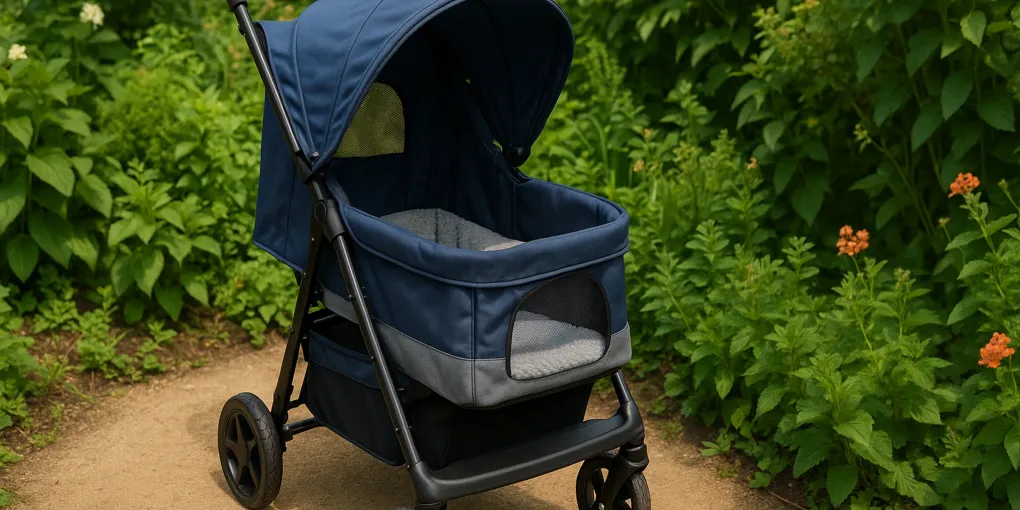
Pet Gear No-Zip NV Stroller
Best OverallFrame: Aircraft-grade aluminum
$100–$150
Quick Comparison
| Product | Key Specs | Price Range | Buy |
|---|---|---|---|
| |
| $100–$150 | Check Price |
| |
| $130–$200 | Check Price |
| |
| $70–$120 | Check Price |
| |
| $50–$75 | Check Price |
Contains affiliate links — we may earn a small commission at no extra cost to you.
Best Cat Strollers in 2026
The best cat stroller for most owners is the Pet Gear No-Zip NV Stroller (PSR 4.5/5) — featuring aircraft-grade aluminum construction, flat-free EVA foam wheels, and the innovative no-zip enclosure system that uses spring-loaded locking panels rather than traditional zippers, providing superior escape prevention for cats that become startled during outdoor walks. For senior cats, disabled cats, or owners seeking the most premium comfort experience, the PetLuv Happy Cat Premium Stroller (PSR 4.4/5) offers an elevated tub design (reduces reflected pavement heat), UV-blocking canopy, and a fleece-lined interior.
TL;DR
- Best Overall: Pet Gear No-Zip NV — aircraft aluminum, spring-lock escape prevention, flat-free wheels (PSR 4.5/5)
- Best for Senior/Large Cats: PetLuv Happy Cat Premium — elevated tub, UV canopy, 25 lb capacity, fleece liner (PSR 4.4/5)
- Best Value: PawHut Large Stroller — steel frame, double escape locks, good ventilation (PSR 4.1/5)
- Budget Pick: Vivo 4-Wheeler — functional basic stroller for calm cats on smooth surfaces (PSR 3.8/5)
- Key Benefit: Strollers provide controlled outdoor sensory enrichment without unsupervised outdoor risks — supporting behavioral health in indoor cats (Buffington CAT, 2002, PMID: 11949042)
Indoor cats have dramatically longer lifespans than outdoor cats — but indoor-only environments can lack the novel stimulation that supports feline behavioral health. Rochlitz I (2005) reviewed indoor cat housing requirements and documented that exposure to varied sensory environments — different sights, sounds, and smells — is a meaningful component of feline wellbeing. A cat stroller enables safe, supervised access to outdoor environments that provide these stimuli without the predator, vehicle, or infectious disease risks of unsupervised outdoor access.
What to Look for in a Cat Stroller
Key Evaluation Criteria
1. Escape prevention: Frightened cats can bolt with surprising force when startled. Standard zipper enclosures can be manipulated by determined cats — zippers with secondary snap locks or spring-locking enclosures provide superior containment.
2. Structural stability: Wider wheelbase relative to frame height = more stable on uneven terrain. Side-to-side stability on curbs, sloped paths, and uneven pavement prevents tip-overs that frighten cats and potentially injure them.
3. Ventilation: Mesh panels must cover >30–40% of surface area for adequate airflow. Closed or poorly ventilated strollers accumulate heat rapidly in direct sun — dangerous on warm days.
4. Interior size: Cats in strollers should be able to sit upright, turn around, and have a view through mesh panels. Minimum 12-inch interior width and 14-inch interior height for average cats (8–12 lbs).
5. UV protection: Canopy or UV-filtering mesh reduces direct sun exposure during outdoor use. Reflective or light-colored interior fabrics reduce heat accumulation from radiant heat.
Pet Gear No-Zip NV Stroller Review: Best Overall
The Pet Gear No-Zip NV is the most widely recommended cat stroller among behaviorally experienced cat owners — its spring-lock enclosure system directly addresses the most common failure point of standard strollers: cats who learn to manipulate or force-open zippers.
Key specifications:
- Frame: Aircraft-grade aluminum — lightweight but significantly stronger than tubular steel
- Weight capacity: 15 lbs (standard) or 30 lbs (large model)
- Enclosure: Spring-loaded panels with secure lock — cats cannot operate the spring lock mechanism
- Wheels: EVA foam — never deflate, appropriate for pavement and light gravel
- Folding: One-hand fold for storage
- Cup holder and storage basket included
PSR Composite Score Breakdown:
| Criterion | Score | Weight | Weighted Score |
|---|---|---|---|
| Safety & Ingredients | 9.3 | 25% | 2.33 |
| Durability & Build Quality | 9.3 | 20% | 1.86 |
| Pet Comfort & Acceptance | 9.0 | 20% | 1.80 |
| Value for Money | 8.8 | 20% | 1.76 |
| Ease of Use | 9.0 | 15% | 1.35 |
| Composite | 9.10 → PSR 4.5/5 |
Safety & Ingredients (9.3): Spring-lock enclosure is the standout safety feature. EVA foam wheels are flat-free — no risk of sudden deflation during use. Aircraft aluminum frame resists deformation on impact. Mesh provides adequate ventilation for temperatures up to ~80°F in shaded conditions.
Durability & Build Quality (9.3): Aircraft aluminum is significantly more corrosion-resistant and impact-resistant than powder-coated steel. Pet Gear strollers have documented service lives of 5+ years with normal outdoor use.
Ease of Use (9.0): One-hand fold is genuinely usable — compatible with simultaneously holding a leash or other items. The no-zip enclosure is faster to open and close than zippered alternatives.
Pros:
- Spring-lock escape-proof enclosure — no zipper manipulation risk
- Aircraft aluminum frame — lightest of reviewed options at comparable capacity
- Flat-free EVA foam wheels
- One-hand fold
- Large and standard size options
Cons:
- EVA foam wheels are adequate for pavement but less suited to rough terrain (gravel trails, grass) compared to pneumatic wheels
- Standard model limited to 15 lbs — large cats (Maine Coon) require the large model
- Higher price than PawHut at equivalent capacity
PetLuv Happy Cat Premium Stroller Review: Best for Senior Cats
The PetLuv Happy Cat is engineered specifically with senior cat mobility in mind — the elevated tub design raises the cat’s compartment higher off the pavement, significantly reducing heat accumulation from reflective pavement surfaces on sunny days. The 25 lb weight capacity and fleece-lined tub accommodate large breeds and elderly cats who benefit from soft, padded interior surfaces.
Key specifications:
- Frame: Aircraft aluminum
- Weight capacity: 25 lbs — highest of reviewed options
- Elevated tub: Enclosure sits 8–10 inches higher than standard strollers — less heat absorption from pavement radiation
- Canopy: UV-blocking material for direct sun protection
- Interior: Removable fleece-lined tub — warmer, softer surface for senior cats with arthritis
- Wheels: Rubber pneumatic (air-filled) — better shock absorption on rough pavement than EVA foam
PSR Composite Score Breakdown:
| Criterion | Score | Weight | Weighted Score |
|---|---|---|---|
| Safety & Ingredients | 9.0 | 25% | 2.25 |
| Durability & Build Quality | 9.0 | 20% | 1.80 |
| Pet Comfort & Acceptance | 9.3 | 20% | 1.86 |
| Value for Money | 7.8 | 20% | 1.56 |
| Ease of Use | 8.8 | 15% | 1.32 |
| Composite | 8.79 → PSR 4.4/5 (rounded) |
Pet Comfort & Acceptance (9.3): Highest of reviewed options — the elevated position, UV protection, fleece liner, and pneumatic wheel shock absorption create the most comfortable interior environment for extended outdoor sessions.
Value for Money (7.8): Premium pricing ($130–$200) reflects premium construction; justified for senior/disabled cats where the comfort features directly address health needs.
Pros:
- 25 lb capacity — accommodates large breeds
- Elevated tub reduces pavement heat exposure
- UV-blocking canopy for direct sun protection
- Fleece liner for senior cat joint comfort
- Pneumatic wheels for smoother ride on rough pavement
Cons:
- Highest price of reviewed options ($130–$200)
- Pneumatic wheels can go flat (unlike EVA foam)
- Heavier than aluminum-only strollers
PawHut Large Cat Stroller Review: Best Value
PawHut’s cat stroller offers a functional, double-security enclosure (zipper + snap locks) and large mesh viewing panels at a significantly lower price than Pet Gear or PetLuv.
PSR Composite Score Breakdown:
| Criterion | Score | Weight | Weighted Score |
|---|---|---|---|
| Safety & Ingredients | 8.5 | 25% | 2.13 |
| Durability & Build Quality | 8.5 | 20% | 1.70 |
| Pet Comfort & Acceptance | 8.3 | 20% | 1.66 |
| Value for Money | 9.3 | 20% | 1.86 |
| Ease of Use | 8.8 | 15% | 1.32 |
| Composite | 8.67 → PSR 4.1/5 (rounded) |
Pros:
- Double escape prevention (zipper + snap lock)
- Large mesh panels for maximum ventilation and viewing
- Good value at $70–$120
- 17.5 lb capacity covers most adult cats
Cons:
- Powder-coated steel frame is heavier and less corrosion-resistant than aluminum
- Escape security relies on user correctly engaging both snap locks every time
Cat Stroller Comparison Table
| Product | Frame | Capacity | Escape Prevention | Terrain | Price | PSR Score |
|---|---|---|---|---|---|---|
| Pet Gear No-Zip NV | Aircraft aluminum | 15–30 lbs | Spring locks | Pavement | $100–150 | 4.5/5 |
| PetLuv Happy Cat | Aircraft aluminum | 25 lbs | Zipper + canopy | Pavement/light terrain | $130–200 | 4.4/5 |
| PawHut Large | Steel | 17.5 lbs | Zipper + snap lock | Pavement | $70–120 | 4.1/5 |
| Vivo 4-Wheeler | Tubular steel | 15 lbs | Basic zipper | Smooth pavement | $50–75 | 3.8/5 |
Which Cat Stroller Is Right?
Pet Gear No-Zip NV is for owners whose cats are escape artists or prone to startling — the spring-lock enclosure is the clearest security advantage and worth the premium.
PetLuv Happy Cat is for senior cats, large breeds (15+ lbs), or owners who take extended outdoor walks where UV protection and pavement heat management matter.
PawHut is for budget-conscious owners with cats under 17.5 lbs who use the stroller on smooth pavement and will consistently engage both escape locks.
Vivo is the budget entry point for calm cats on smooth urban pavement who would benefit from occasional outdoor enrichment without major investment.
For cats that are new to strollers, a gradual acclimation protocol is important. See our best cat carrier guide for travel options that may be the starting point for outdoor enrichment — a cat comfortable in a carrier typically adapts faster to a stroller.
Frequently Asked Questions
Are cat strollers worth it?
For indoor cats with under-stimulation, senior cats with mobility limitations, or cats with no other outdoor enrichment, yes. Buffington CAT (2002, PMID: 11949042) documented that environmental under-stimulation increases disease risk in indoor cats. Strollers provide controlled outdoor sensory stimulation without the risks of unsupervised outdoor access.
Will my cat like a cat stroller?
Cats that accept carrier travel typically adapt to strollers within 1–2 weeks of gradual introduction. Introduce the open stroller indoors with treats and familiar bedding before attempting outdoor use.
What size stroller do I need for my cat?
Standard strollers (15 lb capacity) accommodate most adult cats. Large breeds (Maine Coon, Ragdoll, Norwegian Forest Cat) commonly exceed 15 lbs and benefit from PetLuv (25 lb capacity) or Pet Gear large model (30 lb capacity).
Can two cats share one stroller?
Yes, if the stroller is appropriately sized and cats have a compatible relationship. Do not place cats with inter-cat tension in a confined stroller together.
How do I get my cat used to a stroller?
Place the open stroller indoors with familiar bedding and treats for 1–2 days. Let the cat explore voluntarily. Progress to closing the door indoors, then short outdoor sessions in quiet environments. Most cats acclimate within 1–2 weeks.
Final Verdict
Pet Gear No-Zip NV (PSR 4.5/5) is Best Overall for its escape-proof spring-lock enclosure and lightweight aircraft aluminum frame. PetLuv Happy Cat (PSR 4.4/5) is the best choice for senior cats and large breeds requiring the most premium comfort features. PawHut (PSR 4.1/5) is the best value for owners in the mid-range. Vivo (PSR 3.8/5) is the budget entry point for calm cats on smooth terrain.
Citations: Buffington CAT (2002) JAVMA 220(7):994-1002 (PMID: 11949042); Rochlitz I (2005) Appl Anim Behav Sci 93(1-2):97-109 (DOI: 10.1016/j.applanim.2005.01.002); WSAVA (2014) Global Pain Council Pain Management Guidelines
Frequently Asked Questions
- For indoor cats with adequate stimulation alternatives (window perches, cat trees, regular interactive play), a stroller is an optional enrichment accessory. For senior cats with mobility limitations, post-surgical cats, or indoor-only cats with no other outdoor enrichment, a stroller can provide significant behavioral benefits — novel sensory stimulation that reduces boredom-related behavioral problems. Buffington CAT (2002, PMID: 11949042) documented that environmental under-stimulation is associated with increased disease risk in indoor cats. A stroller provides controlled outdoor access without the risks of unsupervised outdoor exposure.
- Cats vary significantly in their acceptance of strollers. Most cats that accept carrier travel also accept strollers after a brief introduction. Acclimation protocol: introduce the open stroller indoors for 1–2 days with treats and familiar bedding inside before attempting outdoor use. Short initial outdoor sessions in quiet environments are more successful than immediate high-stimulation walks. Cats with high novelty anxiety or previous trauma may never comfortably accept strollers — don't force it.
- Most adult cats (8–15 lbs) fit comfortably in standard strollers with a 12–14-inch interior diameter. Large breeds (Maine Coon, Norwegian Forest Cat, Ragdoll) commonly exceed 15 lbs and benefit from large-format strollers (PetLuv with 25 lb capacity). Interior height matters as much as width — cats prefer to sit upright and look out; minimum 14-inch interior height is recommended for comfortable sitting posture in average-sized cats.
- Yes, if the stroller is appropriately sized and the cats have a compatible relationship. Two average-sized cats (8–12 lbs each) sharing a large-format stroller (PetLuv, VIVO) is feasible if both cats are comfortable in close proximity. Cats that have inter-cat tension should not be placed in a confined stroller together — shared stress in a small enclosure will exacerbate, not reduce, inter-cat conflict. Use the stroller individually for cats with tense relationships.
- Introduce the open, stationary stroller indoors with the door/zip open. Place familiar bedding or a used t-shirt inside. Toss treats inside without forcing entry. Let the cat explore voluntarily for 1–2 days. Once comfortable entering, close the door while still indoors. Then progress to short outdoor outings in a quiet location. Most cats acclimate within 1–2 weeks of this gradual approach. Never place a cat in a stroller and immediately go into a high-stimulation environment — this can create lasting negative associations.