COZIWOW 92.1-inch Modular Cat Tunnel
Best connector tunnelFormat: Extendable wooden tunnel
Quick picks
| Product | Key Specs |
|---|---|
| See price on Amazon |
|
| See price on Amazon |
|
| See price on Amazon |
|
| See price on Amazon |
|
Product availability, certifications, and retailer details can change; check the current Amazon page before buying.
Best outdoor cat enclosure: quick answer
The best outdoor cat enclosure is the one that keeps the cat in, keeps obvious hazards out, and still gives the cat a reason to use it. For most homes, that means a roofed metal or wood catio with secure doors, small gaps, stable shelves, and anchoring. A portable fabric tunnel can be useful for supervised yard time, but it should not be described as predator-resistant or left outside as a permanent catio.
Our connector pick is the COZIWOW 92.1-inch modular cat tunnel on Amazon. It can bridge a window, door, or separate catio, but it is not a standalone full enclosure. The PawHut 95-inch extra-large walk-in catio on Amazon is a better starting point if you need an enclosure you can enter for cleaning, shelf checks, and time with multiple cats.
August 2026 refresh check: the COZIWOW recommendation was narrowed to the exact verified 92.1-inch connector tunnel, and the walk-in recommendation now points to the exact verified PawHut 95-inch model. Other tagged Amazon paths remain category searches when an exact current listing cannot be established. Verify dimensions, roof, latch hardware, return terms, and price before buying.
This guide is safety-first because outdoor access has two sides. Cats benefit from environmental enrichment, including vertical space, scent, sun, and visual stimulation. The AAFP/ISFM feline environmental needs guidelines and the AVMA cat enrichment overview support giving cats safe ways to express natural behavior. But free-roaming and poorly secured outdoor setups expose cats to traffic, fights, infectious disease, falls, weather, parasites, and wildlife conflict. A catio is useful only if it controls those risks rather than moving them into a different shape.
Quick picks by setup
- Best connector tunnel: View the COZIWOW 92.1-inch modular cat tunnel on Amazon. Best for linking a window or existing catio; not a standalone enclosure.
- Best walk-in catio: View the PawHut 95-inch extra-large walk-in catio on Amazon. Best when you need human entry, multiple shelves, and easier cleaning.
- Best garden-style wood option: Search Amazon for Aivituvin wooden catios. Best for covered patios or mild climates where annual wood inspection is realistic.
- Best supervised portable option: Search Amazon for portable cat lawn enclosures. Best for short sessions with an owner present, not for unattended outdoor time.
What makes an outdoor cat enclosure safe?
Full containment comes first. A useful catio has no open top, no flexible gap at the door, no loose tunnel seam, no shelf close enough to help a cat push out a panel, and no corner that can lift in wind. If the cat can get its head, shoulder, or paw leverage into a gap, assume a motivated cat may keep working at it.
Predator resistance needs careful wording. A strong metal enclosure with a roof, small openings, and secure latch can reduce access by dogs, raccoons, birds of prey, and neighborhood wildlife. It is still not magic. Ground predators can dig, raccoons can manipulate weak latches, and wind can damage panels. If predators are common where you live, add ground anchoring, a secondary latch, and regular inspection.
Roof coverage matters for both escape control and overhead risk. Open-top exercise pens are not catios. A roof also limits sudden escape when a frightened cat climbs, jumps, or bolts.
Anchoring matters more than many product listings make it sound. Tall panels can act like a sail in a storm. A light enclosure on a deck, balcony, or uneven yard needs a clear anchoring plan before the cat uses it.
Enrichment matters after safety. A safe empty box is not enough. Cats need shade, vertical platforms, scratching surfaces, hiding spots, water access in warm weather, and an easy route back indoors when possible. For indoor enrichment that complements a catio, see our guides to cat trees for large cats and cat water fountains.
COZIWOW 92.1-inch modular cat tunnel: best connector tunnel
This exact COZIWOW listing is an extendable wooden tunnel measuring about 92.1 inches long. It is useful as a bridge between a window, door, or separate catio so a cat can move between spaces without being carried outside. It does not provide the occupied volume, human-access door, platforms, or full standalone footprint of a catio.
What to check before buying: confirm the 92.1-inch run fits the intended route, how both ends attach, whether gaps remain at the window or catio connection, and how the tunnel will be anchored against movement and weather.
Best fit: households that already have, or separately plan to install, a secure enclosure and need a modular connector from the home.
Watch-outs: do not treat the tunnel as a complete catio or predator-resistant shelter. Anchor it, inspect connector points after storms, add shade where needed, and supervise until the entire route has been proven escape-resistant.
PawHut 95-inch extra-large walk-in catio: best for multiple cats and cleaning access
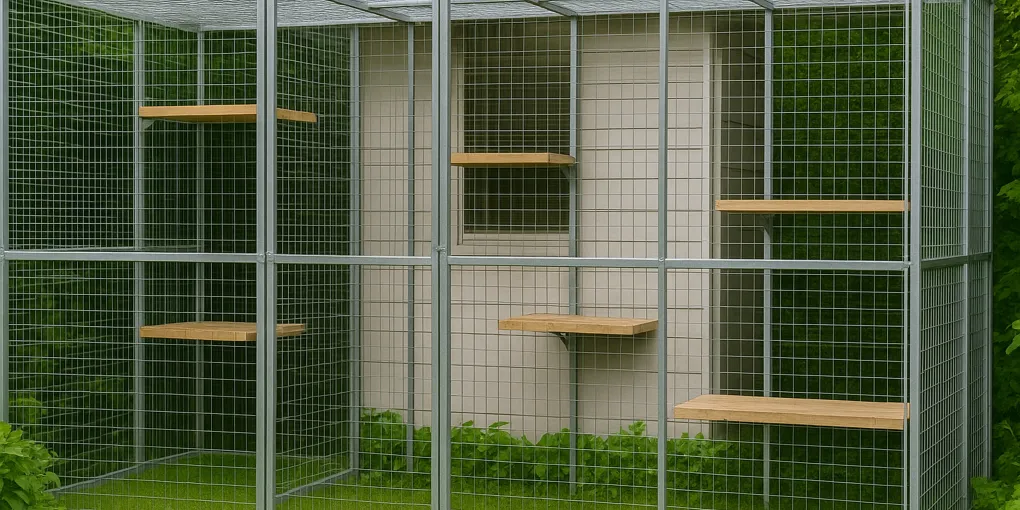
A walk-in enclosure solves two problems that small catio kits create: humans can enter, and cats can use more vertical space. Human entry matters because shelves, latches, floor panels, litter areas, and water bowls are easier to inspect when you do not have to crawl through a small door.
The exact linked PawHut model is a 95-inch extra-large walk-in catio. Its walk-in format is a better fit for multi-cat households, cats that need room to pass each other without conflict, and owners who want to sit inside the enclosure. It is also easier to add stable platforms, scratching surfaces, and shaded rest zones.
Best fit: a permanent yard location, multiple cats, and owners willing to spend more time on assembly.
Watch-outs: choose a level site, plan anchoring before use, and verify roof coverage. If the enclosure includes a weather cover, make sure heat can still escape and that cats always have shade and water.
Aivituvin wooden outdoor catio: best garden-style option
A wood catio can look more like garden furniture than a metal cage, which matters if the enclosure will sit near a patio or window. Aivituvin-style wooden cat houses often include platforms, roof panels, and a more home-integrated look than wire-only kits.
The trade-off is maintenance. Wood can swell, rot, split, or loosen around screws. Mesh staples or panel fasteners can loosen over time. If you choose wood, inspect it after heavy rain and at least seasonally. Keep it off constantly wet ground and reseal or repair as needed with pet-appropriate products.
Best fit: covered patios, mild climates, supervised or semi-permanent setups, and owners who care about appearance.
Watch-outs: do not rely on a decorative wood hutch as a high-security predator barrier unless the mesh, latches, roof, floor, and fasteners are all strong enough for your location.
Portable mesh lawn enclosures: best only with supervision
Portable mesh tunnels and pop-up enclosures are useful for travel, apartment dwellers with access to a safe yard, or cats that are being introduced gradually to outdoor sounds and smells. They are not the same thing as a permanent catio.
The main advantage is low commitment. You can set one up, sit beside it, watch how the cat reacts, and pack it away. The main limitation is also clear: fabric or nylon mesh can tear, collapse, shift, or be breached by another animal. Use portable enclosures only when you are present and the weather is calm.
Best fit: short supervised sessions, travel, and testing whether a cat enjoys outdoor enrichment before investing in a larger structure.
Watch-outs: never leave a cat alone in a fabric pop-up, never place it in direct hot sun without shade, and do not use it on an open balcony unless it is part of a fully enclosed fall-safe system.
Balcony and window catio cautions
Balconies require stricter rules than yards. A fall from height can be fatal, and many railing barriers leave gaps that cats can squeeze through. A safe balcony catio needs full enclosure on all sides, a roof or top barrier, no tip risk, no gaps at the rail, and building permission. Do not assume a harness, leash, or partial net makes an open balcony safe.
Window-connected catios also need a secure transition. Check the cat door, tunnel, window insert, and indoor latch. A frightened cat should be able to retreat indoors, but an indoor cat should not be able to push the connection loose.
If your cat also spends supervised time outside the enclosure, a GPS cat tracker and a secure cat carrier for travel can help with transport and recovery planning. They do not replace a secure catio.
How we evaluated these catios
We weighted safety above aesthetics. A pretty enclosure with weak latches or fabric walls is not equivalent to a roofed, anchored metal catio. We looked for four practical questions:
- Can the cat escape through a top, door, seam, tunnel, or floor gap?
- Can common hazards such as dogs, raccoons, wind, or overheating reach the cat?
- Does the enclosure provide vertical space, shade, and resting options?
- Can an owner inspect, clean, and maintain the structure without skipping hard-to-reach areas?
The scores are category scores, not claims that one listing is permanently unchanged or predator-proof. Always check the current listing photos, dimensions, manuals, reviews, and return terms before buying.
Evidence and source notes
Feline welfare guidance supports enriched indoor environments and safe outlets for natural behavior. The AAFP/ISFM environmental needs guidelines emphasize resources, hiding, climbing, play, and control over the environment, while the AVMA cat enrichment overview gives owner-level enrichment context. Wildlife groups such as American Bird Conservancy caution against free-roaming because cats can be injured outdoors and can affect wildlife. For this buyer guide, those sources translate into a practical standard: controlled outdoor access is helpful only when containment, shade, inspection, and escape prevention are built into the product choice.
Outdoor cat enclosure FAQ
What is the safest type of outdoor cat enclosure?
A roofed, fully enclosed, anchored structure with secure latches and stable panels is the safest category for unsupervised outdoor access. The exact product still needs to fit your yard, weather, predator risk, and cat’s behavior.
Can cats be left alone in a catio?
Only in a sturdy catio that has been checked for gaps, latches, anchoring, roof coverage, heat, shade, and water. Fabric pop-ups, temporary tunnels, and unanchored pens should be supervised.
How big should an outdoor cat enclosure be?
Bigger is better, but layout matters as much as floor area. A useful enclosure gives cats vertical shelves, a shaded resting spot, a hiding place, and enough room to turn, stretch, and avoid another cat. Multi-cat households need more space and more than one resting level.
Is a catio better than letting a cat roam outdoors?
For most indoor cats, a secure catio is the safer outdoor option because it adds scent, sun, and visual enrichment while reducing traffic, fight, disease, parasite, escape, and wildlife risks. It does not remove every hazard, so inspection and supervision decisions still matter.
Frequently Asked Questions
- The safest catio for unsupervised outdoor access is a fully enclosed structure with a roof, secure doors, escape-resistant seams, sturdy mesh or panels, and anchoring appropriate for wind and ground conditions. Fabric pop-ups can be useful for supervised sessions but should not be treated as predator-resistant housing.
- Only consider unsupervised time in a sturdy, roofed, escape-resistant enclosure that has been inspected for latches, gaps, anchoring, weather exposure, and predator access. Portable nylon or fabric enclosures should be supervised.
- Check the assembled size, roof coverage, mesh or panel material, door latch design, anchoring method, gap size around doors and tunnels, platform stability, weather rating, and whether replacement parts are available.
- Balconies require extra caution because fall risk changes the safety math. Use only a fully enclosed system that cannot tip, slide, or leave gaps at railings, and follow building rules. A harness or open railing barrier is not a substitute for a secure enclosure.