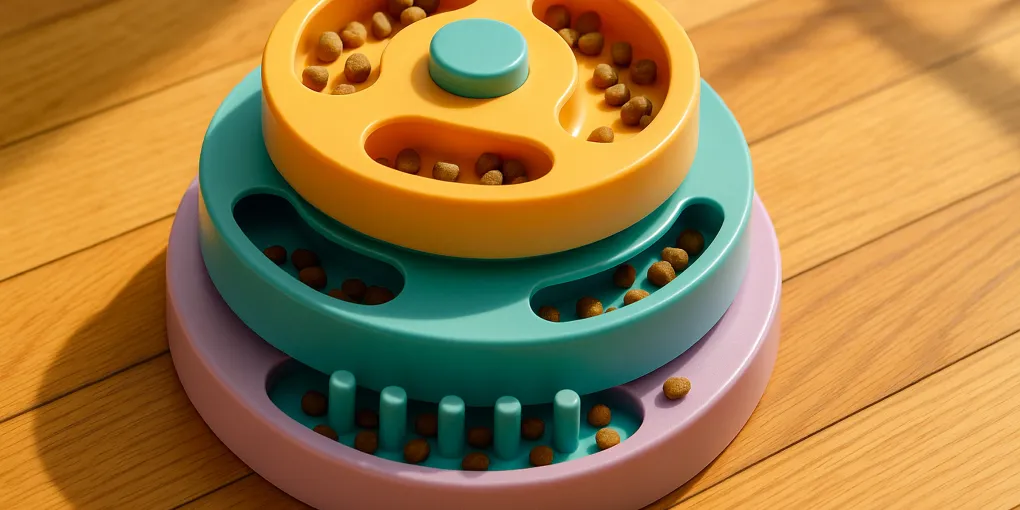
Trixie 5-in-1 Activity Center Cat Toy Feeding Station
Best OverallDifficulty: Beginner to intermediate
$25–$35
Quick Comparison
| Product | Key Specs | Price Range | Buy |
|---|---|---|---|
| |
| $25–$35 | Check Price |
| |
| $20–$30 | Check Price |
| |
| $15–$25 | Check Price |
| |
| $10–$15 | Check Price |
Contains affiliate links — we may earn a small commission at no extra cost to you.
Best Cat Interactive Feeders in 2026
The best cat interactive feeder for most households is the Trixie 5-in-1 Activity Center (PSR 4.6/5) — five distinct feeding challenge stations in a single unit, beginner-to-intermediate difficulty range, and dishwasher-safe food-grade construction. For cats specifically needing hunting behavioral fulfillment, Doc & Phoebe’s Indoor Hunting Feeder (PSR 4.5/5) is the standout, replacing bowl feeding with a hide-and-seek kibble hunt that replicates the full predatory sequence.
TL;DR
- Best Overall: Trixie 5-in-1 Activity Center — five challenge types, dishwasher safe, beginner to intermediate (PSR 4.6/5)
- Best for Hunting Behavior: Doc & Phoebe’s Hunting Feeder — 3 soft mice simulating hunt-catch-eat; highest pet comfort score (PSR 4.5/5)
- Best Beginner Puzzle: Catit Senses 2.0 Food Tree — adjustable difficulty tower; easiest first introduction (PSR 4.4/5)
- Best Budget: KONG Cat Wobbler — durable, dishwasher safe, variable reward schedule; $10–$15 (PSR 4.2/5)
- Key Stat: 30/30 cats on food puzzle feeding showed improvement in weight, vomiting, anxiety, and aggression within 6 months (Dantas et al., 2016, DOI: 10.1177/1098612X16643753)
Indoor cats receive food in bowls in under 30 seconds — eliminating the 6–8 hours of daily hunting, catching, and consuming behavior that drives the feline behavioral repertoire. Interactive feeders restore that behavioral outlet through a simple mechanism: require the cat to manipulate a device to earn kibble. The result is longer meal times (15–25 minutes vs. 30–90 seconds), cognitive engagement, reduced anxiety-based behaviors, and in many cats, measurable weight reduction.
Why Indoor Cats Need Food Puzzles
Wild and feral cats consume approximately 8–12 small prey items per day, spending the majority of waking hours in active predatory behavior — scanning, stalking, pouncing, and consuming. Indoor cats receive caloric equivalence in seconds with none of the behavioral content. Ellis SL et al. (2013, PMID: 23603504) in the AAFP/ISFM Feline Environmental Needs Guidelines specifically cite feeding enrichment as a highest-priority indoor cat need, noting that absence of foraging opportunity is a primary driver of indoor cat behavioral pathology.
The landmark outcome data: Dantas LM et al. (2016, DOI: 10.1177/1098612X16643753) conducted the defining study — transitioning 30 cats from bowl feeding to food puzzle feeding produced improvements across every tracked outcome measure: mean weight reduction of 3.5%, reduction in vomiting frequency, decreased hiding and aggression scores, and reduced anxiety within 6 months. All 30 cats improved. This is an unusually consistent result in animal behavioral research.
Buffington CAT et al. (2006, PMID: 16713360) documented that multimodal environmental enrichment including feeding enrichment reduced sickness behaviors in indoor cats with idiopathic cystitis — suggesting that the cognitive stimulation of food puzzles extends beyond behavioral outcomes to physical health indicators.
Speed eating and vomiting: Cats that consume a full kibble meal in under 60 seconds frequently vomit undigested food immediately after — a mechanical regurgitation (not pathological nausea) caused by rapid ingestion volume. Slowing meal time to 15–25 minutes via puzzle feeder interrupts this cycle. The effect resolves in most cats as soon as puzzle feeding is implemented consistently.
For cats that benefit from both puzzle feeding and supplemental digestive support, see our best cat probiotic supplement guide.
Difficulty Levels: How to Start and Progress
Interactive feeders range from beginner (large openings, kibble visible, minimal manipulation) to advanced (multi-step manipulation, obscured kibble). Matching difficulty to experience is essential: a cat that cannot access food from a puzzle will abandon it in frustration and form a negative association with puzzle feeding generally.
The Veterinary Society of Animal Behavior (2022) protocol:
- Start with the easiest available feeder; confirm the cat reliably accesses food within 5 minutes
- Increase complexity gradually — allow 2–4 weeks at each level before advancing
- Run two feeder types simultaneously to prevent habituation to a single format
- For advanced cats, rotate feeder types regularly; novelty maintains cognitive engagement
All four products reviewed here are appropriate as starting points. The Catit Food Tree offers built-in adjustable difficulty; the Trixie 5-in-1 offers multiple starting points within the same unit.
Trixie 5-in-1 Activity Center Review: Best Overall
The Trixie 5-in-1 Activity Center is the most complete puzzle feeder in this evaluation — five distinct feeding challenge stations built into a single unit, covering a range of manipulation types that prevents habituation and serves cats from first introduction through intermediate enrichment.
Key specifications:
- Design: Flat activity board with 5 separate challenge stations
- Stations include: rotating wheel, peg field (requires paw threading), wave tray, flip-lid compartments, and open cone columns
- Materials: Food-grade ABS plastic; BPA-free
- Cleaning: Fully dishwasher safe
- Food compatibility: Kibble and small treats (not wet food)
- Price: $25–$35
PSR Composite Score Breakdown:
| Criterion | Score | Weight | Weighted Score |
|---|---|---|---|
| Safety & Ingredients | 9.5 | 25% | 2.38 |
| Durability & Build Quality | 8.8 | 20% | 1.76 |
| Pet Comfort & Acceptance | 9.2 | 20% | 1.84 |
| Value for Money | 8.8 | 20% | 1.76 |
| Ease of Use | 8.5 | 15% | 1.28 |
| Composite | 9.02 → PSR 4.6/5 |
Safety & Ingredients (9.5): Food-grade ABS plastic with no documented off-gassing or toxic components. No small detachable parts. Fully dishwasher safe for complete bacterial decontamination between uses.
Pet Comfort & Acceptance (9.2): Five station types mean virtually all cats find at least one starting point they can access, reducing the risk of abandonment frustration. The variety also maintains long-term engagement — cats that habituate to one station have four others to explore.
Durability (8.8): Solid plastic construction handles persistent batting and pawing. Some reviewers note the cone columns can be nudged off the tray by vigorous cats, though they snap back easily.
Value (8.8): At $25–$35 for five challenge types, the per-station cost is the lowest of any reviewed product — particularly relevant when a cat outgrows simpler feeders and needs variety.
Ease of Use (8.5): Filling is straightforward; each station loads from the top. The one limitation: because it’s a flat board, it should be used on a non-slip surface and watched initially to ensure it doesn’t slide during use.
Pros:
- Five different challenge types in one unit — prevents habituation
- Dishwasher safe for hygienic cleaning
- Food-grade, BPA-free materials
- Appropriate for beginners through intermediate difficulty
- Highest value per challenge station of any reviewed product
Cons:
- Flat board can slide on smooth floors without a non-slip mat underneath
- Cone columns can be displaced by vigorous cats (though easily repositioned)
- Not compatible with wet food
Doc & Phoebe’s Indoor Hunting Feeder Review: Best for Natural Hunting Behavior
Doc & Phoebe’s Indoor Hunting Feeder takes a fundamentally different approach from stationary puzzle boards: instead of a device the cat interacts with at a fixed location, it provides three soft mouse-shaped feeders that the owner hides around the home. The cat must search, locate, and retrieve each mouse to access its portion of kibble — completing the full predatory sequence (hunt, catch, eat) that bowl feeding eliminates entirely.
Key specifications:
- Design: 3 soft plush mice, each with a kibble-holding interior cavity
- Capacity: Each mouse holds approximately 1/3 of a meal’s kibble portion
- Fill method: Included funnel for easy loading
- Material: Soft fabric exterior; food-grade plastic interior insert
- Food compatibility: All kibble sizes; small treats
- Price: $15–$25
PSR Composite Score Breakdown:
| Criterion | Score | Weight | Weighted Score |
|---|---|---|---|
| Safety & Ingredients | 9.5 | 25% | 2.38 |
| Durability & Build Quality | 8.0 | 20% | 1.60 |
| Pet Comfort & Acceptance | 9.5 | 20% | 1.90 |
| Value for Money | 9.5 | 20% | 1.90 |
| Ease of Use | 8.0 | 15% | 1.20 |
| Composite | 8.98 → PSR 4.5/5 |
Pet Comfort & Acceptance (9.5): The highest pet comfort score in this review — the hunt-find-eat sequence most directly aligns with feline behavioral drives. Cats with high predatory drive who show little interest in stationary puzzles often engage immediately with the hunting feeder because the format is instinctively legible.
Safety (9.5): Soft exterior with no rigid edges. Fabric mice are appropriately sized to prevent ingestion. The plastic kibble insert is food-grade and removable for cleaning. No choking hazards.
Durability (8.0): The fabric exterior is the limiting factor — enthusiastic cats may shred the mouse over time. Replacement mice are sold separately. For cats that destroy soft toys quickly, the mice may need replacement every few months.
Value (9.5): At $15–$25 for a set of three mice plus the filling funnel, this is the second-lowest price point in the review. The feeding format also eliminates the need for an additional puzzle feeder for many cats — it functions as a complete mealtime replacement.
Ease of Use (8.0): Filling with a funnel is a two-step process compared to dropping kibble directly into a bowl or tray. Hiding the mice adds daily setup time. For owners with limited time, this is a mild friction point — though most owners report the 2–3 minute setup becomes habitual quickly.
Pros:
- Most behaviorally authentic enrichment — completes full hunt-catch-eat sequence
- Highest pet comfort and acceptance of all reviewed feeders
- Strong value: three feeders for $15–$25
- Works with all kibble sizes
- Particularly effective for high-drive, hunt-motivated cats
Cons:
- Fabric exterior degrades with aggressive cats; replacements add long-term cost
- 2–3 minutes daily setup time to fill and hide mice
- Cats that hide mice in difficult-to-retrieve locations may leave uneaten kibble
Catit Senses 2.0 Food Tree Review: Best Beginner Puzzle
The Catit Senses 2.0 Food Tree is the most beginner-appropriate stationary puzzle feeder in this review. Its vertical tower design is cognitively legible from first introduction: kibble is loaded at the top, cats can see and smell it immediately, and it drops down through the levels as they paw at openings. The adjustable difficulty inserts mean this single feeder can scale from fully open (effectively a slow dispensing tube) to restricted access requiring deliberate paw placement.
Key specifications:
- Design: Vertical tower, 3 levels
- Mechanism: Kibble loaded at top; pawed down through staggered level openings
- Difficulty adjustment: Included insert rings open or restrict each level’s opening
- Food compatibility: Kibble and small treats
- Cleaning: Fully dishwasher safe (separates into components)
- Price: $20–$30
PSR Composite Score Breakdown:
| Criterion | Score | Weight | Weighted Score |
|---|---|---|---|
| Safety & Ingredients | 9.5 | 25% | 2.38 |
| Durability & Build Quality | 8.5 | 20% | 1.70 |
| Pet Comfort & Acceptance | 8.8 | 20% | 1.76 |
| Value for Money | 9.0 | 20% | 1.80 |
| Ease of Use | 8.2 | 15% | 1.23 |
| Composite | 8.87 → PSR 4.4/5 |
Pet Comfort & Acceptance (8.8): The vertical format with visible kibble gives cats immediate understanding of what is required. The learning curve is lower than flat puzzles with multiple different station types, making this the safest first-feeder choice for cats with no puzzle experience.
Value (9.0): At $20–$30, the Catit Food Tree is among the lower-priced options in this review. Its adjustable difficulty inserts effectively provide multiple difficulty levels without purchasing a new feeder.
Durability (8.5): Solid plastic construction, though the tower can be knocked over by particularly vigorous cats on smooth surfaces. Placing on a non-slip mat resolves this.
Ease of Use (8.2): Loading kibble into the top is straightforward. Disassembling for cleaning requires separating the levels, which is easy but slightly more involved than cleaning a flat board.
Pros:
- Most beginner-accessible design — vertical tower makes kibble immediately visible and legible
- Adjustable difficulty: beginner to intermediate with included inserts
- Dishwasher safe components
- Well-priced for adjustable difficulty range
Cons:
- Single feeding mechanism (drop-down) may cause habituation in experienced puzzle cats
- Can tip on smooth floors without a non-slip mat
- Not compatible with wet food
KONG Cat Wobbler Review: Best Budget
The KONG Cat Wobbler applies the brand’s signature variable reward schedule to cat feeding — kibble dispenses through a small hole as the cat bats the weighted bottom-heavy ball. Because the ball rolls unpredictably and kibble falls out irregularly, it creates a variable reward schedule that maintains engagement beyond what a fixed-dispensing puzzle can. At $10–$15, it is the lowest cost feeder in this review.
Key specifications:
- Design: Weighted wobble ball; kibble dispenses from a small top opening as the ball is batted
- Mechanism: Physical rolling and batting; variable reward schedule
- Material: Durable food-grade plastic; weighted base
- Cleaning: Fully dishwasher safe
- Food compatibility: Kibble and small treats
- Price: $10–$15
PSR Composite Score Breakdown:
| Criterion | Score | Weight | Weighted Score |
|---|---|---|---|
| Safety & Ingredients | 9.0 | 25% | 2.25 |
| Durability & Build Quality | 8.5 | 20% | 1.70 |
| Pet Comfort & Acceptance | 7.0 | 20% | 1.40 |
| Value for Money | 9.5 | 20% | 1.90 |
| Ease of Use | 7.8 | 15% | 1.17 |
| Composite | 8.42 → PSR 4.2/5 |
Value (9.5): At $10–$15, the KONG Wobbler is the lowest-priced feeder in this review. For households looking to trial puzzle feeding before committing to a more complex unit, it is the lowest-risk entry point.
Safety & Ingredients (9.0): KONG-grade durable plastic with no documented ingestion or choking risks. Fully dishwasher safe for regular sanitation.
Pet Comfort & Acceptance (7.0): The Wobbler’s limitation is cat type specificity. Cats with high batting and play drive engage readily; cats that prefer stationary foraging or tactile manipulation may find the rolling format unrewarding and abandon it. The variable reward mechanism is genuinely effective for the subset of cats that take to it, but it is the most cat-specific feeder in this review.
Ease of Use (7.8): The small dispensing hole can be challenging to fill without spills. Some owners use a funnel or dispensing tool; others find tilting the ball and loading through the hole manageable with practice.
Pros:
- Lowest price in the review — $10–$15
- Variable reward schedule (unpredictable kibble release) maintains engagement
- KONG-grade durability; dishwasher safe
- Good for physically active, play-motivated cats
Cons:
- Less effective for cats that prefer stationary manipulation over batting and chasing
- Small fill opening can be awkward without a funnel
- Single enrichment mechanism; experienced cats may habituate
Cat Interactive Feeder Comparison Table
| Product | Type | Difficulty | Price | Food Compatible | PSR Score |
|---|---|---|---|---|---|
| Trixie 5-in-1 Activity Center | Flat board, 5 stations | Beginner–Intermediate | $25–$35 | Kibble, small treats | 4.6/5 |
| Doc & Phoebe’s Hunting Feeder | Hidden mice foragers | Beginner (hunt-based) | $15–$25 | All kibble sizes | 4.5/5 |
| Catit Senses 2.0 Food Tree | Vertical tower | Beginner (adjustable) | $20–$30 | Kibble, small treats | 4.4/5 |
| KONG Cat Wobbler | Wobble ball dispenser | Beginner | $10–$15 | Kibble, small treats | 4.2/5 |
Choosing the Right Interactive Feeder for Your Cat
For cats new to puzzle feeding: Start with the Catit Senses 2.0 Food Tree at its most open setting, or the Trixie 5-in-1 Activity Center with kibble placed in the easiest stations. Both provide quick early wins that build confidence before difficulty escalates.
For high-drive, hunt-motivated cats: Doc & Phoebe’s Hunting Feeder is the clear choice. Cats that stalk, pounce, and actively hunt toy prey during play will engage with hidden mice feeders more readily than with stationary puzzle boards.
For experienced puzzle cats needing variety: The Trixie 5-in-1 is best — its five station types provide the format variety that prevents the habituation that single-mechanism feeders eventually produce. Rotating the Trixie with the KONG Wobbler further prevents habituation.
For budget-first households: The KONG Wobbler at $10–$15 is a functional starting point. If the cat engages well, the Trixie or Doc & Phoebe’s feeders can be added to build a multi-feeder rotation.
Wet food eaters: All four feeders in this guide require dry kibble. For wet food-only cats, flat lick-mat style feeders are the appropriate format. See our best cat slow feeder bowl guide for options compatible with wet food.
For complementary enrichment, interactive feeders pair well with physical play from a wand toy and foraging treats from our best cat treats guide. Cats on puzzle feeders may also benefit from a cat water fountain to ensure hydration remains accessible throughout extended foraging sessions. For diet context, see our best cat food for indoor cats guide, as kibble selection affects how well treats dispense from puzzle openings. Cats with digestive sensitivity may benefit from the best cat probiotic supplement alongside a slowed feeding routine. For additional enrichment formats, see our best cat puzzle toy, best automatic cat toy, and best cat wand toy guides.
Frequently Asked Questions
Do cat food puzzles really help indoor cats?
Yes. Dantas LM et al. (2016, DOI: 10.1177/1098612X16643753) found that 30 of 30 cats transitioned to food puzzle feeding showed improvements in weight (mean -3.5%), vomiting frequency, anxiety scores, and aggression within 6 months. Ellis SL et al. (2013, PMID: 23603504) lists feeding enrichment as one of the highest-priority behavioral needs for indoor cats. The core mechanism is behavioral: indoor cats receive no foraging opportunity, and puzzle feeders restore cognitively meaningful feeding activity. The AAFP and Veterinary Society of Animal Behavior both recommend food puzzles as primary enrichment for all indoor cats.
Which puzzle feeder is best for beginners?
The Catit Senses 2.0 Food Tree is the most accessible starting point. Its vertical tower design is immediately legible to cats — they can see and smell kibble at the top, then paw it down through the levels. The adjustable difficulty inserts let you start with fully open levels and gradually restrict access as the cat builds confidence. The Trixie 5-in-1 Activity Center is also beginner-appropriate, with five stations offering different challenge types so inexperienced cats can find a starting point they can succeed with. The key rule: always confirm the cat can reliably access food before increasing difficulty.
Can I use puzzle feeders with wet cat food?
Most mechanical dispensers — including the Catit Food Tree and KONG Wobbler — are designed for dry kibble and small treats only. Wet food clogs dispensing mechanisms and is difficult to clean from narrow openings. For wet food feeders, flat lick-mat style puzzles with shallow grooves work well — smear wet food across the grooves and clean easily after each meal. All four products in this guide are kibble-optimized. For wet food options, see our best cat slow feeder bowl guide.
How do I introduce my cat to a food puzzle?
Start by placing kibble around the outside of the puzzle so the cat can eat successfully before interacting with the device itself. In the second session, place kibble both outside and in the easiest accessible openings. By sessions three through five, load the puzzle fully and allow the cat to work through it independently. Keep initial sessions to 10–15 minutes and remove uneaten food after 30 minutes. The Veterinary Society of Animal Behavior (2022) recommends allowing 2–4 weeks at each difficulty level before advancing to a harder feeder. Never force the cat to interact — engagement should always be voluntary.
Final Verdict
Trixie 5-in-1 Activity Center (PSR 4.6/5) is Best Overall for the majority of indoor cats — five distinct feeding challenge types, dishwasher-safe food-grade construction, and a beginner-to-intermediate difficulty range that serves cats from first introduction through long-term routine use. Doc & Phoebe’s Indoor Hunting Feeder (PSR 4.5/5) is the better choice for hunt-motivated cats and the most behaviorally authentic option available, replacing bowl feeding with a complete foraging sequence. Catit Senses 2.0 Food Tree (PSR 4.4/5) is the most accessible entry point for puzzle-naive cats. KONG Cat Wobbler (PSR 4.2/5) is the lowest-cost starting point for households trialing puzzle feeding before committing to a more complex unit.
The research basis for food puzzle feeding is unusually consistent: Dantas et al. (2016) documented improvement in every tracked behavioral and health metric across all 30 cats in the study. For indoor cats, replacing bowl feeding with puzzle feeding is one of the highest-impact single interventions available.
Citations: Dantas LM, Delgado MM, Johnson I, Buffington CAT (2016) JFMS 18(9):723-732 (DOI: 10.1177/1098612X16643753); Ellis SL et al. (2013) JFMS 15(3):219-230 (PMID: 23603504); Buffington CAT et al. (2006) JFMS 8(4):261-268 (PMID: 16713360); Herron ME & Buffington CAT (2010) Compendium 32(12):E4
Frequently Asked Questions
- Yes. Dantas LM et al. (2016, DOI: 10.1177/1098612X16643753) found that 30 of 30 cats transitioned to food puzzle feeding showed improvements in weight (mean -3.5%), vomiting frequency, anxiety scores, and aggression within 6 months. Ellis SL et al. (2013, PMID: 23603504) lists feeding enrichment as one of the highest-priority behavioral needs for indoor cats. The core mechanism is behavioral: indoor cats receive no foraging opportunity, and puzzle feeders restore cognitively meaningful feeding activity. The AAFP and Veterinary Society of Animal Behavior both recommend food puzzles as primary enrichment for all indoor cats.
- The Catit Senses 2.0 Food Tree is the most accessible starting point. Its vertical tower design is immediately legible to cats — they can see and smell kibble at the top, then paw it down through the levels. The adjustable difficulty inserts let you start with fully open levels and gradually restrict access as the cat builds confidence. The Trixie 5-in-1 Activity Center is also beginner-appropriate, with five stations that offer different challenge types so inexperienced cats can find a starting point they can succeed with. The key rule: always confirm the cat can reliably access food before increasing difficulty.
- Most mechanical dispensers — including the Catit Food Tree and KONG Wobbler — are designed for dry kibble and small treats only. Wet food clogs the dispensing mechanisms and is difficult to clean out of narrow openings. For wet food feeders, use flat lick-mat style puzzles with shallow grooves that can be smeared with wet food and cleaned easily. All four products in this guide are kibble-optimized. If your cat eats only wet food, see our best cat slow feeder bowl guide, which includes flat puzzle options compatible with wet food.
- Start by placing kibble around the outside of the puzzle so the cat can eat successfully before interacting with the device. In the second session, place kibble both outside and in the easiest openings. By sessions 3–5, load the puzzle fully and let the cat work through it. Keep initial sessions to 10–15 minutes and remove uneaten food after 30 minutes. Never force the cat to interact — interest should be voluntary. The Veterinary Society of Animal Behavior (2022) recommends allowing 2–4 weeks per difficulty level before advancing to a harder feeder.