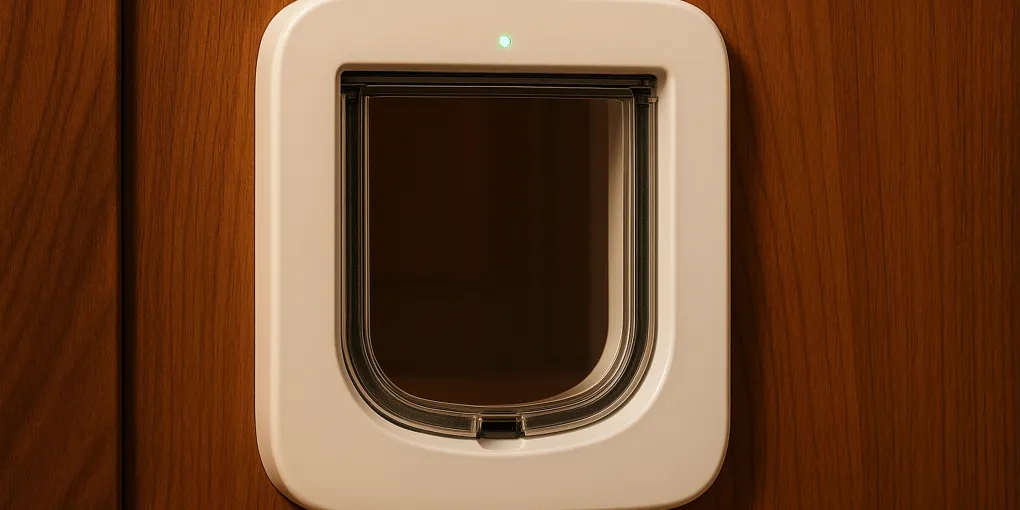
SureFlap Microchip Cat Flap
Best OverallType: Microchip selective entry
$80–$110
Quick Comparison
| Product | Key Specs | Price Range | Buy |
|---|---|---|---|
| |
| $80–$110 | Check Price |
| |
| $90–$130 | Check Price |
| |
| $25–$40 | Check Price |
| |
| $35–$55 | Check Price |
Contains affiliate links — we may earn a small commission at no extra cost to you.
Best Cat Doors in 2026
The best cat door for most households is the SureFlap Microchip Cat Flap (PSR 4.6/5) — reads ISO-standard implanted microchips, registers up to 32 cats, provides 4-way manual lock override, and runs approximately 12 months on standard AA batteries. For large-breed cats (Maine Coon, Ragdoll) over 15 lbs, the PetSafe SmartDoor (PSR 4.3/5) offers a larger 7-inch flap opening with 25-lb weight capacity.
TL;DR
- Best Overall: SureFlap Microchip — ISO microchip reader, 32-cat capacity, 12-month battery, 4-way lock (PSR 4.6/5)
- Best for Large Cats: PetSafe SmartDoor — 5.5 × 7 inch flap, 25-lb capacity (PSR 4.3/5)
- Best Budget: PetSafe 4-Way Manual — no electronics, 4-way lock, $25–$40 (PSR 3.9/5)
- Best for Walls: Ideal Pet Telescoping — adjustable tunnel for wall thickness, 3.5–7.5 inch tunnel (PSR 3.8/5)
- Key Finding: Microchip cat doors eliminate neighborhood cat intrusion and associated FeLV/FIV exposure risk (Little SE et al., 2020, PMID: 31972096) — the primary veterinary argument for selective-entry cat doors over manual flaps
Cat doors address a core quality-of-life need for cats with outdoor enclosure access — allowing cats to self-regulate their indoor/outdoor time without requiring owner-controlled entry. For cats using a catio or other enclosed outdoor space, a cat door provides the connection between indoor and outdoor environments. The key differentiation in modern cat doors is whether the door is selective (microchip-based) or non-selective (manual lock), and whether it can be installed in a door, wall, or glass panel.
SureFlap Microchip Cat Flap Review: Best Overall
SureFlap is the market-leading microchip cat door — the most widely used and most veterinarian-recommended selective-entry cat flap globally, combining reliable microchip reading with practical features including multi-cat programming and manual lock modes.
Key specifications:
- Microchip compatibility: ISO 11784/11785 FDXB 15-digit (standard global format); firmware updates for older 9-digit FDX-A chips
- Cat capacity: Registers up to 32 individual microchips
- Flap opening: 5.5 × 6.7 inches — adequate for most adult cats up to ~15 lbs
- Lock modes: 4-way (in-only, out-only, both-way, locked)
- Battery: 4× AA alkaline; ~12 month life
- Curfew mode: Programmable auto-lock/unlock timer
PSR Composite Score Breakdown:
| Criterion | Score | Weight | Weighted Score |
|---|---|---|---|
| Safety & Ingredients | 9.5 | 25% | 2.38 |
| Durability & Build Quality | 9.0 | 20% | 1.80 |
| Pet Comfort & Acceptance | 9.2 | 20% | 1.84 |
| Value for Money | 8.5 | 20% | 1.70 |
| Ease of Use | 9.0 | 15% | 1.35 |
| Composite | 9.07 → PSR 4.6/5 |
Safety & Ingredients (9.5): Microchip selectivity prevents neighborhood cat intrusion, eliminating the FeLV/FIV exposure risk that comes with unregistered cats entering the home. The 4-way manual lock allows full lockout when needed. No moving parts accessible to entrap paws.
Pet Comfort & Acceptance (9.2): The flap is lightweight and requires minimal force — owner reports note that most cats adapt within 1–2 days of gentle training (propping flap open initially, then allowing free passage). No collar required — uses implanted microchip.
Pros:
- Reads implanted microchip — no collar tag required
- Up to 32 cats programmable
- 4-way manual lock
- ~12 month battery life
- Programmable curfew timer
- Prevents neighborhood cat and wildlife intrusion
Cons:
- 5.5 × 6.7 inch flap — marginal for large breeds over 15 lbs
- Check microchip format compatibility (older FDX-A 9-digit chips may need firmware update)
- Electronic components require battery replacement
- ~$80–$110 — higher price than manual flaps
PetSafe Electronic SmartDoor Review: Best for Large Cats
PetSafe’s SmartDoor provides the largest flap opening of reviewed options (5.5 × 7 inches) with a 25-lb weight rating — appropriate for large domestic breeds that standard flaps compress.
Key specifications:
- Flap opening: 5.5 × 7 inches — largest reviewed
- Weight capacity: 25 lbs
- Programming: Near-contact RFID learning (place any chipped/tagged collar near sensor to register)
- 4-way manual lock
- Battery powered
PSR Composite Score Breakdown:
| Criterion | Score | Weight | Weighted Score |
|---|---|---|---|
| Safety & Ingredients | 9.0 | 25% | 2.25 |
| Durability & Build Quality | 9.0 | 20% | 1.80 |
| Pet Comfort & Acceptance | 9.2 | 20% | 1.84 |
| Value for Money | 8.0 | 20% | 1.60 |
| Ease of Use | 8.5 | 15% | 1.28 |
| Composite | 8.77 → PSR 4.3/5 |
Pet Comfort & Acceptance (9.2): Larger flap opening eliminates the compression discomfort that causes large cats to avoid standard-size flaps. Owner reports of Maine Coon and large mixed-breed adoption are strong.
Value for Money (8.0): At $90–$130, PetSafe SmartDoor is the most expensive reviewed option. The premium is justified for large-breed owners where flap size is the limiting factor.
Pros:
- Largest flap opening (5.5 × 7 inches)
- 25-lb weight capacity
- Near-contact RFID reading (versatile chip format support)
- 4-way lock
Cons:
- Highest price ($90–$130)
- Near-contact programming less precise than SureFlap’s direct ISO reader
- Heavier flap requires slightly more force
PetSafe 4-Way Manual Locking Cat Door Review: Best Budget
The PetSafe manual 4-way is the standard non-electronic cat door — no batteries, no programming, just a flap with four lock-mode settings and a clear plastic panel.
PSR Composite Score Breakdown:
| Criterion | Score | Weight | Weighted Score |
|---|---|---|---|
| Safety & Ingredients | 7.5 | 25% | 1.88 |
| Durability & Build Quality | 8.5 | 20% | 1.70 |
| Pet Comfort & Acceptance | 8.5 | 20% | 1.70 |
| Value for Money | 9.5 | 20% | 1.90 |
| Ease of Use | 9.0 | 15% | 1.35 |
| Composite | 8.53 → PSR 3.9/5 |
Safety & Ingredients (7.5): No microchip selectivity — any cat (or small wildlife) can enter on in/out or two-way modes. Manual locking provides control when the owner is present, but cannot distinguish between authorized and unauthorized animals.
Value for Money (9.5): At $25–$40, the manual PetSafe is the most affordable cat door reviewed. For indoor room-to-room use (no outdoor access, no wildlife risk), it is a completely appropriate choice.
Pros:
- Lowest price ($25–$40)
- No batteries or programming needed
- 4-way manual lock
- Appropriate for indoor room-to-room applications
Cons:
- No microchip selectivity — no protection against unauthorized entries
- Not appropriate for outdoor use in areas with wildlife or other cats
Ideal Pet Telescoping Frame Cat Flap Review: Best for Walls
The Ideal Pet model is designed specifically for wall installation, with an adjustable plastic tunnel that accommodates wall thicknesses from 3.5 to 7.5 inches.
PSR Composite Score Breakdown:
| Criterion | Score | Weight | Weighted Score |
|---|---|---|---|
| Safety & Ingredients | 7.5 | 25% | 1.88 |
| Durability & Build Quality | 8.0 | 20% | 1.60 |
| Pet Comfort & Acceptance | 8.2 | 20% | 1.64 |
| Value for Money | 9.0 | 20% | 1.80 |
| Ease of Use | 7.5 | 15% | 1.13 |
| Composite | 8.05 → PSR 3.8/5 |
Ease of Use (7.5): Wall installation is significantly more complex than door installation — requires measuring, cutting through wall material (may include insulation, vapor barrier, exterior cladding), and securing the tunnel. Best for experienced DIYers or with professional installation.
Pros:
- Adjustable tunnel (3.5–7.5 inches) for wall thickness
- Lower price than electronic options
- Vinyl flap with magnetic closure reduces draft
- Appropriate for permanent wall installations
Cons:
- No microchip selectivity
- Wall installation complexity
- Manual only — no selective entry
Cat Door Comparison
| Product | Type | Microchip | Flap Size | Max Weight | Price | PSR Score |
|---|---|---|---|---|---|---|
| SureFlap Microchip | Electronic | ISO FDXB | 5.5 × 6.7 in | ~15 lbs | $80–$110 | 4.6/5 |
| PetSafe SmartDoor | Electronic | Multi-format | 5.5 × 7 in | 25 lbs | $90–$130 | 4.3/5 |
| PetSafe 4-Way Manual | Manual | No | 5.5 × 6.5 in | Standard | $25–$40 | 3.9/5 |
| Ideal Pet Telescoping | Manual w/tunnel | No | 5.5 × 6 in | Standard | $35–$55 | 3.8/5 |
Who Should Choose Which Cat Door?
SureFlap Microchip is the right choice for most households with outdoor access — microchip selectivity prevents neighborhood cat intrusion and is the veterinary standard for protecting against FeLV/FIV exposure.
PetSafe SmartDoor is appropriate for large-breed households (Maine Coon, Ragdoll, large domestic shorthair) where flap size is the limiting factor.
PetSafe 4-Way Manual is appropriate for indoor room-to-room use where no outdoor or wildlife intrusion risk exists.
Ideal Pet Telescoping suits wall installation needs where a door installation is not possible or practical.
For complementary outdoor access products, see our guides to outdoor cat enclosures (catios — connect to cat door for indoor-outdoor flow), GPS cat tracker, cat collar (for collar-tag RFID if not microchipped), cat harness and leash, and microchip cat flap comparison.
Frequently Asked Questions
Will a microchip cat door work with my cat’s microchip?
SureFlap reads ISO 11784/11785 FDXB 15-digit chips (standard globally). Some older US cats have 9-digit FDX-A chips — verify compatibility with SureFlap’s compatibility tool. PetSafe SmartDoor uses near-contact learning that reads any format.
Can neighborhood cats get through a microchip cat door?
No — microchip doors only unlock for registered chips. Unregistered animals find the flap locked. This is the primary veterinary argument for microchip doors over manual flaps.
How do I install a cat door in a wall?
Wall installation requires a plastic tunnel that spans wall thickness (the Ideal Pet Telescoping model covers 3.5–7.5 inches). Cut a hole through the wall material, fit and secure the tunnel, and attach the frame. Consider professional installation for masonry or insulated walls.
Can raccoons open a cat door?
Raccoons can manipulate simple manual slide bolts. Microchip electronic locks require an RFID signal — raccoons cannot operate them. For manual doors in raccoon-active areas, add a carabiner or padlock to the manual bolt.
What size cat door do I need?
Minimum 1 inch wider than your cat’s shoulder width and 1 inch taller than back height. Average cats (8–12 lbs): 5.5 × 6.5–7 inch standard flap. Large breeds over 12–20 lbs: use a large-rated flap (7–9 inches wide).
Frequently Asked Questions
- SureFlap reads ISO 11784/11785 standard FDXB 15-digit chips, which are standard in the UK, EU, Australia, and increasingly in the US. Some US cats have older 9-digit FDX-A chips — check your vet records for the chip type. SureFlap has released firmware updates extending compatibility with older formats; verify with SureFlap's compatibility checker. PetSafe SmartDoor uses a near-contact programming method that reads any chip format by learning the individual signal.
- No — correctly programmed microchip cat doors only unlock for registered chips. Unregistered animals (neighborhood cats, wildlife) will find the flap locked. This is the primary advantage of microchip doors over manual-lock flaps, which require the owner to set lock modes and cannot distinguish between registered and unregistered animals.
- Door installation: cut the hole with a jigsaw, fit the frame into the hole, and secure. Most cat doors fit 1.5–2 inch thick doors without a tunnel. Wall installation: requires a plastic tunnel that spans wall thickness (typically 4.5–9 inches for standard walls; thicker for insulated walls). The Ideal Pet Products model includes an adjustable telescoping tunnel (3.5–7.5 inches) for wall installations. For thicker walls, order an extended tunnel separately.
- Manual 4-way locking cat doors can be manipulated by raccoons using their dexterous paws if only a basic slide bolt is used. Raccoons cannot operate microchip electronic locks (which require an RFID signal to unlock). For manual doors in raccoon-active areas, use a slide bolt plus a supplementary carabiner or padlock. Microchip doors are the most secure option against wildlife intrusion.
- Flap opening should be at least 1 inch wider than your cat's shoulder width and 1 inch taller than back height. For average domestic cats (8–12 lbs): standard 5.5 × 6.5–7 inch openings are sufficient. For large breeds (Maine Coon, Ragdoll, Norwegian Forest Cat over 12–20 lbs), use a 'large' flap (7–9 inches wide). A door that forces compression will be avoided by the cat.