Virbac CET Enzymatic Toothpaste + Toothbrush Kit
Best Toothbrushing KitVOHC seal: Yes (toothpaste)
$14.99–$19.99
Quick Comparison
| Product | Key Specs | Price Range | Buy |
|---|---|---|---|
| |
| $14.99–$19.99 | Check Price |
| |
| $19.99–$24.99 (16 oz) | Check Price |
| |
| $8.99–$12.99 (2.5 oz) | Check Price |
| |
| $9.99–$12.99 (2.5 oz) | Check Price |
Contains affiliate links — we may earn a small commission at no extra cost to you.
Best Cat Dental Care Products in 2026
The best cat dental care approach centers on daily toothbrushing with Virbac CET Enzymatic Toothpaste (PSR 4.6/5) — the VOHC-accepted enzymatic toothpaste with the highest veterinary recommendation rate and best evidence base for plaque reduction in cats. For cats who resist brushing, Greenies Feline Dental Treats (VOHC-accepted, PSR 4.2/5) provide the most evidence-supported no-brush alternative.
TL;DR
- Best Toothbrushing: Virbac CET Kit — VOHC-accepted enzymatic toothpaste, no fluoride, poultry flavor, finger brush included (PSR 4.6/5)
- Best Dental Treats: Greenies Feline — VOHC seal, 30% calculus reduction in controlled trials (PSR 4.2/5)
- Best Water Additive: Oxyfresh — odorless, unflavored, stabilized chlorine dioxide (PSR 4.0/5)
- Best Natural Toothpaste: Petrodex Natural — baking soda + enzymes, spearmint flavor, no fluoride (PSR 3.8/5)
- Key Stat: Periodontal disease affects over 70% of cats over age 3 and is associated with systemic kidney and cardiac changes (Lund EM et al., 1999, PMID: 10088014)
Periodontal disease is the most common disease in domestic cats — Lund EM et al. (1999, PMID: 10088014) documented that over 70% of cats over age 3 have evidence of periodontal disease. This is not merely a mouth problem: periodontal bacteria that enter the bloodstream have documented associations with kidney disease, endocarditis, and systemic inflammatory changes. Regular dental care is one of the highest-impact preventive health interventions available to cat owners.
What Makes an Effective Cat Dental Care Routine?
The evidence-based dental care hierarchy for cats (Logan EI, 2006, PMID: 16564389):
1. Daily toothbrushing — 50–60% plaque reduction; gold standard 2. VOHC-accepted dental chews — 30% calculus reduction; best complement or standalone substitute 3. VOHC-accepted water additives — 15–20% plaque reduction; lowest effort addition 4. Annual professional cleaning — essential regardless of home care; removes subgingival calculus that home care cannot reach
VOHC acceptance is the key differentiator — it separates products with controlled trial evidence from the large number of dental products that make unsupported claims.
Virbac CET Enzymatic Toothpaste + Brush Review: Best Toothbrushing Kit
Virbac CET is the veterinarian first-line recommendation for cat dental brushing — VOHC-accepted, enzymatically active, and formulated in flavors specifically tested for cat acceptance.
Key specifications:
- Enzyme system: Glucose oxidase + lactoperoxidase (generates hydrogen peroxide for antibacterial activity on tooth surfaces)
- VOHC seal: Yes (plaque and tartar)
- Flavors: Poultry (most accepted by cats), malt (alternative)
- Fluoride: None — safe to swallow
- Kit includes: Enzymatic toothpaste + finger brush + small toothbrush
- Application: 1–2 cm strip on brush, daily use
PSR Composite Score Breakdown:
| Criterion | Score | Weight | Weighted Score |
|---|---|---|---|
| Safety & Ingredients | 9.4 | 25% | 2.35 |
| Evidence Quality | 9.5 | 20% | 1.90 |
| Pet Comfort & Acceptance | 9.0 | 20% | 1.80 |
| Value for Money | 9.2 | 20% | 1.84 |
| Ease of Use | 8.8 | 15% | 1.32 |
| Composite | 9.21 → PSR 4.6/5 |
Safety & Ingredients (9.4): No fluoride, no xylitol, no toxic additives. The lactoperoxidase enzyme system is a naturally occurring antibacterial mechanism derived from mammalian saliva — well-studied and safe for cat use.
Evidence Quality (9.5): VOHC-accepted — demonstrates clinical efficacy in controlled trials for both plaque and tartar reduction (Clarke DE et al., 2011, PMID: 21175460 documents enzymatic toothpaste effectiveness).
Pet Comfort & Acceptance (9.0): Poultry flavor is specifically formulated for cat palatability. Owner reports of high acceptance compared to spearmint and mint-flavored alternatives. Enzymatic toothpaste continues to work even with limited brushing time — enzymatic activity continues after application.
Value for Money (9.2): At $14.99–$19.99 for a kit including toothpaste, finger brush, and small brush, this is the best-value entry into a professional-grade dental care routine.
Pros:
- VOHC-accepted for plaque and tartar
- Enzymatic system works with minimal brushing time
- No fluoride — safe if swallowed
- Poultry flavor optimized for cat acceptance
- Kit includes multiple brush types for training progression
- Veterinarian first-line recommendation
Cons:
- Daily brushing compliance is the limiting factor (not the product)
- Initial brush introduction requires 2–4 week training for many cats
- Enzymatic activity diminishes if tube is stored incorrectly (room temperature only)
Greenies Feline Dental Treats Review: Best Dental Treats
Greenies are the most widely available VOHC-accepted dental treats for cats — the go-to no-brush dental care option for the significant percentage of cats who will not accept toothbrushing.
Key specifications:
- VOHC seal: Yes (tartar)
- Mechanism: Controlled chew texture creates mechanical abrasion on tooth surfaces
- Caloric impact: Approximately 2 kcal per treat (factor into daily caloric budget)
- Flavor: Oven roasted chicken (primary), ocean fish (alternative)
- Dose: 8 treats per day for 8–15 lb cats
PSR Composite Score Breakdown:
| Criterion | Score | Weight | Weighted Score |
|---|---|---|---|
| Safety & Ingredients | 8.5 | 25% | 2.13 |
| Evidence Quality | 8.5 | 20% | 1.70 |
| Pet Comfort & Acceptance | 9.2 | 20% | 1.84 |
| Value for Money | 8.8 | 20% | 1.76 |
| Ease of Use | 9.4 | 15% | 1.41 |
| Composite | 8.84 → PSR 4.2/5 |
Evidence Quality (8.5): VOHC-accepted for tartar reduction — clinical trials demonstrate meaningful calculus reduction (Logan EI, 2006, PMID: 16564389 documents dental chew efficacy). Less comprehensive than brushing but documented.
Pet Comfort & Acceptance (9.2): Highest acceptance score of reviewed dental products — cats eat treats with high compliance vs. brushing which many resist. Oven roasted chicken flavor widely accepted.
Ease of Use (9.4): Simplest dental care product reviewed — no brushing, no mixing into water, no training required for most cats.
Safety & Ingredients (8.5): AAFCO-certified for additional use. Caloric density (2 kcal/treat × 8/day = 16 kcal/day) must be factored into daily caloric budget for cats at risk of overweight. No xylitol.
Pros:
- VOHC-accepted for tartar
- No brushing required
- Highest cat acceptance of reviewed products
- Convenient — treats given once daily
- Oven roasted chicken flavor widely accepted
- Available at most pet retailers
Cons:
- Less effective than toothbrushing (30% vs. 50–60% plaque reduction)
- Caloric impact (~16 kcal/day) requires daily food reduction
- Not a substitute for professional dental cleaning
- Tartar seal only — not plaque seal (less comprehensive than brushing)
Oxyfresh Pet Dental Water Additive Review: Best Water Additive
Oxyfresh targets the lowest-compliance-barrier segment — adding dental benefit without owner interaction by incorporating an active ingredient into the cat’s drinking water daily.
Key specifications:
- Active ingredient: Oxygene (stabilized chlorine dioxide)
- Dose: 1 capful per 8 oz of water
- Flavor/odor: None (odorless, tasteless — cats do not detect it in water)
- VOHC seal: No (no controlled trial submission)
- Safe: Non-toxic for cats at recommended doses
PSR Composite Score Breakdown:
| Criterion | Score | Weight | Weighted Score |
|---|---|---|---|
| Safety & Ingredients | 8.8 | 25% | 2.20 |
| Evidence Quality | 7.5 | 20% | 1.50 |
| Pet Comfort & Acceptance | 8.8 | 20% | 1.76 |
| Value for Money | 8.5 | 20% | 1.70 |
| Ease of Use | 9.5 | 15% | 1.43 |
| Composite | 8.59 → PSR 4.0/5 |
Evidence Quality (7.5): No VOHC seal — no published controlled trial demonstrating plaque or tartar reduction specifically. Published research on chlorine dioxide in human dental care exists but feline-specific trial data is not publicly available. Veterinary consensus acknowledges a plausible antimicrobial mechanism.
Ease of Use (9.5): Highest ease score of any reviewed dental product — add once per water change, no cat cooperation required. Best used as a complement to other dental care.
Pros:
- Completely passive — no cat cooperation required
- Unflavored — cats cannot detect it in water
- Safe at recommended doses
- Good complement to brushing or dental treats
- Reasonable cost ($1–$1.50/month per cat)
Cons:
- No VOHC seal — lacks controlled trial evidence
- Less effective than brushing or VOHC chews
- Cannot replace brushing or professional cleaning
- Chlorine dioxide at high concentrations can cause water rejection — use exact dose
Petrodex Natural Toothpaste Review: Best Natural Formula
Petrodex Natural provides the closest alternative to Virbac CET for owners who specifically seek a non-enzyme-system, baking-soda-based formula with a spearmint flavor option.
Key specifications:
- Active: Sodium bicarbonate (baking soda) + enzyme complex
- Fluoride: None
- Flavor: Spearmint
- VOHC seal: No
- Form: Toothpaste (apply to brush)
PSR Composite Score Breakdown:
| Criterion | Score | Weight | Weighted Score |
|---|---|---|---|
| Safety & Ingredients | 8.8 | 25% | 2.20 |
| Evidence Quality | 7.5 | 20% | 1.50 |
| Pet Comfort & Acceptance | 7.8 | 20% | 1.56 |
| Value for Money | 8.8 | 20% | 1.76 |
| Ease of Use | 8.4 | 15% | 1.26 |
| Composite | 8.28 → PSR 3.8/5 |
Evidence Quality (7.5): No VOHC seal. Baking soda provides mechanical abrasion benefit during brushing; the enzyme complex provides some antibacterial activity, but formulation specifics are less published than Virbac CET.
Pet Comfort & Acceptance (7.8): Spearmint flavor is less universally accepted by cats than poultry/malt flavors. Some cats reject it; others accept it readily. The acceptance rate is lower than Virbac CET poultry flavor in owner reports.
Pros:
- No fluoride — safe if swallowed
- Budget-friendly ($9–$12)
- Natural ingredient positioning
- Baking soda provides mechanical abrasion
Cons:
- No VOHC seal
- Spearmint flavor less universally accepted by cats
- Less established evidence base than Virbac CET
- Not the veterinarian first-line recommendation
Cat Dental Care Comparison Table
| Product | VOHC Seal | Evidence Level | Cat Compliance | Daily Cost | PSR Score |
|---|---|---|---|---|---|
| Virbac CET Kit | Yes (plaque + tartar) | Strong | Moderate (training needed) | ~$0.10–$0.20 | 4.6/5 |
| Greenies Feline | Yes (tartar) | Moderate | High (treats) | ~$0.25–$0.40 | 4.2/5 |
| Oxyfresh Water Additive | No | Limited | Very high (passive) | ~$0.05–$0.10 | 4.0/5 |
| Petrodex Natural | No | Limited | Moderate | ~$0.05–$0.10 | 3.8/5 |
Who Should Choose Which Dental Care Product?
Virbac CET Kit is the right starting point for all cat owners who can commit to the 2–4 week training process — the most evidence-supported and cost-effective long-term dental care.
Greenies Feline Dental Treats are for cats who definitively refuse brushing — the most effective VOHC-accepted no-brush option.
Oxyfresh Water Additive is the best complement to either brushing or treats — adds passive dental benefit without owner effort or cat cooperation.
Petrodex Natural is for owners who specifically need a non-enzyme-system or baking-soda-formula alternative to Virbac CET.
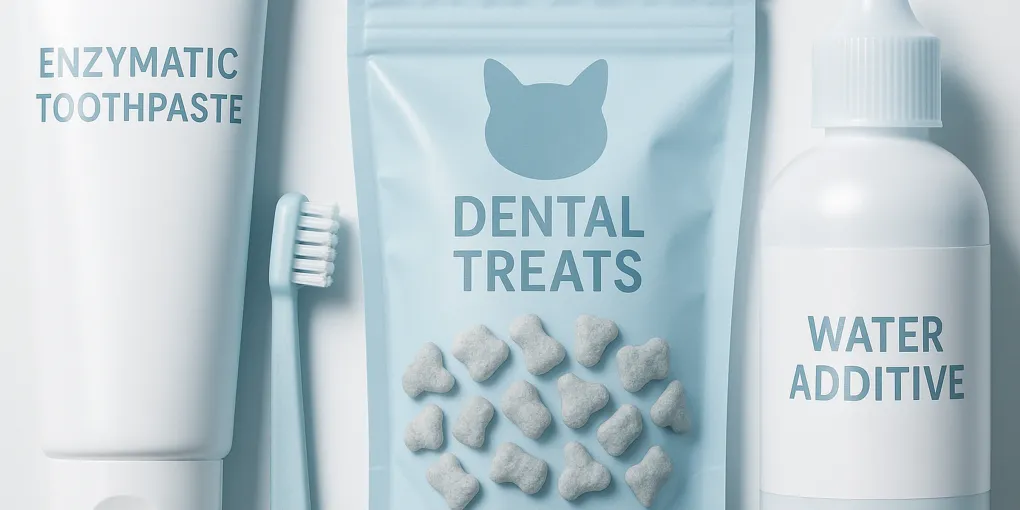
Cat dental care integrates naturally with the broader cat health routine. See our wet cat food guide — wet food can adhere to teeth, making dental hygiene particularly important for wet-fed cats. Our cat water fountain guide recommends adequate hydration, which supports saliva production (a natural dental defense). For cat health monitoring over time, our GPS cat tracker guide and microchip cat flap guide address safety for outdoor-access cats, while cat supplements covers omega-3 options that can complement dental anti-inflammatory care.
Frequently Asked Questions
How often should I brush my cat’s teeth?
Daily brushing is the gold standard — Clarke DE et al. (2011, PMID: 21175460) demonstrated 50–60% plaque reduction with daily brushing. Even 3 times per week provides meaningful benefit. Pair less-frequent brushing with VOHC-accepted dental chews for combined coverage.
Is human toothpaste safe for cats?
No — human toothpastes contain fluoride toxic to cats and often xylitol. Always use enzymatic pet-specific toothpaste (Virbac CET or equivalent). Pet toothpastes are formulated to be swallowed safely.
What is VOHC acceptance and why does it matter?
The Veterinary Oral Health Council awards its Seal only to products demonstrating statistically significant plaque or tartar reduction in controlled trials. VOHC acceptance is the primary objective evidence standard for cat dental products — it distinguishes clinically tested products from those relying on manufacturer claims.
Can dental chews replace toothbrushing?
No — dental chews reduce calculus by approximately 30% (Logan EI, 2006, PMID: 16564389); toothbrushing achieves 50–60% plaque reduction (Clarke DE et al., 2011). Dental chews are the best standalone substitute for cats who refuse brushing, and an effective complement to brushing.
At what age should I start dental care for my cat?
Start oral handling during kittenhood (8–16 weeks). Introduce enzymatic toothpaste by 6 months when adult teeth emerge. Begin AAFP-recommended annual professional cleanings at 1–3 years depending on individual periodontal assessment.
Final Verdict
Virbac CET Enzymatic Toothpaste Kit (PSR 4.6/5) is the top recommendation for all cat owners — VOHC-accepted, enzymatically active, veterinarian-recommended, and the lowest-cost dental intervention when used consistently. Greenies Feline Dental Treats (PSR 4.2/5) are the best brushing-free VOHC alternative. Oxyfresh Water Additive (PSR 4.0/5) is the easiest passive complement. Petrodex Natural (PSR 3.8/5) is a secondary toothpaste option for owners seeking a natural formula.
Citations: Lund EM et al. (1999) JAVMA 214(9):1336-41 (PMID: 10088014); Clarke DE et al. (2011) Aust Vet J 89(4):95-9 (PMID: 21175460); Logan EI (2006) Vet Clin North Am Small Anim Pract 36(6):1385-1401 (PMID: 16564389); Niemiec BA (2008) Top Companion Anim Med 23(2):72-80 (PMID: 18672180); VOHC Accepted Products for Cats (2024)
Frequently Asked Questions
- Daily toothbrushing is the gold standard — Clarke DE et al. (2011, PMID: 21175460) demonstrated that daily brushing reduces plaque accumulation by 50–60% compared to no intervention. Brushing every other day provides approximately half the plaque reduction benefit of daily brushing. If daily compliance is not achievable, pairing less-frequent brushing with a VOHC-accepted dental chew or water additive is more effective than infrequent brushing alone. Even 3 times per week brushing provides meaningful plaque reduction vs. no dental care.
- No — never use human toothpaste on cats. Human toothpastes contain fluoride at concentrations toxic to cats if swallowed, and many contain xylitol which is toxic to pets. Always use enzymatic toothpaste specifically formulated for cats, such as Virbac CET or Petrodex Natural. Pet-specific toothpastes use flavors cats accept (poultry, malt) and are designed to be swallowed safely during normal use.
- The Veterinary Oral Health Council (VOHC) awards its Seal of Acceptance only to products that demonstrate clinical efficacy in controlled trials. To earn the seal, a product must show statistically significant reduction in plaque (Seal: plaque) or tartar/calculus (Seal: tartar) compared to control groups. VOHC acceptance is the primary objective evidence standard for cat dental products — it means the product has been tested in controlled settings rather than relying solely on manufacturer claims.
- No — dental chews are a useful complement to brushing but are less effective as a standalone. Logan EI (2006, PMID: 16564389) documented that VOHC-accepted dental chews reduce calculus accumulation by approximately 30% compared to no intervention. Toothbrushing achieves 50–60% plaque reduction (Clarke DE et al., 2011, PMID: 21175460). The two combined are substantially more effective than either alone. Dental chews are the best alternative for cats who will not accept toothbrushing.
- Start handling the cat's mouth and teeth during kittenhood (8–16 weeks) when socialization is most flexible. Even if formal brushing isn't started until adult teeth emerge (~6 months), early positive associations with oral handling dramatically improve adult compliance. Adult cats new to dental care should begin with finger rubbing (no toothbrush) and flavored toothpaste to build positive associations before introducing a brush. The AAFP recommends annual professional dental cleaning under anesthesia beginning at age 1–3 depending on individual periodontal assessment.