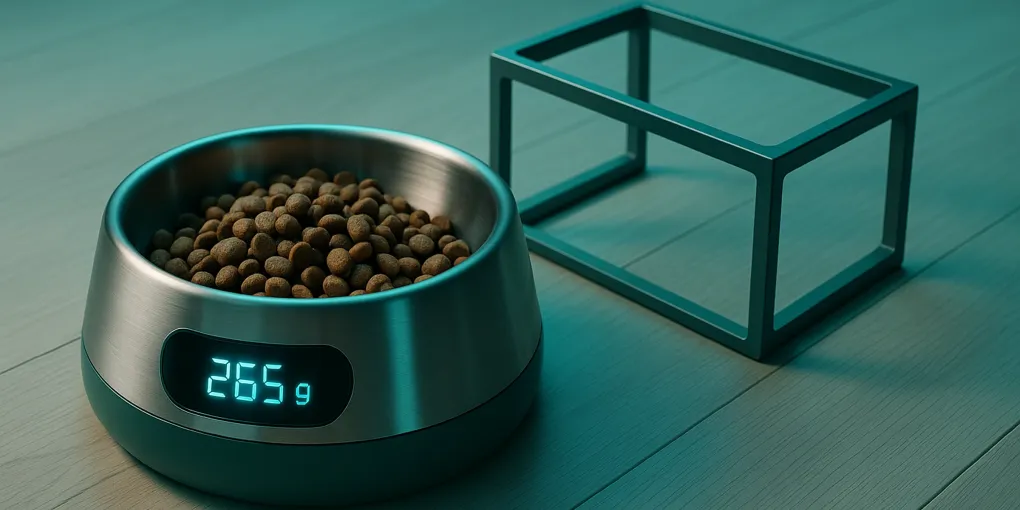
Best Smart Pet Bowl in 2026: PSR-Scored Portion-Tracking Bowls
Buyer's GuidePetlibro Smart Pet Feeder Bowl
Best OverallApp Connected: Yes (iOS/Android)
$55–$75
Quick Comparison
| Product | Key Specs | Price Range | Buy |
|---|---|---|---|
| |
| $55–$75 | Check Price |
| |
| $40–$55 | Check Price |
| |
| $35–$50 | Check Price |
| |
| $60–$80 | Check Price |
Contains affiliate links — we may earn a small commission at no extra cost to you.
Best Smart Pet Bowl in 2026
The best smart pet bowl for most dogs and cats is the Petlibro Smart Pet Feeder Bowl (PSR 4.4/5) — it combines load-cell gram-level portion tracking, a timed motorized lid that closes after a programmable interval, and a stainless inner bowl in a single unit with a mature app that logs daily and weekly intake trends. For fast-eating dogs or cats at bloat risk, the Goomazing Slow Feeder Smart Bowl (PSR 4.3/5) pairs a deep-ridge anti-bloat maze surface with app-based eating speed monitoring and anomaly alerts.
TL;DR
- Best Overall: Petlibro Smart Pet Feeder Bowl — load cell tracking, timed motorized lid, stainless inner bowl, mature app (PSR 4.4/5)
- Best for Fast Eaters: Goomazing Slow Feeder Smart Bowl — anti-bloat maze + speed monitoring app alerts (PSR 4.3/5)
- Best Value: Arf Pets Smart Bowl — load cell intake tracking with voice cue, lowest price with genuine smart features (PSR 4.2/5)
- Best for Multi-Pet: Closer Pets Model 200 — microchip/RFID lid control keeps restricted-diet pets safe (PSR 4.0/5)
- Key Stat: 56% of US dogs and 54% of US cats are classified overweight or obese (APOP, 2022) — smart bowls add precision to portion management without fully removing the pet’s natural bowl-access behavior
What Makes a Bowl “Smart”?
A smart pet bowl is not simply a slow feeder or a scheduled automatic feeder. The defining features are:
Portion tracking: Embedded load cell scales measure how much food is placed in the bowl and how much remains after the meal, calculating net intake per feeding event and logging it to an app. This produces a historical intake record that can be shared with a veterinarian.
Eating speed monitoring: Accelerometer-based designs (Goomazing) detect bowl movement and tongue-impact patterns to estimate eating speed, flagging meals where food was consumed unusually quickly or left entirely untouched.
Motorized or RFID lid control: Timed lids (Petlibro) close the bowl after a set duration, preventing free-grazing and reducing wet food contamination risk. RFID lids (Closer Pets) open only for the registered pet — a critical feature in multi-pet households with restricted-diet animals.
App connectivity and logging: All reviewed smart bowls sync meal data to a smartphone app without requiring a paid subscription for core features.
How We Evaluated Smart Pet Bowls
PSR uses a weighted composite formula: Composite = (Safety × 0.30) + (Efficacy & Performance × 0.25) + (Real-World Acceptance × 0.20) + (Value × 0.15) + (Transparency & Brand Trust × 0.10). Criteria are scored 0–10; composite scores range 0–5. Evidence sources: CPSC recall database, manufacturer published specifications, Amazon verified purchase reviews (combined 10,000+ ratings across reviewed products), and published veterinary literature on portion control and bloat risk.
PSR Composite Score Breakdown
| Criterion | Weight | Petlibro | Goomazing | Arf Pets | Closer Pets |
|---|---|---|---|---|---|
| Safety | 30% | 9.0 | 8.5 | 8.5 | 8.5 |
| Efficacy & Performance | 25% | 8.5 | 8.0 | 8.0 | 7.5 |
| Real-World Acceptance | 20% | 9.0 | 9.0 | 8.5 | 8.0 |
| Value | 15% | 8.5 | 9.0 | 9.0 | 8.0 |
| Transparency & Brand Trust | 10% | 9.5 | 8.5 | 8.0 | 7.5 |
| PSR Composite | — | 4.4/5 | 4.3/5 | 4.2/5 | 4.0/5 |
Petlibro leads on Transparency & Brand Trust — its Petlibro app is the most mature platform in this category, with multi-pet profiles, daily/weekly intake graphs, and reliable WiFi connection. Goomazing and Arf Pets score highest on Value — both deliver genuine smart features at $40–$55. Closer Pets scores lower on Efficacy & Performance because the battery-operated RFID lid mechanism requires 4×C batteries approximately every 3 months and the lid motor shows more wear variance in long-term owner reports than the USB-powered competitors.
Petlibro Smart Pet Feeder Bowl: Best Overall
The Petlibro Smart Pet Feeder Bowl earns the top PSR score by combining three features that are typically sold separately: gram-level load cell tracking, a motorized timed lid, and a 304 stainless steel inner bowl — all under $75.
Key features:
- Load cell sensor records food weight placed and food weight remaining; net intake calculated per meal and logged automatically in the Petlibro app
- Motorized lid opens fully when the pet approaches (motion detection) and closes after a user-configurable interval (1–30 minutes) — reduces wet food contamination exposure and discourages free-grazing
- Inner bowl is 304 stainless steel, removable, and dishwasher safe — no plastic leaching concerns for the food contact surface
- USB-C power with battery backup maintains lid function during brief power interruptions
- Multi-pet profiles supported in app; works for cats and dogs up to approximately 40 lbs
Limitation: The motorized lid produces a soft mechanical sound on open and close. Most pets habituate within 1–3 days; noise-sensitive cats may need a brief acclimatization period with the lid propped open before programming the timed closure.
Safety: BPA-free ABS outer housing, food-grade 304 stainless inner bowl, no active CPSC recalls. USB-C charging complies with standard consumer electronics electrical safety requirements.
View Petlibro Smart Pet Feeder Bowl on Amazon — Best for: Owners who want accurate intake data, wet food safety through timed lid closure, and a durable stainless food surface in one device
Goomazing Slow Feeder Smart Bowl: Best for Fast Eaters
The Goomazing Smart Bowl addresses the two primary eating-speed risks — rapid ingestion and aerophagia contributing to bloat — through a combined hardware and software approach. The bowl’s interior surface uses a deep-ridge maze pattern that physically slows the eating rate, while the Goomazing app monitors meal duration and flags unusually fast completions as anomaly alerts.
Why eating speed matters: Glickman et al. (2000, PMID: 10850676) identified rapid eating as a significant modifiable behavioral risk factor for gastric dilatation-volvulus (GDV) in large-breed dogs. Deep-chested breeds — including Great Danes, Weimaraners, German Shepherds, and Labrador Retrievers — benefit most from anti-bloat feeding interventions. The Goomazing maze design typically extends meal duration 4–8× compared to a flat bowl, consistent with slow feeder category benchmarks.
Key features:
- Deep-ridge stainless inner maze surface slows eating rate mechanically — no app required for the core bloat-prevention benefit
- Accelerometer sensor detects eating motion; app calculates approximate eating speed per meal
- Anomaly alerts notify the owner when the meal is consumed significantly faster or slower than the pet’s baseline — a flag for illness (reduced appetite) or stress (eating faster than usual)
- No motorized components — quieter and simpler than lid-equipped bowls; no lid closure risk
Limitation: No lid means wet food is not recommended for extended periods at room temperature beyond 2–4 hours. Not ideal for households where a second pet may consume the bowl’s contents.
View Goomazing Slow Feeder Smart Bowl on Amazon — Best for: Large-breed dogs with known fast-eating behavior; owners who want baseline appetite monitoring to catch illness early
Arf Pets Smart Bowl: Best Value
The Arf Pets Smart Bowl delivers the core smart bowl proposition — gram-level load cell intake tracking with app logging — at the lowest price point in this review. For owners who already use the Arf Pets ecosystem (the Arf Pets automatic feeder), the app integration provides a combined intake picture across both devices.
Key features:
- Load cell embedded in bowl base measures food added and food remaining; gram-level net intake logged per meal in the Arf Pets app
- Voice recording playback at mealtime — record a 10-second message that plays when the feeding event begins; consistent with Arf Pets’ brand differentiator across their product line
- Available in a standard BPA-free plastic inner bowl version and an upgraded 304 stainless inner bowl version; choose based on whether pet has plastic sensitivity or chin acne concerns
- USB-C or 3×AAA battery operation — battery mode suitable for placement away from outlets
- App integrates with Arf Pets automatic feeder if owned — combined scheduled + bowl-level intake data in one view
Limitation: No lid closure mechanism — wet food not safe for prolonged room-temperature exposure. No multi-pet RFID access control. App is functional but less polished than Petlibro for data visualization.
View Arf Pets Smart Bowl on Amazon — Best for: Budget-conscious owners who want genuine load cell tracking; Arf Pets ecosystem users; pets that benefit from familiar voice cues at mealtime
Closer Pets Model 200: Best for Multi-Pet Households
The Closer Pets Model 200 solves a problem the other three bowls cannot: it physically prevents the wrong pet from eating the contents. Using the pet’s existing microchip number (9-digit or 10-digit formats supported) or a supplied RFID disc worn on the collar, the magnetic lid opens only for the registered animal. When a different pet approaches, the lid stays closed or snaps shut on approach detection.
Why this matters clinically: In households with one pet on a prescription renal diet, weight management formula, or diabetes-management regimen, open-access bowls create a constant risk of dietary contamination — either the diet pet eating the other pet’s unrestricted food, or the unrestricted pet consuming the medical food. The Model 200 is the most practical non-crating solution for this scenario.
Key features:
- Reads existing microchip — no implanting or replacing required; compatible with most standard microchip formats used in the US and UK
- Included RFID disc clips to a collar for pets without a microchip
- Magnetic lid provides a firm close that resists most paw interference from curious housemates
- App logs lid open/close events by timestamp — provides a basic meal timing record even without a scale
- Stainless inner bowl removable for cleaning
Limitation: No load cell — portion accuracy depends on how much the owner loads into the bowl, not what the bowl measures. App logging is event-based (lid open/close timestamps) rather than gram-level intake data. Battery powered (4×C batteries, approximately 3 months per set) — more consumable cost than USB alternatives.
View Closer Pets Model 200 on Amazon — Best for: Multi-pet households where one animal is on a restricted diet; any scenario requiring access-controlled feeding without full crate separation
Which Smart Bowl Should You Choose?
| Scenario | Best Pick |
|---|---|
| Want intake data + wet food safety | Petlibro Smart Pet Feeder Bowl |
| Fast-eating large dog at bloat risk | Goomazing Slow Feeder Smart Bowl |
| Budget under $50, want real tracking | Arf Pets Smart Bowl |
| Multi-pet household with diet restrictions | Closer Pets Model 200 |
| Already using Arf Pets auto feeder | Arf Pets Smart Bowl (ecosystem integration) |
| Noise-sensitive cat | Goomazing or Arf Pets (no lid motor) |
Frequently Asked Questions
What is the difference between a smart pet bowl and an automatic pet feeder?
An automatic feeder stores food in a hopper and dispenses measured portions on a fixed schedule — the pet has no bowl access between programmed meals. A smart bowl sits out like a regular bowl and adds embedded intelligence: a load cell that measures how much is eaten per meal, app logging of intake history, motorized lids that close after a set interval, or RFID recognition that opens only for the registered pet. Smart bowls preserve natural bowl-access behavior while tracking or controlling portions. They are often better suited for households that want intake data without the rigid scheduling of a hopper feeder.
Are smart pet bowls safe for cats?
Yes — all four reviewed bowls are compatible with cats. Key considerations for cats: the motorized lid sound (present in Petlibro and Closer Pets) should not be startling to noise-sensitive individuals — most cats habituate within 1–3 days when introduced gradually. Anti-bloat maze surfaces should have channels wide and shallow enough for cats’ narrower muzzles. The Goomazing and Arf Pets bowls, which have no motorized components, are typically the easiest cat introductions.
Do smart pet bowls require a subscription?
None of the four reviewed products require a paid subscription for core app functionality. Intake logging, meal history, speed alerts, and RFID access control are all included at no ongoing cost. Always confirm terms at purchase — app subscription requirements can change after initial product launch.
How accurate is load cell portion tracking?
Load cell sensors in the Petlibro and Arf Pets bowls are typically accurate to ±2–5 grams under normal conditions, which is comparable to a kitchen food scale and meaningfully more precise than measuring cups (which introduce 20–40% variance per serving). Accuracy may drift if the sensor is exposed to moisture or the bowl is dropped; the manufacturer app typically includes a recalibration function.
Can a smart pet bowl help in a multi-pet household?
Yes — the Closer Pets Model 200 is specifically designed for this use case. It reads each pet’s existing microchip and opens the magnetic lid only for the registered animal. When any other pet approaches, the lid stays closed. This is the most practical non-crating method for households where one pet is on a restricted diet (renal, diabetic, or weight management food) and the other has unrestricted access to a different formula.
Related PSR Guides
- Best Dog Smart Feeder
- Best Automatic Cat Feeder
- Best Cat Slow Feeder Bowl
- Best Digital Pet Scale
- Best Dog Food for Weight Management
- Best Smart Dog Water Fountain
- Best Dog Puzzle Feeder
Frequently Asked Questions
- An automatic feeder stores food in a hopper and dispenses measured portions on a schedule — the pet has no access between meals. A smart bowl sits on the floor like a regular bowl, but adds intelligence: a load cell that measures how much is eaten per meal, app logging of intake data, motorized lids that close after a set time, or RFID recognition that opens only for the registered pet. Smart bowls give pets more natural bowl-access behavior while still tracking or controlling portions. They are often better suited for households that want data collection without strict time-lock feeding.
- Yes — all four reviewed smart bowls are tested with cats. The key considerations for cats specifically are: (1) the motorized lid noise should not startle a skittish cat — Petlibro's lid operates quietly enough that most cats habituate within 1–3 days; (2) anti-bloat maze surfaces should have shallow enough channels for cats' narrower muzzles; (3) bowl height should be appropriate — cats generally prefer flat or slightly elevated surfaces rather than deep bowls. The Goomazing maze design and Arf Pets bowls have been used for cats in verified owner reports.
- None of the four reviewed smart bowls require a paid subscription for core functionality. The Petlibro, Goomazing, and Arf Pets apps provide full intake logging, meal history, and alert notifications at no ongoing cost. The Closer Pets app similarly includes RFID access management without a subscription. Always confirm subscription terms at purchase, as manufacturer policies may change after product launch.
- Load cell sensors in the Petlibro and Arf Pets bowls are typically accurate to ±2–5 grams under normal conditions — comparable to a basic kitchen food scale. This precision is sufficient for most weight management protocols and meaningfully more accurate than visual estimation or measuring cups (which introduce 20–40% variance per serving). Accuracy may drift over time if the sensor is exposed to moisture or the bowl is dropped; recalibrate periodically using a known-weight reference per the manufacturer's app instructions.
- Yes — the Closer Pets Model 200 is designed specifically for this scenario. It reads each pet's existing microchip (9 or 10 digit) or an included RFID disc collar attachment, and the magnetic lid opens only when the registered pet is detected within range. When an unregistered pet approaches, the lid remains closed or snaps shut. This is the most effective non-crating solution for households where one pet is on a restricted diet (renal, weight management, diabetes) and another is not.