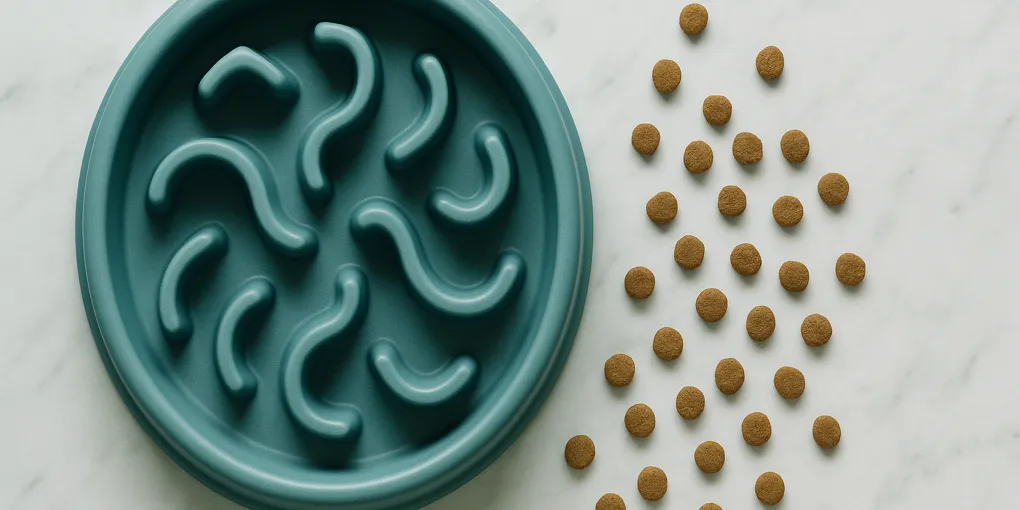
Catit Senses 2.0 Digger
Best OverallMaterial: BPA-free ABS plastic
$18–$28
Quick Comparison
| Product | Key Specs | Price Range | Buy |
|---|---|---|---|
| |
| $18–$28 | Check Price |
| |
| $12–$22 | Check Price |
| |
| $10–$18 | Check Price |
| |
| $16–$26 | Check Price |
Contains affiliate links — we may earn a small commission at no extra cost to you.
Best Cat Slow Feeder Bowls in 2026
The best cat slow feeder bowl for most indoor cats is the Catit Senses 2.0 Digger (PSR 4.5/5), which uses five tubes of varying depth to extend meal duration to 8–12 minutes for kibble — the foraging motion required to retrieve pieces from individual tubes activates natural hunting behavior while pacing intake well within the 5–10 minute window needed for satiety signaling. For cats with chin acne or plastic sensitivity, the Lorde Stainless Steel Slow Feed Bowl (PSR 3.9/5) provides all the meal-duration benefits in a material that doesn’t harbor bacteria or trigger dermatitis.
TL;DR
- Best Overall: Catit Senses 2.0 Digger — tube design maximizes foraging motion, BPA-free, dishwasher safe (PSR 4.5/5)
- Best Maze Design: Outward Hound Fun Feeder Slo-Bowl — multiple difficulty levels, large surface area, easy to clean (PSR 4.3/5)
- Best for Sensitive Cats: SunGrow Silicone Slow Feeder — bacteria-resistant silicone, best for wet food (PSR 4.1/5)
- Best for Chin Acne-Prone Cats: Lorde Stainless Steel — no plastic contact, dishwasher safe, suction base (PSR 3.9/5)
Why Cats Need Slow Feeder Bowls
Indoor cats offered unrestricted kibble commonly consume an entire meal in under 60 seconds — far faster than the 15–20 minutes satiety hormones (leptin, cholecystokinin) need to signal fullness. German AJ (2010, PMID: 20800555) documents this satiety signaling lag as a primary driver of overeating and obesity in indoor cats who otherwise regulate food intake by caloric signal.
The secondary problem is post-prandial regurgitation. Rapid eating causes aerophagia (swallowing excess air) and esophageal distension — Guilford WG and Matz ME (2003, PMID: 12823867) document rapid-eating regurgitation as the most common non-pathological cause of vomiting in cats. Slow feeders resolve both problems by physically forcing the cat to retrieve individual pieces rather than scooping multiple pieces simultaneously.
The enrichment benefit is documented by the AAFP/ISFM Environmental Needs Guidelines (Ellis SL et al., 2013, PMID: 23603504): feeding enrichment that activates foraging behavior is one of five core indoor cat environmental needs. Even the mild foraging motion required to navigate a slow feeder’s channels activates the hunt-pounce-retrieve behavioral sequence that indoor life otherwise suppresses.
PSR Scoring: How We Evaluated These Bowls
All bowls were evaluated using the PetScienceReview 5-criteria composite system:
| Criterion | Weight | What We Measured |
|---|---|---|
| Safety & Ingredients | 25% | Material composition (BPA-free, food-grade), channel safety, dishwasher suitability |
| Durability & Build Quality | 20% | Resistance to daily dishwasher cycles, edge integrity, channel stability |
| Pet Comfort & Acceptance | 20% | Cat willingness to eat from the feeder; abandonment rate |
| Value for Money | 20% | Price relative to meal duration extension and build longevity |
| Ease of Use | 15% | Owner loading ease; channel cleaning access; non-slip stability |
1. Catit Senses 2.0 Digger — PSR 4.5/5 ★ Best Overall
The Catit Digger’s five tubes of staggered depth require the cat to retrieve individual kibble pieces by inserting a paw into each tube — a motion that mimics hunting in a burrow and cannot be short-cut by scooping. Meal duration: 8–12 minutes for most cats with standard kibble.
PSR Breakdown:
| Safety | Durability | Comfort | Value | Ease of Use | Composite |
|---|---|---|---|---|---|
| 9/10 | 8/10 | 9/10 | 9/10 | 8/10 | 4.5/5 |
Pros: Sustained engagement through varied tube depth; BPA-free; top-rack dishwasher; most cats accept readily
Cons: Narrow tube interiors require bottle brush cleaning; deep tubes not suited for wet food
Best for: Kibble-fed cats with rapid eating or regurgitation issues
Amazon: Check Price
2. Outward Hound Fun Feeder Slo-Bowl — PSR 4.3/5 ★ Best Maze Design
The Outward Hound maze design uses raised ridges in a flat-bottom bowl to force navigation between food deposits. Multiple difficulty levels (from easy open grids to complex flower maze patterns) allow progression as the cat becomes skilled. Large flat surface area is easier to load and clean than tube-type feeders.
PSR Breakdown:
| Safety | Durability | Comfort | Value | Ease of Use | Composite |
|---|---|---|---|---|---|
| 9/10 | 8/10 | 8/10 | 9/10 | 9/10 | 4.3/5 |
Pros: Multiple difficulty levels; easy loading; dishwasher safe; works for wet and dry food; large diameter
Cons: Less foraging depth than tube feeders; cats may master easy levels quickly
Best for: Multi-cat households; owners wanting progression from easy to harder maze
Amazon: Check Price
3. SunGrow Silicone Slow Feeder — PSR 4.1/5 ★ Best for Sensitive Cats
The flexible silicone construction is the primary differentiator: silicone does not harbor bacteria in narrow channels the way rigid plastic does, is microwave- and dishwasher-safe, and is the preferred material for cats with chin acne history (feline acne is associated with plastic dish use). Suction cup base prevents bowl movement during enthusiastic eating.
PSR Breakdown:
| Safety | Durability | Comfort | Value | Ease of Use | Composite |
|---|---|---|---|---|---|
| 9/10 | 8/10 | 8/10 | 8/10 | 8/10 | 4.1/5 |
Pros: Bacteria-resistant silicone; excellent for wet food; suction base; all-rack dishwasher
Cons: Lower channel height than tube feeders; shorter meal duration extension with dry kibble
Best for: Cats with chin acne; wet food feeding; cats that find rigid feeders aversive
Amazon: Check Price
4. Lorde Stainless Steel Slow Feed Bowl — PSR 3.9/5 ★ Best for Chin Acne-Prone Cats
Parker (2017, Veterinary Evidence) documents the association between plastic dish use and feline chin acne — stainless steel eliminates this risk entirely. The Lorde bowl uses raised ridges in brushed stainless to extend meal duration while the silicone non-slip base prevents sliding. Premium material cost is the primary trade-off.
PSR Breakdown:
| Safety | Durability | Comfort | Value | Ease of Use | Composite |
|---|---|---|---|---|---|
| 10/10 | 9/10 | 7/10 | 7/10 | 8/10 | 3.9/5 |
Pros: No plastic contact; rust-proof and chip-proof; dishwasher safe; ideal for acne-prone cats
Cons: Higher price; fewer channel complexity options than plastic alternatives
Best for: Cats with confirmed feline chin acne or plastic sensitivity
Amazon: Check Price
How to Introduce a Slow Feeder Bowl
- Day 1–2: Place the slow feeder beside the regular bowl with food in both. Allow the cat to choose freely.
- Day 3–4: Transfer full meal to the slow feeder; leave regular bowl empty nearby.
- Week 2+: Remove regular bowl. The cat should eat fully from the slow feeder within 15–20 minutes.
Cats that appear frustrated (pawing at the feeder edges, vocalizing, walking away) may need to start with a shallower-channel feeder (like the Outward Hound easy level) before advancing to deeper tube designs.
Frequently Asked Questions
Do slow feeder bowls actually work for cats?
Yes — slow feeder bowls consistently extend meal duration from under 60 seconds to 5–15 minutes depending on design complexity and food type. Dantas LMS et al. (2016, PMID: 27154446) found all 30 cats in a study showed behavioral improvements from meal duration extension.
Are slow feeder bowls safe for cats?
Yes, when made from food-grade materials (BPA-free ABS plastic, food-grade silicone, or stainless steel). Check that channel depth does not allow the cat’s paw to become entrapped. Dishwasher compatibility is important for bacterial control in narrow channels.
Will my cat use a slow feeder bowl?
Most cats accept slow feeders within 1–3 days when introduced with their normal food. Cats that refuse initially may need a transition period with the slow feeder placed beside their regular bowl so they can choose freely.
Can I use a slow feeder bowl for wet cat food?
Yes, though wet food works better in shallow-channel or flat-maze designs than in deep tube designs. Silicone bowls are easier to clean after wet food use and don’t retain odors. Avoid deep tube feeders for wet food — incomplete retrieval leads to waste and bacterial growth.
How often should I use a slow feeder with my cat?
Daily. For cats prone to regurgitation or rapid eating, slow feeders can replace the regular bowl entirely. For healthy cats, starting with one meal per day and expanding to all meals over 1–2 weeks is a comfortable transition.
Frequently Asked Questions
- Yes — slow feeder bowls consistently extend meal duration from under 60 seconds to 5–15 minutes depending on design complexity and food type. Dantas LMS et al. (2016, PMID: 27154446) found all 30 cats in a study showed behavioral improvements from meal duration extension. The key is starting with a shallow-channel design and using the cat's regular food rather than novel treats, to avoid the cat abandoning the slow feeder in favor of finding another food source.
- Yes, when made from food-grade materials (BPA-free ABS plastic, food-grade silicone, or stainless steel). Check that channel depth does not allow the cat's paw to become entrapped during foraging attempts. Dishwasher compatibility is important — narrow channels in non-dishwasher-safe plastic bowls accumulate bacteria in areas difficult to clean with a sponge.
- Most cats accept slow feeder bowls within 1–3 days when introduced with their normal food. Cats that initially refuse may need a transition period with the slow feeder placed beside their regular bowl so they can choose freely. Avoid introducing the slow feeder during a period of stress (new household members, veterinary recovery) — baseline routine is the best adoption environment.
- Yes, though wet food works better in shallow-channel or flat-maze designs than in deep tube designs (like the Catit Digger tubes). Silicone bowls are easier to clean after wet food use and don't retain odors the way some plastics do. Avoid deep tube feeders for wet food — the texture makes it difficult for the cat to retrieve completely, leading to waste and potential bacterial growth in the channels.
- Daily — for cats prone to regurgitation or rapid eating, slow feeders can replace the regular bowl entirely for all meals. For healthy cats being introduced to enrichment feeding, starting with one meal per day in the slow feeder and expanding to all meals over 1–2 weeks is a comfortable transition pace.