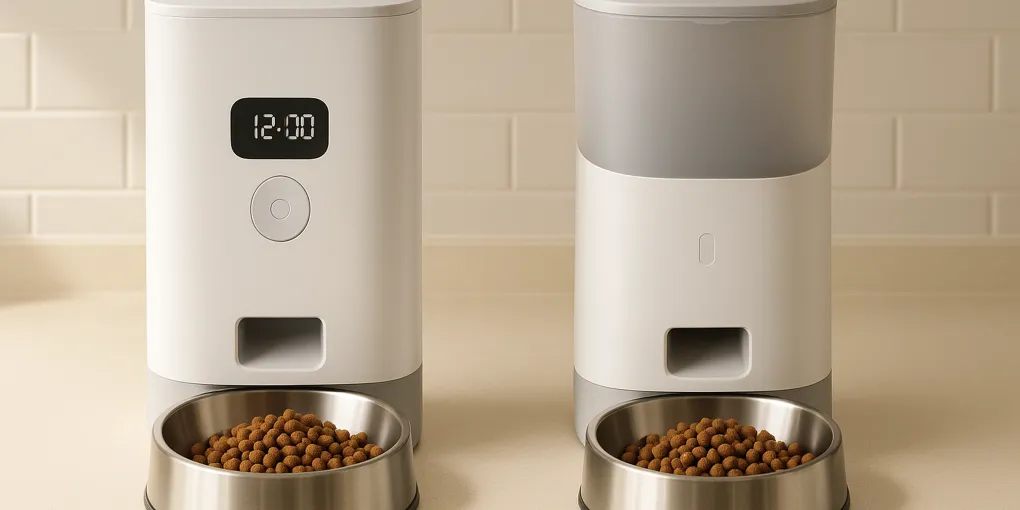
Best Automatic Feeder for Multiple Pets in 2026: Multi-Pet and Split-Meal Solutions
Buyer's GuideSureFeed Microchip Pet Feeder
Best OverallPet ID: Implanted microchip or RFID tag
~$180–$200
Quick Comparison
| Product | Key Specs | Price Range | Buy |
|---|---|---|---|
| |
| ~$180–$200 | Check Price |
| |
| $150–$170 | Check Price |
| |
| $60–$90 | Check Price |
| |
| $80–$110 | Check Price |
Contains affiliate links — we may earn a small commission at no extra cost to you.
Best Automatic Feeder for Multiple Pets in 2026
The best automatic feeder for multi-pet households with different dietary needs is the SureFeed Microchip Pet Feeder (PSR 4.4/5) — the only feeder in this review that reads each pet’s implanted microchip and opens exclusively for the registered animal. In households where one cat is on a prescription renal diet, a diabetic dog requires precise carbohydrate portions, or a recovering pet has medication mixed into food, the SureFeed’s microchip-gated access control is not a convenience feature — it is a clinical necessity. For multi-pet households where all pets eat the same food and scheduling flexibility is the primary need, the PetSafe Smart Feed 2.0 (PSR 4.2/5) delivers reliable WiFi-connected scheduling with strong battery backup.
TL;DR
- Best Overall: SureFeed Microchip Pet Feeder — microchip-gated lid, wet and dry food, prevents food theft completely (PSR 4.4/5)
- Best WiFi Scheduling: PetSafe Smart Feed 2.0 — 12 meals/day, app control, dual AC + battery power, 24-cup capacity (PSR 4.2/5)
- Best High Capacity: Petlibro Granary Smart Feeder — 6L hopper, USB-C battery backup up to 7 days, strong value (PSR 4.1/5)
- Best Dual-Pet Design: WOpet SmartFeeder — two independent compartments with separate schedules, one unit for two pets (PSR 3.9/5)
Why Multi-Pet Feeding Is a Different Problem
Automatic feeders designed for single-pet households fail in multi-pet environments in two predictable ways: dominant eaters steal food from subordinate pets, and pets on different diets or medications receive the wrong food. These are not edge cases — food stealing between cats is one of the most commonly reported problems in multi-pet households, and veterinary nutrition guidance increasingly emphasizes the importance of precise dietary separation for pets with chronic conditions.
Food Aggression and Resource Guarding in Multi-Pet Households
Food aggression is a specific behavioral pattern in which one pet defends a food resource — actively or passively — from other pets in the household. It is distinct from simple opportunistic stealing: a resource-guarding dog or cat may eat faster, body-block access, growl or hiss near the food area, or rush to finish before other pets approach. Even in households where no overt aggression occurs, subordinate pets may eat less than their required portion because they avoid the feeding area while a more dominant animal is present.
This feeding competition has documented effects on dietary compliance. When a cat on a prescription renal diet shares an open-access feeder with a healthy cat, the renal-diet cat may consume the wrong food, the healthy cat may consume medically restricted food, or both may eat suboptimal portions under the social pressure of shared access. Veterinary nutritionists recommend dietary separation not only for medically critical diets but for any multi-pet household where weight management is a goal for one or more pets — since caloric intake cannot be reliably controlled at a shared open-access bowl.
Meal frequency also matters. AAFCO (Association of American Feed Control Officials) feeding guidelines and veterinary nutrition research support multiple smaller meals per day over single large meals for both cats and dogs, with particular benefit for cats prone to vomiting after rapid, large-portion ingestion. An automatic feeder that distributes daily intake across 6–12 meals significantly reduces this risk compared to once- or twice-daily manual feeding. The ability to program separate meal schedules for each pet — achieved via microchip gating or dual-compartment design — is the core functional differentiator that makes multi-pet feeders a meaningful category beyond single-pet convenience products.
When Dietary Separation Is Medically Necessary
Several common chronic conditions require strict dietary separation in multi-pet households:
- Chronic kidney disease (CKD) in cats: Prescription renal diets are phosphorus-restricted; access to a healthy cat’s standard diet can accelerate kidney deterioration.
- Diabetes mellitus: Consistent carbohydrate and caloric intake at timed intervals is critical for glycemic control. Irregular access to additional food disrupts insulin dosing.
- Food allergies or sensitivities: Novel protein diets for elimination trials are invalidated if the allergic pet can access the other pet’s standard food.
- Weight management: Precisely portioned caloric restriction is undermined by cross-access, even occasionally.
In all of these cases, the SureFeed Microchip Pet Feeder’s physical lid gating — which opens only for the registered microchip — is the only automatic feeder mechanism in this review that can be reliably used to satisfy the medical separation requirement.
The automatic feeder market has responded with two categories of solution: open-access schedulers (which manage when food is dispensed but not who eats it) and identity-gated feeders (which control which pet can physically access each bowl). Choosing between these categories depends entirely on whether your household has pets with different dietary requirements. Cat owners specifically may also find value in reviewing the best automatic wet food cat feeder guide, which covers feeders designed for the portion timing and hygiene requirements of wet food. For dogs that eat too quickly, the best dog puzzle feeder provides a behavioral slow-feeding alternative that works alongside a scheduled automatic feeder.
How We Evaluated Multi-Pet Automatic Feeders
PSR Composite = (Safety × 0.25) + (Durability × 0.20) + (Pet Comfort × 0.20) + (Value × 0.20) + (Ease of Use × 0.15)
Safety evaluates food hygiene design, physical hazard risk, and — most critically for this category — whether the feeder prevents unauthorized access when dietary separation is medically required. Pet Comfort scores how reliably each pet receives their intended meal without competition stress. Durability assesses construction quality and multi-year reliability of both mechanical dispensing components and electronic systems. Value accounts for upfront cost, ongoing consumable cost, and feature-to-price ratio. Ease of Use scores app quality, setup complexity, and daily management burden.
SureFeed Microchip Pet Feeder Review: Best Overall
Price: ~$180–$200 | Check Price on Amazon
Specs:
- Pet ID: Implanted microchip (ISO 11784/11785) or RFID collar tag (included)
- Food type: Wet and dry food compatible
- Lid mechanism: Motion-sensing, opens when registered pet approaches
- Power: 4×C batteries (approximately 6 months per set)
- Connectivity: Sure Petcare app via Hub (Hub sold separately, ~$50); operates without Hub as standalone microchip feeder
PSR Score Breakdown:
| Criterion | Weight | Score /10 | Weighted |
|---|---|---|---|
| Safety | 25% | 9.5 | 2.38 |
| Durability | 20% | 8.5 | 1.70 |
| Pet Comfort | 20% | 9.5 | 1.90 |
| Value for Money | 20% | 7.0 | 1.40 |
| Ease of Use | 15% | 8.0 | 1.20 |
| PSR Composite | 8.58 → 4.4/5 |
Safety (9.5/10): The microchip-gated lid is the defining safety feature of this review. When a pet on a prescription diet (renal, hepatic, urinary, diabetic) lives with another pet, accidental cross-feeding of the wrong food is a genuine health risk. The SureFeed eliminates this risk entirely — the lid physically cannot open for a non-registered microchip. The sealed bowl design also prevents wet food from drying out between meal presentations, reducing bacterial growth risk compared to open bowls.
Durability (8.5/10): SureFeed units have strong multi-year reliability records in owner review aggregates. The motion-sensing mechanism and lid motor are the primary wear components, with most units operating reliably for 3–5 years under daily use. Battery life of approximately 6 months per set of 4 C batteries is reasonable given the motor’s operation frequency.
Pet Comfort (9.5/10): For pets being fed separately in a multi-pet household, the SureFeed creates a dedicated, protected feeding zone. Subordinate pets no longer experience the anxiety of eating while a dominant pet hovers nearby. Each pet has exclusive access to their own bowl, which reduces mealtime stress — a behavioral benefit with documented effects on digestive health and eating rate normalization in cats.
Value for Money (7.0/10): The ~$180–$200 price per unit, plus $50 for the Hub if app connectivity is desired, is the highest hardware investment in this review. In a two-pet household with different dietary needs, two units are required — bringing the total to $360–$400 plus the Hub. This cost is justified when dietary separation is medically necessary; for households where pets simply eat the same food, less expensive options deliver similar scheduling benefits.
Ease of Use (8.0/10): Setup requires microchip registration (approach the bowl with the pet — the feeder auto-reads the chip) and bowl pre-loading. There is no hopper or automatic dispensing; the bowl must be filled by the owner for each meal cycle. The Sure Petcare app (when Hub is connected) logs feeding times and duration, providing a useful health monitoring record over time.
Pros: Only feeder in this review that prevents food theft, wet and dry food compatible, excellent multi-pet dietary separation, long battery life, quiet lid operation Cons: No automatic dispensing (bowl must be pre-filled), one feeder per pet required, Hub sold separately for app features, highest hardware cost in this review
PetSafe Smart Feed 2.0 Review: Best WiFi Scheduling
Price: $150–$170 | Check Price on Amazon
Specs:
- Capacity: 24-cup hopper
- Meals: Up to 12 scheduled daily; slow-feed dispense option
- Portions: 1/8 cup increments, 1/8–4 cups per meal
- Connectivity: 2.4GHz WiFi + dedicated app (iOS/Android)
- Power: AC adapter + 5×D battery backup
PSR Score Breakdown:
| Criterion | Weight | Score /10 | Weighted |
|---|---|---|---|
| Safety | 25% | 8.5 | 2.13 |
| Durability | 20% | 8.5 | 1.70 |
| Pet Comfort | 20% | 8.0 | 1.60 |
| Value for Money | 20% | 8.0 | 1.60 |
| Ease of Use | 15% | 8.5 | 1.28 |
| PSR Composite | 8.31 → 4.2/5 |
Safety (8.5/10): The PetSafe Smart Feed uses BPA-free food-contact materials throughout and the slow-feed dispense option reduces bloat risk in dogs prone to eating too quickly. The dual-power system (AC plus 5 D-battery backup) ensures meals are dispensed even during power outages, which is a meaningful safety factor for pets on medication-timed feeding schedules.
Durability (8.5/10): PetSafe is one of the most reviewed automatic feeder brands globally, with the Smart Feed line consistently receiving high marks for multi-year mechanical reliability. The hopper and auger mechanism handle standard dry kibble without jamming under normal operating conditions, and the app has maintained stable functionality over multiple firmware generations.
Pet Comfort (8.0/10): The slow-feed dispense mode reduces rapid eating behavior, which is associated with vomiting and digestive discomfort in dogs. Up to 12 scheduled meals per day allows spreading calories across more frequent small portions — a veterinary-recommended approach for weight management and digestive health. Open access design means pet comfort scores lower than microchip-gated options in households with dominant eaters.
Value for Money (8.0/10): At $150–$170, the PetSafe Smart Feed 2.0 is well-positioned for a full-featured WiFi feeder with industry-leading review volume. The 24-cup capacity reduces daily refill burden, and the app quality is consistently praised in owner feedback as more stable than many budget WiFi feeders.
Ease of Use (8.5/10): App setup is straightforward and scheduling is intuitive. The pause-feeding feature allows travel and schedule disruptions to be managed remotely without reprogramming. Low-food alerts via the app prevent accidental missed meals.
Pros: Industry-leading review volume and reliability, 12 meals/day maximum flexibility, slow-feed mode, strong dual-power backup, polished app Cons: No pet identity access control, dry food only, open-access design allows food stealing, no camera option
Petlibro Granary Smart Feeder Review: Best High Capacity
Price: $60–$90 | Check Price on Amazon
Specs:
- Capacity: 6L (approximately 24 cups)
- Meals: Up to 10 scheduled daily
- Connectivity: 2.4GHz WiFi + app (iOS/Android)
- Power: AC adapter + USB-C rechargeable battery backup (up to 7 days)
- Voice recording: 10-second custom message playable at mealtimes
PSR Score Breakdown:
| Criterion | Weight | Score /10 | Weighted |
|---|---|---|---|
| Safety | 25% | 8.0 | 2.00 |
| Durability | 20% | 8.0 | 1.60 |
| Pet Comfort | 20% | 8.0 | 1.60 |
| Value for Money | 20% | 9.0 | 1.80 |
| Ease of Use | 15% | 8.5 | 1.28 |
| PSR Composite | 8.28 → 4.1/5 |
Safety (8.0/10): BPA-free construction, food-grade hopper with sealing rotor design that limits kibble exposure to air and humidity. The USB-C battery backup system providing up to 7 days of power resilience is the standout safety-adjacent feature — medication-timed feeding schedules are protected through extended power outages.
Durability (8.0/10): At the $60–$90 price point, the Granary’s build quality exceeds expectations. The hopper material resists moisture absorption, and the auger mechanism handles standard kibble sizes reliably. Camera model (Granary Cam) adds a 1080p camera with night vision for remote visual confirmation of feeding.
Pet Comfort (8.0/10): The voice recording feature — owners can record a 10-second message that plays at each meal — has documented behavioral benefits for pets that associate their owner’s voice with mealtime, reducing anxiety in dogs prone to separation distress. Meal history logging in the app provides a useful record of feeding patterns for monitoring appetite changes.
Value for Money (9.0/10): At $60–$90, the Petlibro Granary delivers WiFi scheduling, large hopper capacity, USB-C battery backup, and voice recording at roughly half the price of the PetSafe Smart Feed 2.0. For multi-pet households where all pets eat the same diet, this represents exceptional value.
Ease of Use (8.5/10): App setup is quick and schedule programming is intuitive. The USB-C battery backup charges via standard cable rather than requiring proprietary batteries — a meaningful convenience advantage.
Pros: Outstanding value for WiFi features, large 6L capacity, USB-C battery backup up to 7 days, voice recording, meal history logging Cons: Dry food only, no pet identity access control, hopper-style dispensing has ~10% portion variability
WOpet SmartFeeder Review: Best Dual-Pet Design
Price: $80–$110 | Check Price on Amazon
Specs:
- Design: Dual-compartment (two independent hoppers + two bowls)
- Meals: Up to 6 scheduled daily per compartment (independently programmable)
- Connectivity: 2.4GHz WiFi + app (iOS/Android)
- Power: AC adapter + battery backup
- Pet ID: None — spatial separation only
PSR Score Breakdown:
| Criterion | Weight | Score /10 | Weighted |
|---|---|---|---|
| Safety | 25% | 7.5 | 1.88 |
| Durability | 20% | 7.5 | 1.50 |
| Pet Comfort | 20% | 7.5 | 1.50 |
| Value for Money | 20% | 8.5 | 1.70 |
| Ease of Use | 15% | 8.0 | 1.20 |
| PSR Composite | 7.78 → 3.9/5 |
Safety (7.5/10): The dual-compartment design allows different foods to be stored and dispensed from each side without manual bowl swapping, which reduces handling contamination risk. However, without microchip gating, there is no physical prevention of a pet accessing the wrong bowl. For households where one pet has a medically critical diet restriction, this design cannot be considered safe enough.
Durability (7.5/10): The WOpet SmartFeeder has a shorter owner-reported review history than PetSafe or Petlibro, with some reports of the dual-dispenser mechanism requiring recalibration after extended use. Build quality is adequate for the price point.
Pet Comfort (7.5/10): For cooperative two-pet households where each pet reliably eats from its own bowl and does not steal from the other, the dual-compartment design provides meaningful mealtime organization. Each pet has a designated feeding position with a consistent scent profile — a behavioral comfort factor for routine-oriented pets.
Value for Money (8.5/10): Managing two pets’ feeding schedules from one device at $80–$110 is good value when spatial bowl separation is sufficient for the household’s needs. Eliminates the need to purchase, set up, and monitor two separate single-pet feeders.
Ease of Use (8.0/10): The app manages both compartments from a single interface, with independent scheduling for each. This consolidated management is more convenient than maintaining two separate feeder apps in a two-pet household.
Pros: One device manages two pets’ schedules independently, different foods in each compartment, good value for two-pet households, consolidated app management Cons: No microchip gating (cannot prevent food theft by determined pets), lower owner review volume than competitors, dual-dispenser mechanism requires more maintenance than single-dispenser designs
Which Multi-Pet Feeder Should You Buy?
- Choose SureFeed Microchip if any pet in your household is on a prescription diet, receives medication in food, or if food theft between pets is actively occurring. This is the only option in this review that guarantees dietary separation.
- Choose PetSafe Smart Feed 2.0 if all pets eat the same food and your primary need is reliable WiFi scheduling across up to 12 meals per day, with industry-proven reliability and strong battery backup.
- Choose Petlibro Granary if all pets eat the same food and you want maximum value — WiFi scheduling, large capacity, and 7-day USB-C battery backup at roughly half the cost of the PetSafe.
- Choose WOpet SmartFeeder if you have exactly two pets who eat different foods but reliably eat from their own bowls, and you want to manage both schedules from a single device without investing in microchip-gated hardware.
For more on managing individual pet feeding, see the guides on best microchip pet feeder, best automatic cat feeder, and best dog smart feeder. For monitoring feeding remotely via camera, the best cat feeder with camera guide covers integrated camera options in detail. Owners who want to monitor their multi-pet household’s activity levels alongside feeding management should also review the best pet activity monitor and best smart pet bowl guides for complementary health-tracking tools.
Frequently Asked Questions
What is the best automatic feeder for two cats with different diets?
The SureFeed Microchip Pet Feeder is the definitive solution for cats on different diets. One unit registers to one cat’s implanted microchip — the lid opens only for that cat and closes when they step away. For a two-cat household with different dietary requirements, two SureFeed units are recommended. This is the only design in this review that guarantees dietary separation regardless of which pet approaches first.
Can automatic feeders handle both dogs and cats in the same household?
It depends on the feeder design. The SureFeed Microchip Pet Feeder reads the same ISO microchip standard used in both dogs and cats. Open-access feeders (PetSafe, Petlibro, WOpet) do not differentiate by species — any pet in the home can access them. For mixed-species households where size difference prevents cross-feeding, open-access feeders placed at species-appropriate heights can work with strategic positioning.
Do automatic pet feeders work if the WiFi goes down?
All WiFi feeders in this review store scheduled meal times locally on the unit and continue dispensing on schedule during a network outage. What is lost during an outage is remote control capability — schedule changes and manual feed commands from the app require active connectivity. Both PetSafe Smart Feed 2.0 and Petlibro Granary also include battery backup, so programmed meals continue even through power outages, not just WiFi outages.
How do I stop my cat from stealing my other cat’s food from an automatic feeder?
An open-access hopper feeder cannot prevent food theft by design. The SureFeed Microchip Pet Feeder is the only solution that physically prevents cross-access — its lid only opens when the registered pet’s microchip is detected and closes when they step away. For households where active food stealing is occurring, two SureFeed units (one per cat) is the recommended approach.
How large a capacity do I need for a multi-pet household?
Plan for approximately 2–3 cups of dry kibble per medium-sized dog per day, or 1/4–1/2 cup per cat per day. For a two-dog household, a 24-cup hopper (PetSafe Smart Feed 2.0 or Petlibro Granary at approximately 24 cups) allows 3–5 days between refills. For a two-cat household, the same capacity provides weeks of supply. Larger dogs or multiple large breeds may warrant looking at commercial-capacity feeders beyond the consumer products reviewed here.
Evidence sources: [AAFCO (Association of American Feed Control Officials), Pet Food Labeling and Feeding Guidelines, current edition], [AVMA (American Veterinary Medical Association), Pet Obesity and Nutritional Management resources], [Amazon verified review counts cited where applicable].
Frequently Asked Questions
- The SureFeed Microchip Pet Feeder is the definitive solution for cats on different diets. One unit registers to one cat's implanted microchip — the lid opens only for that cat and closes when they step away. For a two-cat household with different diet requirements, two SureFeed units are recommended (one per cat). This is the only design in this review that guarantees dietary separation regardless of pet behavior.
- It depends on the feeder design. The SureFeed Microchip Pet Feeder works for both dogs and cats and reads the same microchip standard used in both species. Open-access feeders (PetSafe, Petlibro, WOpet) do not differentiate by species — any pet in the home can access them. For mixed-species households where size prevents cross-feeding (large dog, small cat with elevated feeder), open-access feeders can work with strategic placement.
- All WiFi feeders in this review store scheduled meal times locally and will continue dispensing meals during a network outage. The PetSafe Smart Feed 2.0 and Petlibro Granary both maintain their programmed schedule without active WiFi. What is lost during an outage is remote control capability — you cannot change schedules or trigger manual feeds from the app until connectivity is restored.
- An open-access hopper feeder cannot prevent food theft by design — any pet near the bowl can eat from it. The SureFeed Microchip Pet Feeder is the only solution in this review that physically prevents this: its lid only opens when the registered pet's microchip is detected and closes when they step away. For households where food theft is occurring, two SureFeed units (one per cat) is the recommended approach.
- A general guideline: plan for approximately 2–3 cups of dry kibble per medium-sized dog per day, or 1/4–1/2 cup per cat per day. For a two-dog household, a 24-cup hopper (PetSafe Smart Feed 2.0 or Petlibro Granary at 6L) allows 3–5 days between refills. For a two-cat household, the same hopper capacity provides weeks of supply. Larger dogs or multiple large dogs may warrant looking at larger-capacity commercial feeders.