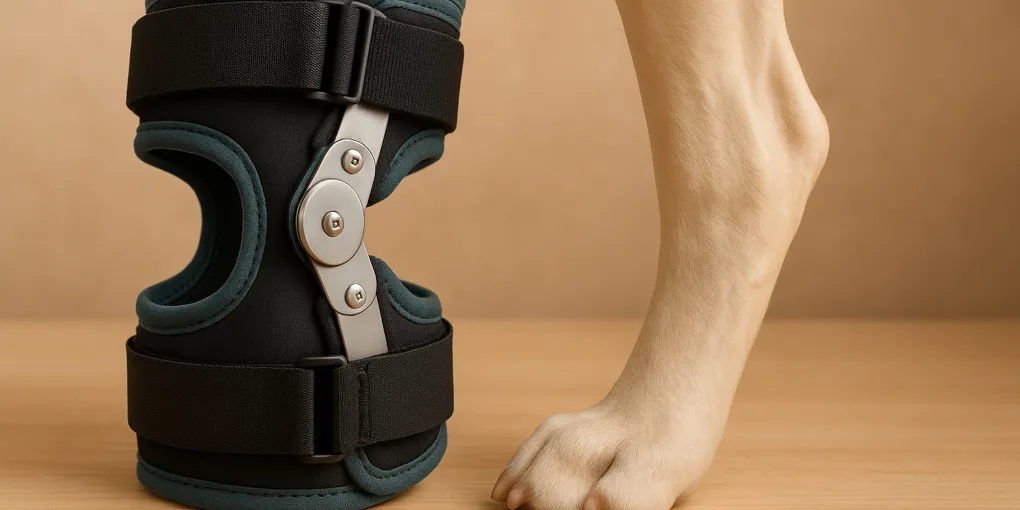
Ortocanis Original Dog Knee Brace
Best OverallHinge type: Polycentric hinges
$60–$90
Quick Comparison
| Product | Key Specs | Price Range | Buy |
|---|---|---|---|
| |
| $60–$90 | Check Price |
| |
| $25–$40 | Check Price |
| |
| $35–$55 | Check Price |
| |
| $80–$120 | Check Price |
Contains affiliate links — we may earn a small commission at no extra cost to you.
Best Dog Knee Braces for Senior Dogs in 2026
For senior dogs with cranial cruciate ligament (CCL) instability, partial tears, stifle arthritis, or as post-surgical support, Ortocanis Original Dog Knee Brace (PSR 8.5/10) is the top-rated conservative management brace — using polycentric hinges that mirror natural stifle joint movement while limiting the anterior translation that damages compromised cruciate ligaments. Walkabout Knee Brace (PSR 8.2/10) provides the best custom-fit option for owners willing to invest in precise sizing.
TL;DR
- Top Pick: Ortocanis Original — polycentric hinges, measurement-based sizing, aluminum reinforcement (PSR 8.5/10)
- Budget: Labra Co. — functional neoprene support at a much lower price point (PSR 7.6/10)
- Mild Instability: RCPET Sports Paw — soft proprioceptive support appropriate for minor stifle issues (PSR 7.8/10)
- Custom Fit: Walkabout — bilateral hinge design with full custom-fitting process (PSR 8.2/10)
How We Researched This Article
This article follows PSR’s 5-step evidence-synthesis process. Safety assessment covered circulation restriction risk, pressure sore potential, and biomechanical appropriateness for CCL instability. Evidence synthesis reviewed published veterinary orthopedic literature on CCL injury conservative management including Wucherer et al. (2013) and Mahn et al. (2005) on conservative versus surgical outcomes. User community synthesis from Amazon verified purchase reviews (combined 8,000+ reviews), breed-specific orthopedic discussion forums, and certified canine rehabilitation therapist practice guidelines.
Understanding CCL Injuries in Senior Dogs
The cranial cruciate ligament (CCL) in dogs is equivalent to the anterior cruciate ligament (ACL) in humans — it stabilizes the stifle (knee) joint by preventing the tibia from sliding forward relative to the femur. Unlike human ACL tears (typically acute trauma), canine CCL disease is predominantly degenerative:
Progressive degeneration, not just injury: In senior dogs, CCL disease develops from years of microtrauma, inflammatory mediators, conformational factors, and age-related collagen changes. The ligament doesn’t always snap suddenly — it frays and weakens over months to years. This is why senior dogs are overrepresented in CCL diagnosis statistics (Whitehair et al., 1993).
Both knees are commonly affected: Studies estimate that 40–60% of dogs who tear one CCL eventually develop disease in the contralateral (opposite) stifle as well — often because the remaining sound leg bears compensatory overload while the injured leg is protected. Brace use can help distribute load during this period.
Conservative management criteria: Dogs who are surgical candidates generally achieve better functional outcomes from surgery (TPLO is the gold standard for larger breeds). However, senior dogs with significant comorbidities (cardiac disease, renal insufficiency, uncontrolled diabetes) may not safely tolerate anesthesia and surgery — making conservative management with bracing, rehabilitation, and weight management the appropriate path.
What Makes a Good Knee Brace for Senior Dogs?
Hinge type — the most important design element: The hinge determines whether the brace actually controls stifle movement or merely warms and compresses. Polycentric or bilateral hinges follow the stifle’s natural arc of motion while physically limiting anterior tibial translation — the abnormal movement that damages the CCL. Simple neoprene wraps lack this function.
Sizing precision: A brace that rotates or slides during movement creates pressure sores and provides unreliable support. Measurement-based sizing (thigh circumference, leg length, hock-to-stifle distance) produces a better fit than simple S/M/L categories derived from body weight alone.
Material breathability for extended wear: Senior dogs are more prone to skin sensitivity. Neoprene in contact with skin for hours needs perforations or moisture-wicking lining to prevent maceration and pressure sores.
Suspension systems: Braces that rely only on the stifle itself for stability tend to rotate and slip. Better designs include a thigh cuff with proximal suspension, preventing the brace from rotating along the limb during movement.
Weight — every ounce matters: Heavier braces add fatigue load to already-compromised senior limbs. Aluminum-frame braces balance structural rigidity with lower mass than steel-framed alternatives.
PSR Composite Score Breakdown
| Criterion | Weight | Ortocanis Original | Walkabout | RCPET | Labra Co. |
|---|---|---|---|---|---|
| Safety & Ingredients | 25% | 9.0 | 8.5 | 8.5 | 8.0 |
| Durability & Build Quality | 20% | 9.0 | 9.0 | 8.0 | 7.0 |
| Pet Comfort & Acceptance | 20% | 8.5 | 8.5 | 8.5 | 7.5 |
| Value for Money | 20% | 8.0 | 7.0 | 8.5 | 9.0 |
| Ease of Use | 15% | 7.5 | 7.5 | 8.5 | 8.0 |
| PSR Composite | — | 8.5 | 8.2 | 7.8 | 7.6 |
Score notes: Ortocanis leads on Safety and Durability — the aluminum polycentric hinge is the most structurally sound design reviewed. Walkabout ties on Durability but loses points in Value at its price premium. RCPET earns the best scores for mild-instability use where structural hinge isn’t required — its soft design excels in Pet Comfort and Ease of Use for that application. Labra Co. leads Value but loses meaningfully on Durability and structural support for genuine CCL instability.
Ortocanis Original Dog Knee Brace: Best Overall
The Ortocanis brace uses polycentric hinges — two pivot points that replicate the actual biomechanical rotation axis of the dog stifle during flexion and extension. This engineering approach means the hinge follows the joint rather than creating a single-point lever that loads the joint abnormally. The aluminum reinforcement elements reduce torsional flex that compromises structural support during lateral movement.
What makes it the top pick:
- Polycentric hinge design is the most mechanically appropriate for CCL instability support
- Measurement-based sizing (3 measurements required) produces a custom-level fit at a stock-brace price
- Aluminum reinforcement without excess weight
- Available through veterinary rehabilitation therapy networks — validated by certified canine rehab professionals
Application note: The Ortocanis brace requires 10–15 minutes to fit correctly initially. Work with a canine rehabilitation therapist for the first fitting to ensure correct positioning over the stifle.
Safety: No documented recalls. Neoprene is latex-free (important for dogs with latex sensitivity). Hinge covers protect the skin from direct metal contact.
Best for: Senior dogs with documented partial CCL tears or stifle instability; post-surgical support; dogs enrolled in formal rehabilitation programs.
View Ortocanis Dog Knee Brace on Amazon
Walkabout Knee Brace: Best Custom Fit
Walkabout provides bilateral (both-side) hinges rather than a single medial hinge, distributing support force more evenly around the circumference of the joint. The detailed measurement process (7 measurements submitted to Walkabout) produces a brace closer to true custom fit than measurement-plus-stock-selection approaches. The removable liner allows washing without compromising the brace frame.
Why bilateral hinges matter:
- A brace with hinges on only one side concentrates mechanical force on that side — creating a lever effect that can exacerbate medial or lateral ligament stress
- Bilateral hinges balance the load distribution during weight bearing, more closely mimicking natural joint mechanics
Trade-offs:
- The most expensive conservative brace option reviewed — investment requires commitment to consistent, supervised use
- Measurement submission and manufacturing process means a 1–2 week wait for delivery
- Bulkier than single-hinge alternatives — may cause gait adaptation in small dogs
Safety: Neoprene liner removable for independent washing. Metal components covered to prevent skin contact. No documented recalls.
Best for: Owners willing to invest in the most precise fit available without going fully custom-fabricated by a veterinary orthotist; large senior dogs with documented stifle disease.
View Walkabout Knee Brace on Amazon
RCPET Sports Paw Dog Knee Brace: Best for Mild Instability
RCPET’s soft neoprene/nylon design provides proprioceptive feedback (enhanced joint position awareness) and compression warmth without rigid hinge support. For senior dogs with mild stifle arthritis rather than structural CCL instability — where the goal is comfort and circulation rather than mechanical support — a soft brace is appropriately matched to the need and causes less resistance from the dog.
When soft braces are appropriate:
- Mild chronic stifle arthritis without instability on orthopedic exam
- Post-surgical recovery where the repair provides the structural support and compression/warmth is the therapeutic goal
- Owner education phase — introducing a dog to brace wearing before upgrading to a rigid brace
Where it falls short:
- Provides no meaningful resistance to anterior tibial translation — the abnormal movement in CCL instability
- For genuine CCL tears, a soft brace provides comfort but not structural support
Safety: Machine washable neoprene. No rigid elements — no pressure point risk from hard components. Available in XS–XL.
Best for: Senior dogs with mild stifle arthritis; post-surgical compression and warmth support; first-time brace introductions.
View RCPET Sports Paw Brace on Amazon
Labra Co. Dog Knee Brace: Best Budget
Labra Co. offers functional neoprene stifle support at the most accessible price point reviewed. For owners in financial hardship or for dogs with very mild instability requiring minimal support, Labra Co. provides a workable entry point into stifle bracing without the investment of the Ortocanis or Walkabout systems.
Where it delivers:
- Very accessible price — reduces the barrier to starting conservative management
- Machine washable neoprene
- Basic sizing by thigh circumference with multiple size options
Significant limitations:
- Fixed frame does not replicate stifle biomechanics — provides compression and mild support but not hinge-controlled joint stabilization
- Less durable neoprene than premium options — seam splitting reported after 3–4 months of daily use
- Does not provide adequate support for moderate to severe CCL instability
Safety: Neoprene. No documented material hazards. Machine washable.
Best for: Budget-constrained owners; dogs with very mild stifle instability; evaluation phase before purchasing a premium brace.
View Labra Co. Dog Knee Brace on Amazon
Supporting CCL Recovery and Stifle Health in Senior Dogs
Knee bracing is most effective as part of a comprehensive approach to stifle health:
- Joint supplements — glucosamine, chondroitin, and omega-3s support cartilage health and reduce inflammation that contributes to ligament degeneration
- Omega-3 fish oil — EPA and DHA reduce inflammatory mediators implicated in CCL disease progression
- Weight management — every pound of excess weight increases compressive load on the stifle; CCL recovery is significantly better in dogs at or below ideal body weight
- Dog ramps and stairs — eliminate high-impact landing forces from jumping off furniture during recovery
- Mobility harness support — assists with hind limb weight bearing during walks when the brace alone is insufficient
Related Senior Dog Care Articles
- Best Joint Supplements for Senior Dogs
- Best Omega-3 Fish Oil for Senior Dogs
- Best Dog Mobility Harness for Senior Dogs
- Best Dog Ramps and Stairs for Senior Dogs
- Best Orthopedic Dog Beds for Senior Dogs
Frequently Asked Questions
Can a knee brace replace surgery for my senior dog’s CCL tear?
No — a knee brace cannot repair or replace a torn CCL. Surgery (TPLO, TTA) is the standard of care for complete tears. Conservative management with bracing is appropriate for partial tears in dogs who are poor surgical candidates, or mild stifle instability that doesn’t warrant surgery. Consult a veterinary orthopedic specialist before making a treatment decision.
How do I know if my senior dog needs a knee brace?
Signs suggesting stifle instability include sudden-onset hind limb lameness especially after exercise, reluctance to bear weight on a rear leg, sitting with one leg extended outward, and muscle atrophy in one thigh. A veterinarian must confirm the diagnosis — lameness in senior dogs has many causes and a brace applied to the wrong structure provides no benefit.
How long should my senior dog wear a knee brace per day?
Build up gradually: start with 30 minutes, increasing to 2–4 hours of supervised active time over 1–2 weeks. Never leave a dog unmonitored wearing a brace. Remove it during rest and sleep to allow skin to breathe and circulation to normalize.
What’s the difference between a neoprene soft brace and a hinged brace?
Soft neoprene braces provide proprioceptive feedback and warmth but minimal structural support against joint instability. Hinged braces actually limit abnormal joint movement — appropriate for documented CCL instability. For genuine CCL instability, a hinged brace provides meaningfully better support.
Will my senior dog accept wearing a knee brace?
Most senior dogs habituate within 1–2 weeks with gradual introduction and a correct fit. Dogs who persistently chew the brace typically indicate incorrect fit creating pressure points, or underlying pain that needs better management. Check fit first before concluding the dog is intolerant.
Frequently Asked Questions
- No — a knee brace cannot repair or replace a torn cranial cruciate ligament (CCL). Surgery (TPLO, TTA, or extracapsular repair) is the standard of care for complete CCL tears and provides the most reliable return to function. Conservative management with bracing, physical therapy, and rest is appropriate for: partial CCL tears in dogs who are poor surgical candidates due to age or health, post-surgical support during recovery, and mild stifle instability that doesn't warrant surgical intervention. Discuss your senior dog's specific situation with a veterinary orthopedic specialist before making a treatment decision.
- Signs your senior dog may have stifle (knee) instability warranting assessment include: sudden-onset hind limb lameness especially after exercise, reluctance to bear weight on a rear leg, sitting with one leg extended outward rather than tucked, muscle atrophy in one thigh relative to the other, and a positive 'drawer sign' on veterinary orthopedic examination. Never purchase a knee brace without first having a veterinarian confirm the diagnosis — lameness in senior dogs has many causes (hip, spine, nerve) and a brace applied to the wrong structure provides no benefit and may delay appropriate diagnosis.
- Build up brace wearing time gradually: 30 minutes initially, then increasing to 2–4 hours of supervised active time over 1–2 weeks. Never leave a dog unmonitored wearing a brace — circulation restrictions, pressure sores, or brace displacement can develop and go unnoticed. During rest and sleep, remove the brace to allow skin to breathe and circulation to normalize. Most therapeutic use targets 2–4 hours of braced activity time (walks, physical therapy) rather than all-day wearing.
- Acceptance varies significantly. Many senior dogs habituate within 1–2 weeks, especially if the brace fit is correct and wear time is built up gradually. Dogs who chew at the brace persistently typically indicate either incorrect fit (pressure points), skin irritation from the material, or underlying pain that's not being adequately managed. Check the fit first — a correctly fitted, comfortable brace is one most dogs tolerate well. If the dog persistently removes or chews the brace after correct fitting, consult your veterinarian to ensure pain management is adequate.
- Soft neoprene braces provide proprioceptive feedback (improved body awareness) and warmth to increase circulation and flexibility, but provide minimal structural support against joint translation or instability. They're appropriate for mild arthritis, post-surgical warming, and minor soft tissue support. Rigid or semi-rigid hinged braces (polycentric or bilateral hinges) actually limit abnormal joint movement — the hinge controls the arc of motion to reduce the shear forces that damage already-compromised cruciate ligaments. For documented CCL instability, a hinged brace provides meaningfully better support than a neoprene soft wrap.