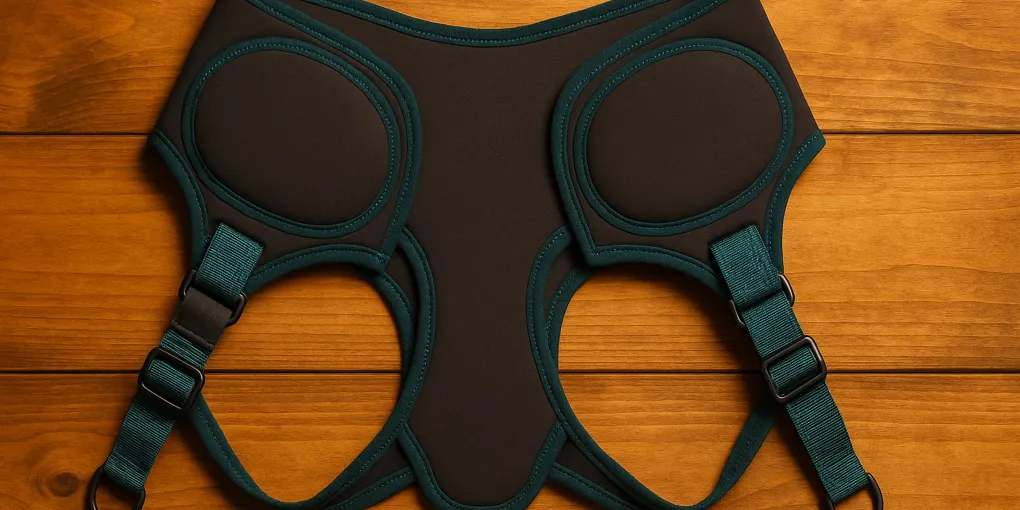
Ortocanis Hip Brace for Dogs
Best OverallSupport type: Bilateral hip compression + warmth
$50–$80
Quick Comparison
| Product | Key Specs | Price Range | Buy |
|---|---|---|---|
| |
| $50–$80 | Check Price |
| |
| $25–$40 | Check Price |
| |
| $65–$95 | Check Price |
| |
| $20–$35 | Check Price |
Contains affiliate links — we may earn a small commission at no extra cost to you.
Best Hip Braces for Senior Dogs in 2026
For senior dogs with hip dysplasia, hip arthritis, or hind-end weakness that reduces their quality of movement, Ortocanis Hip Brace for Dogs (PSR 8.6/10) is the top-rated option — using a measurement-based sizing system and bilateral neoprene compression that delivers therapeutic warmth and proprioceptive feedback across the full hip girdle. Walkabout Hip Hound (PSR 8.2/10) provides the best coverage for dogs with moderate-to-severe hip dysplasia where full hindquarter support is needed.
TL;DR
- Top Pick: Ortocanis Hip Brace — measurement-based sizing, bilateral compression, washable (PSR 8.6/10)
- Hip Dysplasia: Walkabout Hip Hound — full hindquarter wrap with foam padding for advanced cases (PSR 8.2/10)
- Budget: Agon Dog Hip Brace — functional compression support at lower price (PSR 7.7/10)
- Mild Support: Labra Dog Hip Brace — soft neoprene for mild arthritis and general comfort (PSR 7.5/10)
How We Researched This Article
This article follows PSR’s 5-step evidence-synthesis process. Safety assessment covered circulation restriction risk, abdominal pressure on GI structures, and compensatory injury potential from gait alteration. Evidence synthesis reviewed veterinary orthopedic literature on hip dysplasia management including Breur & Blevins on conservative management, physical therapy evidence for proprioceptive devices, and thermal therapy evidence for joint pain. User community synthesis from Amazon verified purchase reviews (combined 7,000+ reviews), breed-specific hip dysplasia forum discussions, and certified canine rehabilitation therapist practice guidance.
Understanding Hip Dysplasia and Senior Dog Hip Health
Hip dysplasia progresses over a dog’s lifetime — senior dogs with this condition have accumulated decades of compensatory change:
Muscle atrophy in the hindquarters: Years of reduced rear limb loading causes progressive muscle loss in the gluteal, hamstring, and quadriceps groups. This muscle loss reduces joint stability further — the muscle mass that would help stabilize a dysplastic hip in a young dog is diminished in the senior. Braces that add external support compensate for some of this lost muscle stability.
Compensatory front limb loading: Dogs with painful hips shift weight forward to the front limbs — a compensation that overloads shoulders, elbows, and cervical spine. Front limb arthritis secondary to chronic hip compensation is common in senior dogs with hip dysplasia. Managing the rear limb pain and support reduces front limb overload.
Pain sensitization over time: Chronic pain causes central sensitization — the nervous system becomes increasingly responsive to pain signals. A dog with years of untreated or inadequately managed hip pain may experience more intense pain at similar levels of joint pathology than a dog whose pain has been consistently managed. This is why multimodal management (medication + physical therapy + supportive devices + weight management) is recommended by veterinary rehabilitation specialists.
Weight and joint load: Every additional pound of body weight adds roughly 3–4 pounds of peak compressive force across each hip joint during walking. For senior dogs with hip dysplasia, weight management is often the highest-impact single intervention — hip braces are most effective in dogs at or near ideal body weight.
What Makes a Good Hip Brace for Senior Dogs?
Bilateral coverage: Hip dysplasia typically affects both hips — even when one is more symptomatic, the contralateral hip is compensatorily loaded. A brace that covers both hips simultaneously provides more comprehensive support than a single-hip design.
Thermal retention: Neoprene’s primary therapeutic mechanism for arthritis is heat retention — maintaining local tissue temperature increases blood flow, reduces joint stiffness, and lowers pain from cold-related muscle contraction. Dogs with hip dysplasia often move better after being gently warmed; neoprene compression provides this continuously during activity.
Suspension and stability (avoiding slippage): A hip brace that slides down the hindquarters during movement provides no benefit — worse, it can cause a dog to stumble. Braces secured with waist bands and leg loop attachments stay in position better than those relying on compression alone.
Leg loop integration: Braces that attach around the hindlegs (figure-8 loops through the rear legs) are significantly more stable than those that drape over the hindquarters without leg attachment. The Ortocanis and Walkabout both use leg integration.
Material safety for sensitive senior skin: Long-term neoprene contact can cause contact dermatitis in some dogs. Monitor the skin under the brace weekly — redness, hair loss, or scratching at the brace indicate skin reaction requiring a material change or break.
PSR Composite Score Breakdown
| Criterion | Weight | Ortocanis Hip Brace | Walkabout Hip Hound | Agon | Labra |
|---|---|---|---|---|---|
| Safety & Ingredients | 25% | 9.0 | 9.0 | 8.5 | 8.5 |
| Durability & Build Quality | 20% | 9.0 | 9.0 | 7.5 | 7.0 |
| Pet Comfort & Acceptance | 20% | 8.5 | 8.5 | 7.5 | 7.5 |
| Value for Money | 20% | 8.5 | 7.0 | 9.0 | 9.0 |
| Ease of Use | 15% | 7.0 | 7.0 | 8.5 | 8.5 |
| PSR Composite | — | 8.6 | 8.2 | 7.7 | 7.5 |
Score notes: Ortocanis and Walkabout lead on Safety and Durability — both measurement-based sizing systems produce better-fitting, safer products. Ortocanis edges Walkabout on Value through better coverage at a lower price. Agon and Labra lead on Ease of Use — simpler S/M/L sizing is faster to navigate even if less precise. The Ease of Use penalty for measurement-based products reflects the learning curve of initial fitting, not ongoing use.
Ortocanis Hip Brace for Dogs: Best Overall
Ortocanis’s hip brace provides bilateral compression through the hip girdle using a neoprene/lycra blend that delivers sustained warmth without the overheating risk of pure neoprene. The sizing process requires three measurements (waist, hip circumference, and leg circumference) — this precision produces a brace that stays correctly positioned through activity rather than sliding or rotating.
What makes it the top pick:
- Measurement-based sizing produces a fitted result — the most common complaint with generic S/M/L hip braces (sliding, rotating) is avoided with proper sizing
- Bilateral coverage of both hips simultaneously with a single product
- Neoprene/lycra blend retains heat while allowing more flexibility of movement than pure neoprene
- Leg loops provide the suspension stability needed to keep the brace over the hips during activity
Safety: Latex-free neoprene. No documented CPSC recalls. Leg loops designed with breakaway safety should the dog catch a limb.
Best for: Senior dogs with bilateral hip dysplasia or arthritis; dogs enrolled in formal rehabilitation programs where the brace is part of a veterinary-supervised protocol; dogs who have failed to maintain position in simpler S/M/L products.
View Ortocanis Hip Brace on Amazon
Walkabout Hip Hound: Best for Hip Dysplasia
Walkabout’s Hip Hound design extends coverage beyond the hip joints to include the full hindquarter — from the waist through the upper thigh — with additional foam padding over the hip joint area. For dogs with advanced hip dysplasia where joint inflammation and sensitivity require additional cushioning, the padded design reduces direct impact to the hip region during movement.
Why full hindquarter coverage matters in advanced cases:
- Foam padding reduces impact forces during weight bearing — meaningful for dogs with advanced arthritic inflammation where any pressure over the joint causes pain response
- Extended coverage provides more muscle groups the proprioceptive feedback effect — not just hip joint position sense but full hindquarter body awareness
- Walkabout’s measurement process (7 measurements) produces the most precisely fitted product reviewed
Trade-offs:
- Most expensive product reviewed — requires commitment to consistent use to justify investment
- Bulkier than Ortocanis — some dogs require additional acclimation time to the hindquarter coverage
- Measurement process and 1–2 week delivery time requires planning
Safety: Foam padding is non-toxic. Machine-washable liner. No documented recalls.
Best for: Senior dogs with moderate-to-advanced hip dysplasia; dogs with documented hip joint inflammation requiring padding in addition to compression; owners willing to invest in the most comprehensive fit.
View Walkabout Hip Hound on Amazon
Agon Dog Hip Brace: Best Budget
Agon’s hip brace provides functional bilateral hip compression at a significantly lower price than measurement-based premium options. For owners testing whether their senior dog responds to hip compression support before investing in a premium product, or for dogs with mild hip arthritis where precise fitting isn’t critical, Agon provides a workable entry point.
Where it delivers:
- Accessible price for evaluation phase
- Machine washable neoprene
- Functional compression for mild hip arthritis and general stiffness
Limitations:
- S/M/L sizing based on weight rather than circumference measurements — higher fitting variability
- Leg loop design is simpler — more sliding risk during active movement
- Less durable neoprene than premium options
Best for: Budget-limited owners; dogs with mild hip arthritis not requiring aggressive support; evaluation phase before purchasing a premium product.
View Agon Dog Hip Brace on Amazon
Labra Dog Hip Support Brace: Best for Mild Support
Labra’s hip support wrap uses a simple neoprene compression band over the hindquarters — appropriate for senior dogs with mild general stiffness and age-related hip discomfort where structural support isn’t the primary need, but warmth and mild proprioceptive input provide comfort benefit.
Appropriate for:
- Mild age-related stiffness without documented hip dysplasia or structural instability
- Cold-weather warming before exercise for senior dogs with general rear stiffness
- Dogs who are sensitive to the weight and bulk of more structured braces
Not appropriate for:
- Documented hip dysplasia with joint laxity
- Dogs who need structural hindquarter support
Safety: Soft neoprene. No documented safety issues. Machine washable.
Best for: Senior dogs with mild general stiffness; cold-weather warmup support; dogs who resist structured braces.
View Labra Dog Hip Brace on Amazon
Complete Hip Dysplasia Management for Senior Dogs
Hip braces are most effective as part of a comprehensive approach:
- Joint supplements — glucosamine, chondroitin, and UC-II collagen address cartilage health and reduce inflammation
- Omega-3 fish oil — EPA and DHA reduce prostaglandin-mediated inflammation driving hip pain
- Mobility harness — for dogs who need owner-assisted weight bearing during walks, a harness complements a brace’s proprioceptive support
- Orthopedic beds — reduces pressure point loading on hip joints during rest; often the highest-impact comfort improvement for dogs with hip dysplasia
- Dog ramps — eliminates high-impact loading on hip joints from jumping on and off furniture or into vehicles
- Weight management — the single most impactful lifestyle intervention for hip dysplasia management
Related Senior Dog Care Articles
- Best Joint Supplements for Senior Dogs
- Best Omega-3 Fish Oil for Senior Dogs
- Best Dog Mobility Harness for Senior Dogs
- Best Orthopedic Dog Beds for Senior Dogs
- Best Dog Ramps and Stairs for Senior Dogs
Frequently Asked Questions
What is hip dysplasia and how does it affect senior dogs?
Hip dysplasia is a developmental malformation of the hip joint causing abnormal wear, joint laxity, pain, and progressive osteoarthritis. Most prevalent in large breeds, by senior age even dogs diagnosed mildly as young adults often have significant arthritis. Conservative management (pain medication, supplements, weight management, physical therapy, and supportive devices) is appropriate for dogs who are not surgical candidates.
How does a hip brace help a dog with hip dysplasia?
Hip braces provide therapeutic warmth (neoprene retains heat, reducing joint stiffness and increasing circulation), proprioceptive feedback (compression improves body awareness), and psychological comfort (many dogs move more confidently with brace in place). Braces do NOT structurally correct joint incongruity or prevent arthritic progression.
Can a hip brace be used alongside hip dysplasia medications?
Yes — hip braces are complementary to medication, not a replacement. Standard senior hip dysplasia management combines NSAIDs or other pain medications with joint supplements, weight management, and physical therapy. A hip brace adds thermal and proprioceptive support to this multimodal approach.
What size hip brace do I need for my senior dog?
Size based on hindquarter circumference and waist circumference — not body weight alone. Senior dogs with muscle atrophy have smaller circumferences than their weight suggests. Ortocanis and Walkabout require 2–3 measurements for precise sizing.
How long should a senior dog wear a hip brace daily?
Build up gradually — start with 30 minutes during supervised activity, increasing to 2–4 hours over 1–2 weeks. Remove during rest. Never leave a dog unmonitored while wearing a brace. Dogs who consistently resist the brace despite correct fit may have pain the brace is exacerbating — consult your veterinarian.
Frequently Asked Questions
- Hip dysplasia is a developmental malformation of the hip joint — the ball (femoral head) and socket (acetabulum) don't fit together properly, causing abnormal wear, joint laxity, pain, and progressive osteoarthritis. It's most prevalent in large breeds (German Shepherds, Golden Retrievers, Labradors, Rottweilers) but occurs in all breeds. By senior age, dogs with hip dysplasia have accumulated years of compensatory muscle use and arthritic change — even dogs diagnosed only mildly as young adults often have significant hip arthritis by age 8–10. Conservative management (pain medication, joint supplements, weight management, physical therapy, and supportive devices) is appropriate for dogs who are not surgical candidates.
- Hip braces for dogs provide several mechanisms of support: (1) Thermal therapy — neoprene retains body heat, increasing local circulation and reducing joint stiffness; warming before exercise is documented to reduce hip dysplasia-associated pain during movement. (2) Proprioceptive feedback — compression around the hip girdle increases the dog's awareness of hindquarter position, which can improve gait quality in dogs with reduced joint position sense from arthritis. (3) Psychological comfort — many dogs move more confidently with the brace in place, possibly from the compression effect similar to anxiety wraps. Hip braces do NOT structurally correct joint incongruity or prevent arthritic progression.
- Yes — hip braces are complementary to, not replacement for, medication. Standard hip dysplasia management in senior dogs typically combines NSAIDs (carprofen, meloxicam) or other pain medications with joint supplements, weight management, and physical therapy. A hip brace adds thermal and proprioceptive support to this multi-modal approach. Discuss with your veterinarian — some dogs see better functional improvement from physical therapy and medical management alone without bracing.
- Hip brace sizing is based on hindquarter circumference (around the hips at the widest point) and waist circumference, rather than body weight. Senior dogs with significant muscle atrophy in the hindquarters have smaller circumferences than their body weight suggests. Measure carefully: take the circumference measurement at the widest point of the hips and around the waist just behind the rib cage. Ortocanis and Walkabout require 2–3 measurements for their sizing process — more precise than single-measurement products.
- Build wearing time gradually — start with 30 minutes during a supervised activity period, increasing to 2–4 hours over 1–2 weeks as the dog acclimates. Hip braces should be worn during active periods (walks, play) and removed during rest. Never leave a dog unmonitored while wearing a brace — circulation changes, pressure sores, and brace displacement can occur and go unnoticed. Dogs who consistently resist the brace despite correct fitting may have pain that the brace is exacerbating — consult your veterinarian.