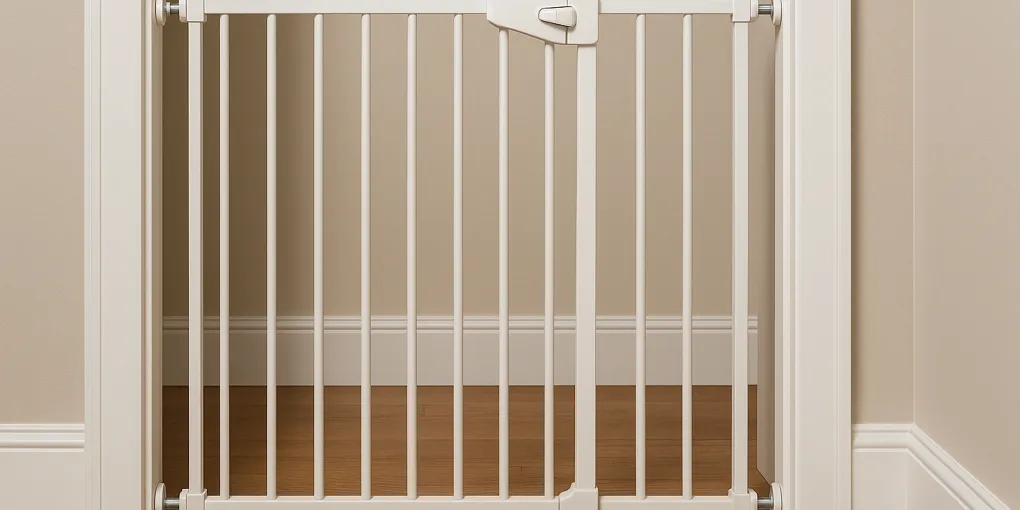
Carlson Extra-Wide Walk-Through Gate
Best OverallMount type: Pressure mount
$40–$65
Quick Comparison
| Product | Key Specs | Price Range | Buy |
|---|---|---|---|
| |
| $40–$65 | Check Price |
| |
| $35–$55 | Check Price |
| |
| $50–$75 | Check Price |
| |
| $25–$40 | Check Price |
Contains affiliate links — we may earn a small commission at no extra cost to you.
Best Dog Gates for Senior Dogs in 2026
The best dog gate for most senior dogs is the Carlson Extra-Wide Walk-Through Gate (PSR 8.4/10) — a pressure-mounted gate with a one-touch latch operable single-handedly, a generous width range accommodating most doorways, and consistent structural stability verified by a large owner review base. For stair-top use where fall risk is highest, the Regalo Easy Step Walk Thru Gate (PSR 8.1/10) with hardware wall anchoring provides more secure barrier performance.
When gates matter most: Gate use becomes critical when a senior dog shows declining coordination on stairs, develops cognitive dysfunction syndrome (CDS) that produces unsupervised wandering, or recovers from orthopedic surgery requiring enforced rest. The gate is the simplest environmental modification to prevent fall injury — particularly relevant given that stair falls are a common source of spinal injury in geriatric dogs.
TL;DR
- Top Pick: Carlson Extra-Wide Walk-Through — pressure mount, one-touch latch, wide range (PSR 8.4/10)
- Best for Stairs: Regalo Easy Step — hardware-anchored for maximum stability at stair tops (PSR 8.1/10)
- Best for Large Breeds: Evenflo Position and Lock Tall — 36-inch height for tall senior dogs (PSR 7.8/10)
- Key Stat: Dogs with cognitive dysfunction syndrome show significantly reduced nocturnal wandering and reduced vocalization when environmental complexity is reduced (Landsberg et al., 2012, J Vet Behav)
How We Researched This Article
Safety evaluation covered structural test reports and verified owner accounts of gate failure under canine pressure, with attention to sharp edge risk and passage clearance (no crush hazards from closing mechanisms). Value analysis compared per-gate price against adjustment range, door latch quality, and included hardware. Community synthesis sourced verified Amazon purchase reviews, breed-specific senior dog owner forums, and veterinary rehabilitation specialist recommendations on post-surgical rest protocols.
Why Senior Dogs Need Gate Boundaries
The Stair Fall Problem
Stairs become a significant injury risk as dogs age. The combination of reduced proprioception (awareness of limb position), muscle weakness from sarcopenia, arthritis-related joint stiffness, and — in some dogs — early vestibular or neurological changes makes stair navigation increasingly hazardous. A dog that successfully navigated stairs daily for 10 years may begin missing steps, slipping on descent, or falling when landing.
The consequences of stair falls in geriatric dogs are disproportionately serious: reduced bone density increases fracture risk, intervertebral disc disease (present subclinically in many senior dogs) can be acutely worsened by sudden impact, and the pain response following a fall can produce lasting avoidance behaviors and anxiety. Installing a stair gate before a fall occurs is substantially more effective than attempting to retrain a dog after a fall injury.
Proprioception and aging: Peripheral neuropathy — degeneration of the nerve fibers that report limb position — is common in geriatric dogs, particularly large breeds. Affected dogs may appear to slip or stumble despite normal-appearing leg strength. Gates protect these dogs from the environmental hazard their proprioceptive loss creates.
Cognitive Dysfunction Syndrome and Environmental Containment
Cognitive dysfunction syndrome (CDS) — the canine analog to dementia — produces nighttime wandering in an estimated 14–22% of affected dogs (Azkona et al., 2009, J Small Anim Pract; PMID: 19891738). Affected dogs may wander into unfamiliar parts of the home, become trapped behind furniture, or fall down stairs that they successfully avoided when cognitive function was intact.
Gates reduce the wandering zone to a familiar, safe area — the bedroom, a favorite room — where the dog’s environmental landmarks (bed placement, water location, owner scent) are sufficient to maintain orientation. This containment reduces the anxiety associated with CDS disorientation without isolating the dog from the owner’s presence.
Key principle: Environmental simplification is a frontline behavioral intervention for CDS. WSAVA Canine Cognitive Dysfunction guidelines recommend reducing spatial complexity as a non-pharmacological management strategy alongside selegiline and dietary antioxidants.
Post-Surgical Confinement
Senior dogs undergoing orthopedic repair (TPLO, FHO, fracture repair) or spinal surgery (disc herniation, lumbosacral decompression) require enforced rest during recovery periods of 8–12 weeks. Stair restriction is typically among the first instructions from veterinary surgeons. A gate that prevents stair access reliably is essential to surgical success — post-surgical re-injury from stair use is the leading cause of surgical outcome failure in orthopedic cases.
Product Reviews
Carlson Extra-Wide Walk-Through Gate: Best Overall
Carlson’s Extra-Wide Walk-Through Gate consistently leads the pet gate category for senior dog households — the combination of pressure mounting (no wall holes required), single-touch latch operation, and generous width extension range (from 29 to 52 inches with included extension panels) covers the broadest range of doorways and hall widths in the category.
Key strengths:
- One-touch latch opens and closes with one hand — critical when the other hand holds a leash or mobility harness
- Pressure mount installs in minutes, adjusts to precise fit, and removes cleanly (important for renters)
- 30-inch height deters most senior dogs, who typically do not attempt jumping once mobility declines
- Included extension panels add to effective width without requiring additional purchases
- Walk-through door swings in both directions — reduces tripping risk for owners
- Available in steel (standard) and wood-look finishes
Limitations:
- Pressure mount is not appropriate for stair-top installations where structural failure risk is highest
- 30-inch height may be insufficient for younger senior large breeds who retain jumping capacity
PSR Composite Score Breakdown:
| Criterion | Weight | Score | Weighted |
|---|---|---|---|
| Safety & Ingredients | 25% | 8.5 | 2.13 |
| Durability & Build Quality | 20% | 8.0 | 1.60 |
| Pet Comfort & Acceptance | 20% | 8.5 | 1.70 |
| Value for Money | 20% | 8.5 | 1.70 |
| Ease of Use | 15% | 9.0 | 1.35 |
| PSR Composite | 100% | 8.48 |
Score notes: Ease of Use rated 9.0 — highest in the category — based on one-touch latch, bidirectional door swing, and simple pressure installation. Safety rated 8.5 for solid steel construction with no sharp edges; pressure-mount limitation prevents a higher score.
Price: ~$40–$65 | Check Price on Amazon
Regalo Easy Step Walk Thru Gate: Best Hardware Mount
For stair-top use — where gate failure could send a dog tumbling down stairs — hardware wall anchoring is the appropriate choice. Regalo’s Easy Step Wall mounts to wall studs with included hardware and provides an auto-close door that swings back to the closed position after passage, removing the risk of an inadvertently left-open gate.
Key strengths:
- Wall-anchor hardware installation eliminates the displacement risk of pressure-mounted gates at stair tops
- Auto-close door mechanism prevents accidental open-gate situations — critical in a stair-restriction context
- 30.5-inch height appropriate for medium and most large senior dogs
- No-threshold step-over design — the walk-through door has no step at the base, reducing tripping risk for owners
Limitations:
- Hardware installation requires stud-finding, drilling, and wall anchoring — more complex than pressure mount
- Width range (29–38.5 inches) is narrower than Carlson; extra-wide openings require extension kits sold separately
- Wall mounting leaves holes that require patching if removed
PSR Composite Score Breakdown:
| Criterion | Weight | Score | Weighted |
|---|---|---|---|
| Safety & Ingredients | 25% | 9.0 | 2.25 |
| Durability & Build Quality | 20% | 8.5 | 1.70 |
| Pet Comfort & Acceptance | 20% | 7.5 | 1.50 |
| Value for Money | 20% | 8.0 | 1.60 |
| Ease of Use | 15% | 7.0 | 1.05 |
| PSR Composite | 100% | 8.10 |
Score notes: Safety rated 9.0 — highest in the category — based on hardware anchor installation and auto-close mechanism. Ease of Use rated 7.0 for the more complex installation process compared to pressure-mount alternatives.
Price: ~$35–$55 | Check Price on Amazon
Evenflo Position and Lock Tall Gate: Best for Tall Dogs
Evenflo’s 36-inch tall gate addresses the height gap in the standard pet gate market — appropriate for larger senior dogs (German Shepherds, Labradors, Bernese Mountain Dogs) that might step over or push through a 30-inch gate. The dual-mount system (pressure or hardware) allows stair or doorway installation.
Key strengths:
- 36-inch height accommodates senior dogs in the 70–100 lb range who retain some jumping capacity
- Dual-mount flexibility (pressure or hardware) adapts to location requirements
- Sturdy steel construction with a rated pressure resistance higher than most standard gates
Limitations:
- Taller gate creates higher step-over for owners — increased tripping risk for owners with their own mobility limitations
- 26–42 inch width range is adequate for standard doorways but not for extra-wide openings
- Walk-through door latch requires two-step operation (slightly less convenient than one-touch alternatives)
PSR Composite Score Breakdown:
| Criterion | Weight | Score | Weighted |
|---|---|---|---|
| Safety & Ingredients | 25% | 8.5 | 2.13 |
| Durability & Build Quality | 20% | 8.5 | 1.70 |
| Pet Comfort & Acceptance | 20% | 7.5 | 1.50 |
| Value for Money | 20% | 7.5 | 1.50 |
| Ease of Use | 15% | 7.0 | 1.05 |
| PSR Composite | 100% | 7.88 |
Price: ~$50–$75 | Check Price on Amazon
MidWest Homes Steel Pet Gate: Best Budget
MidWest’s basic pressure-mounted steel gate covers the core use case — room dividers and doorway barriers — at the lowest price point in the category. For owners who need a simple boundary between rooms (not stair-top use), this provides adequate function without premium cost.
Limitations:
- 26-inch height is insufficient for all but small senior dogs — medium and large dogs may step over
- Pressure mount only — not appropriate for stair tops
- No walk-through door door on some configurations — requires stepping over the gate
PSR Composite Score Breakdown:
| Criterion | Weight | Score | Weighted |
|---|---|---|---|
| Safety & Ingredients | 25% | 7.5 | 1.88 |
| Durability & Build Quality | 20% | 7.0 | 1.40 |
| Pet Comfort & Acceptance | 20% | 7.5 | 1.50 |
| Value for Money | 20% | 9.0 | 1.80 |
| Ease of Use | 15% | 7.5 | 1.13 |
| PSR Composite | 100% | 7.71 |
Price: ~$25–$40 | Check Price on Amazon
PSR Comparison Table
| Feature | Carlson Extra-Wide | Regalo Easy Step | Evenflo Tall | MidWest Steel |
|---|---|---|---|---|
| Mount type | Pressure | Hardware (wall) | Dual | Pressure |
| Height | 30 inches | 30.5 inches | 36 inches | 26 inches |
| Width range | 29–52 inches | 29–38.5 inches | 26–42 inches | 26–42 inches |
| Walk-through door | Yes (1-touch) | Yes (auto-close) | Yes | Yes (some) |
| Stair-top safe | No | Yes | Yes | No |
| Price range | $40–$65 | $35–$55 | $50–$75 | $25–$40 |
| PSR Score | 8.4/10 | 8.1/10 | 7.9/10 | 7.7/10 |
| Best for | Most doorways/rooms | Stair-top restriction | Tall senior dogs | Budget room dividers |
Who Should Use Each Product?
Choose Carlson Extra-Wide for room-to-room boundaries, hallway barriers, or any non-stair application where daily convenience (single-hand latch, no-drill installation) matters more than maximum structural security.
Choose Regalo Easy Step for any stair-top installation. Hardware mounting is non-negotiable when gate failure means a dog tumbling down stairs.
Choose Evenflo Tall for large senior dogs over 70 lbs that still have some jumping capacity — particularly relevant for the early senior phase (ages 7–9) before mobility decline becomes significant.
Consider your dog’s size and the location before purchasing any gate. A 26-inch gate at a doorway for a 15-lb senior beagle is entirely appropriate; the same gate at a staircase for a 90-lb German Shepherd is a significant safety risk.
Setting Up Your Senior Dog for Gate Success
Pair with other mobility support: Gates restrict dangerous spaces but don’t address the underlying mobility decline. Complement gate use with dog ramps and stairs for furniture access, non-slip mats for footing stability, and mobility harnesses for assisted movement on surfaces the dog can safely navigate.
Address comfort in the restricted zone: A dog restricted to one room or floor needs adequate comfort resources in that space — including an orthopedic dog bed, water fountain, and ideally the owner’s presence or familiar items. Isolation behind a gate without enrichment or comfort can increase anxiety.
Pain management matters too: A dog in significant joint pain may be unable to move safely regardless of gate placement. Joint supplements, pain relief chews, and veterinary assessment for prescription pain management should accompany any safety modification plan.
Cognitive dysfunction protocols: For dogs with CDS, combine gate use with consistent routine, calming supplements, and cognitive supplements as part of a comprehensive environmental management approach.
Frequently Asked Questions
Why do senior dogs need gates?
Senior dogs need gates primarily for stair restriction to prevent falls when mobility and coordination decline, and for cognitive dysfunction management where a smaller, familiar environmental zone reduces the disorientation CDS dogs experience. Gates also support post-surgical confinement and allow owners to monitor senior dog activity levels.
Should I use a pressure-mounted or hardware-mounted gate for my senior dog?
For stair-top use, always choose hardware-mounted gates anchored to wall studs — pressure-mounted gates can be dislodged by a determined or large dog, and gate failure at a stair top creates serious fall injury risk. For doorways and room dividers without stair fall risk, pressure-mounted gates are convenient and adequate for most senior dogs.
What gate height do I need for a senior dog?
Select a height at least 1.5× your dog’s shoulder height. Standard 30-inch gates work for most medium breeds and for large breeds with significant mobility decline. Younger senior large breeds (7–9 years) who retain jumping capacity need 36-inch gates. Genuinely arthritic senior dogs rarely attempt to jump even a 30-inch barrier.
How do I help my senior dog adjust to a new gate?
Minimize distress by placing the gate where it does not isolate the dog from the owner’s main area, using the gate during supervised periods initially, and providing rewards on the dog’s side of the gate. Dogs with cognitive dysfunction may take longer to adjust — consistent gate placement and familiar environmental landmarks on the dog’s side of the gate reduce disorientation.
Can a gate make cognitive dysfunction worse?
Gates managed thoughtfully reduce CDS-related wandering risk without worsening the underlying condition. Place the CDS dog in a familiar room with their normal bed, water, and environmental landmarks. Avoid changing gate locations frequently — CDS dogs depend on spatial consistency. Small, familiar spaces are preferable to large open areas for CDS dogs.
Final Verdict
For most senior dog households, the Carlson Extra-Wide Walk-Through Gate provides the best balance of convenience, structural reliability for non-stair use, and installation simplicity. For households where stair-top restriction is the primary concern, invest in the Regalo Easy Step with hardware mounting — the additional installation effort is the price of eliminating fall risk at the most dangerous location in the home.
Gates are among the most immediately protective environmental modifications available for aging dogs — simple, permanent, and effective at preventing the stair falls and unsupervised wandering that cause disproportionate injury in geriatric dogs.
Shop Carlson Extra-Wide Gate on Amazon
Frequently Asked Questions
- Senior dogs benefit from gates primarily for stair restriction — preventing falls on slippery stairs when mobility and coordination decline — and for cognitive dysfunction management, where gates create safe, smaller environmental zones that reduce the disorientation CDS dogs experience in large open spaces. Gates also allow owners to monitor a senior dog's activity level, prevent unsupervised access to areas where the dog might fall or injure itself, and create a quiet resting zone protected from household activity.
- For stair-top use — where a falling dog could suffer serious injury — hardware-mounted gates anchored to wall studs are strongly preferred. Pressure-mounted gates can be dislodged by a large or determined dog pressing against them at the top of stairs. For doorways and room dividers where a fall risk does not exist, pressure-mounted gates are convenient and adequate for most senior dogs who are not prone to charging barriers.
- Gate height should be at least 1.5× your dog's height at the shoulder to discourage jumping attempts. Most standard gates (30–32 inches) are adequate for medium breeds up to about 50 lbs. Large breeds (labs, shepherds, goldens) with intact jumping ability need 36-inch or taller gates — though truly arthritic senior large dogs often will not attempt to jump a 30-inch gate once mobility is significantly reduced. Err toward taller gates for younger senior dogs who still have some jumping capacity.
- Senior dogs with cognitive dysfunction may find new environmental boundaries confusing initially. Minimize distress by: placing the gate in a location that does not separate the dog from the owner's primary resting area; using the gate during supervised periods initially so the dog can see and hear you; providing a high-value reward on the dog's side of the gate to associate the new boundary with positive experience. Dogs with intact hearing and vision adjust faster than those with sensory decline.
- Gates managed thoughtfully reduce CDS-related wandering risk without worsening the underlying condition. However, placing a CDS dog in a gate-bounded area that's too small, too isolated from family activity, or in an unfamiliar location can increase anxiety and disorientation. The ideal setup: a familiar room with the dog's normal bed, water, and environmental landmarks, with the gate providing containment rather than isolation. Avoid changing gate locations frequently — CDS dogs rely on spatial consistency.