Hill's Science Diet Sensitive Stomach & Skin
Best OverallAAFCO statement: Complete and balanced for adult maintenance
$55–$85 (15–30 lb)
Quick Comparison
| Product | Key Specs | Price Range | Buy |
|---|---|---|---|
| |
| $55–$85 (15–30 lb) | Check Price |
| |
| $55–$80 (16–30 lb) | Check Price |
| |
| $60–$90 (22–24 lb) | Check Price |
| |
| $45–$70 (22–26 lb) | Check Price |
Contains affiliate links — we may earn a small commission at no extra cost to you.
Best Dog Food for Sensitive Stomachs in 2026
Chronic digestive issues — loose stools, vomiting, gas, bloating — affect an estimated 10–15% of dogs and represent one of the most common reasons owners switch dog food brands. But “sensitive stomach” is a marketing term, not a regulated category, and not all sensitive stomach formulas deliver meaningful improvements. Hill’s Science Diet Sensitive Stomach & Skin (PSR 8.5/10) earns our top pick for combining the highest veterinary recommendation rate in the sensitive stomach category with strong digestibility data, prebiotic fiber inclusion, and a clean recent safety record. Purina Pro Plan Sensitive Skin & Stomach Salmon & Rice (PSR 8.2/10) leads the palatability pick — particularly valuable because dogs with GI issues often have reduced appetite, and palatability drives consistent eating.
TL;DR
- Top Pick: Hill’s Science Diet Sensitive Stomach & Skin — highest vet recommendation rate, prebiotic fiber, clean safety record (PSR 8.5/10)
- Best Palatability: Purina Pro Plan Sensitive Salmon & Rice — high acceptance rates, live probiotics, excellent stool quality reports (PSR 8.2/10)
- Best LID Option: Blue Buffalo Basics LID Turkey & Potato — true limited ingredient, novel protein, good for suspected allergies (PSR 7.8/10)
- Best Budget LID: Natural Balance Sweet Potato & Fish — affordable LID format, novel proteins, no subscription (PSR 7.4/10)
How We Researched This Article
AAFCO compliance statements verified from current product labels. Recall history sourced from FDA CVM recall database. Digestibility data referenced from peer-reviewed literature (Veterinary Clinics of North America, 2021; Case et al., Canine and Feline Nutrition, 2011). Veterinary recommendation context from published surveys and veterinary nutrition guidelines (WSAVA 2021). Owner community synthesis from verified Amazon reviews (combined 130,000+ reviews across four products), r/dogs, r/AskVet, and breed-specific health forums.
What Matters Most in Dog Food for Sensitive Stomachs
Highly digestible ingredients: For GI-sensitive dogs, ingredient digestibility is more important than ingredient “naturalness.” Chicken and rice remain the gold standard for digestibility in dogs with sensitive stomachs — rice is the most highly digestible carbohydrate for dogs, and chicken is well-tolerated by most dogs. Salmon and potato are strong alternatives for dogs sensitive to chicken. Avoid formulas with multiple protein sources, unnamed meat meals, or high-fat content.
Fat content: High-fat diets worsen GI motility in sensitive dogs and can trigger or worsen pancreatitis-adjacent GI symptoms. Sensitive stomach formulas should run 10–14% crude fat on a dry matter basis — lower than performance or grain-free kibble. Check the guaranteed analysis before purchasing.
Fiber balance: Both too little and too much fiber worsen GI symptoms in sensitive dogs. Prebiotic fiber sources (beet pulp, chicory root, fructooligosaccharides) support gut microbiome health and stool consistency. Hill’s Science Diet Sensitive Stomach includes a specific prebiotic fiber blend. Target 3–6% crude fiber for most GI-sensitive dogs.
Limited ingredient vs. standard sensitive stomach: LID (limited ingredient diet) food reduces allergen exposure by using one protein and one carbohydrate source — useful when dietary allergy is suspected. Standard sensitive stomach formulas (Hill’s, Purina Pro Plan Sensitive) are formulated for general GI sensitivity without allergen limitation — appropriate when food allergy is not suspected or confirmed. If your dog has confirmed food allergies, LID or prescription hydrolyzed protein diets are the appropriate choice. For general GI sensitivity without confirmed allergy, standard sensitive stomach food is usually more effective and less expensive.
Avoid artificial additives: Artificial colors, artificial flavors, and artificial preservatives (BHA, BHT) can trigger GI reactions in sensitive dogs. All four reviewed products are free of artificial colors and flavors. BHA and BHT are absent from Hill’s, Purina, and Blue Buffalo Basics; Natural Balance uses mixed tocopherols as natural preservatives.
Transition slowly — especially for sensitive dogs: Sensitive stomach dogs are at highest risk for GI upset during food transitions. A 10–14 day transition (slower than the standard 7–10 days) dramatically reduces transition-related GI distress. Start with 10% new food / 90% old food for 3 days, then 25/75, then 50/50, then 75/25, then 100% new food.
PSR Composite Score Breakdown
| Criterion | Weight | Hill’s SD Sensitive | Purina PP Sensitive | Blue Buffalo Basics | Natural Balance LID |
|---|---|---|---|---|---|
| Safety & Ingredients | 25% | 9.0 | 9.0 | 7.8 | 8.0 |
| Durability & Build Quality | 20% | 8.5 | 8.5 | 8.5 | 8.5 |
| Pet Comfort & Acceptance | 20% | 8.0 | 9.0 | 8.0 | 7.5 |
| Value for Money | 20% | 8.0 | 8.5 | 7.5 | 8.5 |
| Ease of Use | 15% | 8.5 | 8.5 | 8.5 | 8.0 |
| PSR Composite | — | 8.5 | 8.2 | 7.8 | 7.4 |
Score notes: Hill’s and Purina Pro Plan tie on Safety at 9.0 — both have clean records on the specific sensitive stomach SKUs reviewed and employ DACVNs. Blue Buffalo’s brand-level recall history (2010, 2017) reduces its Safety score. Purina Pro Plan Sensitive leads Pet Comfort due to salmon & rice’s consistently high palatability reports and live probiotic inclusion. Natural Balance’s lower palatability reports reduce Pet Comfort score; its lower price point leads Value for Money among LID options.
Hill’s Science Diet Sensitive Stomach & Skin: Best Overall
Hill’s Science Diet Sensitive Stomach & Skin is the most frequently recommended sensitive stomach dog food by veterinarians in the United States. The formula is built around chicken and egg — highly digestible proteins — with rice as the primary carbohydrate and a proprietary prebiotic fiber blend that supports gut microbiome balance and stool consistency.
Key features:
- Prebiotic fiber blend (beet pulp, fructooligosaccharides) — clinically studied for gut microbiome support in dogs
- High-quality protein from chicken and egg — egg is among the most digestible protein sources for dogs
- Omega-6 fatty acids for skin barrier support — addressing the “sensitive skin” component that often accompanies GI sensitivity
- Controlled fat content appropriate for GI-sensitive dogs
- No artificial colors, flavors, or preservatives
Safety: Hill’s issued a voluntary recall in 2019 for excess vitamin D in certain canned wet food products. The Sensitive Stomach & Skin dry food line was not included in that recall. No subsequent recalls on any dry Hill’s line. Hill’s responded to the 2019 recall with enhanced vitamin D testing protocols across all production. DACVN-formulated with feeding trial compliance.
Digestibility data: Hill’s has published digestibility data for the Sensitive Stomach formula showing over 91% protein digestibility — among the highest published digestibility values for commercial dry dog food.
Who it’s best for: Dogs with general GI sensitivity (soft stools, occasional vomiting, gas) without confirmed food allergies, owners whose veterinarians have specifically recommended Hill’s, and dogs who also show skin symptoms alongside GI issues. For additional GI support beyond diet, our digestive enzyme supplement guide covers evidence-based options that can be paired with sensitive stomach food.
View Hill’s Science Diet Sensitive Stomach & Skin on Amazon
Purina Pro Plan Sensitive Skin & Stomach: Best Palatability
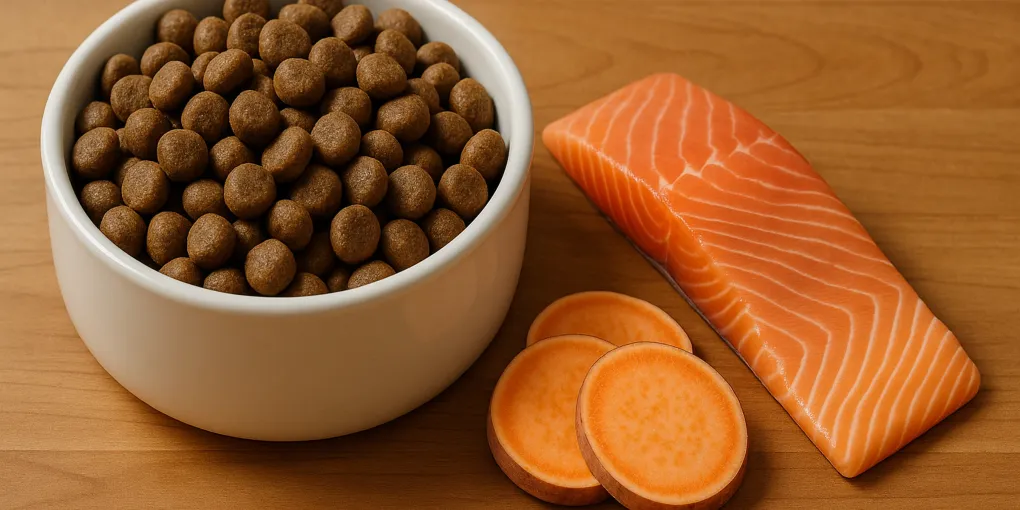
The Purina Pro Plan Sensitive Skin & Stomach Salmon & Rice formula addresses a key practical challenge in GI-sensitive dog management: palatability. Dogs with chronic GI issues often have reduced appetite and may be reluctant eaters. Salmon as the first ingredient is both novel (reducing common protein allergen exposure) and highly palatable — owner reports consistently note that dogs who resist other sensitive stomach foods accept the Pro Plan Sensitive salmon formula enthusiastically.
What drives the palatability advantage:
- Salmon as primary protein — novel for many dogs, and the aroma is consistently high-acceptance
- Rice as primary carbohydrate — maximally digestible, contributes to palatability and stool firming
- Live probiotic cultures (Bacillus coagulans) — viable through best-by date per Purina QA documentation
- Oat meal included as secondary fiber source — gentle and highly digestible
Clinical relevance of included probiotics:
- Bacillus coagulans (also known as Lactobacillus sporogenes in older literature) is one of the most studied probiotic strains for canine GI health
- Spore-forming bacteria survive the manufacturing process and storage better than live Lactobacillus — viable at time of feeding
- Owner reports from verified reviews (25,000+) frequently cite improved stool consistency within 2–3 weeks
Who it’s best for: GI-sensitive dogs who are also picky eaters, dogs who have failed to improve on Hill’s Sensitive (switching proteins often helps when one sensitive stomach formula doesn’t work), and owners who want the added benefit of live probiotics already in the food. For dogs with concurrent joint issues alongside GI sensitivity, our senior dog multivitamin guide covers comprehensive supplement options.
View Purina Pro Plan Sensitive on Amazon
Blue Buffalo Basics LID Turkey & Potato: Best LID Option
Blue Buffalo Basics is the limited ingredient diet line from Blue Buffalo — designed specifically for dogs with suspected food sensitivities or allergies who need a simplified ingredient list. The Turkey & Potato formula uses a single animal protein (deboned turkey) and potato as the primary carbohydrate, with a minimal supplemental ingredient list to reduce the potential allergen load.
Why LID matters for allergy dogs:
- Single protein source — confirms the dog is exposed to only one new protein when transitioning
- Potato as starch — highly digestible and relatively uncommon in most dog food histories, reducing pre-existing sensitization risk
- No chicken, beef, corn, wheat, soy, dairy, or eggs — addresses the most common dietary allergens simultaneously
- Supplemented with omega-3 and omega-6 fatty acids for skin barrier support
Important limitation — recall context: Blue Buffalo has had two brand-level recalls (2010 and 2017) not specific to the Basics line. These historical events reduce the Safety score but do not indicate current safety issues with the Basics LID formula specifically. Owners managing confirmed severe allergies who require the strongest possible safety assurance may prefer Hill’s prescription z/d or Purina Pro Plan Veterinary Diets HA (both require a veterinary prescription and have the most rigorous formulation standards).
Who it’s best for: Dogs undergoing an elimination diet trial for suspected food allergy (under veterinary supervision), dogs who have confirmed reactions to chicken and need a complete chicken-free option, and owners wanting commercial LID food at a lower cost than prescription hydrolyzed diets. For senior dogs with food allergies and concurrent joint concerns, our glucosamine and chondroitin supplement guide covers supplementation options safe to combine with LID food.
View Blue Buffalo Basics LID on Amazon
Natural Balance LID Sweet Potato & Fish: Best Budget LID
Natural Balance (acquired by Nexus Pet Brands in 2020) pioneered the commercial limited ingredient diet category for dogs and has maintained its formulation quality through the ownership transition. The Sweet Potato & Fish formula uses salmon and ocean fish meal as protein sources (both novel for most dogs) with sweet potato as the primary carbohydrate — a highly digestible combination appropriate for elimination diet use.
Budget LID credentials:
- Lowest per-pound cost of any LID option in this guide — approximately 20–30% less expensive than Blue Buffalo Basics
- Salmon and ocean fish meal as protein sources — novel for most dogs, appropriate for chicken and beef allergy management
- Sweet potato as primary carbohydrate — highly digestible and uncommon in most dogs’ food histories
- No corn, wheat, soy, dairy, eggs, or chicken
- Available in multiple sizes (4 lb to 26 lb bags) for flexible purchasing
Post-acquisition quality note: Natural Balance was acquired by Nexus Pet Brands in 2020. Published owner reports and quality forums suggest formula consistency has been maintained, but independent verification of current production standards is limited. Owners with severely allergic dogs who need the highest certainty of LID integrity may prefer to pay the premium for Hill’s or Purina prescription options.
Who it’s best for: Budget-conscious owners whose dogs need LID food for confirmed or suspected food allergies, households with multiple dogs where only one requires LID (reducing overall cost burden), and dogs who require a fish-based protein source as their novel protein option. For additional GI support alongside LID feeding, our probiotic supplement guide covers options compatible with LID diets.
View Natural Balance LID Sweet Potato & Fish on Amazon
Supporting Sensitive Stomach Dogs Beyond Diet
Diet is the foundation of GI health management, but additional support often accelerates improvement. Our digestive enzyme supplement guide covers evidence-based enzyme supplementation that can improve nutrient absorption in dogs with chronic GI issues. Our probiotic supplement guide reviews products appropriate for daily long-term use alongside sensitive stomach food.
For dogs with GI sensitivity who are also senior, age-related changes in digestive efficiency compound food sensitivity issues. Our guides on best senior dog food for large breeds, best senior dog food for small breeds, and best senior dog wet food address age-specific nutrition alongside the digestive considerations covered in this guide.
Dogs with skin symptoms alongside GI issues (a common combination suggesting food allergy rather than simple food intolerance) may also benefit from targeted omega-3 fish oil supplementation and our senior dog skin and coat supplement guide. Additionally, slow feeder bowls can reduce air swallowing during eating, which reduces gas and bloating in GI-sensitive dogs who eat quickly.
Frequently Asked Questions
How do I know if my dog has a sensitive stomach vs. a food allergy?
Food intolerance causes GI symptoms (vomiting, diarrhea, gas) from an ingredient the digestive system processes poorly — no immune response involved. Food allergies involve an immune response and typically cause skin symptoms alongside or instead of GI issues (itching, ear infections, paw licking). A veterinarian-supervised food elimination diet trial (8–12 weeks on a novel protein diet) is the only reliable way to distinguish between the two and identify specific triggers.
What ingredients should I avoid for a sensitive stomach dog?
Artificial colors, artificial preservatives (BHA, BHT), high fat content (above 15% DM), and unnamed by-products can trigger GI reactions in sensitive dogs. Specific proteins (beef, dairy, chicken) are the most common dietary allergens — if your dog reacts to chicken, try a novel protein like turkey, salmon, or duck. Onion and garlic are toxic to all dogs but particularly harmful to GI-sensitive systems.
Is limited ingredient diet (LID) food better for sensitive stomachs?
LID food reduces potential allergen exposures — useful when food allergy is suspected. However, LID is not inherently more digestible than standard sensitive stomach food for dogs without specific allergies. If your dog’s GI issues are not allergen-driven, Hill’s Science Diet Sensitive or Purina Pro Plan Sensitive may be equally or more effective and typically cost less than LID options.
How long does it take to see improvement after switching food?
For food intolerance, stool consistency typically improves within 1–2 weeks of full transition to the new food. Skin symptoms from food allergies take 8–12 weeks to fully resolve after the allergen is removed. Loose stools during transition are common and usually resolve within a week of full transition. If GI symptoms worsen or persist after 2–3 weeks of full transition, consult your veterinarian.
Should I add probiotics to my dog’s food if they have a sensitive stomach?
Probiotic supplementation can help some GI-sensitive dogs by supporting gut microbiome balance. Lactobacillus acidophilus and Enterococcus faecium have the strongest clinical support for canine GI health. Purina Pro Plan Sensitive already includes live Bacillus coagulans probiotic cultures. For dogs on other foods, a veterinarian-recommended probiotic can be added alongside sensitive stomach food — see our best probiotic supplement guide for evidence-based options.
Frequently Asked Questions
- Sensitive stomach (food intolerance) and food allergies are different conditions, though they can overlap. Food intolerance causes GI symptoms (vomiting, diarrhea, gas, loose stools) triggered by an ingredient the digestive system can't process well — it does not involve the immune system. Food allergies involve an immune response and often cause skin symptoms alongside or instead of GI symptoms (itching, ear infections, paw licking, hives). A food elimination diet trial (8–12 weeks on a novel protein diet, supervised by a veterinarian) is the only reliable way to distinguish between the two and identify specific triggers.
- For most GI-sensitive dogs: artificial colors, artificial preservatives (BHA, BHT), rendered animal fat (often from mixed sources), and unnamed by-products can trigger reactions. High-fat diets worsen GI motility issues in sensitive dogs. Spices, onion powder, and garlic are toxic in any dog but especially harmful to sensitive GI systems. Individually, specific proteins (beef, dairy, chicken are most common allergens) may be triggers — if your dog reacts to chicken, switch to a novel protein like turkey, salmon, or duck.
- LID food reduces the number of potential allergen exposures — making it easier to identify and eliminate a specific trigger if your dog is reacting to a dietary allergen. However, LID food is not inherently more digestible than standard sensitive stomach food for dogs without specific food allergies. If your dog's GI issues are not allergen-driven (just general sensitivity), a well-formulated sensitive stomach food like Hill's or Purina Pro Plan Sensitive may be equally or more effective and often costs less than LID.
- For food intolerance cases, stool consistency typically improves within 1–2 weeks of full transition to a new food. Skin symptoms from food allergies take 8–12 weeks to fully resolve after the offending allergen is removed — immune-mediated responses resolve slowly. During the transition period, loose stools are common and are not necessarily a sign that the new food is wrong. If GI symptoms worsen after 2–3 weeks of full transition, consult your veterinarian.
- Probiotic supplementation can help some dogs with sensitive stomachs by supporting gut microbiome balance and reducing GI inflammation. The evidence base for specific probiotic strains in dogs is growing — Lactobacillus acidophilus and Enterococcus faecium have the best clinical support. Purina Pro Plan Sensitive already includes live probiotic cultures (Bacillus coagulans). For dogs on other foods, a veterinarian-recommended probiotic can be added — see our guide on [best probiotic supplements for senior dogs](/blog/best-probiotic-supplement-senior-dogs) for evidence-based options.