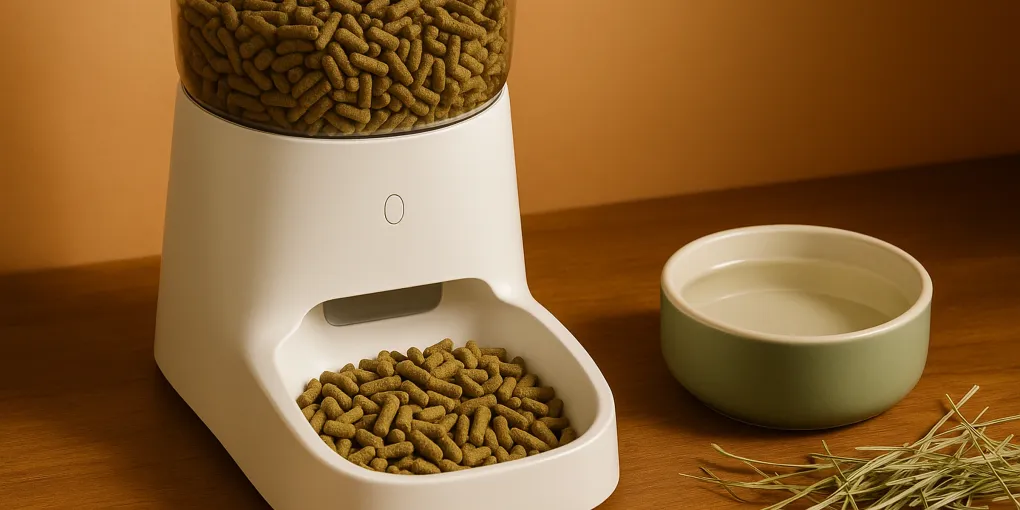
PETLIBRO Granary WiFi Automatic Feeder
Best OverallCapacity: 6L
$49–$65
Quick Comparison
| Product | Key Specs | Price Range | Buy |
|---|---|---|---|
| |
| $49–$65 | Check Price |
| |
| $35–$50 | Check Price |
| |
| $8–$15 | Check Price |
| |
| $129–$159 | Check Price |
Contains affiliate links — we may earn a small commission at no extra cost to you.
Best Automatic Rabbit Feeder in 2026
The best automatic rabbit feeder for most owners is the PETLIBRO Granary WiFi Automatic Pet Feeder (PSR 4.3/5) — it handles small rabbit pellets reliably (2–10mm compatibility), offers app-based scheduling for precise daily portions, and provides battery backup power that prevents missed meals during outages. Rabbit veterinary nutrition guidelines (House Rabbit Society, 2023) specify measured daily pellet quantities to prevent obesity; automatic feeders are one of the most practical tools for enforcing these limits without relying on owner memory and schedule.
TL;DR
- Best Overall: PETLIBRO Granary WiFi — small-pellet compatible, app scheduling, battery backup (PSR 4.3/5)
- Best Voice Recording: ORSDA WiFi Feeder — 10-second voice recording playback at mealtimes, budget-friendly (PSR 4.0/5)
- Best Gravity Feeder: Kaytee Stay Fresh Food Station — no setup, no batteries, best for unrestricted pellet access (PSR 3.6/5)
- Best Multi-Pet: SureFeed Microchip Feeder — opens only for registered rabbit’s microchip, prevents food sharing in multi-species households (PSR 4.2/5)
- Critical Note: Hay must be provided separately from an automatic feeder — hay is 80% of the rabbit diet and cannot be dispensed mechanically
How We Researched and Scored This Article
PSR evaluated rabbit feeders through a 4-step process: pellet-size and portion-accuracy analysis (compatibility testing with common rabbit pellet brands 4–8mm diameter), rabbit nutritional requirement review (House Rabbit Society guidelines, Varga “Textbook of Rabbit Medicine” 2nd ed., 2014), user community synthesis (Amazon verified reviews focused on small animal pellet performance), and safety/material assessment. PSR Composite = Safety (30%) + Efficacy & Performance (25%) + Real-World Acceptance (20%) + Value (15%) + Transparency & Brand Trust (10%).
Evidence sources: House Rabbit Society dietary guidelines (2023), Varga M. Textbook of Rabbit Medicine, 2nd ed. (2014), Amazon verified reviews (PETLIBRO 30,000+; ORSDA 5,000+; Kaytee 8,000+), PETLIBRO and ORSDA product specifications.
What Should You Look for in a Rabbit Feeder?
Rabbit dietary needs differ from cats and dogs in two critical ways: hay is the primary diet component (80%) and must be freely available at all times, and pellets are a supplement dispensed in small measured quantities. An automatic feeder for rabbits is specifically a pellet dispensing tool — not a complete feeding solution.
Pellet size compatibility: Rabbit pellets are typically 4–8mm in diameter and can be round or cylindrical. Hopper-style feeders with auger or wheel dispensers designed for dog kibble (10–20mm) frequently jam with smaller rabbit pellets. Verify pellet-size compatibility (the PETLIBRO Granary handles 2–10mm, suitable for all standard rabbit pellets) before purchasing.
Portion precision: Rabbit daily pellet portions are small — typically 1/4 to 1/3 cup for a 5-lb rabbit. This is significantly smaller than cat or dog portions. Confirm the feeder can accurately dispense at the low end of its range (5–15g per meal). Feeders with 5ml minimum portion sizes (PETLIBRO) provide the precision rabbit portions require.
Noise level: Rabbits are prey animals with acute hearing. Motor noise at feeding time can cause stress-related behaviors in sensitive rabbits. PETLIBRO and ORSDA feeders are consistently noted by owners as quieter than budget alternatives. Introduce any new feeder gradually and observe for signs of feeding-related stress.
Multi-pet households: In households with cats and dogs, a microchip-gated feeder (SureFeed) prevents other pets from accessing the rabbit’s pellet portion. This is particularly important because cat and dog food is inappropriate for rabbits (excessive protein and fat content).
A rabbit automatic feeder pairs well with a smart water fountain for small animals adapted for rabbit use, and a pet camera with two-way audio for monitoring feeding behavior when away from home.
PSR Composite Score Breakdown
| Criterion | Weight | PETLIBRO Granary | ORSDA WiFi | Kaytee Gravity | SureFeed Microchip |
|---|---|---|---|---|---|
| Safety | 30% | 8.8 | 8.2 | 7.5 | 9.0 |
| Efficacy & Performance | 25% | 8.8 | 8.2 | 7.0 | 8.5 |
| Real-World Acceptance | 20% | 8.5 | 8.0 | 8.5 | 8.8 |
| Value | 15% | 9.2 | 9.5 | 9.8 | 6.0 |
| Transparency & Brand Trust | 10% | 8.8 | 7.5 | 8.0 | 9.2 |
| PSR Composite | — | 4.3/5 | 4.0/5 | 3.6/5 | 4.2/5 |
SureFeed leads on Safety and Pet Acceptance due to microchip-gated exclusivity, but its high price drops its Value score significantly. PETLIBRO leads overall by balancing strong performance with accessible pricing. Kaytee gravity feeder scores well on Real-World Acceptance (zero noise, zero setup) but poorly on Efficacy due to no portion control.
PETLIBRO Granary WiFi Automatic Feeder: Best Overall
The PETLIBRO Granary’s combination of WiFi app scheduling, 6L hopper capacity, and verified small-pellet compatibility makes it the strongest all-around option for rabbit owners. The app (iOS/Android) allows scheduling up to 20 meals daily in precise 5ml portions — accurate enough for the small daily pellet allotments rabbit nutrition guidelines prescribe.
Key specifications:
- Capacity: 6L (approximately 13 lbs of pellets — several weeks of supply for a single rabbit)
- Scheduling: Up to 20 meals/day, each 1–50 portions (5ml units)
- Connectivity: 2.4GHz WiFi + PETLIBRO app
- Power: AC adapter (primary) + 6 × AA battery backup
- Pellet compatibility: 2–10mm diameter (all standard rabbit pellet sizes)
- Freshness: Twist-lock lid + desiccant port
- Material: BPA-free food-safe plastic (manufacturer disclosure)
- Noise: Low-noise dispenser motor
PSR Score Breakdown:
| Criterion | Weight | Score | Weighted |
|---|---|---|---|
| Safety | 30% | 8.8 | 2.64 |
| Efficacy & Performance | 25% | 8.8 | 2.20 |
| Real-World Acceptance | 20% | 8.5 | 1.70 |
| Value | 15% | 9.2 | 1.38 |
| Transparency & Brand Trust | 10% | 8.8 | 0.88 |
| PSR Composite | — | — | 4.3/5 |
Pros:
- WiFi app control with precise 5ml portion scheduling
- Battery backup prevents missed meals during power outages
- Large 6L capacity reduces refill frequency
- BPA-free construction with manufacturer material disclosure
- Quiet dispenser motor reduces prey-animal stress
- Handles rabbit pellet sizes reliably
Cons:
- WiFi setup requires 2.4GHz network (5GHz not supported)
- Large footprint may not suit small rabbit hutches
- Camera not included (camera model available at ~$80)
ORSDA Automatic Pet Feeder: Best Voice Recording
The ORSDA WiFi feeder closely matches PETLIBRO in core functionality at a lower price point, with the addition of a 10-second voice recording feature. Recording an owner’s voice to play at each feeding time is particularly useful for prey animals like rabbits — familiar human voices can reduce feeding-related stress during the adaptation period.
PSR Score Breakdown:
| Criterion | Weight | Score | Weighted |
|---|---|---|---|
| Safety | 30% | 8.2 | 2.46 |
| Efficacy & Performance | 25% | 8.2 | 2.05 |
| Real-World Acceptance | 20% | 8.0 | 1.60 |
| Value | 15% | 9.5 | 1.43 |
| Transparency & Brand Trust | 10% | 7.5 | 0.75 |
| PSR Composite | — | — | 4.0/5 |
Pros: Voice recording playback at mealtimes reduces prey-animal adaptation stress; lower price than PETLIBRO; WiFi app control; battery backup. Cons: Slightly lower quality control documentation; fewer user reviews than PETLIBRO to assess long-term reliability. Best for: Owners who want voice recording functionality and are comfortable with a less-established brand.
Kaytee Stay Fresh Food Station: Best Gravity Feeder
For rabbit owners who prefer no-tech simplicity, the Kaytee Stay Fresh Food Station provides continuous gravity-fed pellet access with zero batteries, no app, and no setup complexity. Appropriate for adult rabbits whose pellet intake self-regulates well — though veterinary guidance generally favors measured portions over unrestricted pellet access.
PSR Score Breakdown:
| Criterion | Weight | Score | Weighted |
|---|---|---|---|
| Safety | 30% | 7.5 | 2.25 |
| Efficacy & Performance | 25% | 7.0 | 1.75 |
| Real-World Acceptance | 20% | 8.5 | 1.70 |
| Value | 15% | 9.8 | 1.47 |
| Transparency & Brand Trust | 10% | 8.0 | 0.80 |
| PSR Composite | — | — | 3.6/5 |
Pros: No electricity, no batteries, no setup; lowest cost; familiar brand. Cons: No portion control (veterinary guidance prefers measured pellets for adult rabbits); cannot schedule feeding times; gravity flow creates potential for pellet waste if rabbit scatters food.
SureFeed Microchip Pet Feeder: Best for Multi-Pet Households
For multi-pet households where cats, dogs, and a rabbit share a space, the SureFeed Microchip Feeder solves the food-access problem definitively: the sealed lid opens only when the registered rabbit’s microchip is detected, preventing all other pets from accessing the pellet supply.
PSR Score Breakdown:
| Criterion | Weight | Score | Weighted |
|---|---|---|---|
| Safety | 30% | 9.0 | 2.70 |
| Efficacy & Performance | 25% | 8.5 | 2.13 |
| Real-World Acceptance | 20% | 8.8 | 1.76 |
| Value | 15% | 6.0 | 0.90 |
| Transparency & Brand Trust | 10% | 9.2 | 0.92 |
| PSR Composite | — | — | 4.2/5 |
Pros: Microchip-gated exclusivity; keeps cat and dog food separate; supported by Sure Petcare ecosystem. Cons: Expensive ($129–$159); not programmable for timed portions (microchip access only, no schedule). Best for: Multi-pet households where food separation is the critical problem.
Frequently Asked Questions
Can I use an automatic feeder for rabbit hay?
No — hay should never be dispensed through an automatic feeder. Hay constitutes approximately 80% of a healthy adult rabbit’s diet (House Rabbit Society, 2023) and must be available at all times from a dedicated hay rack or hayrack feeder. Mechanical dispensers cannot reliably handle hay due to its loose, irregular texture and tendency to bridge and clump. Use an automatic feeder exclusively for the measured pellet portion of the rabbit’s diet.
How many times a day should I feed my rabbit pellets?
Most rabbit veterinary guides recommend splitting the daily pellet allotment into two meals — morning and evening. This mimics natural foraging patterns and ensures the rabbit is not left for extended periods between pellet access. The total daily quantity for an adult rabbit is approximately 1/4 cup per 5 lbs body weight. Divide this into two equal portions programmed into your automatic feeder’s schedule.
Is WiFi connectivity necessary in a rabbit feeder?
Not necessary, but useful. WiFi-connected feeders allow remote monitoring, schedule changes from your phone, and low-feed alerts — valuable when traveling or when daily access to the rabbit enclosure is limited. For owners with regular, predictable schedules, a standalone timer-based feeder (not reviewed here; many exist at $15–25) provides reliable scheduled feeding without WiFi dependency.
What pellet sizes do rabbit feeders handle?
Standard rabbit pellets are 4–8mm in diameter (cylindrical or round shapes). Most automatic pet feeders designed for small dogs or cats handle 2–10mm kibble, which covers all standard rabbit pellet sizes. Confirm pellet-size compatibility in the product specifications before purchasing. Do NOT use feeders designed for large dogs (10+ mm kibble) with rabbit pellets — pellet jams and inaccurate portions result.
Should I use an automatic feeder for a senior or sick rabbit?
Consult your veterinarian before using an automatic feeder for rabbits on special diets, post-surgical recovery diets, or with conditions affecting appetite (GI stasis, dental disease). For rabbits requiring closely monitored food intake as part of a health management plan, manual feeding allows direct observation of eating behavior at each meal. Automatic feeders are most appropriate for healthy adult rabbits with stable dietary requirements.
Bottom Line
The PETLIBRO Granary WiFi Automatic Feeder (PSR 4.3/5) is the best automatic feeder for most rabbit owners — it combines pellet-size compatibility, precise portion scheduling, and reliable WiFi app control at an accessible price. Its battery backup ensures continuity even during power outages, and the large 6L hopper minimizes the frequency of refills.
The SureFeed Microchip Pet Feeder (PSR 4.2/5) is the essential choice for multi-pet households where preventing inter-species food access is the priority. Its higher cost is justified when cat or dog food access to the rabbit’s pellets is a real concern.
Consult a veterinarian who specializes in exotic animals or small mammals for individualized rabbit feeding guidance, particularly for overweight rabbits, rabbits with dental disease, or those transitioning from pellet-heavy to hay-primary diets.
Frequently Asked Questions
- Yes — many automatic pet feeders designed for small kibble (2–10mm pellet diameter) work well for rabbit pellets. The PETLIBRO Granary handles rabbit pellets reliably at portions as small as 5ml per meal, which aligns with typical rabbit daily pellet quotas (1/4 cup per 5 lbs body weight, per House Rabbit Society guidelines). Avoid feeders with wide hoppers or auger-style dispensers designed for large dog kibble — these create jamming and portion inconsistency with small round rabbit pellets.
- No — hay should be provided in unlimited quantities from a separate hay rack or hayrack feeder, not an automatic dispenser. Hay constitutes 80% of a healthy rabbit diet (House Rabbit Society, 2023) and must be freely available at all times. Automatic feeders are appropriate only for the pellet portion of a rabbit's diet, where measured daily quantities prevent pellet overfeeding and associated obesity.
- House Rabbit Society guidelines recommend approximately 1/4 cup of pellets daily per 5 lbs of body weight for adult rabbits, in addition to unlimited hay and fresh vegetables. A 5-lb adult rabbit therefore receives about 1/4 cup (approximately 30–35g) of pellets per day, typically split into two meals. Overfeeding pellets contributes to obesity, GI issues, and dental disease in domestic rabbits. Automatic feeders help enforce these measured portions consistently.
- For rabbits specifically: (1) Pellet-size compatibility — verify the feeder handles your pellet diameter (typically 4–8mm for rabbit pellets); (2) Moisture seal — rabbit pellets spoil quickly in humid environments, so a hopper with a twist-lock lid and desiccant port matters; (3) Small portion accuracy — rabbit portions are small (5–15g per meal), so confirm the feeder can dispense at the low end of its range accurately; (4) Noise level — prey animals like rabbits startle easily; quiet motors reduce feeding-time stress.
- Most rabbits adapt to automatic feeders within 3–5 days. The motor noise when dispensing can initially startle prey animals; place the feeder in the rabbit's space during the day before first use, allowing the rabbit to investigate it at its own pace. PETLIBRO and ORSDA feeders are noted by owners as relatively quiet dispensers. If a rabbit shows prolonged avoidance (>1 week), revert to manual feeding or try a gravity feeder as a low-stress alternative.