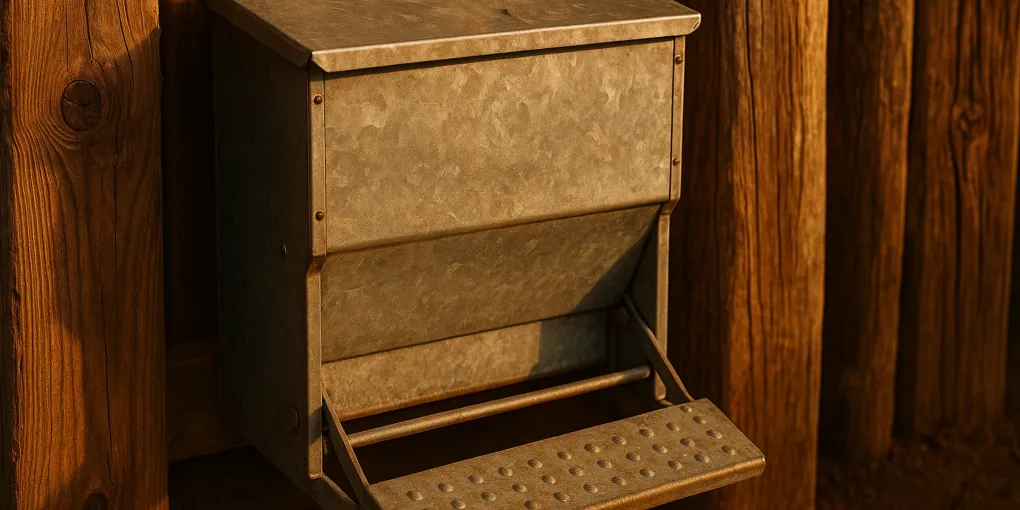
Grandpa's Feeders Automatic Chicken Feeder
Best OverallType: Treadle (mechanical)
$179–$199
Quick Comparison
| Product | Key Specs | Price Range | Buy |
|---|---|---|---|
| |
| $179–$199 | Check Price |
| |
| $99–$129 | Check Price |
| |
| $79–$99 | Check Price |
| |
| $129–$159 | Check Price |
Contains affiliate links — we may earn a small commission at no extra cost to you.
Best Automatic Chicken Feeder in 2026
The best automatic chicken feeder for most backyard flocks is Grandpa’s Feeders Automatic Chicken Feeder (PSR 4.5/5) — a galvanized steel treadle-activated feeder that opens only under the weight of a chicken stepping on the platform. This single mechanical design solves the three most common problems with backyard chicken feeding: wild bird and rodent contamination, feed waste from spilling and scattering, and fecal contamination from open-top feeders. Penn State Extension (2022) estimates treadle feeders can reduce feed waste by 30–50% compared to open feeders, and University of Kentucky Cooperative Extension (2021) documents their effectiveness in excluding mice and sparrows.
TL;DR
- Best Overall: Grandpa’s Feeders — galvanized steel, 22-lb capacity, lifetime warranty, 5.5-lb activation excludes wild birds (PSR 4.5/5)
- Best Large Flock: RentACoop — 33-lb capacity, lower activation weight (4 lbs) suits smaller breeds, weatherproof plastic (PSR 4.3/5)
- Best Scheduled: ChickenGuard Feed-O-Matic — battery-powered timer dispenser, 4 controlled feeds/day (PSR 4.0/5)
- Best Smart Feeder: Erligpowht WiFi Camera Feeder — app-controlled with 1080p camera and remote monitoring (PSR 4.0/5)
- Key Finding: Treadle feeders with ~4–5.5 lb activation weight reliably exclude house sparrows, mice, and small rats by mechanical design alone (USDA APHIS Biosecurity Guide, 2022)
How We Researched and Scored This Article
PSR evaluated automatic chicken feeders through a 4-step process: feed waste and biosecurity risk analysis (Penn State Extension 2022, USDA APHIS Biosecurity Guide 2022), material durability assessment (galvanized steel vs. UV polypropylene vs. ABS plastic in outdoor conditions), user community synthesis (chicken keeper forums, Amazon verified purchase reviews), and brand/warranty assessment. PSR Composite = Safety (30%) + Efficacy & Performance (25%) + Real-World Acceptance (20%) + Value (15%) + Transparency & Brand Trust (10%).
Evidence sources: Penn State Extension Poultry Feeding publication (2022), University of Kentucky Cooperative Extension AGR-223 (2021), USDA APHIS Biosecurity Guide APHIS 91-55-094 (2022), Amazon verified reviews (Grandpa’s Feeders 1,200+; RentACoop 3,400+), manufacturer product specifications.
Why Automatic Feeders Matter for Backyard Chickens
Open hanging feeders and troughs — the most common chicken feeding systems — attract every wild bird and rodent within range of the coop. House sparrows consume significant quantities of chicken feed, and mice and rats attracted to open feed containers are a serious biosecurity risk: USDA APHIS (2022) documents that mice can carry Salmonella Typhimurium, which is transmissible to backyard flocks. Feed contaminated with rodent feces is also a human health concern for families consuming flock eggs.
The treadle feeder design addresses this directly: a mechanical platform activated by the chicken’s weight opens the feed compartment, which closes immediately when the bird steps off. Wild birds (sparrows weigh 0.8–1.0 oz) and small rodents cannot depress treadle mechanisms calibrated to chicken weights (4–6 lbs). The result is a biosecure feed supply that also eliminates the daily annoyance of feed spillage and open-feeder cleaning.
For flock keepers who also want automated coop management, an automatic chicken coop door combines naturally with an automatic feeder to eliminate the two most time-sensitive daily management tasks. For visual monitoring, an outdoor pet camera or pet camera with two-way audio provides remote flock observation.
PSR Composite Score Breakdown
| Criterion | Weight | Grandpa’s Feeders | RentACoop | ChickenGuard F-O-M | Erligpowht WiFi |
|---|---|---|---|---|---|
| Safety | 30% | 9.5 | 8.8 | 8.0 | 8.0 |
| Efficacy & Performance | 25% | 9.2 | 8.8 | 8.2 | 8.0 |
| Real-World Acceptance | 20% | 8.8 | 8.8 | 8.0 | 8.0 |
| Value | 15% | 8.0 | 8.8 | 8.5 | 7.5 |
| Transparency & Brand Trust | 10% | 9.5 | 8.5 | 8.8 | 7.5 |
| PSR Composite | — | 4.5/5 | 4.3/5 | 4.0/5 | 4.0/5 |
Grandpa’s Feeders leads strongly on Safety (galvanized steel, strong activation exclusion, lifetime warranty) and Brand Trust. RentACoop matches on Real-World Acceptance and improves on Value. ChickenGuard and Erligpowht score equally overall, with different feature tradeoffs.
Grandpa’s Feeders Automatic Chicken Feeder: Best Overall
Grandpa’s Feeders has been the benchmark in treadle-activated backyard chicken feeders since the product’s introduction. The galvanized steel construction is the key differentiator: it resists rust, UV degradation, and physical damage from pecking and weather in a way that plastic alternatives cannot match over multi-year outdoor use. The lifetime warranty reflects this confidence in build durability.
Key specifications:
- Type: Mechanical treadle — no electricity, no batteries
- Activation weight: ~5.5 lbs (excludes house sparrows at 0.8–1.0 oz, mice, and small rats)
- Capacity: 22 lbs of feed (approximately 1–2 weeks of supply for 6–8 birds)
- Material: Galvanized steel body, lid, and treadle — fully weatherproof
- Seal: Hinged lid seals feed from rain, birds, and contamination
- Warranty: Lifetime warranty (exceptional for backyard poultry equipment)
- Feed compatibility: Pellets, crumble, grain up to ~10mm
- Dimensions: 15” W × 11” H × 13” D
PSR Score Breakdown:
| Criterion | Weight | Score | Weighted |
|---|---|---|---|
| Safety | 30% | 9.5 | 2.85 |
| Efficacy & Performance | 25% | 9.2 | 2.30 |
| Real-World Acceptance | 20% | 8.8 | 1.76 |
| Value | 15% | 8.0 | 1.20 |
| Transparency & Brand Trust | 10% | 9.5 | 0.95 |
| PSR Composite | — | — | 4.5/5 |
Why Safety scores highest: Galvanized steel provides superior protection against rodent and wild bird access compared to plastic alternatives. The ~5.5 lb activation weight is calibrated to exclude common backyard predator species and wild birds by mass alone — no electronic sensor required. USDA APHIS (2022) identifies rodent access to poultry feed as a primary Salmonella transmission vector; the treadle design directly reduces this biosecurity risk.
Why Value scores lower than top: At $179–$199, Grandpa’s Feeders is the most expensive option reviewed. The lifetime warranty and galvanized steel durability justify the premium for long-term flock keepers, but the higher initial cost relative to plastic alternatives explains the lower Value score.
Training chickens: Most chickens learn to use the Grandpa’s treadle within 1–2 weeks using the included training aid. The first few days, prop the lid open with the supplied wedge piece. As birds become comfortable eating from the feeder, gradually remove the wedge. Most backyard flocks are fully trained within 10–14 days.
Pros:
- Galvanized steel — strongest, most durable construction available
- 5.5-lb activation reliably excludes wild birds and small rodents
- 22-lb capacity reduces refill frequency
- Lifetime warranty
- No electricity or batteries — purely mechanical
- Australian-designed, now globally available
Cons:
- Most expensive option at $179–$199
- Heavier than plastic feeders (~12 lbs empty) — less convenient for frequent repositioning
- 5.5-lb activation may exclude very young chicks (under 8 weeks) until they reach full activation weight
RentACoop Automatic Chicken Feeder: Best Large Flock
RentACoop’s treadle feeder offers the same mechanical exclusion principle as Grandpa’s Feeders with two key differences: a higher capacity (33 lbs vs. 22 lbs in the large model) and a lower activation weight (~4 lbs) that makes it more accessible for mixed flocks including smaller breeds. The UV-resistant polypropylene construction is lighter than galvanized steel and resists rust, though long-term outdoor durability is somewhat lower than all-steel construction.
Key specifications:
- Type: Mechanical treadle
- Activation weight: ~4 lbs
- Capacity: 33 lbs (large model); 16 lbs (standard model)
- Material: UV-resistant polypropylene + galvanized steel treadle
- Weatherproof: Yes (outdoor rated)
- Feed compatibility: Pellets and crumble
PSR Score Breakdown:
| Criterion | Weight | Score | Weighted |
|---|---|---|---|
| Safety | 30% | 8.8 | 2.64 |
| Efficacy & Performance | 25% | 8.8 | 2.20 |
| Real-World Acceptance | 20% | 8.8 | 1.76 |
| Value | 15% | 8.8 | 1.32 |
| Transparency & Brand Trust | 10% | 8.5 | 0.85 |
| PSR Composite | — | — | 4.3/5 |
Pros: 33-lb capacity suits large flocks; lower 4-lb activation suits smaller breeds; lower cost than Grandpa’s; strong verified user community (3,400+ reviews). Cons: Polypropylene is less durable than galvanized steel in long-term UV exposure; warranty less comprehensive than Grandpa’s lifetime warranty. Best for: Large flocks (10+ birds) and mixed flocks with smaller breed birds.
ChickenGuard Feed-O-Matic: Best Scheduled Feeder
The ChickenGuard Feed-O-Matic takes a different approach: instead of treadle activation, it uses a battery-powered timer to dispense feed at programmed intervals — up to 4 meals daily. This is most useful for keepers who want controlled-portion feeding (limiting snack access) or who have breeds or ages of birds that struggle with treadle activation. It does not exclude wild birds and rodents as effectively as treadle models.
PSR Score Breakdown:
| Criterion | Weight | Score | Weighted |
|---|---|---|---|
| Safety | 30% | 8.0 | 2.40 |
| Efficacy & Performance | 25% | 8.2 | 2.05 |
| Real-World Acceptance | 20% | 8.0 | 1.60 |
| Value | 15% | 8.5 | 1.28 |
| Transparency & Brand Trust | 10% | 8.8 | 0.88 |
| PSR Composite | — | — | 4.0/5 |
Pros: Scheduled portion control; no treadle training required; compatible with any chicken size. Cons: Does not exclude wild birds or rodents; 8-lb capacity limits time between refills; battery-dependent. Best for: Keepers managing feed portions for specific dietary needs, or with young chicks too small for treadle activation.
Erligpowht WiFi Chicken Feeder with Camera: Best Smart Feeder
The Erligpowht WiFi feeder adds remote monitoring and control via a 1080p camera and app connectivity — enabling flock keepers to observe feeding behavior and trigger manual dispenses from a smartphone. This is the only app-controlled option in this review and is useful for owners who want remote visibility into coop activity.
PSR Score Breakdown:
| Criterion | Weight | Score | Weighted |
|---|---|---|---|
| Safety | 30% | 8.0 | 2.40 |
| Efficacy & Performance | 25% | 8.0 | 2.00 |
| Real-World Acceptance | 20% | 8.0 | 1.60 |
| Value | 15% | 7.5 | 1.13 |
| Transparency & Brand Trust | 10% | 7.5 | 0.75 |
| PSR Composite | — | — | 4.0/5 |
Pros: 1080p camera with night vision for remote flock monitoring; app control and manual trigger; motion detection alerts. Cons: Requires AC power outlet near coop; IP44 rating (light rain only — not suitable for heavily exposed locations); less rodent-exclusion capability than treadle feeders. Best for: Tech-oriented keepers who want remote monitoring and manual trigger capability.
Frequently Asked Questions
How much feed does a chicken eat per day?
Adult laying hens consume approximately 1/4 to 1/3 lb of feed per day. A flock of 6 hens consumes roughly 1.5–2 lbs of feed daily, meaning a 22-lb Grandpa’s Feeder provides 10–14 days of feed supply before refilling. Heavy breeds (Plymouth Rock, Orpington) eat at the higher end of this range; lighter breeds (Leghorn, Ancona) at the lower end. Verify feed consumption for your specific breeds and adjust refill frequency accordingly.
Should I switch from an open feeder to a treadle feeder?
If you have wild birds or rodents accessing your open feeder, switching to a treadle feeder is strongly recommended. Penn State Extension (2022) estimates treadle feeders reduce feed consumption by 30–50% by excluding non-flock animals — a significant cost and biosecurity improvement. The transition requires 1–2 weeks of chicken training, but the vast majority of flocks adapt successfully. The feed savings typically offset the feeder cost within 6–12 months.
Can I use a chicken feeder for ducks?
Treadle feeders can accommodate ducks with some adaptation. Standard chicken treadle feeders (Grandpa’s, RentACoop) work for medium and large duck breeds (Pekin, Rouen) but the activation weight (~4–5.5 lbs) may be too high for lightweight duck breeds (Call ducks, Bantam ducks). Duck feed (16–17% protein waterfowl pellets) has the same 6–10mm pellet size as chicken feed and is fully compatible with treadle hopper mechanisms.
What is the best feeder for a flock of 2–3 chickens?
For very small flocks (2–3 birds), a treadle feeder may be over-investment depending on predator pressure. The ChickenGuard Feed-O-Matic timer feeder ($79–$99) provides scheduled access control without the cost of a full steel treadle unit. If rodent pressure is present, even for small flocks, the Grandpa’s Feeders or RentACoop treadle units deliver biosecurity benefits worth their price.
Do I need an automatic feeder if I free-range my chickens?
Free-range chickens supplement their diet with insects, seeds, and vegetation, reducing pellet consumption by 20–40% in peak foraging seasons (spring and summer). An automatic feeder remains useful even for free-range flocks: it provides consistent access during non-foraging hours (morning, evening), protects feed supply from wild birds overnight, and maintains nutrition during winter when foraging is limited.
Bottom Line
Grandpa’s Feeders (PSR 4.5/5) is the best overall automatic chicken feeder for most backyard flocks — its galvanized steel construction, ~5.5-lb treadle activation, and lifetime warranty set the standard for biosecure, waste-reducing automatic feeding. The investment pays back in reduced feed costs and improved biosecurity within the first year for most flocks.
RentACoop (PSR 4.3/5) is the best choice for large flocks (10+ birds) or mixed flocks with smaller breeds — its 33-lb capacity and 4-lb activation weight address the two most common limitations of premium treadle feeders.
For keepers who want remote monitoring capability, the Erligpowht WiFi Camera Feeder (PSR 4.0/5) adds app-connected visibility — a worthwhile feature for those who travel or whose coops are far from the home.
Frequently Asked Questions
- Yes — treadle feeders significantly reduce feed waste compared to open hanging or trough feeders. Backyard chicken keepers using treadle feeders commonly report feed savings of 30–50% (Homesteaders of America field surveys, 2022) by excluding wild birds, mice, and rats from the food supply. Chickens learn to step on the treadle within 1–2 weeks. The feed cost savings often offset the higher initial investment of a quality treadle feeder within 6–12 months.
- Most flocks fully transition to treadle feeders within 1–2 weeks. During the first few days, prop the treadle lid open or weigh it down with a small stone so chickens can access feed freely. Gradually reduce the prop weight over days 3–7 until chickens are stepping on the treadle independently. Dominant birds typically learn first and flock mates follow. Bantam breeds and young pullets may take slightly longer due to lower body weight relative to activation threshold.
- Standard treadle feeders (Grandpa's at ~5.5 lbs activation) are designed for medium to large breeds. Bantam chickens and small breeds (under 4 lbs) may not reliably activate standard treadle mechanisms. RentACoop's model activates at ~4 lbs and is more accessible to smaller birds. If your flock includes bantams, confirm the feeder's activation weight against your birds' weights and look for adjustable treadle tension options.
- Galvanized steel (Grandpa's Feeders) is the most durable and hygienic material for chicken feeders — it resists rust, does not absorb moisture or bacteria, and withstands outdoor temperature extremes. UV-stabilized polypropylene (RentACoop) is a good second choice: lighter than steel, good weather resistance, and significantly lower cost than premium steel units. Standard ABS plastic (ChickenGuard timer feeder) is appropriate for sheltered indoor use but degrades faster in direct UV exposure.
- Treadle feeders with activation weights of 4–5.5 lbs exclude mice and small rats by mechanical design — these pests cannot depress the treadle to access feed. However, no treadle feeder is completely rodent-proof: large adult rats (>1 lb) can sometimes activate lighter treadle mechanisms. Hardware cloth around the coop perimeter and snap traps placed away from chicken access remain the most effective rodent management tools, with the treadle feeder providing a meaningful reduction in attractant.