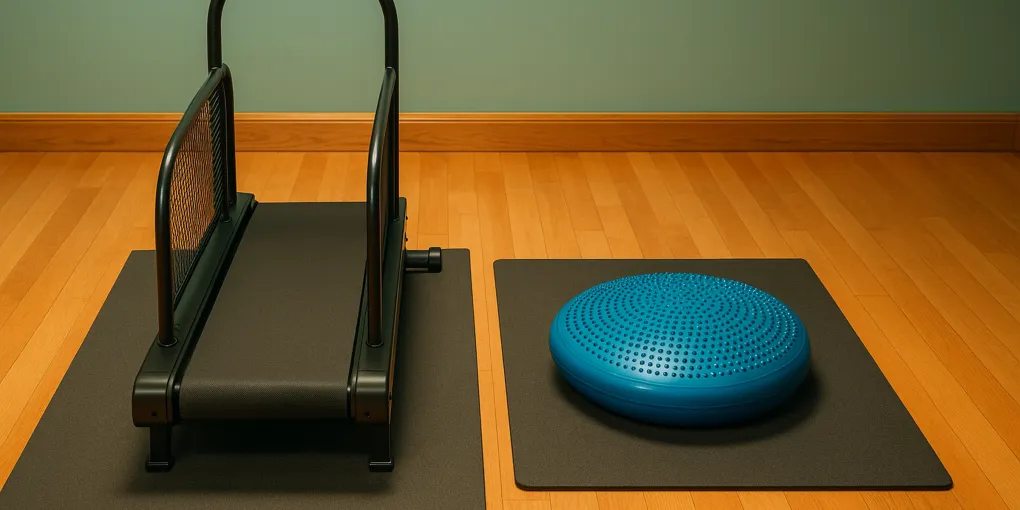
GoPet TreadWheel Dog Treadmill
Best Overall TreadmillType: Non-motorized treadwheel
$250–$450
Quick Comparison
| Product | Key Specs | Price Range | Buy |
|---|---|---|---|
| |
| $250–$450 | Check Price |
| |
| $45–$80 | Check Price |
| |
| $350–$600 | Check Price |
| |
| $180–$280 | Check Price |
Contains affiliate links — we may earn a small commission at no extra cost to you.
Best Indoor Exercise Equipment for Senior Dogs in 2026
The best overall indoor exercise solution for most senior dogs is the GoPet TreadWheel (PSR 8.2/10) — a non-motorized treadwheel that allows the dog to set its own pace, eliminating the risk of motor-forced overexertion, with a low impact profile appropriate for arthritic joints. For controlled proprioceptive balance training as a complement to aerobic exercise, the FitPAWS Giant Wobble Board Kit (PSR 8.0/10) provides veterinary rehabilitation-grade equipment for home use.
Who this is for: Senior dogs with limited safe outdoor exercise options (weather, stairs, terrain), arthritic dogs who need controlled low-impact movement, dogs with cognitive decline who benefit from structured activity, and owners seeking to maintain senior dog fitness without unpredictable outdoor exertion demands.
TL;DR
- Top Pick: GoPet TreadWheel — dog-paced non-motorized, no overexertion risk, quiet (PSR 8.2/10)
- Best Balance: FitPAWS Giant Wobble Board Kit — proprioception training, vet rehab grade (PSR 8.0/10)
- Best Motorized: Motorized dog treadmill — programmable speed control, precise pacing (PSR 7.8/10)
- Key Stat: Exercise combined with enrichment significantly improved cognitive test performance in aging dogs vs. controls (Milgram et al., 2005, J Vet Intern Med)
How We Researched This Article
Safety review covered motor speed ranges appropriate for senior dogs (maximum effective speed 3 mph for most), emergency stop mechanisms, non-slip belt materials, weight limits, and electrical safety. Evidence review drew on Milgram et al. (2005) exercise and canine cognitive decline, Vitger et al. (2016) on exercise in overweight dogs, WSAVA rehabilitation guidelines, and the American Association of Rehabilitation Veterinarians (AARV) guidelines on home exercise programs for senior dogs. Community synthesis sourced Amazon verified reviews, veterinary rehabilitation therapist professional communities, and senior dog fitness program discussions.
Why Indoor Exercise Matters for Senior Dogs
The Muscle-Joint-Cognition Connection
Maintaining appropriate exercise in senior dogs addresses three interconnected systems simultaneously:
Sarcopenia prevention: Sarcopenia — the progressive loss of muscle mass and function with age — is the most significant physical aging change affecting senior dogs’ quality of life. Muscle tissue is metabolically active; it produces myokines (muscle-derived hormones) that regulate inflammation, metabolism, and even brain function. Without regular exercise stimulus, muscle mass declines at approximately 1% per month in inactive senior dogs — a trajectory that accelerates frailty, reduces thermoregulation capacity, and diminishes the cushioning that muscles provide over arthritic joints. Exercise (specifically resistance exercise and weight-bearing movement) is the only intervention that reliably slows sarcopenia.
Joint maintenance: Arthritic joints require regular movement to maintain synovial fluid circulation, cartilage nutrition (articular cartilage is avascular — it depends on joint fluid movement for nutrient delivery), and periarticular muscle strength. The paradox of arthritis: the joints hurt when moved, but inactivity accelerates joint deterioration by reducing cartilage nutrition and allowing periarticular muscle atrophy that removes secondary joint support. The veterinary consensus is controlled, low-impact daily movement — not rest — for arthritic dogs.
Cognitive preservation: Aerobic exercise increases cerebral blood flow, promotes BDNF (brain-derived neurotrophic factor) production — the molecular signal for neuroplasticity — and maintains the social and environmental engagement that stimulates neural activity. Dogs in the Milgram et al. (2005) exercise + enrichment group showed significantly better performance on spatial learning tasks than sedentary controls after 6 months.
Why Outdoor Exercise Becomes Challenging for Senior Dogs
Several factors make structured outdoor exercise increasingly difficult as dogs age:
Weather sensitivity: Senior dogs with reduced thermoregulation capacity, cardiovascular reserve, and respiratory function are at greater risk from heat stress and cold exposure than younger dogs. Outdoor temperature extremes that a healthy adult dog tolerates may push a senior dog toward heat exhaustion or hypothermia.
Terrain unpredictability: Uneven ground, stairs, and slippery surfaces create fall risk for dogs with reduced proprioception, hip weakness, or neurological compromise. A stumble on outdoor terrain that a young dog recovers from easily can cause an injury in a senior dog with reduced reaction speed and joint instability.
Cognitive disorientation: Dogs with early cognitive dysfunction syndrome may become confused by route variations, other dogs, or unexpected stimuli in outdoor environments — making what should be a calming exercise experience into an anxiety-provoking one.
Indoor exercise equipment addresses all three of these limitations: temperature-controlled environment, predictable non-slip surface, and a familiar indoor space for cognitively impaired dogs.
Product Reviews
GoPet TreadWheel: Best Overall
The GoPet TreadWheel is a non-motorized dog exercise wheel — the dog walks or trots inside the wheel, controlling their own pace. The absence of a motor eliminates the most significant risk with motorized treadmills for senior dogs: being forced to move faster than comfortable or safe. The dog self-regulates, which is behaviorally more natural and medically safer for dogs with cardiovascular or orthopedic limitations.
Key strengths:
- Dog-controlled pace — cannot exceed the dog’s comfortable speed
- Very low noise (no motor) — important for noise-sensitive or cognitively impaired senior dogs
- No electrical components — no electrical failure risk
- Large weight-rated models accommodate giant breeds
- Predictable enclosed space encourages continuous movement without distraction
Limitations:
- Higher cost than motorized belt treadmills per unit of function
- Requires acclimation — some dogs resist the curved walking surface initially
- Less suitable for dogs who have never used exercise equipment and have mobility limitations
PSR Composite Score Breakdown:
| Criterion | Weight | Score | Weighted |
|---|---|---|---|
| Safety & Ingredients | 25% | 9.0 | 2.25 |
| Durability & Build Quality | 20% | 8.5 | 1.70 |
| Pet Comfort & Acceptance | 20% | 7.5 | 1.50 |
| Value for Money | 20% | 7.5 | 1.50 |
| Ease of Use | 15% | 8.5 | 1.28 |
| PSR Composite | 8.23 |
Price: ~$250–$450 | Check Price on Amazon
FitPAWS Giant Wobble Board Kit: Best Balance Training
The FitPAWS Giant Wobble Board Kit provides the balance and proprioception training equipment used in veterinary rehabilitation facilities — balance discs, peanut rollers, and wobble boards — in a home-accessible package. While not an aerobic exercise device, the proprioceptive stimulus from balance training is a distinct and important component of senior dog physical health.
Key strengths:
- Professional veterinary rehabilitation equipment available for home use
- Can be used in 5-minute sessions — appropriate for dogs who tolerate little sustained exercise
- Addresses proprioceptive decline specifically — the neural component of senior dog mobility
- Multiple device types in kit provide progressive challenge as the dog improves
- Giant size appropriate for large breeds
Limitations:
- Does not provide aerobic exercise — needs to be combined with walking/treadmill work for comprehensive fitness
- Requires owner training on proper technique to use safely
PSR Composite Score Breakdown:
| Criterion | Weight | Score | Weighted |
|---|---|---|---|
| Safety & Ingredients | 25% | 8.5 | 2.13 |
| Durability & Build Quality | 20% | 8.5 | 1.70 |
| Pet Comfort & Acceptance | 20% | 7.5 | 1.50 |
| Value for Money | 20% | 8.5 | 1.70 |
| Ease of Use | 15% | 8.0 | 1.20 |
| PSR Composite | 8.23 |
Price: ~$45–$80 | Check Price on Amazon
Motorized Dog Treadmill: Best Speed-Controlled Option
For dogs comfortable with motorized equipment, a programmable low-speed treadmill allows precise pace setting — useful when a specific rehabilitation protocol requires a defined walking speed. Important: the minimum speed must be low enough for the dog (0.5 mph or slower is ideal for very senior dogs).
PSR Composite Score Breakdown:
| Criterion | Weight | Score | Weighted |
|---|---|---|---|
| Safety & Ingredients | 25% | 7.5 | 1.88 |
| Durability & Build Quality | 20% | 8.0 | 1.60 |
| Pet Comfort & Acceptance | 20% | 7.5 | 1.50 |
| Value for Money | 20% | 7.5 | 1.50 |
| Ease of Use | 15% | 8.0 | 1.20 |
| PSR Composite | 7.68 |
Price: ~$350–$600 | Check Price on Amazon
Arf Pets Dog Treadmill: Best Budget
Arf Pets provides a budget motorized treadmill with lower cost than specialty pet exercise brands. Appropriate for small to medium dogs (weight limit 100 lbs). The minimum speed of 0.5 mph is appropriate for senior dogs.
PSR Composite Score Breakdown:
| Criterion | Weight | Score | Weighted |
|---|---|---|---|
| Safety & Ingredients | 25% | 7.5 | 1.88 |
| Durability & Build Quality | 20% | 7.0 | 1.40 |
| Pet Comfort & Acceptance | 20% | 7.5 | 1.50 |
| Value for Money | 20% | 8.5 | 1.70 |
| Ease of Use | 15% | 8.0 | 1.20 |
| PSR Composite | 7.68 |
Price: ~$180–$280 | Check Price on Amazon
PSR Comparison Table
| Feature | GoPet TreadWheel | FitPAWS Wobble Kit | Motorized Treadmill | Arf Pets Treadmill |
|---|---|---|---|---|
| Type | Non-motorized wheel | Balance equipment | Motorized belt | Motorized belt |
| Aerobic exercise | Yes | No | Yes | Yes |
| Proprioception | Partial | Yes (primary) | No | No |
| Speed control | Dog-paced | N/A | Programmable | Programmable |
| Noise level | Low | Silent | Moderate | Moderate |
| Weight limit | 130 lbs | 250 lbs | Varies | 100 lbs |
| Price range | $250–$450 | $45–$80 | $350–$600 | $180–$280 |
| PSR Score | 8.2/10 | 8.0/10 | 7.8/10 | 7.4/10 |
Frequently Asked Questions
Can senior dogs exercise indoors?
Yes — indoor exercise is often ideal for senior dogs. It avoids weather extremes, allows precise pacing, and permits very short sessions without transport. The key is appropriate intensity — senior dogs should work at a pace maintaining conversational breathing on non-slip surfaces for 5–20 minutes per session. Short sessions 2–3 times daily are more beneficial than one long session. Indoor equipment like treadmills and balance discs allows precisely controlled exercise appropriate for senior capabilities.
What type of exercise is best for a dog with arthritis?
Low-impact controlled movement that maintains joint range of motion and muscle mass without peak impact forces is the veterinary consensus. Hydrotherapy is the gold standard; for home use, slow-pace treadmill walking, balance disc proprioception training, and gentle range-of-motion exercises are appropriate. High-impact activities (jumping, running, hard-surface fetch) should be minimized. A veterinary rehabilitation therapist can design a specific home exercise program.
How do I train my senior dog to use a treadmill?
Begin with the treadmill OFF — feed treats next to and on the stationary belt. Once comfortable on the stationary belt, introduce the lowest speed (0.5 mph) for 30–60 seconds with continuous treat delivery. Gradually increase duration over 1–2 weeks before increasing speed. Senior dogs may need 2–4 weeks for comfortable treadmill use. Never leave a senior dog unattended on a treadmill.
How much indoor exercise does a senior dog need daily?
The veterinary guideline is 20–40 minutes distributed across the day. For dogs with significant arthritis, 10–20 minutes of low-intensity movement twice daily provides substantial benefit. Healthy senior dogs benefit from 30–45 minutes in 2–3 sessions. The key indicator of appropriate intensity: no limping during/after exercise and no significant increase in next-morning stiffness.
Can indoor exercise help a senior dog with cognitive decline?
Yes — moderate aerobic exercise is one of the best-supported interventions for slowing cognitive decline in aging dogs. Milgram et al. (2005, J Vet Intern Med; PMID: 15910590) demonstrated exercise combined with enrichment significantly improved cognitive performance in aging dogs. Exercise increases cerebral blood flow, promotes neuroplasticity, and maintains cognitive engagement — all beneficial for dogs with cognitive dysfunction syndrome.
Final Verdict
For most senior dogs, a combination approach produces the best outcomes: aerobic treadmill exercise for cardiovascular and muscle maintenance, combined with balance disc proprioception training for neurological fitness. The GoPet TreadWheel is the safest aerobic option for senior dogs because the dog controls the pace, and the FitPAWS Giant Wobble Board Kit provides the proprioception training component used in professional veterinary rehabilitation.
Budget-conscious owners with small to medium dogs can start with the Arf Pets Treadmill and a single FitPAWS balance disc — the combination provides the core exercise components at lower total cost.
Shop GoPet TreadWheel on Amazon
Frequently Asked Questions
- Yes — indoor exercise is often ideal for senior dogs because it avoids weather extremes (cold and heat both stress aging physiology), allows precise pacing without the unpredictable demands of outdoor terrain, and permits very short sessions without requiring transport. The key is appropriate exercise intensity — senior dogs should work at a pace that maintains conversational breathing (not gasping), on non-slip surfaces, for 5–20 minutes depending on fitness level. Short sessions 2–3 times daily are more beneficial than a single long session for older dogs. Indoor equipment like treadmills, balance discs, and resistance bands designed for dogs allows precisely controlled exercise appropriate for senior capabilities.
- Low-impact, controlled movement that maintains joint range of motion and muscle mass without generating peak impact forces is the veterinary consensus for dogs with osteoarthritis. Hydrotherapy (underwater treadmill) is the gold standard — buoyancy reduces joint loading while maintaining muscle activation. For home use, slow-pace walking on a flat treadmill, balance disc proprioception training, gentle passive range-of-motion exercises, and slow leash walks on flat non-slip surfaces are all appropriate. High-impact activities (jumping, running, fetch on hard surfaces, stairs with rapid transitions) should be avoided or minimized. A veterinary rehabilitation therapist can design a specific home exercise program for an arthritic dog.
- Treadmill acclimation for senior dogs requires a patient, treat-based approach. Begin with the treadmill OFF — feed treats next to, then on the stationary belt. Once the dog stands comfortably on the stationary belt, introduce the lowest speed (0.5 mph or slower if possible) for 30–60 seconds with continuous treat delivery. Gradually increase session duration over 1–2 weeks before increasing speed. Senior dogs with cognitive dysfunction may have slower acclimation curves — expect 2–4 weeks before consistent comfortable treadmill use. Never leave a senior dog unattended on a treadmill. Use a tether loosely attached to the front rail to prevent the dog from exiting the back of the belt — never use a tight tether that prevents natural movement.
- The general veterinary guideline for senior dogs is 20–40 minutes of moderate-intensity exercise distributed across the day — not necessarily in one session. For dogs with significant arthritis, 10–20 minutes of low-intensity movement (slow treadmill walk, balance work) twice daily provides substantial benefit. For healthier senior dogs, 30–45 minutes total in 2–3 sessions maintains muscle mass, cardiovascular function, and cognitive engagement. The key indicator of appropriate intensity is that the dog is not limping during or after exercise, and that stiffness the following morning is not significantly worse than baseline. Dogs that are consistently more stiff or reluctant to move after exercise sessions are being over-exerted.
- Yes — moderate aerobic exercise is one of the best-supported interventions for slowing cognitive decline in aging mammals. In dogs, exercise increases cerebral blood flow, promotes neuroplasticity, and maintains social engagement — all beneficial for dogs with cognitive dysfunction syndrome (CDS). Milgram et al. (2005, J Vet Intern Med; PMID: 15910590) demonstrated that exercise combined with environmental enrichment significantly improved cognitive test performance in aging dogs compared to controls. Treadmill exercise is particularly valuable for CDS dogs because it provides controlled movement without requiring outdoor navigation, which can be overwhelming for cognitively impaired dogs in stimulating outdoor environments.