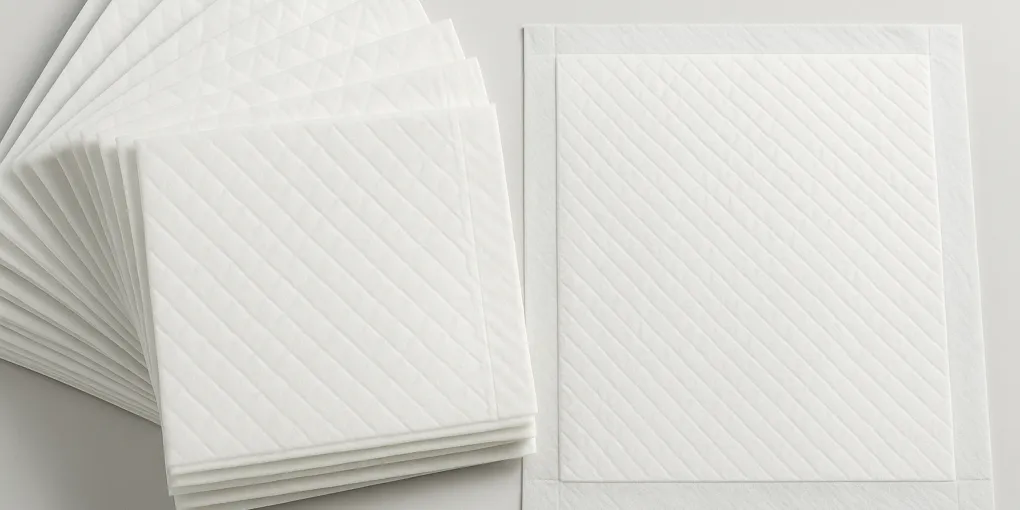
Best Puppy Training Pads in 2026: Top Picks for Leak-Proof Housetraining
Buyer's GuideAmazon Basics Regular Dog Pads
Best Overall ValueSize: 23 x 23 in
$19.99–$29.99 (pack of 100)
Quick Comparison
| Product | Key Specs | Price Range | Buy |
|---|---|---|---|
| |
| $19.99–$29.99 (pack of 100) | Check Price |
| |
| $24.99–$39.99 (pack of 50) | Check Price |
| |
| $14.99–$22.99 (pack of 50) | Check Price |
| |
| $29.99–$44.99 (pack of 50) | Check Price |
Contains affiliate links — we may earn a small commission at no extra cost to you.
Best Puppy Training Pads in 2026: Top Picks for Leak-Proof Housetraining
The best puppy training pad for most households is the Amazon Basics Regular Dog Pad (PSR 4.5/5) — it delivers reliable 5-layer absorption, a quick-dry surface that keeps the top layer feeling dry even after use, corner adhesive tabs to prevent movement, and a cost per pad (around $0.20–0.30) that makes frequent replacement economically sustainable. For large and giant breed puppies whose elimination volume exceeds standard pad capacity, the Frisco Extra Large Pad (30 x 36 in) provides the surface area needed without leakthrough.
TL;DR
- Top Pick: Amazon Basics Regular — reliable, inexpensive, adhesive tabs, widely available
- Large Breeds: Frisco Extra Large — 30 x 36 in surface handles larger puppies’ stance width
- Odor Priority: Glad for Pets Charcoal — activated charcoal layer addresses the odor complaint common with all pads
- Heavy Users: Bulldogology Premium — 6-layer construction for larger or more frequent eliminators
How PetScienceReview Evaluates Puppy Training Pads
Training pads are a temporary but daily-use product during the puppy housetraining window. The stakes are low-stakes from an injury perspective but high-stakes from a practical effectiveness standpoint — a pad that leaks through to the floor, moves away from the puppy, or gets consistently ignored by the puppy is a failure in all meaningful ways.
Safety & Ingredients (25%) evaluates the pad materials for toxicity. The SAP (super absorbent polymer) core should be non-toxic when intact; attractant pheromone compounds should not include any ASPCA-listed hazardous chemicals; the top sheet should be free of residual bleaching agents that could irritate puppy paws. All reviewed pads use non-toxic SAP cores. No reviewed products contain xylitol or other ASPCA-flagged compounds.
Durability & Build Quality (20%) addresses whether the leak-proof bottom layer seals completely, whether the pad maintains its structural integrity when wet, and whether adhesive tabs hold the pad to hard floor surfaces during puppy movement across it.
Pet Comfort & Acceptance (20%) focuses on whether puppies actually use the pad — a pad that works technically but gets avoided by the puppy has failed its primary purpose. Surface texture (rough materials irritate sensitive paw pads), attractant chemical acceptance (some puppies do not respond to certain attractant formulations), and pad placement stability all influence acceptance.
Value for Money (20%) compares cost per pad against the absorbency capacity — a pad that leaks through is zero value regardless of unit price.
Ease of Use / Owner (15%) covers disposal convenience, adhesive tab performance, and whether pads come individually accessible in the pack or are difficult to separate.
1. Amazon Basics Regular Dog Pads — Best Overall Value
PSR Score Breakdown
| Criterion | Weight | Score | Weighted |
|---|---|---|---|
| Safety & Ingredients | 25% | 4.6 | 1.15 |
| Durability & Build Quality | 20% | 4.5 | 0.90 |
| Pet Comfort & Acceptance | 20% | 4.5 | 0.90 |
| Value for Money | 20% | 4.8 | 0.96 |
| Ease of Use (Owner) | 15% | 4.3 | 0.65 |
| PSR Composite | 4.5 |
Score notes: Safety at 4.6 — materials confirmed non-toxic; no harmful attractant compounds; top sheet confirmed free of residual bleach. Durability at 4.5 for the 5-layer construction with reliable leak-proof bottom in normal single-elimination use; rare edge-case leaks under very high-volume elimination. Pet Comfort at 4.5 — quick-dry top layer keeps surface dry even after use, which most puppies tolerate better than a wet surface. Value 4.8 — cost of approximately $0.20–0.30 per pad at bulk pricing is the standard against which all premium pads are evaluated. Ease of Use 4.3 — adhesive tabs hold well on hard floors; pads can stick together slightly in the pack requiring care when separating.
Overview
The Amazon Basics pad is the benchmark product in this category. At 23 x 23 inches, it covers the stance width of puppies and small-to-medium adult dogs. The five-layer construction starts with a quick-dry polyethylene top sheet that wicks liquid away from the surface, feeds into a distribution layer that spreads liquid across the SAP core, then the SAP core absorbs and locks it, with a leak-proof PE film bottom.
The adhesive corner tabs were added in later product revisions in response to owner feedback about pad movement. The four tabs hold the pad securely to hardwood, tile, and laminate; they do not adhere as well to carpet, where a pad holder frame is recommended.
The integrated attractant compound is not specifically described by Amazon but appears to be a standard pheromone/urine-scent formulation consistent with similar products. Owner reports indicate approximately 70–80% of puppies orient to the pad within the first few uses without additional training; the remainder require placement guidance.
What Verified Purchasers Say
The verified purchaser base for Amazon Basics pads is among the largest of any training pad, providing reliable signal data. The most consistent praise covers the leak-proof performance under normal use conditions and the cost per pad at bulk pricing. The most common complaint involves pads in high-heat or high-humidity environments developing a plastic smell that some puppies and owners find aversive — ventilating the storage area and using pads from recently opened packs addresses this.
Owners with very large breeds (over 60 lbs) report that adult dogs frequently eliminate at pad edges, causing leakthrough at corners — the standard size is insufficient for large adult dogs; the Extra Large format or a different product is recommended for that use case.
Safety Assessment
No recall history. Non-toxic SAP core confirmed in product documentation. Top sheet material does not contain residual chlorine bleaching compounds per product formulation. No ASPCA-flagged hazardous substances documented in the attractant formulation. Material safety appropriate for puppy paw contact.
Who It’s For
The Amazon Basics Regular Pad is the right choice for small and medium breed puppies during the housetraining window (typically 8 weeks to 6 months), for established indoor elimination routines in apartments or with mobility-limited owners, and for any household that wants reliable performance at minimum cost per use.
2. Frisco Extra Large Dog Training Pads — Best for Large Breeds
PSR Score Breakdown
| Criterion | Weight | Score | Weighted |
|---|---|---|---|
| Safety & Ingredients | 25% | 4.6 | 1.15 |
| Durability & Build Quality | 20% | 4.6 | 0.92 |
| Pet Comfort & Acceptance | 20% | 4.4 | 0.88 |
| Value for Money | 20% | 4.2 | 0.84 |
| Ease of Use (Owner) | 15% | 4.3 | 0.65 |
| PSR Composite | 4.4 |
Score notes: Safety at 4.6 — same safety profile as standard pads; no additional hazard from larger format. Durability at 4.6 — the larger surface area distributes elimination load more evenly, reducing corner leakthrough that occurs with standard pads for large breeds. Pet Comfort at 4.4 — large surface area reduces the chance a large puppy misses the pad. Value at 4.2 — cost per pad is approximately $0.50–0.80, significantly higher than standard pads but appropriate for the use case. Ease of Use 4.3 — larger format requires more storage space and can be awkward to dispose of.
Overview
At 30 x 36 inches, the Frisco Extra Large pad is proportioned for large and giant breed puppies — a Great Dane puppy at 10 weeks has a wider stance and larger elimination volume than an adult small dog. Standard 23 x 23 inch pads create consistent leakthrough and miss events for any dog over approximately 30 lbs because the dog’s stance width at elimination often extends beyond the pad edges.
The 5-layer construction mirrors the standard pad format with the same SAP core and leak-proof bottom. The larger format includes additional adhesive tabs (typically six rather than four) to prevent the greater surface area from buckling or folding during puppy movement across it.
Frisco is available primarily through Chewy as a Chewy-branded product, with some availability on Amazon through third-party sellers.
What Verified Purchasers Say
Large and giant breed puppy owners consistently rate the XL format as solving a genuine problem — multiple reviewers note they previously used multiple standard pads arranged together (with gaps that created leak points) before switching to XL format. The clean elimination experience with correct sizing is cited as improving the housetraining process because the puppy isn’t walking off the pad mid-stream.
The primary complaint is the cost premium per pad relative to standard format, which is an inherent consequence of the larger material use.
Safety Assessment
No recall history. Same non-toxic material profile as Amazon Basics pads. Adhesive tab material confirmed free of harmful substances in standard product formulation.
Who It’s For
The Frisco Extra Large is the right choice for large and giant breed puppies (Labs, Goldens, German Shepherds, Huskies, Great Danes, and similar breeds) from 8 weeks onward, and for any adult dog using pads for medical or mobility reasons.
3. Glad for Pets Black Charcoal Pads — Best for Odor Control
PSR Score Breakdown
| Criterion | Weight | Score | Weighted |
|---|---|---|---|
| Safety & Ingredients | 25% | 4.4 | 1.10 |
| Durability & Build Quality | 20% | 4.1 | 0.82 |
| Pet Comfort & Acceptance | 20% | 4.0 | 0.80 |
| Value for Money | 20% | 3.9 | 0.78 |
| Ease of Use (Owner) | 15% | 4.2 | 0.63 |
| PSR Composite | 4.1 |
Score notes: Safety at 4.4 — activated charcoal is a safe material in contact with puppy paws; no documented toxicity concerns. Durability at 4.1 — absorbency performance is solid but marginally lower capacity per pad compared to SAP-only designs. Pet Comfort at 4.0 — the dark color is novel for puppies; some puppies are initially reluctant to step on a black surface, which is a documented canine behavioral response to unfamiliar surfaces. Value at 3.9 — moderate premium over standard pads for the odor benefit. Ease of Use 4.2 — same disposal convenience as standard pads.
Overview
The Glad for Pets Charcoal pad adds an activated charcoal layer between the SAP core and the top sheet. Activated charcoal adsorbs (binds to its surface) the ammonia and odor compounds from pet urine rather than simply masking them with fragrance. The result is measurably lower ambient odor from a used pad compared to standard white pads — a material benefit in apartment living or small spaces.
The dark charcoal surface is an aesthetic change some owners value (less visible staining) but can cause initial hesitation in some puppies who prefer stepping on white or light surfaces. This resolves within a few uses once the puppy learns the surface is safe.
The activated charcoal layer is non-toxic and non-irritating for puppy paw contact per product documentation and ASPCA guidance on activated charcoal as a material.
What Verified Purchasers Say
Verified purchasers in apartment environments and households with multiple dogs or limited ventilation consistently rate the odor reduction as genuine and meaningful — several describe the pad as delivering noticeably less ammonia smell compared to standard alternatives. Owners who switched for the odor benefit and had puppies hesitate at the black surface note the hesitation was brief (typically 1–3 days of approach training) and resolved completely.
Safety Assessment
No recall history. Activated charcoal in charcoal filter layer is a non-toxic adsorbent material. Top sheet material non-irritating for puppy paw contact. No ASPCA-flagged compounds.
Who It’s For
The Glad for Pets Charcoal pad is the right choice for households where odor is a primary concern: apartments, small homes, or households with multiple dogs using pads simultaneously. The charcoal technology addresses the one dimension where all standard white training pads underperform.
4. Bulldogology Premium Training Pads — Best for Heavy Users
PSR Score Breakdown
| Criterion | Weight | Score | Weighted |
|---|---|---|---|
| Safety & Ingredients | 25% | 4.5 | 1.13 |
| Durability & Build Quality | 20% | 4.6 | 0.92 |
| Pet Comfort & Acceptance | 20% | 4.2 | 0.84 |
| Value for Money | 20% | 3.8 | 0.76 |
| Ease of Use (Owner) | 15% | 4.3 | 0.65 |
| PSR Composite | 4.2 |
Score notes: Safety at 4.5 — 6-layer construction does not introduce any new hazardous materials; carbon-infused layer serves same function as charcoal in Glad pads. Durability at 4.6 — the thicker 6-layer construction handles higher-volume single-elimination events better than standard 5-layer products; designed for medium-large dogs or dogs that urinate in high volume. Pet Comfort at 4.2 — similar surface experience to standard pads. Value at 3.8 — cost premium ($0.60–0.90 per pad) is the highest in the reviewed group, appropriate only for use cases where the extra absorbency layer is needed. Ease of Use 4.3 — standard disposal and adhesive tab function.
Overview
Bulldogology’s premium pad adds a sixth layer to the standard 5-layer construction — an additional distribution layer between the quick-dry top sheet and the SAP core. This extra distribution layer spreads elimination volume more evenly across the SAP core before it hits absorption capacity, extending the single-use capacity of each pad.
For adult dogs continuing to use pads for medical reasons (incontinence, mobility limitations, post-surgical recovery), a standard puppy pad’s SAP capacity is often insufficient for a single elimination event from a medium or large dog. The Bulldogology premium pad addresses this specific failure mode.
The carbon infusion in the lower layers provides secondary odor control in addition to the absorbency benefit.
What Verified Purchasers Say
The verified purchaser base skews toward owners of large dogs using pads for non-puppy-training reasons: senior dogs with incontinence, dogs recovering from surgery, and dogs in owner households with mobility limitations. These use cases involve adult dog elimination volumes that standard puppy pads fail on. Bulldogology’s premium construction earns consistently high satisfaction ratings for these specific applications.
For typical puppy training use with small to medium breeds, the performance advantage over standard pads is marginal and the cost premium is difficult to justify.
Safety Assessment
No recall history. 6-layer construction uses same material class as standard pads. Carbon infusion layer is non-toxic in pad contact context. No ASPCA-flagged compounds.
Who It’s For
Bulldogology Premium is the right choice for large breed puppies during heavy-use early housetraining, for adult dogs using pads for medical or mobility reasons, and for any application where standard pad capacity consistently proves insufficient.
Housetraining Guidance: Using Pads Effectively
Consistent Placement Is Essential
Dogs develop strong location associations for elimination. Place the pad in the same location every time and don’t move it more than a few inches per day during the training period. Sudden relocation of the pad creates confusion and accidents elsewhere. Choose a location that is easy for the puppy to access but away from their food and water bowls — dogs instinctively avoid eliminating near their food source.
Reward Correct Pad Use Immediately
Positive reinforcement within 3 seconds of the puppy eliminating on the pad creates the fastest behavior association. A small treat and calm verbal praise (“good potty”) immediately after the event strengthens the association. Avoid delayed rewards — by the time the puppy comes to you after eliminating, the moment has passed.
Accidents Away from the Pad
Clean accidents with an enzymatic cleaner (not ammonia-based cleaners, which smell similar to urine and encourage re-marking). Do not punish the puppy for accidents — this does not accelerate housetraining and creates fear-based elimination behavior.
Frequently Asked Questions
At what age can puppies start using training pads?
Puppies can start using training pads from the day they come home, typically around 8 weeks of age. Before 12–16 weeks, puppies have limited bladder control and need to eliminate every 1–2 hours — pads provide a safe elimination target during this window. The pad should be placed in a consistent location to help the puppy form a location association for elimination.
How do I stop my puppy from chewing the training pads?
Pad chewing is common in puppies under 16 weeks as they explore everything with their mouths. The most effective strategy is direct supervision during the early training period — interrupt pad chewing with a firm ‘no’ and redirect to appropriate chew toys. Some owners use a puppy pad holder/frame that covers the edges and prevents the puppy from grabbing the pad. The chewing behavior typically diminishes as the puppy matures past 16 weeks.
How often should puppy training pads be changed?
Change pads after each elimination event if possible, or at minimum twice per day. Leaving a soaked pad in place increases the risk that the puppy will avoid it (dogs prefer to eliminate on clean surfaces) and allows ammonia buildup from urine to create stronger odor. Some owners leave a small piece of the used pad under the new pad to preserve the scent marker that guides the puppy back to the correct spot.
Do training pads delay outdoor housetraining?
Used strategically, training pads do not necessarily delay outdoor housetraining. Pads are a practical solution for puppies under 16 weeks who cannot hold their bladder for the duration between walks, for bad weather situations, for apartment dogs without immediate outdoor access, and for owners with mobility limitations. The transition from pads to outdoor elimination is straightforward: gradually move the pad toward and then through the door, then outside, associating the outdoor location with the elimination cue.
Are training pads safe if my puppy ingests part of one?
The SAP (super absorbent polymer) core in training pads can absorb significant liquid in the digestive tract if ingested in quantity. Small amounts of pad material (a bite or two) typically cause no serious harm beyond possible gastrointestinal irritation. If a puppy chews and swallows a significant portion of a pad, contact your veterinarian. The solution to pad chewing is supervision and redirection, not ignoring the behavior and hoping it resolves.
Frequently Asked Questions
- Puppies can start using training pads from the day they come home, typically around 8 weeks of age. Before 12–16 weeks, puppies have limited bladder control and need to eliminate every 1–2 hours — pads provide a safe elimination target during this window. The pad should be placed in a consistent location to help the puppy form a location association for elimination.
- Pad chewing is common in puppies under 16 weeks as they explore everything with their mouths. The most effective strategy is direct supervision during the early training period — interrupt pad chewing with a firm 'no' and redirect to appropriate chew toys. Some owners use a puppy pad holder/frame that covers the edges and prevents the puppy from grabbing the pad. The chewing behavior typically diminishes as the puppy matures past 16 weeks.
- Change pads after each elimination event if possible, or at minimum twice per day. Leaving a soaked pad in place increases the risk that the puppy will avoid it (dogs prefer to eliminate on clean surfaces) and allows ammonia buildup from urine to create stronger odor. Some owners leave a small piece of the used pad under the new pad to preserve the scent marker that guides the puppy back to the correct spot.
- Used strategically, training pads do not necessarily delay outdoor housetraining. Pads are a practical solution for puppies under 16 weeks who cannot hold their bladder for the duration between walks, for bad weather situations, for apartment dogs without immediate outdoor access, and for owners with mobility limitations. The transition from pads to outdoor elimination is straightforward: gradually move the pad toward and then through the door, then outside, associating the outdoor location with the elimination cue.
- The SAP (super absorbent polymer) core in training pads can absorb significant liquid in the digestive tract if ingested in quantity. Small amounts of pad material (a bite or two) typically cause no serious harm beyond possible gastrointestinal irritation. If a puppy chews and swallows a significant portion of a pad, contact your veterinarian. The solution to pad chewing is supervision and redirection, not ignoring the behavior and hoping it resolves.