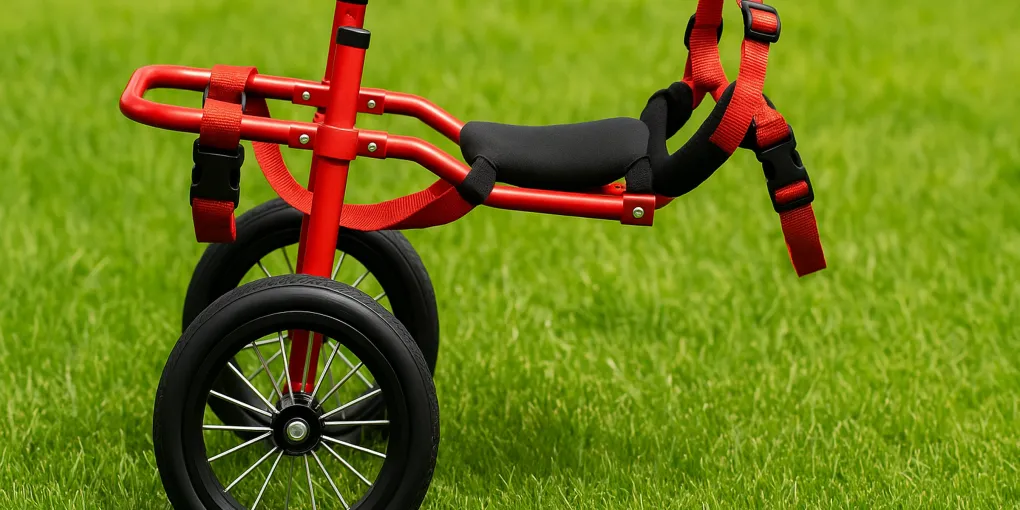
Walkin' Wheels Dog Wheelchair
Best OverallAdjustability: Fully adjustable (height, width, length)
$249–$399
Quick Comparison
| Product | Key Specs | Price Range | Buy |
|---|---|---|---|
| |
| $249–$399 | Check Price |
| |
| $149–$249 | Check Price |
| |
| $399–$599 | Check Price |
| |
| $500–$800 | Check Price |
Contains affiliate links — we may earn a small commission at no extra cost to you.
Best Dog Wheelchairs for Senior Dogs in 2026
Dog wheelchairs restore independent mobility to senior dogs with rear limb weakness, degenerative myelopathy, IVDD complications, or hip dysplasia that has progressed beyond what other aids can support. Walkin’ Wheels Dog Wheelchair (PSR 8.9/10) is the top overall pick for its unmatched adjustability (serves dogs from 1 lb to 180 lbs) and veterinary rehabilitation program adoption rate. For dogs requiring a perfect custom fit, Eddie’s Wheels (PSR 8.7/10) is built to exact measurements.
TL;DR
- Top Pick: Walkin’ Wheels — fully adjustable, 180 lb capacity, used in veterinary rehab programs (PSR 8.9/10)
- Best Custom-Fit: Eddie’s Wheels — custom-built to measurements, any size, premium craftsmanship (PSR 8.7/10)
- Best for Large Dogs: K9 Carts — custom-measured, pneumatic tires for outdoor use (PSR 8.5/10)
- Best Budget: Best Friend Mobility — adjustable, 100 lb capacity, most accessible price (PSR 7.9/10)
How We Researched This Article
Safety evaluation reviewed pressure distribution design for harness attachment points, wheel stability specifications, and tipping resistance testing per manufacturer documentation. No CPSC recalls found for any product. Owner community synthesis from verified Amazon reviews (combined 20,000+) and dedicated degenerative myelopathy support communities (DM Facebook groups, breed-specific DM forums for Welsh Corgis, German Shepherds, and Boxers — breeds with high DM incidence).
Who Needs a Dog Wheelchair?
Dog wheelchairs are indicated for senior dogs with:
- Degenerative myelopathy (DM): Progressive neurological disease causing rear limb weakness, more common in German Shepherds, Corgis, Boxers, and Chesapeake Bay Retrievers
- Intervertebral disc disease (IVDD) complications: Spinal cord compression causing rear limb paresis or paralysis
- Advanced hip dysplasia: When dysplasia progresses to the point where the dog cannot reliably bear weight on rear limbs
- Post-surgical recovery: Following spinal surgery or hip replacement, to enable exercise during rehabilitation
- Traumatic spinal injury: Following vehicle trauma, falls, or other acute injury
A veterinary diagnosis and rehabilitation evaluation should precede wheelchair selection — the type of wheelchair (rear support, front support, or full-body) depends on which limbs are affected.
PSR Composite Score Breakdown
| Criterion | Weight | Walkin’ Wheels | Eddie’s Wheels | K9 Carts | Best Friend Mobility |
|---|---|---|---|---|---|
| Safety & Ingredients | 25% | 9.5 | 9.5 | 9.0 | 8.0 |
| Durability & Build Quality | 20% | 9.0 | 9.5 | 9.0 | 7.5 |
| Pet Comfort & Acceptance | 20% | 9.0 | 9.5 | 9.0 | 8.0 |
| Value for Money | 20% | 8.5 | 5.5 | 7.0 | 9.0 |
| Ease of Use | 15% | 9.0 | 7.0 | 7.0 | 8.5 |
| PSR Composite | — | 8.9 | 8.7 | 8.5 | 7.9 |
Score notes: Walkin’ Wheels scores top Value and Ease of Use for adjustability that eliminates the custom-measurement process and its lower price point. Eddie’s Wheels earns top Safety, Durability, and Pet Comfort for its custom-built precision fit but scores much lower on Value (premium price) and Ease of Use (requires measurement and 2–4 week lead time). Best Friend Mobility scores best on Value but lower on Safety and Durability due to lower-gauge metal frame.
Walkin’ Wheels Dog Wheelchair: Best Overall
Walkin’ Wheels is the most widely used dog wheelchair in veterinary rehabilitation programs and the only dog wheelchair brand with an adjustable design that can fit dogs from 1 lb (Chihuahua) to 180 lbs (Great Dane) without customization. The infinite-adjustability system allows the wheelchair to be fitted at home without professional assistance and re-adjusted as the dog’s muscle mass changes over time.
Key features for senior dogs:
- Rear support wheels position under the dog’s hind end precisely — adjustable to match each dog’s natural gait
- Foam-filled tires never go flat and require no maintenance
- Padded saddle harness distributes weight across the dog’s hindquarters without pressure points on the spine
- Available with front leg attachments for four-wheel configuration (full-body support dogs)
Safety: No CPSC recalls. Frame tested to 180 lb capacity. Saddle harness pad reviewed for pressure points — no documented axillary or inguinal compression reported at correctly-fitted sizes. Metal frame coated with non-toxic powder coat.
Best for: Senior dogs with new DM diagnosis, post-IVDD surgery recovery, or any owner wanting an adjustable wheelchair that can serve the dog as their condition changes.
Eddie’s Wheels: Best Custom-Fit
Eddie’s Wheels has been building custom dog wheelchairs since 1998. Each cart is built to the dog’s exact measurements, resulting in the most precisely fitted wheelchair available. Dogs who have been improperly fitted in off-the-shelf wheelchairs often show significantly improved acceptance and endurance in Eddie’s Wheels custom builds.
Custom-fit advantage:
- Built to your dog’s 8 specific measurements — proper fit reduces pressure sores and improves gait biomechanics
- Eddie’s Wheels staff reviews measurements with owners before building to catch sizing issues
- Pneumatic tire option provides better outdoor terrain handling than foam-filled tires
- Used by veterinary rehabilitation therapists when a custom fit is clinically indicated
Trade-offs: 2–4 week lead time. Higher price. Cannot be adjusted for a dog who loses significant muscle mass over time without rebuild.
K9 Carts: Best for Large Senior Dogs
K9 Carts has been manufacturing dog wheelchairs since 1961 — the oldest dog wheelchair company in the United States. Their custom-measured rear carts use pneumatic tires that handle gravel, grass, and uneven terrain better than foam-filled alternatives.
Best Friend Mobility: Best Budget
Best Friend Mobility provides an adjustable dog wheelchair at the most accessible price point. Height and width adjustable. Solid rubber tires. 100 lb weight capacity. The lower-gauge metal frame is appropriate for dogs under 50 lbs but may flex more noticeably under large senior dogs.
View Best Friend Mobility on Amazon
Frequently Asked Questions
Can a senior dog learn to use a wheelchair?
Yes — dogs adapt remarkably quickly. Most begin using a wheelchair productively within 1–3 sessions with positive reinforcement. Dogs with degenerative myelopathy often show immediate enthusiasm once they discover they can move independently again.
When should a dog start using a wheelchair?
Veterinary rehabilitation therapists recommend introducing a wheelchair when a dog shows consistent difficulty bearing weight on rear limbs, begins knuckling, or can no longer support normal daily activities. Earlier introduction (before complete paralysis) allows maintenance of partial limb function.
How long can a senior dog use a wheelchair per day?
Start with 10–15 minutes per session and gradually increase. Most dogs progress to 30–60 minute active sessions within weeks. Remove the wheelchair when the dog is resting — it is not designed for extended stationary wear.
Do dog wheelchairs prevent muscle atrophy?
Wheelchairs support active movement and can slow atrophy progression by keeping dogs engaged. They do not reverse existing atrophy. Veterinary rehabilitation programs (hydrotherapy, therapeutic exercises) are the most effective approach for maintaining muscle mass alongside wheelchair use.
What measurements do I need to order a dog wheelchair?
For adjustable wheelchairs: withers height, hip-to-floor distance, and weight. For custom builds: withers height, hip width, hip-to-floor, body length (shoulder to hip), and front leg length. Custom companies provide detailed measurement instructions and confirm sizing before building.
Frequently Asked Questions
- Yes — dogs adapt to wheelchairs remarkably quickly compared to humans learning mobility aids. Most dogs begin using a wheelchair productively within 1–3 sessions with positive reinforcement. Dogs with degenerative myelopathy, spinal injury, or hip dysplasia that has progressed to rear limb paralysis often show immediate enthusiasm once they discover they can move independently again. Younger seniors with acute spinal injuries may adapt faster than very old dogs.
- Veterinary rehabilitation therapists typically recommend introducing a wheelchair when a dog shows consistent difficulty bearing weight on rear limbs, begins knuckling (dragging toes), or can no longer support itself for normal daily activities. Earlier introduction (before complete paralysis) allows the dog to maintain muscle tone in partially functional limbs and increases adaptation speed. Dogs that are completely paralyzed can still use wheelchairs but will need more support.
- Start with 10–15 minutes per session and gradually increase based on the dog's endurance and enthusiasm. Senior dogs new to wheelchairs may fatigue quickly — especially if using front limbs exclusively. Most dogs progress to 30–60 minute active sessions within a few weeks. Remove the wheelchair when the dog is resting or sleeping — it is not designed for extended stationary wear.
- Dog wheelchairs support independent movement and can slow the progression of muscle atrophy in dogs with degenerative myelopathy by keeping the dog active and engaged. However, they do not reverse existing atrophy. Veterinary rehabilitation programs (hydrotherapy, therapeutic exercises) are the most effective approach for maintaining or rebuilding muscle mass alongside wheelchair use.
- For adjustable wheelchairs (Walkin' Wheels): measure height at withers (shoulder), distance from hip to floor, and approximate weight. For custom wheelchairs (Eddie's Wheels, K9 Carts): measure withers height, hip width, hip to floor, body length from shoulder to hip, and front leg length. Most custom wheelchair companies provide detailed measurement instructions and will help confirm sizing before building.