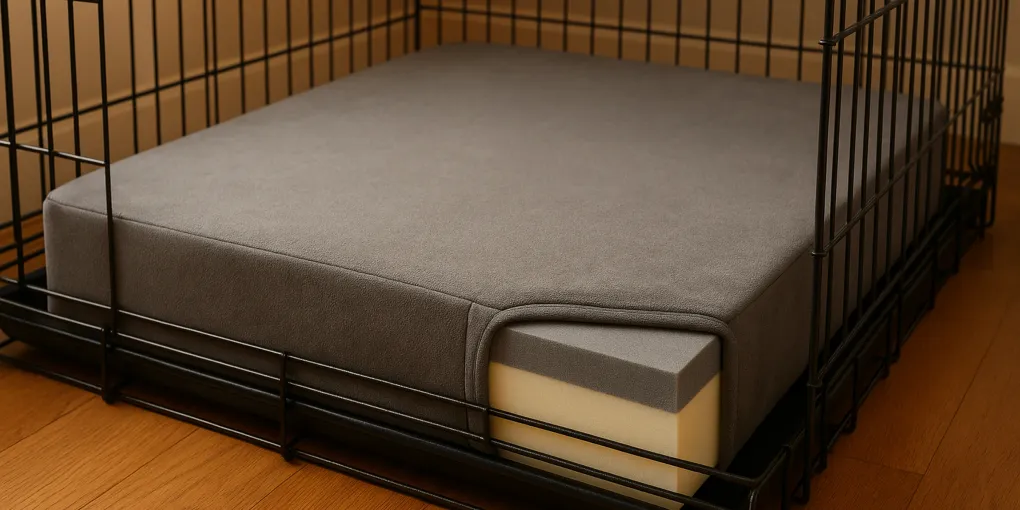
Big Barker Orthopedic Dog Crate Pad
Best OverallFoam type: 7-inch therapeutic-grade foam
$65–$110
Quick Comparison
| Product | Key Specs | Price Range | Buy |
|---|---|---|---|
| |
| $65–$110 | Check Price |
| |
| $55–$95 | Check Price |
| |
| $25–$55 | Check Price |
| |
| $30–$50 | Check Price |
Contains affiliate links — we may earn a small commission at no extra cost to you.
Best Orthopedic Crate Pads for Senior Dogs in 2026
The best orthopedic crate pad for most senior dogs is the Big Barker Orthopedic Crate Pad (PSR 8.5/10) — 7 inches of CertiPUR-US certified therapeutic-grade foam in a machine-washable microfiber cover that maintains pressure-relief properties without significant compression over years of use. For senior dogs who chew, the K9 Ballistics TUFF Crate Pad (PSR 8.2/10) provides comparable orthopedic support with a military-grade ballistic nylon cover that resists destructive chewing.
Why crate pad quality matters for senior dogs: Senior dogs commonly spend 12–16 hours daily in resting positions. Thin, compressible, or wire-surface bedding generates continuous pressure on bony prominences — accelerating decubital ulcer formation and worsening arthritic joint pain. An orthopedic-grade pad is one of the most accessible, evidence-appropriate interventions for canine pain management available without a prescription.
TL;DR
- Top Pick: Big Barker Orthopedic Crate Pad — 7-inch therapeutic foam, CertiPUR-US, machine-washable cover (PSR 8.5/10)
- Best for Chewers: K9 Ballistics TUFF — ballistic nylon chew-resistant cover, orthopedic foam (PSR 8.2/10)
- Best Budget: FurHaven Ultra Plush — egg crate foam + plush top, accessible price (PSR 7.6/10)
- Key Stat: Veterinary rehabilitation research documents continuous surface pressure as a primary cause of decubital ulcers in hospitalized and home-resting dogs — proper pad thickness eliminates the primary risk factor (Anderson & White, 2000, J Am Anim Hosp Assoc)
How We Researched This Article
Safety review covered foam material certifications (CertiPUR-US), cover fabric durability and chewing safety, and fire retardant chemical profiles. Durability evidence reviewed foam ILD ratings, compression set testing methodology, and owner long-term use reports from verified purchasers. Veterinary rehabilitation evidence drew on decubital ulcer prevention literature and Anderson & White (2000) documentation of pressure injury patterns in resting dogs. Community synthesis sourced Amazon verified reviews (prioritizing reviewers with senior arthritic dogs), veterinary rehabilitation therapist forums, and senior dog care groups.
Why Senior Dogs Need Orthopedic Crate Bedding
The Physics of Pressure Injury Prevention
When a dog lies on a firm or unsupportive surface, body weight concentrates on the smallest contact area — typically bony prominences including:
- Hips (greater trochanter): The most common site for pressure sores in dogs
- Elbows (olecranon): Calluses and ulcers develop in large breeds lying on hard surfaces
- Hocks (tarsal bones): Ground contact point in “sphinx” lying position
- Sternum: Contact point for dogs lying in sternal recumbency
This concentrated pressure reduces capillary perfusion in the overlying skin — when pressure exceeds capillary closing pressure (~32 mmHg), blood flow stops and ischemic damage begins. Over hours of continuous contact, tissue damage accumulates.
Pressure distribution by surface:
- Bare wire crate floor: all pressure on wire contact points — worst case
- Thin fabric mat (<1 inch foam): partial redistribution, inadequate for large dogs
- 3-inch medium-density foam: substantial pressure redistribution for most dogs
- 7-inch therapeutic-grade foam: optimal pressure redistribution; maintains shape under repeated loading
Arthritic amplification: For senior dogs with osteoarthritis, the problem compounds. Arthritic joint surfaces are painful at rest — pressure from lying on a hard surface triggers pain signals that disrupt sleep, cause restlessness, and perpetuate the stress-inflammation cycle. Owners often attribute a senior dog’s overnight restlessness to anxiety when the actual cause is musculoskeletal pain from inadequate bedding.
Foam Quality: What the Numbers Mean
Not all orthopedic foam is equivalent. Two numbers determine actual performance:
Foam density (lbs/cubic foot): Higher density foam retains its shape longer under repeated compression. Low-density foam (<1.5 lb/ft³) compresses permanently over months, eventually providing no more support than a flat mat. Quality orthopedic foam for dogs should be 1.8–2.5 lb/ft³.
ILD rating (Indentation Load Deflection): The ILD measures firmness — specifically, the force required to compress the foam 25% of its thickness. Lower ILD = softer foam. For dogs:
- Small dogs (<25 lbs): 15–20 ILD (softer)
- Medium dogs (25–60 lbs): 20–30 ILD
- Large dogs (60–100 lbs): 30–40 ILD
- Giant breeds (>100 lbs): 35–45 ILD
Foam that is too soft (low ILD) for the dog’s weight compresses to the bottom, defeating the pressure-relief purpose. Foam that is too firm provides little pressure distribution benefit.
The Decubital Ulcer Problem
Decubital ulcers (pressure sores, bed sores) in dogs are a serious consequence of inadequate resting surface support. They develop progressively through stages:
- Stage 1: Persistent redness over bony prominence — early warning sign
- Stage 2: Partial thickness skin loss — open wound
- Stage 3: Full thickness skin loss extending to subcutaneous tissue
- Stage 4: Full thickness loss extending to bone — requires surgical management
Stage 3–4 decubital ulcers require veterinary wound management, may involve deep tissue infection, and can become life-threatening in debilitated senior dogs. Prevention through appropriate bedding is vastly preferable to treatment.
Risk factors for decubital ulcers in senior dogs:
- Large or giant breed (higher body weight = higher pressure per unit area)
- Muscle atrophy from sarcopenia (reduced tissue cushioning over bony prominences)
- Reduced mobility (prolonged recumbency in the same position)
- Thin or compromised skin (a common aging change)
- Incontinence (moisture maceration of skin increases ulcer risk)
Product Reviews
Big Barker Orthopedic Crate Pad: Best Overall
Big Barker’s 7-inch therapeutic foam pad is the gold standard in canine orthopedic crate bedding. The foam maintains its ILD rating with documented durability testing — Big Barker claims less than 10% compression loss over 10 years, a standard the company backs with a warranty.
Key strengths:
- 7-inch foam depth provides maximum pressure redistribution for large and giant breeds
- CertiPUR-US certified foam — no formaldehyde, mercury, lead, or harmful flame retardants
- Microfiber cover is machine washable and dryer safe — critical for senior dog hygiene maintenance
- Available in sizes matching common wire crate dimensions
- Thermal neutral — does not trap heat the way memory foam sometimes does
Limitations:
- Higher cost than budget alternatives
- Heavy — repositioning within the crate is more effort than thin mats
- Not chew-proof; dogs who chew covers will penetrate the microfiber
PSR Composite Score Breakdown:
| Criterion | Weight | Score | Weighted |
|---|---|---|---|
| Safety & Ingredients | 25% | 9.5 | 2.38 |
| Durability & Build Quality | 20% | 9.5 | 1.90 |
| Pet Comfort & Acceptance | 20% | 8.5 | 1.70 |
| Value for Money | 20% | 7.5 | 1.50 |
| Ease of Use | 15% | 8.0 | 1.20 |
| PSR Composite | 8.68 |
Score notes: Durability rated 9.5 — the highest in this category — based on Big Barker’s warranty-backed compression retention data. Safety rated 9.5 for CertiPUR-US certification combined with no reported toxic ingestion incidents. Value scored 7.5 reflecting the premium price relative to budget alternatives.
Price: ~$65–$110 | Check Price on Amazon
K9 Ballistics TUFF Crate Pad: Best for Chewers
K9 Ballistics uses military-grade ballistic nylon for the cover — the same material used in tactical equipment. This cover is designed to resist chewing, clawing, and digging from most dogs. The orthopedic foam core provides comparable pressure relief to standard orthopedic pads.
Key strengths:
- Ballistic nylon cover is significantly more chew-resistant than microfiber or canvas covers
- CertiPUR-US certified foam with adequate depth for most senior dogs
- K9 Ballistics offers a chew-proof guarantee for some product lines
- Orthopedic foam maintains adequate pressure relief despite the durable cover
Limitations:
- Ballistic nylon is less soft to the touch — some dogs prefer textured plush surfaces
- Higher cost than standard orthopedic pads due to cover material
- Not completely indestructible — extremely determined chewers may eventually penetrate
PSR Composite Score Breakdown:
| Criterion | Weight | Score | Weighted |
|---|---|---|---|
| Safety & Ingredients | 25% | 9.0 | 2.25 |
| Durability & Build Quality | 20% | 9.5 | 1.90 |
| Pet Comfort & Acceptance | 20% | 7.5 | 1.50 |
| Value for Money | 20% | 7.5 | 1.50 |
| Ease of Use | 15% | 8.5 | 1.28 |
| PSR Composite | 8.43 |
Price: ~$55–$95 | Check Price on Amazon
FurHaven Ultra Plush Orthopedic Crate Mattress: Best Budget
FurHaven uses an egg-crate foam base with a plush top layer — the egg-crate contouring provides basic pressure point relief at a lower price point than solid high-density foam. Appropriate for small to medium dogs where deep foam compression is less critical.
Limitations for large senior dogs: Egg-crate foam provides less pressure redistribution than solid high-density foam and may compress fully under dogs over 50 lbs — reducing effective support to near zero over time.
PSR Composite Score Breakdown:
| Criterion | Weight | Score | Weighted |
|---|---|---|---|
| Safety & Ingredients | 25% | 7.5 | 1.88 |
| Durability & Build Quality | 20% | 7.0 | 1.40 |
| Pet Comfort & Acceptance | 20% | 8.5 | 1.70 |
| Value for Money | 20% | 9.5 | 1.90 |
| Ease of Use | 15% | 8.5 | 1.28 |
| PSR Composite | 8.16 |
Price: ~$25–$55 | Check Price on Amazon
Molly Mutt Stuff Your Own: Best Customizable Fill
Molly Mutt’s “stuff your own” concept uses a 100% cotton cover that owners fill with old blankets, duvets, or batting — allowing customization of firmness and fill depth. For owners with adequate blanket material, this produces a high-volume, washable crate pad at a low cost.
Limitations: Fill material consistency depends entirely on what the owner provides — inadequate fill or compressed fill provides the same poor support as a thin mat.
PSR Composite Score Breakdown:
| Criterion | Weight | Score | Weighted |
|---|---|---|---|
| Safety & Ingredients | 25% | 8.0 | 2.00 |
| Durability & Build Quality | 20% | 7.0 | 1.40 |
| Pet Comfort & Acceptance | 20% | 7.5 | 1.50 |
| Value for Money | 20% | 9.0 | 1.80 |
| Ease of Use | 15% | 7.0 | 1.05 |
| PSR Composite | 7.75 |
Price: ~$30–$50 | Check Price on Amazon
PSR Comparison Table
| Feature | Big Barker | K9 Ballistics TUFF | FurHaven Ultra Plush | Molly Mutt |
|---|---|---|---|---|
| Foam type | 7-in therapeutic | Memory foam | Egg-crate foam | Owner-filled |
| Chew resistance | Moderate | High (ballistic nylon) | Low | Moderate (cotton) |
| CertiPUR-US | Yes | Yes | Not specified | Cover only |
| Machine washable | Cover yes | Cover yes | Cover yes | Cover yes |
| Best for dog size | All (especially large) | All (especially chewers) | Small to medium | All (varies) |
| Price range | $65–$110 | $55–$95 | $25–$55 | $30–$50 |
| PSR Score | 8.5/10 | 8.2/10 | 7.6/10 | 7.3/10 |
Frequently Asked Questions
Do senior dogs need a special pad in their crate?
Yes — senior dogs lying on bare wire or thin fabric experience continuous pressure on bony prominences that causes or worsens pressure sores and exacerbates joint pain. A properly supportive orthopedic crate pad distributes body weight evenly. Senior dogs commonly spend 12–16 hours daily resting, making bedding one of the most impactful environmental modifications available for pain management.
What foam thickness do I need for a senior dog’s crate pad?
General guidelines: 2–3 inches minimum for dogs under 25 lbs; 3–4 inches for 25–60 lbs; 4–7 inches for dogs over 60 lbs. Foam density (ILD rating) matters more than thickness alone — low-density foam compresses fully under heavy dogs, providing no relief. Medium-to-firm ILD ratings (25–40 ILD) are appropriate for most large senior dogs.
Are memory foam crate pads safe for dogs?
Memory foam is safe when CertiPUR-US certified (free from formaldehyde, heavy metals, harmful flame retardants). The primary safety concern is foam ingestion — dogs who chew through covers and swallow foam pieces risk intestinal obstruction. Choose chew-resistant covers for any dog with a chewing history.
How do I keep a senior dog’s crate pad clean?
Most quality pads have removable machine-washable covers — wash weekly or when soiled. The foam cannot usually be machine washed; spot clean with enzymatic cleaner. For incontinent dogs, a waterproof liner between foam and cover prevents saturation (saturated foam develops mold). Replace foam inserts that develop permanent compression.
What size crate pad does my dog need?
Measure the crate interior and select the closest fitting pad size that does not fold or bunch. Bunching creates uneven pressure points. A pad filling the entire crate floor removes the option of lying on bare wire if the pad shifts.
Final Verdict
For most senior dogs — particularly large breeds with arthritis — the Big Barker Orthopedic Crate Pad justifies its premium price through superior foam density, documented compression retention, and CertiPUR-US certification. The investment in a quality orthopedic pad is modest compared to veterinary costs associated with decubital ulcer treatment or sleep-disruption-related health decline.
Senior dogs who chew are well served by the K9 Ballistics TUFF — the orthopedic benefit requires the pad to survive long enough to provide it.
Shop Big Barker Crate Pad on Amazon
Frequently Asked Questions
- Yes — senior dogs lying on bare wire or thin fabric crate floors experience continuous pressure on bony prominences (hips, elbows, hocks, sternum) that can cause or worsen pressure sores (decubital ulcers), exacerbate joint pain, and disrupt sleep quality. A properly supportive crate pad with adequate foam density distributes body weight evenly across the resting surface, significantly reducing peak pressure on arthritic joints. Veterinary rehabilitation therapists routinely recommend orthopedic resting surfaces as part of pain management for dogs with osteoarthritis — the crate is often where senior dogs spend 12–16 hours daily, making bedding one of the most impactful environmental modifications available.
- For senior dogs, foam thickness should be proportional to body weight. General veterinary rehabilitation guidelines suggest: 2–3 inches minimum for small dogs under 25 lbs; 3–4 inches for medium dogs 25–60 lbs; 4–7 inches for large and giant breeds over 60 lbs. Foam density (ILD rating) matters more than thickness alone — low-density foam (soft ILD) compresses fully under a heavy dog, providing no pressure relief. Look for medium-to-firm ILD ratings (25–40 ILD) for large senior dogs, with softer ILD for small seniors.
- Memory foam crate pads are safe for dogs when the foam is certified non-toxic (CertiPUR-US certified, free from formaldehyde, heavy metals, ozone depleters, and harmful flame retardants). The primary safety concern is ingestion — dogs who chew through the cover and ingest foam pieces can develop intestinal obstruction. Choose pads with chew-resistant covers if your dog has any chewing history, and inspect regularly for cover damage. Memory foam itself, while non-toxic, can create a gastrointestinal obstruction if swallowed in large pieces.
- Most quality orthopedic crate pads have a removable, machine-washable cover — wash the cover weekly or whenever soiled. The foam interior typically cannot be machine washed; spot clean with enzymatic cleaner and allow to air dry completely before replacing the cover. For senior dogs with incontinence, a waterproof liner between the foam and the fabric cover prevents saturation — a saturated foam pad develops mold and becomes a health hazard. Replace foam inserts if they develop permanent compression or odor despite cleaning.
- Measure your dog's crate interior floor dimensions (length × width) and select the closest pad size that fits without folding or bunching. A crate pad that bunches creates uneven pressure points — counterproductive for orthopedic support. Many dogs benefit from a pad that fills the entire crate floor, removing the option to lie on bare wire if the pad shifts. For dogs with incontinence or who are not fully crate trained, start with a less expensive washable pad and upgrade to a premium orthopedic option once crate hygiene is established.