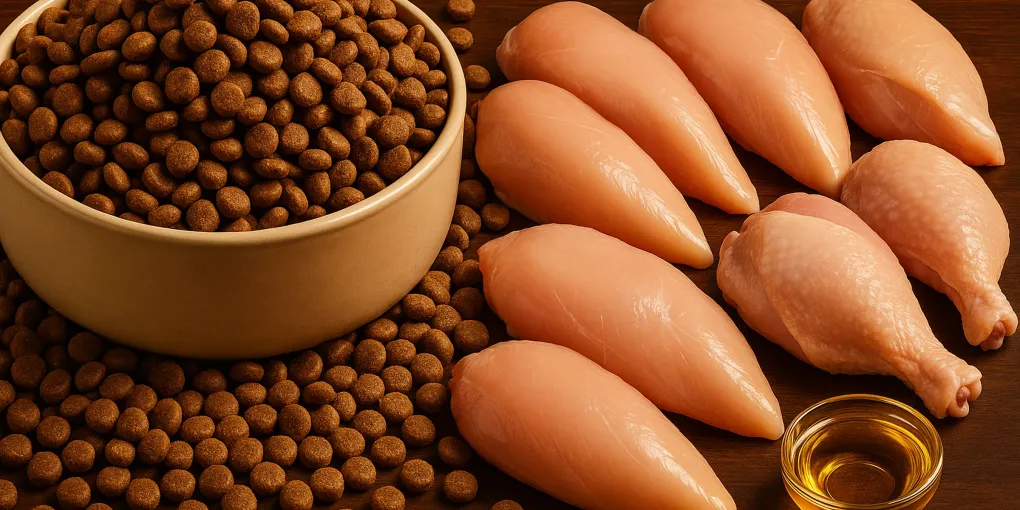
Purina Pro Plan Sport 30/20 All Life Stages
Best OverallAAFCO statement: Complete and balanced for all life stages including large breed puppies
$70–$95 (37.5 lb)
Quick Comparison
| Product | Key Specs | Price Range | Buy |
|---|---|---|---|
| |
| $70–$95 (37.5 lb) | Check Price |
| |
| $65–$85 (30 lb) | Check Price |
| |
| $60–$85 (27.5 lb) | Check Price |
| |
| $65–$90 (30 lb) | Check Price |
Contains affiliate links — we may earn a small commission at no extra cost to you.
Best Dog Food for Active and Working Dogs in 2026
The best dog food for active and working dogs is Purina Pro Plan Sport 30/20 (PSR 8.8/10), which provides exactly the 30% protein and 20% fat profile recommended by veterinary sports nutrition guidelines for sustained aerobic working dogs, with AAFCO all-life-stages certification and an excellent safety record. For moderately active adult dogs who don’t need the full 30/20 profile, Hill’s Science Diet Active Longevity (PSR 8.0/10) provides a feeding trial-certified option at a lower caloric density.
TL;DR
- Best Overall: Purina Pro Plan Sport 30/20 — 30% protein, 20% fat, all-life-stages AAFCO, clean recall history (PSR 8.8/10)
- Best for Field/Sprint Athletes: Eukanuba Premium Performance 30/20 — DHA-enriched, documented sled/field dog use, clean record (PSR 8.3/10)
- Best for Moderately Active: Hill’s Science Diet Active Longevity — feeding trial AAFCO, antioxidants, lower caloric density (PSR 8.0/10)
- Best Breed-Size Formula: Royal Canin Active Life Medium — size-optimized kibble, L-carnitine, no recalls (PSR 7.9/10)
- Key Stat: Dogs performing moderate-intensity exercise for 1–3 hours/day may require 1.6–2.0× resting energy requirement; highly active: 2.0–3.0× RER (NRC, 2006)
Active and working dogs have fundamentally different nutritional requirements than companion dogs of average activity. The standard adult maintenance diet — designed for a dog getting a 30-minute walk twice daily — will leave a daily jogger’s dog underfed and a sled dog seriously calorie-deficient. Getting the macronutrient balance right is the foundation of supporting sustained performance.
What Do Active Dogs Actually Need?
The NRC (2006) documents energy requirements that scale meaningfully with activity intensity. A moderately active dog (1–3 hours of work or exercise daily) may require 1.6–2.0× their resting energy requirement. Dogs performing intense sustained work (herding, sled pulling, field trials, police and military work) can require 2.0–3.0× RER — equivalent to needing nearly twice the caloric intake of a sedentary companion dog of the same size.
The preferred energy substrate for sustained aerobic work is dietary fat, not carbohydrate. Reynolds et al. (1994, Journal of Applied Physiology, DOI: 10.1152/jappl.1994.79.5.1601) demonstrated that sled dogs trained on high-fat diets showed superior muscle glycogen sparing and endurance performance compared to dogs on high-carbohydrate diets — a fundamental finding for canine performance nutrition.
Protein requirements for working dogs are substantially higher than maintenance minimums. Toll et al. (2010, Veterinary Clinics of North America, DOI: 10.1016/j.cvsm.2010.01.002) recommend 28–32% crude protein (DM basis) for dogs performing sustained aerobic work. Wakshlag et al. (2002, PMID: 12434534) documented that post-exercise protein intake within 30–60 minutes is critical for muscle protein synthesis and lean mass maintenance.
Antioxidant requirements also increase with exercise intensity. Increased oxygen consumption during work generates reactive oxygen species (free radicals) that damage cell membranes and muscle tissue. Toll et al. (2010) recommend elevated vitamin E (above maintenance levels) for working dogs to mitigate exercise-induced oxidative stress.
Purina Pro Plan Sport 30/20 All Life Stages Review: Best Overall
Purina Pro Plan Sport 30/20 is the reference formula for working and sporting dog nutrition. The 30% protein, 20% fat profile precisely matches the veterinary nutrition guideline targets for sustained aerobic work. Its AAFCO all-life-stages certification provides flexibility for growing working dog breeds and adult athletes alike.
Key specifications:
- Primary protein: Real chicken (first ingredient)
- Protein: 30% min, Fat: 20% min
- AAFCO: All life stages including large breed puppies — feeding trial substantiated
- EPA/DHA from omega-3-rich fish for joint support
- Elevated vitamin E for antioxidant support during exercise
- Live Lactobacillus probiotic
Working dog community endorsement: Pro Plan Sport is widely used by field trial dog handlers, competitive sled dog mushers, K9 police and military units, and hunting dog owners. This represents meaningful real-world validation beyond controlled feeding trials.
Palatability: Pro Plan Sport 30/20 is routinely cited by working dog handlers for its high voluntary intake — important in working dogs that need to maintain caloric consumption despite the appetite suppression that can accompany sustained physical stress.
Safety record: No significant recalls on the current Sport 30/20 formula.
Pros:
- 30% protein, 20% fat — exactly the recommended performance profile
- AAFCO all-life-stages feeding trial
- Live probiotic and EPA/DHA from fish
- Elevated vitamin E for oxidative support
- No significant recalls
- Strong working dog community track record
Cons:
- Includes corn — not grain-free
- Too calorically dense for sedentary or overweight dogs
- Not appropriate as a primary food for performance dogs at rest periods without portion adjustment
Cost: $70–$95 for a 37.5 lb bag; approximately $0.10–$0.13/oz
Eukanuba Premium Performance 30/20 Sport Review: Best for Field and Sprint Athletes
Eukanuba Premium Performance is specifically designed for high-intensity athletic dogs — field trial dogs, hunting breeds, and sprint athletes. Like Pro Plan Sport, it provides a 30% protein, 20% fat profile, but adds DHA specifically for muscle function support and recovery.
Key specifications:
- Primary protein: Chicken (first ingredient)
- Protein: 30% min, Fat: 20% min
- AAFCO: Complete and balanced for adult maintenance
- DHA from fish oil for muscle function and neural support
- Fermentable fibers for digestive health under physical stress
- Research use history in sled and field dogs (published in veterinary nutrition journals)
Sport-specific design: Eukanuba’s performance formula has a documented research history in sled dog and field trial dog studies, including the Reynolds et al. (1994) study that established the fat-adaptation advantage for endurance dogs. The DHA inclusion at documented levels for muscle function is specific to Eukanuba’s performance positioning.
Adult maintenance AAFCO note: Unlike Pro Plan Sport (all life stages), Eukanuba Performance is adult maintenance — not suitable as the sole diet for puppies. This is the one certification gap vs Pro Plan Sport.
Safety record: No significant recalls on current formula.
Pros:
- 30% protein, 20% fat performance profile
- DHA for muscle function and neural support
- Research history with sled and field dogs
- Clean recall record
- Competitive pricing vs Pro Plan Sport
Cons:
- Adult maintenance only (not all-life-stages)
- Contains corn and poultry by-product meal
- Less widely available than Purina Pro Plan Sport
- No live probiotic
Cost: $65–$85 for a 30 lb bag; approximately $0.12–$0.15/oz
Hill’s Science Diet Active Longevity Review: Best for Moderately Active Dogs
Hill’s Science Diet Active Longevity targets moderately active adult dogs — those who are regularly active but not performing sustained intense work. The formula provides enhanced protein and antioxidants without the full caloric density of performance-specific 30/20 formulas.
Key specifications:
- Primary protein: Chicken meal (first ingredient)
- Protein: 22% min, Fat: 14% min
- AAFCO: Feeding trial substantiated for adult maintenance
- Antioxidant blend (vitamin E, C, beta-carotene)
- Controlled caloric density for maintaining healthy weight
- Supports muscle and joint health
Positioning: Active Longevity fills the gap between standard adult maintenance and full sport formulas. It is appropriate for dogs who run, hike, or work moderately — but not dogs performing sustained intense aerobic work requiring the full 30/20 macronutrient profile.
Feeding trial AAFCO: Among active formulas, Hill’s is distinctive for its feeding trial AAFCO substantiation — providing higher confidence in real-world nutritional completeness compared to profile-only certifications.
Safety record: 2019 recall for vitamin D excess (resolved; different product line). No Active formula recalls.
Pros:
- Feeding trial AAFCO substantiation
- Antioxidant blend for exercise-related oxidative support
- Moderate caloric density — appropriate for everyday active dogs
- Board-certified veterinary nutritionist formulated
- Most vet-recommended brand overall
Cons:
- Lower protein and fat than full sport formulas — not adequate for intense working dogs
- 2019 recall history (different formula, resolved)
- Chicken meal (not fresh chicken) as first ingredient
- Higher price per lb than Purina Pro Plan Sport
Cost: $60–$85 for a 27.5 lb bag; approximately $0.13–$0.16/oz
Royal Canin Active Life Medium Adult Review: Best Breed-Size Active Formula
Royal Canin’s Active Life formula provides size-specific kibble and nutrient optimization for medium-breed active adult dogs. L-carnitine supports fat metabolism, and the energy density balances active lifestyle needs with weight maintenance.
Key specifications:
- Primary proteins: Chicken by-product meal, pork meal, corn
- Protein: 27% min, Fat: 16% min
- AAFCO: Complete and balanced for adult maintenance
- L-carnitine for fat oxidation efficiency
- Prebiotics for digestive health during activity
- Size-specific kibble for medium-breed jaw mechanics
L-carnitine advantage: L-carnitine facilitates the transport of fatty acids into mitochondria for oxidation — supporting fat as an energy substrate during aerobic work. This is particularly relevant for medium-breed active dogs where fat oxidation is the preferred sustained-energy pathway.
Safety record: No significant recalls on Royal Canin Active Life formulas.
Pros:
- L-carnitine for fat metabolism support
- Size-specific kibble design
- Prebiotics for gut health under activity
- No significant recalls
- Structured Royal Canin quality control
Cons:
- Chicken by-product meal and corn as primary ingredients
- Lower protein (27%) and fat (16%) than full sport formulas
- Premium pricing relative to protein content
- Not ideal for dogs requiring peak athletic performance
Cost: $65–$90 for a 30 lb bag; approximately $0.13–$0.16/oz
PSR Composite Score Breakdown
| Criterion | Weight | Purina Sport 30/20 | Eukanuba Performance | Hill’s Active Longevity | Royal Canin Active Life |
|---|---|---|---|---|---|
| Safety & Ingredients | 25% | 9.0 | 9.0 | 8.5 | 8.5 |
| Durability & Build Quality | 20% | 8.5 | 8.5 | 8.5 | 8.5 |
| Pet Comfort & Acceptance | 20% | 9.5 | 8.5 | 8.0 | 8.0 |
| Value for Money | 20% | 9.0 | 8.5 | 7.5 | 7.5 |
| Ease of Use | 15% | 8.5 | 8.0 | 8.5 | 8.0 |
| PSR Composite | — | 8.8 | 8.3 | 8.0 | 7.9 |
Score notes: Purina Pro Plan Sport 30/20 earns the highest composite score for its clean recall history, all-life-stages AAFCO feeding trial status, and exceptional palatability and working dog community endorsement. Eukanuba earns a strong Safety score for its research history with working dogs. Hill’s earns its feeding trial status but loses Pet Comfort and Value points relative to the performance formulas. Royal Canin Active Life’s premium pricing and lower macronutrient levels for the active category reduce its composite.
Frequently Asked Questions
How much protein does an active dog need?
Toll et al. (2010, Veterinary Clinics of North America) recommend 28–32% crude protein (DM basis) for dogs performing sustained aerobic work, and 18–22% fat (DM) as the primary energy substrate. The NRC (2006) documents that working dogs performing moderate-intensity exercise for 1–3 hours/day may require 1.6–2.0× their resting energy requirement. Purina Pro Plan Sport 30/20 and Eukanuba Premium Performance both meet these protein and fat targets at AAFCO-compliant levels.
Should working dogs eat grain-free food?
Grain-free food is not required for working dogs and may introduce unnecessary risk. The FDA has investigated a potential association between grain-free diets high in legumes and dilated cardiomyopathy (DCM) in dogs — the investigation is ongoing. The performance formulas from Purina (Pro Plan Sport), Eukanuba, Hill’s, and Royal Canin all use grain-inclusive recipes, which are appropriate for working dogs and avoid this concern.
How do I feed a working dog before and after exercise?
Working dogs should not eat a full meal immediately before vigorous exercise — feeding 2–3 hours before work allows for proper digestion. Post-exercise, provide a full meal within 30–60 minutes to support glycogen repletion and muscle protein synthesis (Wakshlag et al., 2002, Veterinary Therapeutics). For dogs performing multiple daily work sessions, split feeding into two smaller meals (morning and evening) rather than one large meal.
What is the difference between maintenance and performance dog food?
Maintenance formulas are designed for adult dogs with average activity levels — typically 1.0–1.4× resting energy requirement. Performance or sport formulas provide higher protein (28–32% vs 18–22%), higher fat (18–22% vs 12–14%), and sometimes higher vitamin E for oxidative stress from exercise. Using a performance formula for an inactive dog will cause weight gain. Using a maintenance formula for a highly active working dog will result in inadequate caloric and protein intake.
Is Purina Pro Plan Sport good for dogs?
Purina Pro Plan Sport is among the most widely recommended performance dog foods by working dog handlers, sled dog mushers, and sporting dog field trainers. The 30/20 formula (30% protein, 20% fat) meets the macronutrient targets for sustained aerobic work established by Toll et al. (2010). It uses chicken as the first ingredient, is AAFCO feeding trial substantiated across all life stages, and has no significant recalls on its current Sport formula.
Bottom Line: Best Dog Food for Active Dogs
Purina Pro Plan Sport 30/20 (PSR 8.8/10) is the best dog food for active and working dogs. Its 30/20 protein-to-fat ratio, AAFCO all-life-stages feeding trial, live probiotic, elevated EPA/DHA, and working dog community track record make it the strongest choice across the performance category. Eukanuba Premium Performance 30/20 (PSR 8.3/10) is a close second — particularly for sprint and field dog athletes. Hill’s Science Diet Active Longevity (PSR 8.0/10) is the appropriate choice for moderately active companion dogs rather than true working athletes.
Match the food to the actual activity level: feeding performance-density food to an occasional runner will cause weight gain, just as maintenance food will leave a daily working dog in caloric deficit.
Frequently Asked Questions
- Toll et al. (2010, Veterinary Clinics of North America) recommend 28–32% crude protein (DM basis) for dogs performing sustained aerobic work, and 18–22% fat (DM) as the primary energy substrate. The NRC (2006) documents that working dogs performing moderate-intensity exercise for 1–3 hours/day may require 1.6–2.0× their resting energy requirement. Purina Pro Plan Sport 30/20 and Eukanuba Premium Performance both meet these protein and fat targets at AAFCO-compliant levels.
- Grain-free food is not required for working dogs and may introduce unnecessary risk. The FDA has investigated a potential association between grain-free diets high in legumes and dilated cardiomyopathy (DCM) in dogs — the investigation is ongoing. The performance formulas from Purina (Pro Plan Sport), Eukanuba, Hill's, and Royal Canin all use grain-inclusive recipes, which are appropriate for working dogs and avoid this concern.
- Working dogs should not eat a full meal immediately before vigorous exercise — feeding 2–3 hours before work allows for proper digestion. Post-exercise, provide a full meal within 30–60 minutes to support glycogen repletion and muscle protein synthesis (Wakshlag et al., 2002, Veterinary Therapeutics). For dogs performing multiple daily work sessions, split feeding into two smaller meals (morning and evening) rather than one large meal.
- Maintenance formulas are designed for adult dogs with average activity levels — typically 1.0–1.4× resting energy requirement. Performance or sport formulas provide higher protein (28–32% vs 18–22%), higher fat (18–22% vs 12–14%), and sometimes higher vitamin E for oxidative stress from exercise. Using a performance formula for an inactive dog will cause weight gain. Using a maintenance formula for a highly active working dog will result in inadequate caloric and protein intake.
- Purina Pro Plan Sport is among the most widely recommended performance dog foods by working dog handlers, sled dog mushers, and sporting dog field trainers. The 30/20 formula (30% protein, 20% fat) meets the macronutrient targets for sustained aerobic work established by Toll et al. (2010). It uses chicken as the first ingredient, is AAFCO feeding trial substantiated across all life stages, and has no significant recalls on its current Sport formula.