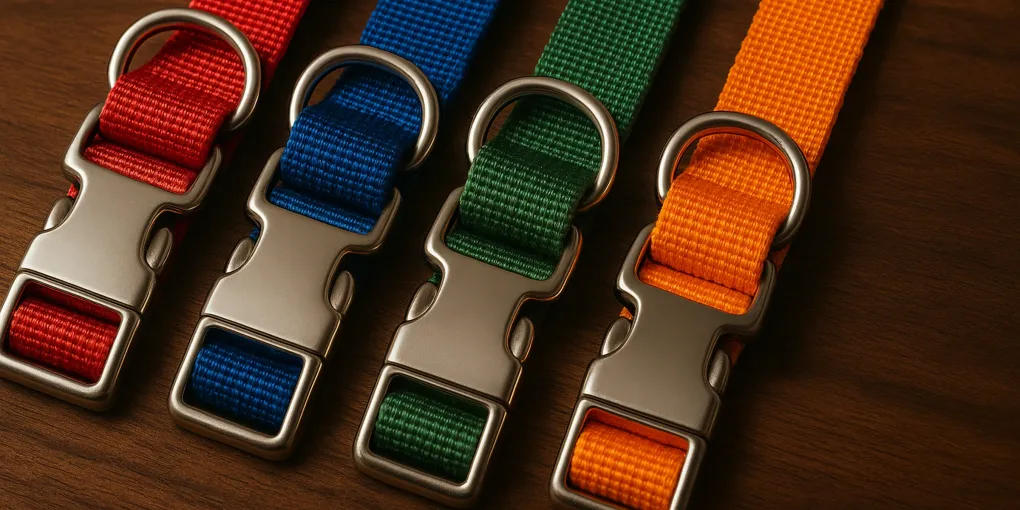
Best Dog Collar in 2026: Top Picks for Safety, Comfort, and Durability
Buyer's GuideRuffwear Front Range Dog Collar
Best OverallSize Range: XXS–XL (8–33 in neck)
$34.95–$39.95
Quick Comparison
| Product | Key Specs | Price Range | Buy |
|---|---|---|---|
| |
| $34.95–$39.95 | Check Price |
| |
| $39.00–$49.00 | Check Price |
| |
| $8.99–$14.99 | Check Price |
| |
| $14.95–$19.95 | Check Price |
Contains affiliate links — we may earn a small commission at no extra cost to you.
Best Dog Collar in 2026: Top Picks for Safety, Comfort, and Durability
The best dog collar for most dogs is the Ruffwear Front Range Dog Collar (PSR 4.7/5) — it combines bomber-grade nylon webbing, an aluminum V-ring that won’t corrode, a quick-release aluminum buckle, and an ID tag slot that keeps your contact information accessible without tag jingle. It’s machine washable, available in sizes from XXS to XL, and has accumulated thousands of verified purchaser reviews confirming durability through years of daily use. For owners who want embedded contact information without a separate tag, the Orvis Personalized Dog Collar stitches your dog’s name and phone number directly into the webbing — eliminating the risk of a tag falling off in an emergency.
TL;DR
- Top Pick: Ruffwear Front Range — best for most dogs, rugged hardware, machine washable
- Runner-Up: Orvis Personalized — best for dogs who lose tags, direct-embroidered ID
- Budget: Blueberry Pet Classic — solid everyday collar under $15, huge color selection
- Training: PetSafe Martingale — limited-slip design prevents collar escape for sighthounds and escape artists
How PetScienceReview Evaluates Dog Collars
A dog collar is one of the few pet products that stays on your dog nearly every hour of every day. The stakes for getting it right — in terms of both safety and comfort — are higher than most owners realize. Our five-criterion PSR composite score weighs each factor according to its real-world importance:
Safety & Ingredients (25%) is the highest-weighted criterion because collar failures have direct injury consequences. We examine hardware toxicity (lead-free buckles, nickel-safe alloys), construction failure points, breakaway mechanisms, and whether the collar design prevents accidental strangulation. Products with any recall history or documented hardware failure patterns score below 3.5 on this criterion.
Durability & Build Quality (20%) addresses how long the collar holds up under daily wear, water exposure, and the mechanical stress of leash attachment. We look at stitching density, webbing material grade, buckle material (aluminum vs. plastic vs. steel), and D-ring gauge.
Pet Comfort & Acceptance (20%) evaluates collar width relative to dog size, presence of padding or lining, edge finishing to prevent fraying that causes skin irritation, and documented reports of dogs tolerating the collar without scratching or rubbing.
Value for Money (20%) compares the price against material quality and expected lifespan — a $40 collar that lasts five years is a better value than a $10 collar replaced annually.
Ease of Use / Owner (15%) covers how quickly the collar can be put on and removed, clarity of size adjustment, ease of cleaning, and whether ID tags can be attached securely.
1. Ruffwear Front Range Dog Collar — Best Overall
PSR Score Breakdown
| Criterion | Weight | Score | Weighted |
|---|---|---|---|
| Safety & Ingredients | 25% | 4.9 | 1.23 |
| Durability & Build Quality | 20% | 4.8 | 0.96 |
| Pet Comfort & Acceptance | 20% | 4.6 | 0.92 |
| Value for Money | 20% | 4.4 | 0.88 |
| Ease of Use (Owner) | 15% | 4.6 | 0.69 |
| PSR Composite | 4.7 |
Score notes: Safety scores 4.9 because Ruffwear uses an aluminum buckle with no recall history, lead-free hardware, and a dual-attachment system (V-ring for ID, D-ring for leash) that distributes load correctly. Durability hits 4.8 thanks to bar-tack stitching at stress points and a webbing material rated for outdoor exposure. Pet Comfort is 4.6 — the collar is lightweight for its strength, but lacks a padded liner that would push it higher. Value at 4.4 reflects the $35–40 price point being above average for a nylon collar, justified by the hardware quality. Ease of Use at 4.6 for quick-release buckle and slide-adjustment that locks reliably.
Overview
Ruffwear has built a reputation in the outdoor/adventure dog gear space, and the Front Range collar is their everyday-carry model — designed for dogs that actually do things. The webbing is the same material grade used in their harnesses and packs: a tightly woven nylon that resists fraying at cut edges and maintains its shape after hundreds of wash cycles.
The collar’s standout feature is its dual-ring hardware configuration. The aluminum V-ring is positioned centrally on the collar’s underside and is sized for ID tags — it holds them flat against the neck, reducing the clanking that drives both dogs and owners crazy. The leash attaches to a separate D-ring at the back of the collar, meaning the mechanical load of a pulling dog is absorbed by the D-ring rather than the tag attachment point, extending hardware life.
The aluminum buckle uses a side-release design that requires simultaneous compression of both buttons to open — a feature that makes accidental release near impossible while keeping deliberate release fast and one-handed. The buckle is constructed from cast aluminum, not the injection-molded plastic used in budget collars, and will not crack in cold weather or UV-degrade over time.
What Verified Purchasers Say
Verified purchasers on Amazon consistently praise the Front Range for outlasting previous collars by a factor of three to five years. The most common positive feedback focuses on the buckle quality — owners report the plastic buckles on previous collars cracking in cold weather or turning brittle after sun exposure, while the aluminum buckle on the Front Range shows no such degradation. Dogs described as strong pullers, swimmers, and mud-rollers are frequently mentioned in reviews, with owners noting the collar cleans up completely in a standard wash cycle.
Critical reviews are rare and primarily concern the $35–40 price point relative to nylon collars available for $10–15. A smaller number of owners report that the collar is slightly heavier than expected, which is notable mostly for very small breeds — the XXS version is appropriate for dogs from 8–11 inches neck circumference, but toy breeds under 5 lbs may find it disproportionate. For any dog over 10 lbs, the weight is imperceptible during wear.
Safety Assessment
No recall history for the Ruffwear Front Range collar as of April 2026. Ruffwear hardware has been independently tested and confirmed free of lead and cadmium. The aluminum V-ring and D-ring meet ASTM F963 standards for metal toy safety (the applicable reference standard for pet product hardware). The nylon webbing does not contain plasticizers or chlorinated compounds. No documented skin sensitization reports in verified purchaser reviews across four years of availability.
Who It’s For
The Ruffwear Front Range is the right choice for active dogs, dogs whose owners prioritize hardware longevity over price, and households with a dog that swims, hikes, or otherwise subjects gear to real stress. It’s available in nine colorways and six sizes, covering necks from 8 to 33 inches — one of the widest ranges of any single collar model. If you have one dog and want to buy one collar and not think about it again for five years, this is the pick.
2. Orvis Personalized Dog Collar — Best Personalized/ID
PSR Score Breakdown
| Criterion | Weight | Score | Weighted |
|---|---|---|---|
| Safety & Ingredients | 25% | 4.6 | 1.15 |
| Durability & Build Quality | 20% | 4.7 | 0.94 |
| Pet Comfort & Acceptance | 20% | 4.4 | 0.88 |
| Value for Money | 20% | 4.0 | 0.80 |
| Ease of Use (Owner) | 15% | 3.8 | 0.57 |
| PSR Composite | 4.5 |
Score notes: Safety at 4.6 reflects brass hardware (no corrosion, no lead reports), solid construction, and the embedded ID feature that eliminates the failure point of a metal tag attachment ring. Durability at 4.7 for heavyweight nylon and solid brass D-ring. Pet Comfort 4.4 — collar is well-finished but does not include padding. Value 4.0 — the $39–49 price is premium for a nylon collar, partially justified by the personalization and brass hardware. Ease of Use 3.8 — hand wash recommendation and the embroidery-over-nylon construction limits how aggressively the collar can be cleaned.
Overview
The defining feature of the Orvis Personalized Collar is its embroidered identification system. Your dog’s name and one phone number are stitched directly into the nylon webbing using high-durability polyester thread in a contrasting color. Unlike engraved metal tags — which can lose legibility after years of scratching against pavement and other tags — the embroidered text retains full readability as long as the collar itself is intact.
This matters in a specific and serious scenario: dogs that escape their yard or get lost in unfamiliar environments. Metal ID tags are frequently lost or become unreadable. An embedded, permanent identification that anyone can read just by looking at the collar is a meaningful safety upgrade for dogs with a history of wandering or escape.
The collar uses heavyweight nylon webbing (noticeably thicker than standard pet store nylon) with a solid brass D-ring and center ring for leash and ID tag attachment respectively. Brass is inherently corrosion-resistant without plating — a distinction from the nickel-plated zinc alloy hardware used in many budget collars, which can develop a powdery corrosion layer over time.
What Verified Purchasers Say
Verified purchasers highlight the quality and legibility of the embroidered text, noting that the stitching holds up through outdoor use, swimming, and repeated hand washing without fading or unraveling. Multiple reviewers mention recovering their lost dog specifically because a finder could read the phone number directly off the collar without searching for or squinting at a tag.
Critical feedback focuses on two areas: the hand-wash recommendation (owners who machine-wash report occasional color bleeding from the nylon webbing, not the embroidery) and the lead time for personalized orders (typically 3–5 business days before shipping). The collar is not available in as wide a size range as the Ruffwear — it tops out at XL (26 inches), which may not accommodate giant breeds like Great Danes or Mastiffs with necks over 26 inches.
Safety Assessment
No recall history. Orvis uses solid brass hardware throughout, tested to be free of lead and cadmium. The embroidery thread is standard polyester — non-toxic, non-irritating in verified purchaser reports. The heavyweight nylon webbing is finished at cut edges to prevent fraying that could cause skin abrasion. No reported hardware failures across verified purchaser reviews.
Who It’s For
The Orvis Personalized Collar is the right choice for dogs that regularly lose tags, households that want the cleanest possible ID solution without a separate engraved tag, and owners who want brass hardware and a premium-feeling collar. It’s particularly well suited for dogs in the medium-to-large range (25–80 lbs) where the collar weight is appropriate.
3. Blueberry Pet Classic Dog Collar — Best Everyday Value
PSR Score Breakdown
| Criterion | Weight | Score | Weighted |
|---|---|---|---|
| Safety & Ingredients | 25% | 4.2 | 1.05 |
| Durability & Build Quality | 20% | 3.9 | 0.78 |
| Pet Comfort & Acceptance | 20% | 4.3 | 0.86 |
| Value for Money | 20% | 4.8 | 0.96 |
| Ease of Use (Owner) | 15% | 4.3 | 0.65 |
| PSR Composite | 4.1 |
Score notes: Safety scores 4.2 — construction is sound with no recall history, but the plastic D-ring and buckle used in smaller sizes are adequate rather than exceptional. Durability at 3.9 reflects the plastic buckle on most sizes, which will eventually UV-degrade and crack under load — owners report 1.5–3 year lifespan with daily use. Pet Comfort 4.3 for the lightweight construction that dogs accept well; the plastic-smooth finish avoids rubbing. Value is the standout at 4.8 — under $15 for a collar with solid construction and enormous color/style variety. Ease of Use 4.3 for the standard side-release buckle and slide adjuster.
Overview
The Blueberry Pet Classic is the benchmark everyday collar for cost-conscious owners who still want a properly constructed product. At under $15 in most sizes and available in over 50 colorways and patterns, it occupies the sweet spot between dollar-store quality and premium gear pricing.
The collar uses standard-grade nylon webbing with bar-tack stitching at the D-ring attachment point — the stress concentration point that determines whether a collar fails during a sudden load. The plastic side-release buckle and slide adjuster are consistent with industry-standard hardware for this price category. The D-ring is nickel-plated steel on larger sizes, which provides adequate strength for dogs up to approximately 80 lbs.
Blueberry Pet offers the collar in a wide range of patterns beyond solid colors — seasonal prints, floral designs, and plaid options are available — which makes it popular as a secondary collar for casual wear or for matching with harnesses and leashes in the same collection.
What Verified Purchasers Say
Reviewers consistently praise the value and the range of options. The collar is frequently purchased in multiples — owners buy several colors and rotate, or purchase the same collar annually as a refresher. The most common critical feedback is that the buckle on smaller sizes (XS and S) can feel flimsy relative to large-breed collar buckles. Several reviewers mention the collar lasting 18 months to 3 years before the buckle begins to show wear, which is consistent with plastic hardware lifespan under regular outdoor use.
The nylon webbing itself rarely fails in reviews — the limiting component is almost always the buckle. Owners who hand-wash regularly report slightly longer buckle life than those who machine-wash, likely due to reduced UV exposure in the dryer vs. sun-drying.
Safety Assessment
No recall history for Blueberry Pet Classic collars. The nylon webbing is tested and confirmed free of lead and heavy metals per the brand’s published documentation. The plastic buckles comply with CPSC requirements. No documented allergic reactions or skin sensitization in verified purchaser reviews. The primary safety limitation is the plastic D-ring on XS and S sizes — sufficient for small dogs (under 25 lbs) but not recommended for medium or large dogs that pull hard on leash.
Who It’s For
The Blueberry Pet Classic is the right choice for small-to-medium dogs, puppies in rapid growth stages who will outgrow collars before hardware degrades, households that like color variety or pattern options, and owners who want a serviceable everyday collar without premium pricing. For large dogs over 50 lbs that pull, upgrade to a collar with metal hardware throughout.
4. PetSafe Martingale Collar — Best Training/No-Slip
PSR Score Breakdown
| Criterion | Weight | Score | Weighted |
|---|---|---|---|
| Safety & Ingredients | 25% | 4.4 | 1.10 |
| Durability & Build Quality | 20% | 4.3 | 0.86 |
| Pet Comfort & Acceptance | 20% | 4.2 | 0.84 |
| Value for Money | 20% | 4.5 | 0.90 |
| Ease of Use (Owner) | 15% | 3.5 | 0.53 |
| PSR Composite | 4.3 |
Score notes: Safety 4.4 — the limited-slip design is inherently safe during supervised walks (cannot fully close like a choke chain) but requires the supervised-use caveat that reduces this score from potential 4.8+. Durability 4.3 for solid polyester webbing and metal D-ring, though the metal loop hardware shows corrosion in some humid-climate reviews. Pet Comfort 4.2 — the dual-loop design distributes pressure well during tightening, though some dogs initially resist the sensation. Value 4.5 for a well-engineered training tool under $20. Ease of Use 3.5 — martingale sizing requires accurate measurement and correct installation of the control loop; improperly fitted martingales are ineffective.
Overview
A martingale collar (also called a limited-slip collar or greyhound collar) operates on a dual-loop principle: the main loop fits loosely around the dog’s neck, and a smaller control loop connects to the leash. When the dog pulls back or attempts to slip backward out of the collar, the control loop tightens the main loop — but only to a preset maximum diameter, preventing the choking that makes traditional slip collars dangerous.
The PetSafe Martingale is the category-standard product for this collar type, widely recommended by professional trainers and shelter staff. The collar is particularly valuable for sighthounds (Greyhounds, Whippets, Italian Greyhounds) whose neck circumference is larger than their head — a geometry that allows conventional flat collars to slip over the head with backward pressure. It’s also used in training contexts for any dog that has learned to back out of their collar when startled.
PetSafe’s version uses polyester webbing (slightly less UV-resistant than nylon but softer and more comfortable against sensitive skin) with a metal D-ring and metal slide stops on the control loop. The metal components are zinc alloy with nickel plating — adequate for most climates but reviewed less favorably in salt air or very humid environments where corrosion accelerates.
What Verified Purchasers Say
Verified purchasers overwhelmingly praise the collar for solving the escape problem — reviews frequently describe dogs that had been successfully escaping flat collars for months being unable to back out of the martingale design. Shelter workers and rescue volunteers are a significant portion of the reviewer base, and they consistently cite the martingale as the standard tool for moving dogs whose history and behavior are unknown.
Training-focused reviewers note that the collar provides a tactile correction cue during leash training that is more communicative than a flat collar without being as aversive as a prong collar. Critical reviews focus on the fitting difficulty for new users — the control loop must be set so the collar fits snugly when fully closed but loosely when slack, and the instructions are described as unclear by some purchasers.
Safety Assessment
No recall history for PetSafe Martingale collars. The limited-slip mechanism has an inherent safety advantage over traditional choke chains: the collar cannot fully close beyond a preset diameter, preventing tracheal compression at the level caused by slip leads or choke chains. The primary safety caveat is the requirement for supervised use only — the loose fit that makes the collar effective during walks creates a snagging risk when unsupervised. PetSafe’s polyester webbing is non-toxic and free of heavy metals per company documentation.
Who It’s For
The PetSafe Martingale is the right choice for sighthound breeds, dogs with a history of escaping flat collars, and dogs in active leash training programs where a clear correction signal is desired. It is not appropriate as an all-day wear collar. For households with sighthound breeds, this is essentially a required piece of equipment for safe outdoor walks.
Comparison Summary
| Collar | Best For | Price | PSR Score |
|---|---|---|---|
| Ruffwear Front Range | Most dogs, active use, hardware longevity | $35–40 | 4.7/5 |
| Orvis Personalized | Dogs that lose tags, permanent embedded ID | $39–49 | 4.5/5 |
| Blueberry Pet Classic | Budget, puppies, color variety, small dogs | $9–15 | 4.1/5 |
| PetSafe Martingale | Sighthounds, escape artists, training | $15–20 | 4.3/5 |
Buying Guide: What to Look for in a Dog Collar
Material Matters More Than It Looks
Nylon collars are the dominant category because nylon webbing is strong, lightweight, resistant to moisture, and can be machine washed. The quality difference between budget and premium nylon collars shows primarily in the weave density (threads per inch) and the finishing at cut edges. Premium collars heat-seal or stitch-finish cut edges to prevent fraying; budget collars often leave raw edges that begin to fray within months and can cause skin irritation from the rough texture.
Leather collars offer natural breathability and a premium feel, but require conditioning every few months and are not machine washable. Leather is not recommended for dogs that swim regularly — repeated wet/dry cycles cause cracking and accelerate hardware corrosion.
Biothane (a waterproof polymer-coated webbing) is increasingly available as a third option — it offers leather-like appearance and feel with the waterproofing of plastic. It’s a strong choice for water dogs but tends to be stiffer and less comfortable for sensitive-skinned dogs than nylon.
Hardware: Plastic vs. Metal
The buckle and D-ring are the structural load-bearing components of any collar. Plastic buckles are adequate for dogs under approximately 40 lbs that don’t pull aggressively. For larger dogs or strong pullers, metal hardware (aluminum, stainless steel, or brass) provides substantially better load tolerance and eliminates the UV-degradation brittleness that causes plastic buckles to fail in cold weather.
D-ring gauge — the diameter of the wire forming the ring — correlates directly with the load it can sustain before deforming. A thin wire D-ring on a budget collar can bend open under sustained pressure from a large dog. This is the most common hardware failure mode in low-cost collars. Verified purchaser reviews that mention a dog “breaking free from the collar” on a leash are almost always describing D-ring deformation, not webbing failure.
Sizing and Fit
Measure your dog’s neck circumference with a soft tape measure at the widest point, then add 2 inches for working space. Most collars list their adjustment range — confirm the collar can be adjusted to fit your measurement with room for the two-finger test. For puppies, choose a collar at the upper end of its adjustment range so it lasts longer, and recheck fit weekly.
Width matters for comfort relative to dog size. A 1-inch-wide collar is appropriate for dogs 30 lbs and up; dogs under 20 lbs are typically more comfortable in ¾-inch or narrower collars. The Blueberry Pet Classic and PetSafe Martingale offer width options calibrated to dog size.
Frequently Asked Questions
What type of dog collar is safest for everyday wear?
A flat buckle collar made of nylon or neoprene-lined nylon with a quick-release plastic or metal buckle is the safest option for everyday wear. It should fit two fingers snugly between the collar and your dog’s neck. Avoid choke chains, prong collars, or slip leads as everyday collars — these can cause tracheal injury if a dog lunges or gets snagged. The Ruffwear Front Range and Blueberry Pet Classic both use quick-release buckles designed to open under emergency pressure.
How tight should a dog collar be?
The standard guideline is the two-finger rule: you should be able to slide two fingers (held flat) between the collar and your dog’s neck, but no more. Too loose risks the collar slipping over the head; too tight can restrict breathing, cause skin chafing, or compress the trachea during pulling. Recheck fit every 2–4 weeks for puppies and growing dogs, as neck size can change rapidly between 8 weeks and 12 months.
Are martingale collars safe for daily wear?
Martingale collars are safe for supervised walks and training but are not recommended as an all-day, unsupervised collar. The limited-slip design tightens when a dog pulls back, which is beneficial during leash walks but creates a strangulation risk if the collar catches on furniture, fencing, or crate wire when no one is present. For daily wear at home, switch to a flat quick-release collar and use the martingale only during walks.
What collar is best for a puppy?
Puppies do best with a lightweight flat nylon collar with a plastic quick-release buckle in the smallest available size. The Blueberry Pet Classic starts at 8 inches, making it appropriate for most puppies from 8 weeks onward. Replace the collar every 4–6 weeks as a puppy grows — a properly fitting puppy collar should be checked weekly. Avoid heavy materials (leather, thick neoprene) until the puppy’s neck is fully developed at around 12 months.
Should I use a collar or harness for my dog?
Collars are suitable for calm dogs who do not pull and are used primarily for ID tag attachment. Harnesses are strongly recommended for dogs that pull, brachycephalic breeds (Bulldog, Pug, French Bulldog), and dogs with tracheal or cervical spine conditions. Many owners use both: a flat collar for ID tags and a harness for actual leash attachment during walks. The Ruffwear Front Range collar includes an aluminum V-ring specifically designed for ID tag attachment alongside a separate leash ring.
Frequently Asked Questions
- A flat buckle collar made of nylon or neoprene-lined nylon with a quick-release plastic or metal buckle is the safest option for everyday wear. It should fit two fingers snugly between the collar and your dog's neck. Avoid choke chains, prong collars, or slip leads as everyday collars — these can cause tracheal injury if a dog lunges or gets snagged. The Ruffwear Front Range and Blueberry Pet Classic both use quick-release buckles designed to open under emergency pressure.
- The standard guideline is the two-finger rule: you should be able to slide two fingers (held flat) between the collar and your dog's neck, but no more. Too loose risks the collar slipping over the head; too tight can restrict breathing, cause skin chafing, or compress the trachea during pulling. Recheck fit every 2–4 weeks for puppies and growing dogs, as neck size can change rapidly between 8 weeks and 12 months.
- Martingale collars are safe for supervised walks and training but are not recommended as an all-day, unsupervised collar. The limited-slip design tightens when a dog pulls back, which is beneficial during leash walks but creates a strangulation risk if the collar catches on furniture, fencing, or crate wire when no one is present. For daily wear at home, switch to a flat quick-release collar and use the martingale only during walks.
- Puppies do best with a lightweight flat nylon collar with a plastic quick-release buckle in the smallest available size. The Blueberry Pet Classic starts at 8 inches, making it appropriate for most puppies from 8 weeks onward. Replace the collar every 4–6 weeks as a puppy grows — a properly fitting puppy collar should be checked weekly. Avoid heavy materials (leather, thick neoprene) until the puppy's neck is fully developed at around 12 months.
- Collars are suitable for calm dogs who do not pull and are used primarily for ID tag attachment. Harnesses are strongly recommended for dogs that pull, brachycephalic breeds (Bulldog, Pug, French Bulldog), and dogs with tracheal or cervical spine conditions. Many owners use both: a flat collar for ID tags and a harness for actual leash attachment during walks. The Ruffwear Front Range collar includes an aluminum V-ring specifically designed for ID tag attachment alongside a separate leash ring.