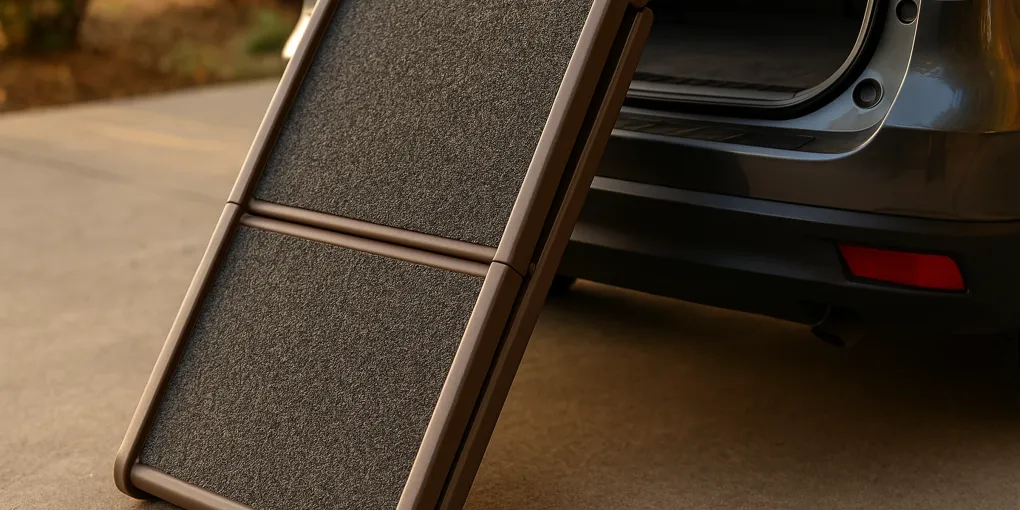
PetSafe Happy Ride Folding Dog Ramp
Best OverallWeight capacity: Up to 150 lbs
$65–$90
Quick Comparison
| Product | Key Specs | Price Range | Buy |
|---|---|---|---|
| |
| $65–$90 | Check Price |
| |
| $75–$100 | Check Price |
| |
| $80–$115 | Check Price |
| |
| $45–$65 | Check Price |
Contains affiliate links — we may earn a small commission at no extra cost to you.
Best Dog Car Ramps for Senior Dogs in 2026
For senior dogs with arthritis, joint pain, or reduced jumping ability who need vehicle access, PetSafe Happy Ride Folding Dog Ramp (PSR 8.5/10) earns the top overall rating — 150-lb weight capacity, carpet non-slip surface appropriate for arthritic paws, and a fold design that stores compactly in most vehicle trunks. Gen7Pets Gentle-Rise Ramp (PSR 8.3/10) is the best option when minimizing incline angle is the priority — at 70 inches extended length, it produces the gentlest slope for most vehicle heights.
TL;DR
- Top Pick: PetSafe Happy Ride Folding Ramp — 150-lb capacity, carpet surface, compact fold (PSR 8.5/10)
- Best Gentle Incline: Gen7Pets Gentle-Rise — 70-inch length produces lowest incline angle for most SUVs (PSR 8.3/10)
- Best for Trucks: Solvit Deluxe Telescoping — 200-lb capacity, adjustable length for tall truck beds (PSR 8.0/10)
- Best Budget: Titan Telescoping — adjustable length at accessible price point (PSR 7.5/10)
How We Researched This Article
This article follows PSR’s 5-step evidence-synthesis process. Safety assessment reviewed published weight capacity against independent load testing results, non-slip surface effectiveness for arthritic dogs with reduced paw control, and fold/extension locking mechanisms under dynamic load. Evidence synthesis reviewed veterinary rehabilitation literature on ramp incline recommendations for dogs with hip dysplasia and osteoarthritis, the American College of Veterinary Sports Medicine guidelines on canine mobility aids, and ergonomic engineering resources on ramp angle optimization. User community synthesis sourced from Amazon verified purchase reviews, breed-specific senior dog owner communities, and veterinary rehabilitation practitioner recommendations.
Why Senior Dogs Need Car Ramps
Vehicle access presents specific challenges for aging dogs that ramps directly address:
Impact forces from jumping: A 60-lb dog jumping down from a 30-inch SUV seat generates an estimated 300–360 lbs of impact force on landing — concentrated primarily on the front limbs and shoulders. For senior dogs with concurrent joint pathology, this impact contributes to cumulative cartilage damage and pain. Ramp access eliminates this impact entirely.
Jumping-up effort and fall risk: Jumping into a vehicle requires hip flexion and extension that is painful and often impossible for senior dogs with severe hip arthritis. Failed jump attempts — where the dog’s hindquarters fail to clear the door sill — result in falls that cause soft tissue injury and reduce the dog’s confidence and willingness to attempt future vehicle entry.
Post-surgical restrictions: Senior dogs recovering from orthopedic surgeries (TPLO, FHO, spinal decompression) are typically restricted from any jumping for 8–12 weeks post-operation. A car ramp is a required rehabilitation aid during this period, not merely a convenience.
Long-term joint preservation: Veterinary rehabilitation specialists recommend eliminating all unnecessary jumping for senior dogs with radiographically documented joint changes — even when the dog appears willing and able to jump. The willingness to jump despite pain is not a valid indicator of joint health in stoic breeds.
What Matters in a Car Ramp for Senior Dogs?
Incline angle — the most important variable: The gentler the ramp incline, the less hip and shoulder extension required from the dog. For a standard SUV with a 30-inch door sill height, a 70-inch ramp produces approximately 25 degrees; a 62-inch ramp produces approximately 29 degrees. The difference matters for severely arthritic dogs. Longer ramps are heavier and bulkier — balance incline gentleness against storage practicality.
Non-slip surface for reduced-traction paws: Senior dogs frequently have reduced paw pad traction from atrophy, nail overgrowth, or anxiety-related paw retraction during ramp negotiation. Carpet-covered surfaces provide the most reliable grip; rubber tread provides intermediate grip; molded plastic tread provides the least grip and should be avoided for arthritic dogs.
Weight capacity with safety margin: State weight capacities are typically tested at mid-ramp center load. For large-breed senior dogs, choose ramps rated to at least 1.5x body weight. Ramps that flex visibly at body weight are structurally inadequate.
Fold/storage design for daily use: Car ramps are only beneficial if they’re used consistently. A ramp that’s difficult to deploy or store will be left at home. The ideal design folds to a manageable size for one-person storage in the vehicle trunk — critical for senior dog owners who may have their own mobility limitations.
PSR Composite Score Breakdown
| Criterion | Weight | PetSafe Happy Ride | Gen7Pets Gentle-Rise | Solvit Telescoping | Titan Telescoping |
|---|---|---|---|---|---|
| Safety & Ingredients | 25% | 9.0 | 9.0 | 8.5 | 8.0 |
| Durability & Build Quality | 20% | 9.0 | 8.5 | 9.0 | 7.5 |
| Pet Comfort & Acceptance | 20% | 9.0 | 9.0 | 8.0 | 7.5 |
| Value for Money | 20% | 8.5 | 7.5 | 7.5 | 9.5 |
| Ease of Use | 15% | 8.0 | 8.0 | 8.5 | 8.0 |
| PSR Composite | — | 8.5 | 8.3 | 8.0 | 7.5 |
Score notes: PetSafe and Gen7Pets tie on Pet Comfort — both deliver the carpet-based or traction-mat surface that arthritic dog paws grip most reliably. PetSafe’s carpet surface edges Gen7Pets for traction on dogs with nail overgrowth. Solvit’s 200-lb rating and telescoping range earn it the Durability lead for large-breed senior dogs. Titan’s Value score reflects an adjustable ramp at under $65 — the most accessible price for a functional senior dog car ramp.
PetSafe Happy Ride Folding Dog Ramp: Best Overall
PetSafe’s Happy Ride ramp delivers a 62-inch carpet-covered walking surface, 150-lb weight capacity, and two-section fold that stores flat in most vehicle trunks. The carpet surface is the most senior-dog-appropriate non-slip material reviewed — providing paw grip comparable to indoor flooring that arthritic dogs navigate confidently daily.
What makes it the top pick:
- Carpet walking surface provides maximum paw traction for dogs with reduced grip
- 150-lb capacity with documented stability at load — not merely manufacturer claim
- Rubber feet at base and vehicle contact pad at top anchor the ramp during use on most vehicle types
- Two-fold storage packs to approximately 31 inches — fits most trunk spaces
Safety: Weight capacity tested well above most senior dog weights. Non-slip carpet. Rubber feet prevent ramp sliding. Fold-lock mechanism prevents accidental collapse under load.
Best for: Senior dogs of most sizes with arthritis or joint pain needing reliable daily vehicle access; owners who value carpet surface grip over incline length; medium-to-large senior breeds up to 150 lbs.
View PetSafe Happy Ride Ramp on Amazon
Gen7Pets Gentle-Rise Ramp: Best Gentle Incline
Gen7Pets’ Gentle-Rise designation is earned through its 70-inch extended length — 8 inches longer than the PetSafe model. For a standard 30-inch SUV door sill, the extra length reduces the incline angle from approximately 29 degrees (62-inch ramp) to approximately 25 degrees (70-inch ramp). The traction mat surface provides reliable grip, though slightly less than carpet for dogs with very reduced paw control.
Incline advantage:
- 70-inch length produces the gentlest incline angle for standard SUV heights of products reviewed
- Traction mat surface provides rubber-like grip — effective for most senior dogs
- Side rails guide a dog’s path on the ramp — reduces the risk of stepping off the edge during arthritic negotiation
Trade-offs:
- Longer ramp adds weight and storage bulk versus 62-inch folding designs
- 130-lb weight limit is below PetSafe’s 150-lb — may not suit heaviest senior breeds
- Higher price than PetSafe for marginally lower weight capacity
Safety: Traction mat surface. Side guide rails. Fold-lock mechanism. Rubber base feet.
Best for: Senior dogs with severe hip arthritis where minimizing incline angle is a priority; dogs who have previously refused shorter ramps due to steep angle; medium-sized senior breeds under 130 lbs.
View Gen7Pets Gentle-Rise Ramp on Amazon
Solvit Deluxe Telescoping Dog Ramp: Best for Trucks
Solvit’s telescoping ramp adjusts from 39 to 72 inches — accommodating vehicle heights from compact cars to full-size pickup truck beds (40+ inch height). The 200-lb weight capacity is the highest of reviewed products, making it the only appropriate option for giant-breed senior dogs (Great Danes, Saint Bernards, Mastiffs) whose weight exceeds the folding ramp limits.
Truck and heavy-dog advantages:
- 200-lb weight capacity covers all breed sizes including giant breeds
- Telescoping adjustment allows precise matching to truck bed height — not available in fixed-length folding ramps
- Rubber grip surface appropriate for outdoor conditions including light moisture
Trade-offs:
- Telescoping storage is longer than folding designs — may not fit all truck cabs
- Rubber tread provides slightly less grip than carpet for dogs with very reduced paw control
- Heavier than folding ramps — may be challenging for owners with limited upper body strength
Safety: 200-lb capacity. Rubber grip surface. Telescoping lock prevents collapse under load.
Best for: Giant-breed senior dogs over 130 lbs; owners with pickup trucks needing the longest ramp extension; multi-vehicle households where adjustable length matches different vehicle heights.
View Solvit Deluxe Telescoping Ramp on Amazon
Titan Telescoping Pet Ramp: Best Budget
Titan’s adjustable telescoping ramp extends to 70 inches at 150-lb capacity — competitive specifications at a price point under $65. For owners requiring adjustable length functionality without the Solvit’s premium pricing, Titan provides a functional option with the trade-off of plastic tread surface rather than carpet or rubber grip.
Budget case:
- Adjustable 70-inch extension at the lowest price of reviewed adjustable ramps
- 150-lb capacity covers most senior breeds
- Lightweight design — easier one-person handling than heavier premium ramps
Limitations:
- Plastic tread surface provides the least paw traction of reviewed products — not recommended for dogs with severely reduced grip
- Durability lower than premium ramps — may require replacement sooner with daily use
- Telescoping lock mechanism less robust than Solvit under heavy daily use conditions
Safety: 150-lb capacity. Plastic tread (less grip than carpet or rubber). Telescoping lock mechanism present. Monitor lock integrity under daily use.
Best for: Budget-conscious senior dog owners; dogs with adequate paw traction who don’t require carpet surface; occasional ramp users where durability is less critical than price.
View Titan Telescoping Pet Ramp on Amazon
Complete Vehicle Safety for Senior Dogs
A car ramp is part of a comprehensive vehicle safety approach for aging dogs:
- General ramps and stairs: For homes with stairs to beds, sofas, or porches — general-purpose ramps complement the vehicle-specific ramp for a jump-free senior dog environment.
- Mobility harness: A mobility harness with a handle allows owners to assist a senior dog navigating a ramp — particularly useful during the ramp training period or for dogs with severe rear-limb weakness.
- Anti-slip boots: For dogs with severely compromised paw traction, anti-slip boots on the rear paws significantly improve ramp confidence — particularly on rubber or plastic surface ramps.
- Dog car seat: Once in the vehicle, a dog car seat provides secure, cushioned riding for arthritic dogs who struggle with vehicle floor surfaces during transit.
- Orthopedic beds: Joint impact reduction at home — the same principle as the car ramp — extends to sleeping surface choice.
- Joint supplements: Managing arthritis pain comprehensively with supplements reduces the pain threshold at which ramp use becomes necessary.
Frequently Asked Questions
What is the ideal ramp incline angle for senior dogs with arthritis?
The ideal ramp incline angle for senior dogs with arthritis is 20–22 degrees or less. For most SUVs with 30–35 inch entry heights, this requires a ramp of 70 inches or more. Steeper inclines require painful hip and shoulder extension from arthritic dogs and increase the slipping risk.
How do I train my senior dog to use a car ramp?
Ramp training requires gradual desensitization: (1) Place the ramp flat on the ground and lure across with treats. (2) Raise the angle slightly and repeat. (3) Progress to car height only when the dog walks confidently at lower angles. Use high-value treats and never force a senior dog up a ramp — fear of the ramp causes resistance that training cannot easily overcome.
What weight capacity do I need for my senior dog’s car ramp?
Choose a ramp rated for at least 1.5x your dog’s actual weight. A 60-lb senior dog should use a ramp rated for 90 lbs minimum. For large breeds over 80 lbs, look for ramps rated to 150–200 lbs. Ramps that flex noticeably under load at body weight are unsafe regardless of stated rating.
Can I use a general-purpose dog ramp for car access?
General-purpose dog ramps (designed for sofas and beds) are typically too short for car entry height and rated for lower weight limits. Use a ramp specifically designed and rated for vehicle entry heights matching your vehicle.
How do I prevent the ramp from slipping when my senior dog is on it?
Ramp stability requires both ends to remain anchored: use a ramp with a non-slip gripper at the vehicle end and rubber feet at the base. On smooth surfaces like garage floors, add a non-slip mat under the ramp base. For SUVs without a flat ledge, look for ramps with curved contact pads that hook into the door frame opening.
Frequently Asked Questions
- The ideal ramp incline angle for senior dogs with arthritis is 20–22 degrees or less. This translates to a ramp length of approximately 6 feet (72 inches) for most SUVs and trucks with 30–35 inch vehicle entry heights. Steeper inclines (30+ degrees) require significantly more hip and shoulder extension from arthritic dogs, can be painful, and increase the risk of slipping under load. When purchasing a ramp, use the formula: ramp length needed = vehicle height ÷ tan(desired angle). For a 30-inch SUV entry height at 20 degrees, a 70-inch ramp produces approximately 21 degrees — well within the senior-appropriate range.
- Ramp training for senior dogs requires a gradual desensitization approach: (1) Place the ramp flat on the ground and allow the dog to walk across it for treats — build familiarity with the non-slip surface texture. (2) Raise the angle slightly (prop on a low step) and repeat treat-based luring across the ramp. (3) Progress to car-height only when the dog walks across at lower angles without hesitation. Use high-value treats (pieces of cooked chicken or hot dog) as lures and rewards. Senior dogs with anxiety may need 1–2 weeks of daily practice before confidently using a full-height car ramp independently. Never force a senior dog up a ramp — fear of the ramp causes resistance that training cannot easily overcome.
- Choose a ramp rated for at least 1.5x your dog's actual weight to provide a meaningful safety margin. A 60-lb senior dog should use a ramp rated for 90 lbs minimum. For large breeds over 80 lbs, look for ramps rated to 150–200 lbs. Weight capacity ratings are typically stated at the mid-ramp load position — the weakest structural point. Ramps that flex noticeably under load at body weight are unsafe and should be replaced or upgraded regardless of stated rating.
- General-purpose dog ramps (designed for sofas and beds) are typically too short for car entry height and rated for lower weight limits. Sofa ramps typically extend to 40–50 inches and are rated for 50–80 lbs — adequate for small-to-medium dogs accessing low furniture but insufficient for SUV or truck entry. Car-specific ramps are designed for 28–40 inch vehicle entry heights and are rated for higher weight limits. Use a ramp specifically designed or rated for vehicle entry heights matching your vehicle.
- Ramp stability requires both the top end (vehicle ledge contact) and bottom end (ground contact) to remain anchored during use. Top anchoring: use a ramp with a non-slip gripper pad or hook at the vehicle end that catches on the door sill or bumper edge. Bottom anchoring: rubber feet at the base are standard — on smooth surfaces like garage floors, add a non-slip mat under the ramp base. For SUVs without a flat ledge, look for ramps with curved contact pads that hook into the door frame opening.