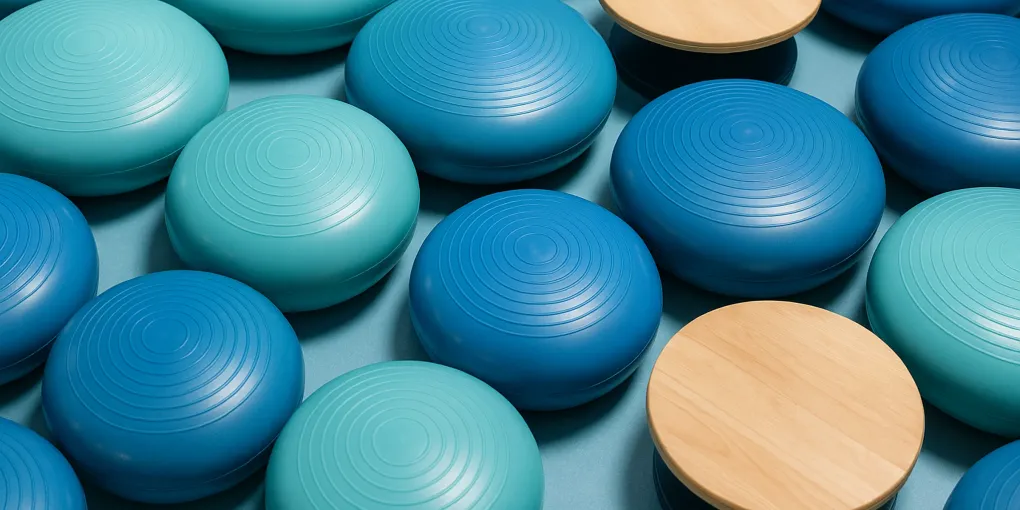
FitPAWS Donut Inflatable Balance Disc
Best OverallSurface type: Inflatable PVC, textured top
$18–$30
Quick Comparison
| Product | Key Specs | Price Range | Buy |
|---|---|---|---|
| |
| $18–$30 | Check Price |
| |
| $25–$45 | Check Price |
| |
| $35–$60 | Check Price |
| |
| $12–$20 | Check Price |
Contains affiliate links — we may earn a small commission at no extra cost to you.
Best Balance Discs and Wobble Boards for Senior Dogs in 2026
For senior dogs with proprioceptive decline, FitPAWS Donut Inflatable Balance Disc (PSR 8.2/10) earns the top overall rating — adjustable inflation allows challenge calibration from nearly flat (appropriate for severely arthritic dogs) to fully inflated (appropriate for more capable seniors), making it the most adaptable tool across the full spectrum of senior dog ability. FitPAWS Peanut (PSR 7.9/10) is the preferred tool for hindquarter-specific proprioception rehabilitation.
Why proprioception training matters for senior dogs: Age-related neurological changes, spinal spondylosis, and muscle atrophy all reduce proprioceptive accuracy — leading to stumbling, slipping, and fall risk that accelerates mobility decline. Balance training is one of the few interventions shown to slow this decline through neuroplasticity.
TL;DR
- Top Pick: FitPAWS Donut Disc — adjustable inflation, textured surface, most adaptable to varying senior dog ability (PSR 8.2/10)
- Best Hindquarter Rehab: FitPAWS Peanut — elongated design addresses rear-end proprioception specifically (PSR 7.9/10)
- Best Advanced Training: Bosu-style balance trainer — fixed challenge appropriate for stronger senior dogs progressing past beginner (PSR 7.5/10)
- Best Budget: FitPAWS Wobble Board — solid wood, directional instability, lowest cost for proprioceptive training basics (PSR 7.3/10)
How We Researched This Article
This article follows PSR’s 5-step evidence-synthesis process. Safety assessment reviewed load ratings, surface slip resistance, puncture resistance (inflatable products), and fall risk under normal use conditions. Evidence synthesis reviewed veterinary rehabilitation literature on proprioception training for canine degenerative joint disease (Millis & Levine, Canine Rehabilitation and Physical Therapy 3rd ed.), research on proprioceptive decline in aging dogs (Sims et al.), and the AAHA rehabilitation guidelines for senior dogs. User community synthesis sourced from Amazon verified reviews, veterinary rehabilitation therapist professional communities, and senior dog fitness training groups.
Understanding Proprioceptive Decline in Senior Dogs
Proprioception — the body’s internal position-sensing system — depends on sensory receptors in muscles, tendons, and joint capsules that report joint angle and movement to the brain. These receptors are called mechanoreceptors, and they are sensitive to both static position and dynamic movement.
Why senior dogs lose proprioceptive accuracy:
Peripheral neuropathy: Aging motor and sensory nerves conduct signals more slowly and with reduced reliability. The proprioceptive pathway from paw to brain degrades over time in many senior dogs, particularly in the hind limbs (longest nerve pathways).
Spinal spondylosis: Arthritic changes in the vertebral column compress the spinal cord and nerve roots — reducing proprioceptive signal transmission from the hindlimbs. Many senior dogs with “wobbly” hind legs have spinal spondylosis as the primary cause.
Sarcopenia: Muscle spindles (the proprioceptive sensors within muscles) lose sensitivity as muscle mass decreases. Dogs with significant muscle atrophy have fewer functional proprioceptors per unit of movement.
Vestibular aging: The inner ear’s vestibular system contributes to balance — age-related vestibular changes (idiopathic vestibular syndrome, geriatric vestibular disease) reduce the complementary balance input that normally compensates for proprioceptive gaps.
What balance training does: Repeated exposure to controlled instability forces the nervous system to recruit all available proprioceptive pathways — strengthening the neural connections that remain functional and slowing decline through activity-dependent neuroplasticity.
Adapting Balance Training for Arthritic Senior Dogs
Standard balance disc protocols are designed for young, healthy dogs. Senior dogs with arthritis require significant protocol modification:
Reduce inflation: A fully inflated balance disc creates significant ankle/wrist (carpus/tarsus) joint challenges — painful and potentially harmful for dogs with joint arthritis. Start with minimal inflation; the disc should give slightly under weight but not roll dramatically.
Shorten sessions: 2–5 minutes of active standing on a balance disc is sufficient for senior dogs. Proprioceptive training is neurologically demanding; fatigue sets in faster than with aerobic exercise.
Use non-slip flooring: Place the disc on a yoga mat or rubber-backed rug. A disc sliding on hardwood floor creates a slip hazard if the dog steps off unexpectedly.
Start with two paws: Senior dogs often start more comfortably with just front paws on the disc while the rear remains on stable ground. This reduces the balance challenge while still training forelimb proprioception.
Increase frequency, not duration: 5 minutes daily produces better proprioceptive adaptation than 20 minutes twice a week — proprioceptive learning consolidates with repeated practice, not extended sessions.
PSR Composite Score Breakdown
| Criterion | Weight | FitPAWS Donut | FitPAWS Peanut | Bosu-Style | Wobble Board |
|---|---|---|---|---|---|
| Safety & Ingredients | 25% | 8.5 | 8.5 | 8.0 | 8.0 |
| Durability & Build Quality | 20% | 8.0 | 8.0 | 8.5 | 9.0 |
| Pet Comfort & Acceptance | 20% | 8.5 | 8.0 | 7.0 | 7.5 |
| Value for Money | 20% | 8.0 | 7.5 | 7.0 | 9.5 |
| Ease of Use | 15% | 8.5 | 7.5 | 7.5 | 7.0 |
| PSR Composite | — | 8.2 | 7.9 | 7.5 | 7.3 |
Score notes: FitPAWS Donut leads Pet Comfort — adjustable inflation makes it the gentlest option for arthritic dogs when deflated, while maintaining challenge capacity as dogs improve. The Peanut’s elongated shape makes hindquarter positioning more intuitive for targeted rear-end rehab but scores slightly lower on Ease of Use due to the learning curve for positioning a dog on an unfamiliar shape. Wobble Board leads Value and Durability — solid wood lasts indefinitely — but the fixed instability challenge makes calibration for senior dogs more difficult.
FitPAWS Donut: Best Overall
The FitPAWS Donut’s inflatable design allows challenge calibration that no rigid board can match — from nearly flat (minimal instability, appropriate for severely arthritic or neurologically compromised senior dogs) to fully inflated (significant proprioceptive challenge for more capable dogs). FitPAWS is the standard equipment brand in veterinary rehabilitation practices.
What makes it the top pick:
- Adjustable inflation allows precise challenge calibration — the single most important feature for senior dog use
- Textured non-slip top surface reduces dog slip risk during active balance work
- Large sizes accommodate medium-to-large breeds
- FitPAWS products are standard equipment in veterinary rehabilitation clinics — this is what the professionals use
Best for: All senior dogs starting proprioceptive training; dogs in formal veterinary rehabilitation programs; owners wanting adjustable challenge as the dog progresses.
FitPAWS Peanut: Best for Hindquarter Rehab
The FitPAWS Peanut’s elongated shape places the dog’s front paws on one bulge and rear paws on the other — naturally positioning the dog to actively engage rear limb proprioception as the peanut rolls. This design specifically addresses the hindquarter instability pattern most common in senior dogs (hindlimb ataxia, hindlimb weakness from DM or spinal disease).
Hindquarter rehab advantages:
- Elongated peanut shape naturally encourages hindquarter engagement
- Lateral rolling motion specifically challenges the hip and stifle (knee) proprioceptors
- Available in sizes for small to large breeds
Trade-offs:
- More challenging to position a dog on initially — requires more handler guidance than a disc
- Lateral roll motion can be alarming to arthritic dogs initially — slow desensitization required
Best for: Dogs with documented hindlimb proprioceptive deficits; DM early stage rehabilitation; post-TPLO or hip surgery proprioceptive recovery.
Bosu-Style Balance Trainer: Best for Advanced Training
A Bosu-style (dome-up balance trainer) provides a fixed instability challenge — the dome deflects under weight in an unpredictable multi-directional pattern. For senior dogs who have mastered balance disc basics and are progressing to higher challenge levels, a Bosu-style trainer represents an appropriate progression.
Advanced training advantages:
- Greater proprioceptive challenge than deflated FitPAWS disc for progressing dogs
- Durable construction — no puncture risk
- Familiar equipment in home gym settings
Trade-offs:
- Not adjustable — challenge is fixed and may be too intense for dogs with severe arthritis
- Higher per-unit cost than FitPAWS alternatives
Best for: Senior dogs with good baseline balance who are progression-ready; dogs in advanced rehabilitation programs under therapist supervision.
View Balance Trainer on Amazon
FitPAWS Wobble Board: Best Budget
The FitPAWS Wobble Board provides directional (two-axis) instability at the lowest cost of reviewed products. Solid wood construction is essentially indestructible and provides a firm, clean surface most dogs step onto willingly.
Budget advantages:
- Lowest cost of reviewed products
- Essentially indestructible — lasts indefinitely with normal use
- Directional instability is more predictable than disc/peanut — may be better tolerated initially by anxious senior dogs
Trade-offs:
- Not adjustable — fixed challenge level may be too much for dogs with severe arthritis or too little for stronger seniors
- Two-axis instability only — less comprehensive proprioceptive stimulation than a disc
Best for: Budget-conscious owners starting proprioceptive training; dogs that accept the wobble board’s predictable motion better than the unpredictable disc motion.
View FitPAWS Wobble Board on Amazon
Related Rehabilitation and Mobility Products
- Dog mobility harness: Mobility harnesses provide external stability support during walks — a complement to balance disc training for dogs whose proprioceptive decline creates outdoor gait instability.
- Non-slip mats: Proprioceptive training should always be performed on non-slip surfaces — non-slip mats throughout the home reduce the fall risk that proprioceptive decline creates on smooth floors.
- Interactive puzzle toys: Cognitive enrichment complements physical balance training — senior dog health is multidimensional, with both physical and cognitive components.
- Joint supplements: Anti-inflammatory supplementation reduces the pain that discourages a dog from engaging in balance exercises — supplement therapy and proprioceptive training work synergistically.
- Dog wheelchair: For dogs with advanced mobility loss from proprioceptive decline, wheeled mobility support allows continued movement despite significant neurological deficit.
- Omega-3 fish oil: Omega-3 fatty acids support neurological tissue health — relevant for dogs with peripheral neuropathy affecting proprioception.
Frequently Asked Questions
What is proprioception training and why does it help senior dogs?
Proprioception is the body’s awareness of its own position in space. Senior dogs experience proprioceptive decline from peripheral neuropathy, spinal spondylosis, muscle atrophy, and vestibular aging — manifesting as stumbling, slipping, and hindlimb ataxia. Balance disc training stimulates proprioceptive nerve pathways. Regular practice has been shown in veterinary rehabilitation research to slow proprioceptive decline, improve balance, and reduce fall frequency in senior dogs.
Is balance disc training safe for a dog with arthritis?
Yes, with adaptations: reduce inflation to lower instability challenge, start with just two paws on the disc, limit sessions to 2–5 minutes, and work on non-slip flooring. Consult a veterinary rehabilitation therapist before starting for dogs with severe osteoarthritis.
How do I teach my senior dog to use a balance disc?
Use treat-based shaping with small steps. Start with a deflated disc and reward any interaction. Progress to one paw, then two paws, then all four. Once comfortable on a deflated disc, introduce very slight inflation and repeat. 5–10 minute daily sessions are sufficient.
How often should a senior dog do balance disc exercises?
2–3 sessions per week for maintenance, with 2–5 minutes of active balance work per session. Daily practice (5 min) is appropriate for active rehabilitation. Proprioceptive training is neurological learning — frequent short sessions outperform infrequent long sessions.
What is the difference between a balance disc and a wobble board for dogs?
A balance disc provides multi-directional instability with adjustable challenge through inflation. A wobble board provides directional (two-axis) instability at a fixed challenge. Balance discs are more versatile and adjustable — better for senior dogs where precise challenge calibration matters.
Frequently Asked Questions
- Proprioception is the body's awareness of its own position in space — the sensory system that tells muscles where joints are and enables coordinated movement without looking at the feet. Senior dogs commonly experience proprioceptive decline from multiple sources: peripheral neuropathy from aging nerves, spinal cord compression from spondylosis (spinal arthritis), reduced vestibular function, and loss of muscle spindle sensitivity from sarcopenia. Reduced proprioception manifests as stumbling, knuckling (toes dragging), crossing of the hind legs, and slipping on smooth floors. Balance disc and wobble board training stimulates proprioceptive nerve pathways — regular practice has been shown in veterinary rehabilitation research to slow proprioceptive decline, improve balance, and reduce fall frequency in senior dogs.
- Balance disc training can be safely adapted for arthritic dogs, but the approach differs from training a healthy dog. Key adaptations include: reducing inflation level to lower the instability challenge (an over-inflated disc creates sharp ankle/wrist challenges that can be painful for arthritic dogs); starting with just two feet on the disc rather than all four; limiting session duration to 2–5 minutes for dogs with significant arthritis; and working on a non-slip floor surface so that disc movement does not cause the dog to slip. Consult a veterinary rehabilitation therapist before starting balance disc training for a dog with severe osteoarthritis — they can design a safe progression protocol.
- Use treat-based shaping with very small steps. Begin with the disc fully deflated on a non-slip surface. Mark and reward any interaction with the disc — sniffing, touching with a paw. Gradually reinforce placing one front paw on the disc, then two front paws, then all four. Once the dog is comfortable standing on the deflated disc, introduce very slight inflation and repeat the progression. A 5-10 minute daily session is sufficient — senior dogs fatigue proprioceptive training faster than younger dogs. Avoid forcing paws onto the disc; voluntary engagement produces better proprioceptive learning than forced positioning.
- Veterinary rehabilitation practitioners typically recommend 2–3 sessions per week for senior dogs doing proprioceptive balance training as a maintenance program — with 2–5 minutes of active balance work per session. Daily practice is appropriate for dogs in active rehabilitation programs, but rest days allow proprioceptive adaptations to consolidate. Unlike aerobic exercise, proprioceptive training is neurological learning — more frequent but shorter sessions (5 min daily) are more effective than longer infrequent sessions.
- A balance disc is an inflatable disc that provides multi-directional instability — the dog's weight causes the disc to shift in any direction, stimulating 360-degree proprioceptive response. Inflation level adjusts the challenge. A wobble board is a rigid board balanced on a central pivot — it tips in two opposing directions only, like a seesaw on a central point. Wobble boards provide directional instability training and are generally simpler for initial proprioception work. Balance discs are more versatile and adjustable, making them more appropriate for senior dogs where challenge calibration matters.