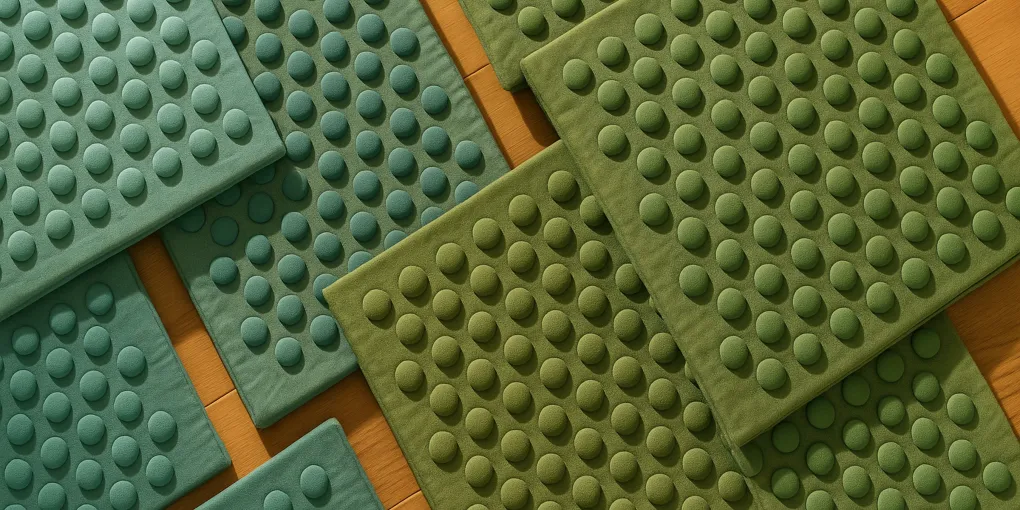
Trixie Dog Reflexology Mat
Best OverallSurface type: Rounded pressure nodes on foam base
$20–$35
Quick Comparison
| Product | Key Specs | Price Range | Buy |
|---|---|---|---|
| |
| $20–$35 | Check Price |
| |
| $25–$40 | Check Price |
| |
| $30–$50 | Check Price |
| |
| $40–$65 | Check Price |
Contains affiliate links — we may earn a small commission at no extra cost to you.
Best Acupressure and Therapy Mats for Senior Dogs in 2026
For senior dogs needing complementary pain relief and relaxation support, Trixie Dog Reflexology Mat (PSR 8.0/10) earns the top rating — BPA-free TPR rounded nodes, appropriate pressure intensity for dogs, and availability in sizes for different breeds. PetSafe Massage Mat (PSR 7.7/10) is the top choice for dogs that need therapy support during vehicle travel.
Evidence framing: Acupressure mats should be framed as complementary tools alongside veterinary pain management, not replacements for NSAID therapy, joint supplementation, or other evidence-based interventions. Available veterinary evidence supports modest benefits for pain and relaxation; individual dog response varies significantly.
TL;DR
- Top Pick: Trixie Reflexology Mat — BPA-free TPR rounded nodes, multiple sizes, appropriate gentle intensity for dogs (PSR 8.0/10)
- Best Vehicle/Rest Use: PetSafe Massage Mat — multi-density foam, seat-compatible size for car travel (PSR 7.7/10)
- Best Acupoint Density: Acumat Pet Therapy — highest node density for dogs that tolerate more pressure stimulation (PSR 7.5/10)
- Best Combined Therapy: Snuggly Warm Therapy Mat — combined infrared warmth and soft massage for heat-plus-acupressure benefit (PSR 7.4/10)
How We Researched This Article
This article follows PSR’s 5-step evidence-synthesis process. Safety assessment reviewed material safety data (BPA, phthalates, sharp node construction), small parts shedding risk, electrical component safety for thermal/infrared models, and absence of toxic dyes. Evidence synthesis reviewed veterinary integrative medicine literature on acupressure and acupuncture in dogs (Robinson, Veterinary Acupuncture; IVAS guidelines), endorphin release mechanisms from pressure stimulation, gate-control pain theory applied to acupressure, and the limited canine RCT data on acupoint stimulation for pain. User community synthesis sourced from Amazon verified purchase reviews, integrative veterinary medicine communities, and senior dog owner groups using complementary therapies.
The Science Behind Acupressure for Dogs
Acupressure’s mechanisms can be understood both through traditional Chinese medicine frameworks and modern physiological research — both offer relevant perspectives.
Traditional Chinese Medicine perspective: TCM maps the body’s energy flow (Qi, pronounced “chee”) along meridians — channels through which Qi flows. Blockages in these channels, in TCM theory, produce pain and disease. Pressure on acupoints along meridians is theorized to release blockages and restore balanced Qi flow. This framework is not scientifically validated in Western research but has clinical tradition spanning thousands of years.
Western physiological mechanisms: Modern research proposes several physiological mechanisms for observed acupressure effects:
- Mechanoreceptor stimulation: Pressure activates A-beta mechanoreceptors that compete with pain signal transmission in the dorsal horn — the same gate-control mechanism underlying TENS (transcutaneous electrical nerve stimulation) therapy
- Endorphin release: Sustained point pressure triggers release of beta-endorphins, enkephalins, and serotonin — endogenous pain modulators with analgesic and mood-elevating effects documented in humans undergoing acupressure
- Parasympathetic activation: Pressure at specific points (particularly cervical and sacral regions) activates the parasympathetic nervous system — reducing cortisol, heart rate, and muscle tension
- Local circulation: Sustained focal pressure followed by release creates a reactive hyperemia response — increased local blood flow that delivers oxygen and clears inflammatory metabolites
For senior dogs, the parasympathetic activation and pain gate effects may be the most clinically relevant — reducing the chronic pain-anxiety cycle that accelerates behavioral deterioration in arthritic seniors.
Choosing the Right Node Intensity for Your Dog
The most common mistake when purchasing an acupressure mat is selecting one designed for human sensitivity. Human acupressure mats often have sharp plastic nodes — providing an intense, almost painful sensation that humans seeking deep stimulation choose deliberately. This intensity is inappropriate for dogs, whose skin is both thicker (keratin layer) and more sensitive in the underlying dermis, and who cannot communicate that the sensation is unpleasant before visibly distressed.
Safe node characteristics for dogs:
- Rounded tips (not sharp points)
- Moderate node density — spaced to distribute pressure rather than concentrate it
- TPR (thermoplastic rubber) or polyethylene nodes rather than hard ABS plastic for initial use
- Tested specifically for pet use — “pet acupressure mat” products are calibrated for canine tolerance
How to assess your dog’s response: The gold standard measure is whether the dog voluntarily stays on the mat. A dog that remains still, relaxes their breathing, closes their eyes, or leans into the mat is experiencing beneficial stimulation. A dog that stands up repeatedly, shows tense body posture, yawns (stress indicator), or looks away is experiencing uncomfortable stimulation — discontinue or switch to a gentler product.
PSR Composite Score Breakdown
| Criterion | Weight | Trixie Reflexology | PetSafe Massage | Acumat Pet | Snuggly Warm Therapy |
|---|---|---|---|---|---|
| Safety & Ingredients | 25% | 9.0 | 8.5 | 8.0 | 8.0 |
| Durability & Build Quality | 20% | 8.5 | 8.0 | 8.0 | 7.5 |
| Pet Comfort & Acceptance | 20% | 8.0 | 7.5 | 7.0 | 7.5 |
| Value for Money | 20% | 8.0 | 8.0 | 7.5 | 7.0 |
| Ease of Use | 15% | 7.5 | 8.0 | 7.5 | 7.5 |
| PSR Composite | — | 8.0 | 7.7 | 7.5 | 7.4 |
Score notes: Trixie leads Safety — BPA-free TPR material with rounded node profile and no electrical components achieves the highest safety confidence of reviewed products. The Trixie mat is specifically designed for dogs, not adapted from human acupressure equipment. Acumat leads node density but scores lower on Pet Comfort — higher density creates a more intense sensation that some senior dogs find uncomfortable. Snuggly Warm Therapy Mat scores lower on Safety due to its electrical infrared component — not hazardous but introduces more complexity to monitor.
Trixie Dog Reflexology Mat: Best Overall
Trixie’s Dog Reflexology Mat is designed specifically for canine use — rounded TPR (thermoplastic rubber) nodes at a density and intensity profile calibrated for dog skin and tolerance. The BPA-free construction and absence of electrical components makes it the safest and simplest acupressure option. Trixie is a well-established European pet product brand with a broad product quality reputation.
What makes it the top pick:
- Specifically designed for dogs — not a human mat adapted for pet use
- Rounded TPR nodes — appropriate intensity for dog tolerance without sharp-point risk
- BPA-free — material safety confirmed
- Multiple sizes — available for small through large breeds
- No electrical components — no overheating, chewing, or shock risk
Safety: BPA-free TPR. Rounded node profile. No electrical components. No small parts.
Best for: Senior dogs new to acupressure therapy; handlers wanting the safest and simplest mat option; dogs that need very gentle initial stimulation.
View Trixie Reflexology Mat on Amazon
PetSafe Massage Mat: Best for Vehicle and Rest Use
The PetSafe mat’s compact, seat-sized dimensions (12” × 20”) fit vehicle seats, crates, and dog beds — allowing acupressure therapy during travel or as a permanent resting surface overlay. Multi-density foam with raised nodes provides varied pressure feedback across different weight distribution zones.
Vehicle and rest advantages:
- Seat-compatible dimensions — usable in vehicles for dogs with travel anxiety or post-vet-visit pain
- Lightweight and portable — easy to carry between home, vehicle, and veterinary visits
- Multi-density foam adapts to the dog’s body weight rather than providing uniform resistance
Trade-offs:
- Smaller than full-body alternatives — best for small to medium breeds
- Fixed dimensions — not available in multiple sizes
Best for: Senior dogs needing acupressure support during car travel; small breed seniors; owners wanting a portable therapy mat for varied use locations.
View PetSafe Massage Mat on Amazon
Acumat Pet Therapy Mat: Best Acupoint Density
The Acumat uses a higher node density than the Trixie — more acupoints per square inch, providing more intense and comprehensive point stimulation. This is appropriate for dogs that have acclimated to gentler mats and are ready for more intense stimulation, but not appropriate as a starting mat for dogs new to acupressure.
High-density advantages:
- More extensive coverage of potential acupoints across the contact area
- Appropriate for dogs that have progressed through gentle mat tolerance
- Larger surface area — better coverage for large breeds
Trade-offs:
- Higher intensity — requires prior mat acclimation; not appropriate for dogs new to acupressure
- ABS plastic nodes are firmer than TPR alternatives
- Some dogs find the intensity uncomfortable even after acclimation
Best for: Senior dogs that have demonstrated tolerance for gentler mats and are ready for more comprehensive stimulation; owners working with a veterinary acupressurist who recommends higher node density.
Snuggly Warm Therapy Mat: Best Combined Therapy
The Snuggly Warm Therapy Mat combines low-level infrared warming (through a 12V electrical element) with soft massage nodes — pairing the circulation and muscle-relaxation benefits of heat therapy with acupressure point stimulation. For senior dogs who benefit from both thermal and pressure-based interventions, the combination can provide additive relief in a single product.
Combined therapy advantages:
- Infrared warmth + acupressure point stimulation simultaneously
- Low-level infrared operates at safe temperatures (significantly below burn threshold)
- Soft massage nodes appropriate for dogs new to combined therapy
Trade-offs:
- Electrical component — cord management required, no unsupervised use
- Higher cost than non-electrical alternatives
- Infrared elements require occasional inspection for integrity
Best for: Senior dogs who benefit from both heat and acupressure; owners who use heat therapy already and want to add acupressure benefit; supervised sessions where the handler can monitor both effects.
View Snuggly Warm Therapy Mat on Amazon
Related Complementary Therapy Products
- Heating pad for dogs: Dedicated heating pads provide more targeted and temperature-controlled heat than combination therapy mats — appropriate for dogs needing precisely applied heat therapy for specific arthritic joints.
- Dog massage glove: Handler-applied massage provides human contact along with physical stimulation — the social bonding component is a documented anxiolytic factor that mat-only acupressure cannot replicate.
- Orthopedic dog beds: Orthopedic foam addresses arthritic pain through postural support; combining an acupressure mat on top of an orthopedic base provides both structural support and point stimulation.
- Calming supplements: For dogs with high anxiety that prevents relaxation onto a therapy mat, calming supplement support may be needed before acupressure therapy becomes accessible.
- Arthritis supplements: Anti-inflammatory supplementation and acupressure therapy address joint pain through different mechanisms — complementary approaches to canine arthritis management.
- Cognitive supplements: The parasympathetic activation from acupressure therapy supports the same stress-reduction goals as cognitive supplements — relevant for senior dogs with both pain and CDS.
Frequently Asked Questions
Does acupressure work for dogs with arthritis?
Acupressure modestly but genuinely benefits dogs through mechanoreceptor stimulation (gate-control pain mechanism), endorphin release, parasympathetic nervous system activation, and local circulation improvement. Available veterinary evidence supports modest benefits for pain and relaxation. It is best framed as a complementary therapy alongside veterinary pain management, not a replacement for NSAID therapy or joint supplementation.
What is the difference between acupressure and acupuncture for dogs?
Acupuncture uses needles inserted at specific points — a veterinary procedure requiring a licensed veterinarian. Acupressure applies sustained pressure to the same points without needles, which can be done at home with an owner’s hands or a mat. Both engage similar physiological pathways; needle insertion provides more intense stimulation than surface pressure.
How do I get my senior dog to lie on an acupressure mat?
Only voluntary use provides benefit — never force placement. Begin by letting the dog investigate the mat freely. Place familiar blankets on it. Progress to treats on the mat, then standing on it while treating, then resting with front paws. Observe body language closely: relaxed posture, closed eyes, and remaining still indicate comfort; tension, whale eye, or repeated movement away indicate the mat is uncomfortable.
Are acupressure mats safe for senior dogs?
Standard commercial acupressure mats with rounded nodes are safe. Key considerations: choose BPA-free materials, rounded (not sharp) nodes, no small parts, and veterinary-calibrated intensity. Do not use human mats designed for intense sensation. Avoid mats on areas with open wounds or skin conditions. Always supervise sessions, particularly for mats with electrical components.
How long should a session on an acupressure mat last for a senior dog?
Initial sessions: 2–3 minutes as the dog acclimates. Established sessions: 10–15 minutes. The physiological effects occur within the first 10–15 minutes — longer sessions provide no additional benefit. Daily 10-minute sessions are a common recommendation from veterinary integrative medicine practitioners as complementary pain management for senior dogs.
Frequently Asked Questions
- Acupressure for dogs exists at the intersection of traditional Chinese medicine (TCM) principles and modern physical therapy. The TCM framework posits that pressure on specific body points (acupoints) along meridians releases blocked energy (Qi) to reduce pain. Modern physiological research offers a different but compatible explanation: pressure on specific anatomical points stimulates mechanoreceptors and proprioceptive nerves, triggers local and systemic release of endorphins and enkephalins (endogenous pain modulators), and reduces muscle tension through gate-control pain mechanisms. Veterinary studies on acupressure and acupuncture are limited compared to human research, but available evidence suggests modest but real benefits for pain and relaxation in dogs. Acupressure is most appropriately framed as a complementary therapy alongside veterinary pain management, not a replacement for NSAID therapy or joint supplementation.
- Acupuncture uses thin needles inserted at specific anatomical points — a veterinary procedure requiring a licensed veterinarian (or certified veterinary acupuncturist). Acupressure applies sustained pressure to the same anatomical points without needle insertion — this can be done by an owner using fingers, thumbs, or an acupressure mat, with no veterinary license required. Both modalities target the same acupoints and theoretically engage the same physiological pathways (mechanoreceptor stimulation, endorphin release, parasympathetic nervous system activation), but needle insertion provides more intense point stimulation than surface pressure. Veterinary acupuncture is practiced by certified veterinarians and has more clinical evidence; acupressure mats are a home-use version of the same general concept.
- The key is voluntary acceptance — never force a dog onto an acupressure mat. Begin by placing the mat in a location the dog already rests and allowing investigation without pressure. Place a familiar blanket or small piece of the owner's clothing on the mat to make it smell familiar. Progress to placing treats on the mat, then on the mat while the dog stands on it, then while resting with front paws on the mat. Once the dog voluntarily rests on the mat, proceed to full-body contact sessions. Senior dogs with arthritis may find certain pressure node patterns uncomfortable — observe the dog's body language carefully and remove the mat if the dog shows tension, whale eye, yawning, or attempts to move away.
- Standard commercial acupressure mats with rounded pressure nodes are safe for senior dogs. The key safety considerations are: (1) material safety — choose mats made from BPA-free materials without sharp plastic tips; (2) node sharpness — points should be rounded, not sharp enough to puncture or scratch skin; (3) voluntary use — forced placement creates stress, not benefit; (4) supervision — do not leave a dog unattended on a mat, particularly if it has any electrical components; (5) skin health — senior dogs with thin skin, open wounds, or skin conditions should not use acupressure mats on affected areas. High-density node mats (sharper points designed for humans seeking intense sensation) are not appropriate for dogs — choose mats specifically designed for pets with gentler node profiles.
- Initial sessions should be very brief — 2–3 minutes of contact while the dog settles onto the mat. As the dog becomes comfortable, sessions can extend to 10–15 minutes. Longer than 15–20 minutes is generally unnecessary — the physiological effects (endorphin release, muscle relaxation) occur within the first 10–15 minutes of pressure stimulation. Many owners use acupressure mat sessions as a transition to sleep — the parasympathetic activation effect can facilitate the dog settling for a nap. Daily 10-minute sessions are a common recommendation from veterinary integrative medicine practitioners for senior dogs using acupressure as a complementary pain management tool.