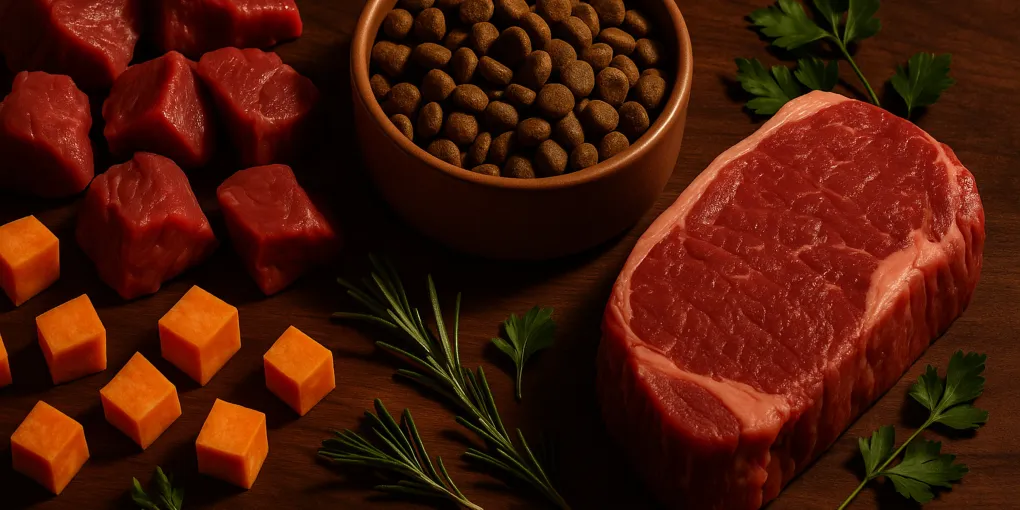
Merrick Grain-Free Texas Beef + Sweet Potato
Best OverallAAFCO statement: Complete and balanced for all life stages
$65–$85 (22 lb)
Quick Comparison
| Product | Key Specs | Price Range | Buy |
|---|---|---|---|
| |
| $65–$85 (22 lb) | Check Price |
| |
| $55–$70 (28 lb) | Check Price |
| |
| $65–$85 (24 lb) | Check Price |
| |
| $55–$75 (35 lb) | Check Price |
Contains affiliate links — we may earn a small commission at no extra cost to you.
Best Beef Dog Food in 2026
The best beef dog food for most adult dogs is Merrick Grain-Free Texas Beef + Sweet Potato (PSR 8.4/10), featuring deboned beef as the first ingredient at 32% protein — the highest protein level of the reviewed formulas — with sweet potato as a digestible carbohydrate. For owners who prefer a grain-inclusive formula with a feeding trial AAFCO certification, Purina Pro Plan SAVOR Beef & Rice (PSR 8.2/10) is the stronger choice.
TL;DR
- Best Overall: Merrick Grain-Free Texas Beef + Sweet Potato — deboned beef first, 32% protein, all-life-stages AAFCO (PSR 8.4/10)
- Best for Variety: Taste of the Wild High Prairie — bison + venison red meat blend, all-life-stages, clean recall history (PSR 8.3/10)
- Best Grain-Inclusive: Purina Pro Plan SAVOR Beef & Rice — feeding trial AAFCO, beef first, live probiotics (PSR 8.2/10)
- Best Natural Beef: Blue Buffalo Wilderness Rocky Mountain — deboned beef, no artificial additives (PSR 7.9/10)
- Key Stat: Beef provides complete essential amino acids at high biological value and is among the most palatable proteins for dogs — but is the most common food allergen trigger (34% of cases) per Mueller et al. (2016)
Beef-based dog foods offer exceptional palatability and high-quality protein — but they come with an important context: beef is the most common food allergen trigger in dogs. This guide helps owners understand the beef dog food landscape, identify the highest-quality formulas, and make an informed choice based on their dog’s individual history.
The Case for Beef Dog Food
Beef provides a nutritionally excellent protein source for dogs. The NRC (2006) documents beef as a complete protein with high essential amino acid content, including high biological value for branched-chain amino acids (leucine, isoleucine, valine) essential for muscle maintenance. Beef also provides:
- Zinc: Critical for immune function, wound healing, and coat health — beef is one of the highest bioavailability zinc sources available
- Iron (heme iron): The most bioavailable iron form, essential for hemoglobin synthesis and oxygen transport
- Vitamin B12: Required for nervous system function and red blood cell production
- Conjugated linoleic acid (CLA): Found in grass-fed beef fat; some evidence for metabolic health benefits in dogs
The palatability advantage is real and well-documented. Laflamme et al. (2008, JAVMA, DOI: 10.2460/javma.232.5.687) documented feeding preference surveys showing beef among the most willingly consumed proteins by dogs across multiple studies.
The allergenicity context: Mueller et al. (2016, BMC Veterinary Research, DOI: 10.1186/s12917-016-0633-8) documented beef as the leading food allergen trigger in dogs at 34% of adverse food reaction cases. This high prevalence reflects beef’s historical ubiquity in commercial dog foods — not any inherent toxicity. Dogs raised without previous beef exposure are lower risk for beef allergy. Owners of dogs with known food allergies should not use beef as an elimination diet protein unless veterinary testing has specifically cleared it.
Merrick Grain-Free Texas Beef + Sweet Potato Review: Best Overall
Merrick uses deboned beef as the first ingredient with a 32% minimum protein content — the highest of the reviewed beef formulas. Sweet potato provides a digestible, naturally sweet carbohydrate source appropriate for most adult dogs.
Key specifications:
- Primary protein: Deboned beef (first ingredient), beef meal (second)
- Protein: 32% min, Fat: 17% min
- AAFCO: Complete and balanced for all life stages
- Grain-free with sweet potato and potatoes
- Made in USA; no artificial colors, flavors, or preservatives
- Omega-3 and omega-6 fatty acids from flaxseed and salmon oil
Dual beef ingredient design: Leading with both deboned beef and beef meal maximizes the fresh-meat proportion while adding protein-concentrated beef meal. This results in the highest verified protein content of reviewed options.
All-life-stages certification: Merrick’s AAFCO all-life-stages certification means Texas Beef is appropriate for puppies, adults, and seniors — useful for households with multiple dogs at different life stages.
Safety record: One minor 2018 recall for an isolated batch (vitamin D excess) — resolved; no recalls since. Merrick’s US manufacturing adds traceability advantages.
Pros:
- Deboned beef as first ingredient
- Highest protein content (32%) of reviewed options
- All-life-stages AAFCO
- Made in USA
- No artificial additives
- Sweet potato as digestible carbohydrate
Cons:
- 2018 recall history (resolved)
- High fat (17%) — not appropriate for overweight dogs
- Grain-free with potatoes/legumes — FDA DCM investigation context
- Premium pricing
Cost: $65–$85 for a 22 lb bag; approximately $0.17–$0.20/oz
Taste of the Wild High Prairie Review: Best for Variety Seekers
Taste of the Wild High Prairie uses bison and roasted venison as its primary proteins — red meat proteins closely related nutritionally to beef but representing lower-allergenicity novel protein sources for dogs with known beef sensitivity.
Key specifications:
- Primary proteins: Bison (first), roasted venison
- No beef listed but beef by-products absent; bison and venison are red meat proteins
- Protein: 32% min, Fat: 18% min
- AAFCO: All life stages including large breed puppies — feeding trial substantiated
- Grain-free with sweet potato, peas, and lentils
- Antioxidants from tomatoes, blueberries, raspberries, raspberries
Nutritional profile: Bison and venison provide red meat nutrition comparable to beef — similar amino acid profiles, heme iron, zinc, and B12 — but at lower allergenicity for dogs sensitized to beef specifically. This makes High Prairie the bridge between beef and novel-protein categories.
AAFCO all-life-stages: The feeding trial substantiated all-life-stages certification is a meaningful differentiator from many grain-free options.
Safety context: 2018 heavy metals lawsuit (resolved; levels within FDA guidelines). No recalls affecting High Prairie formula.
Pros:
- Red meat profile similar to beef but lower allergenicity
- AAFCO all-life-stages feeding trial
- High protein (32%) and fat (18%)
- Antioxidant fruits and vegetables
- Competitive pricing
- Good for dogs transitioning from beef with mild sensitivity
Cons:
- Not technically “beef” as the primary protein
- High legume content (peas, lentils) — FDA DCM context
- 2018 heavy metals context (resolved)
- Grain-free only
Cost: $55–$70 for a 28 lb bag; approximately $0.12–$0.14/oz
Purina Pro Plan SAVOR Adult Beef & Rice Review: Best Grain-Inclusive
Purina Pro Plan SAVOR Beef & Rice provides beef as the primary protein in a grain-inclusive formula with rice — the most broadly recommended carbohydrate source in veterinary nutrition. The feeding trial AAFCO certification and live probiotic are meaningful quality differentiators.
Key specifications:
- Primary protein: Beef (first ingredient)
- Protein: 26% min, Fat: 16% min
- AAFCO: Feeding trial substantiated for adult maintenance
- Grain-inclusive: rice and corn as carbohydrate sources
- Live Lactobacillus probiotic
- No artificial colors, flavors, or preservatives
Grain-inclusive advantage: Rice is one of the most digestible and safest carbohydrate sources for adult dogs. SAVOR Beef & Rice avoids the legume-heavy composition of grain-free formulas, which is relevant given the FDA’s ongoing DCM investigation.
Feeding trial AAFCO: Among beef dog foods, the Purina Pro Plan SAVOR series is distinctive for feeding trial AAFCO substantiation — providing higher confidence in real-world nutritional completeness than profile-only formulas.
Safety record: No significant recalls on the current SAVOR beef formula.
Pros:
- Beef as first ingredient
- Feeding trial AAFCO certification
- Grain-inclusive — avoids legume-heavy grain-free concern
- Live probiotic
- Clean current recall history
- Best value per lb of reviewed grain-inclusive options
Cons:
- Contains corn — some owners prefer corn-free
- Lower protein than Merrick or Taste of the Wild
- Poultry by-products as secondary protein source
- Adult maintenance only (not all-life-stages)
Cost: $55–$75 for a 35 lb bag; approximately $0.09–$0.12/oz
Blue Buffalo Wilderness Rocky Mountain Recipe Beef Review: Best Natural
Blue Buffalo Wilderness Rocky Mountain uses deboned beef as the first ingredient in a grain-free, high-protein formula with natural preservatives and the LifeSource Bits vitamin blend.
Key specifications:
- Primary protein: Deboned beef (first ingredient)
- Protein: 30% min, Fat: 15% min
- AAFCO: Complete and balanced for adult maintenance
- Grain-free with sweet potatoes and peas
- LifeSource Bits — cold-formed vitamin/mineral blend
- No artificial preservatives, colors, or flavors
Ingredient quality: Deboned beef leads, followed by deboned chicken as a secondary protein (which provides additional amino acid diversity). The Rocky Mountain branding emphasizes natural, wilderness-style protein sourcing.
Safety context: Blue Buffalo’s 2017 recall involved undeclared chicken in certain formulas. Rocky Mountain Beef itself is not a chicken-free formula (deboned chicken is a listed secondary protein), so the cross-contamination concern is less directly applicable here.
Pros:
- Deboned beef as first ingredient
- Natural preservatives
- No artificial colors or flavors
- LifeSource Bits vitamin blend
- 30% protein
Cons:
- Historical recalls (2010, 2017) reduce Safety score
- Grain-free with legumes — FDA DCM context
- LifeSource Bits are proprietary and not independently validated
- More expensive per oz vs Purina Pro Plan SAVOR
Cost: $65–$85 for a 24 lb bag; approximately $0.15–$0.19/oz
PSR Composite Score Breakdown
| Criterion | Weight | Merrick Texas Beef | Taste of Wild High Prairie | Purina SAVOR Beef & Rice | Blue Buffalo Wilderness |
|---|---|---|---|---|---|
| Safety & Ingredients | 25% | 8.0 | 8.5 | 9.0 | 7.5 |
| Durability & Build Quality | 20% | 8.5 | 8.5 | 8.5 | 8.0 |
| Pet Comfort & Acceptance | 20% | 9.0 | 8.5 | 8.5 | 8.5 |
| Value for Money | 20% | 8.0 | 9.0 | 9.0 | 7.5 |
| Ease of Use | 15% | 8.5 | 8.5 | 8.5 | 8.5 |
| PSR Composite | — | 8.4 | 8.3 | 8.2 | 7.9 |
Score notes: Purina Pro Plan SAVOR earns the top Safety score for its feeding trial AAFCO certification and clean recall history. Taste of the Wild earns strong Value for AAFCO all-life-stages at the most competitive price. Merrick earns the top Pet Comfort score for the highest protein concentration and deboned beef palatability. Blue Buffalo’s historical recalls reduce its Safety score. Merrick’s 2018 recall slightly reduces its Safety vs Purina.
Frequently Asked Questions
Is beef good for dogs?
Yes — beef is an excellent protein source for dogs without documented beef sensitivity. Beef provides a complete essential amino acid profile with high biological value and is one of the most palatable proteins for most dogs. Beef is also a good source of zinc, iron, and B12, which support immune function, oxygen transport, and metabolic health (NRC, 2006). The important caveat: beef is the most common food allergen in dogs at 34% of adverse food reactions (Mueller et al., 2016, BMC Veterinary Research), so dogs with unknown allergy history should be monitored when first transitioning to a beef-primary diet.
Can beef dog food cause allergies?
Yes — beef is the most commonly documented food allergen trigger in dogs, at approximately 34% of adverse food reaction cases (Mueller et al., 2016). The allergy develops through repeated exposure, not any inherent property of beef protein itself. Dogs raised on chicken or fish-primary formulas who switch to beef are at lower risk than dogs with a lifetime of beef exposure. Signs of beef allergy include itchy skin, recurring ear infections, and gastrointestinal upset. If these appear after starting beef food, consult a veterinarian for a proper elimination trial.
What is the difference between beef meal and deboned beef in dog food?
Deboned beef is fresh beef muscle meat with bones removed, typically containing 60–70% moisture. Beef meal is rendered, dehydrated beef that has had most moisture removed — making it approximately 65% protein by weight vs. around 18% protein by fresh weight for deboned beef. Both are nutritionally valid. Beef meal provides more concentrated protein per gram of ingredient. Deboned beef listed first often sounds better but may represent less actual protein in the finished food than beef meal if used at the same weight.
Is grain-free beef dog food better than grain-inclusive?
There is no nutritional advantage to grain-free beef dog food for dogs without grain intolerance. The FDA has ongoing investigation into a potential association between grain-free diets with high legume content and dilated cardiomyopathy (DCM) in dogs. Grain-inclusive beef formulas (like Purina Pro Plan SAVOR Beef & Rice) are appropriate for the majority of adult dogs and avoid the legume-heavy composition that has drawn regulatory scrutiny. Choose grain-free only when a specific dietary need (grain sensitivity, owner preference) justifies it.
What beef dog food is best for dogs who are picky eaters?
Palatability surveys and verified owner reports consistently show that beef is among the most willingly consumed proteins by dogs. Among reviewed formulas, Merrick Grain-Free Texas Beef and Purina Pro Plan SAVOR Beef & Rice receive the strongest palatability reports from verified purchasers across multiple dog sizes and temperaments. Beef’s naturally rich aroma and high fat content (which drives palatability) make beef formulas effective for transitioning dogs who have rejected other protein sources.
Bottom Line: Best Beef Dog Food
Merrick Grain-Free Texas Beef + Sweet Potato (PSR 8.4/10) is the best beef dog food for owners who want maximum protein from a beef-first formula — deboned beef first, 32% protein, all-life-stages AAFCO certification. Purina Pro Plan SAVOR Beef & Rice (PSR 8.2/10) is the better choice for owners who want feeding trial AAFCO certification, grain-inclusive nutrition, and the best price per lb among the reviewed beef formulas. Taste of the Wild High Prairie (PSR 8.3/10) suits owners seeking red meat nutrition from lower-allergenicity bison and venison proteins.
Important note for owners: Beef is the most common food allergen in dogs. If your dog has not previously eaten beef and develops skin, ear, or digestive symptoms after transitioning to a beef formula, discontinue and consult your veterinarian — do not assume the symptoms are unrelated to the diet change.
Frequently Asked Questions
- Yes — beef is an excellent protein source for dogs without documented beef sensitivity. Beef provides a complete essential amino acid profile with high biological value and is one of the most palatable proteins for most dogs. Beef is also a good source of zinc, iron, and B12, which support immune function, oxygen transport, and metabolic health (NRC, 2006). The important caveat: beef is the most common food allergen in dogs at 34% of adverse food reactions (Mueller et al., 2016, BMC Veterinary Research), so dogs with unknown allergy history should be monitored when first transitioning to a beef-primary diet.
- Yes — beef is the most commonly documented food allergen trigger in dogs, at approximately 34% of adverse food reaction cases (Mueller et al., 2016). The allergy develops through repeated exposure, not any inherent property of beef protein itself. Dogs raised on chicken or fish-primary formulas who switch to beef are at lower risk than dogs with a lifetime of beef exposure. Signs of beef allergy include itchy skin, recurring ear infections, and gastrointestinal upset. If these appear after starting beef food, consult a veterinarian for a proper elimination trial.
- Deboned beef is fresh beef muscle meat with bones removed, typically containing 60–70% moisture. Beef meal is rendered, dehydrated beef that has had most moisture removed — making it approximately 65% protein by weight vs. around 18% protein by fresh weight for deboned beef. Both are nutritionally valid. Beef meal provides more concentrated protein per gram of ingredient. Deboned beef listed first often sounds better but may represent less actual protein in the finished food than beef meal if used at the same weight.
- There is no nutritional advantage to grain-free beef dog food for dogs without grain intolerance. The FDA has ongoing investigation into a potential association between grain-free diets with high legume content and dilated cardiomyopathy (DCM) in dogs. Grain-inclusive beef formulas (like Purina Pro Plan SAVOR Beef & Rice) are appropriate for the majority of adult dogs and avoid the legume-heavy composition that has drawn regulatory scrutiny. Choose grain-free only when a specific dietary need (grain sensitivity, owner preference) justifies it.
- Palatability surveys and verified owner reports consistently show that beef is among the most willingly consumed proteins by dogs. Among reviewed formulas, Merrick Grain-Free Texas Beef and Purina Pro Plan SAVOR Beef & Rice receive the strongest palatability reports from verified purchasers across multiple dog sizes and temperaments. Beef's naturally rich aroma and high fat content (which drives palatability) make beef formulas effective for transitioning dogs who have rejected other protein sources.