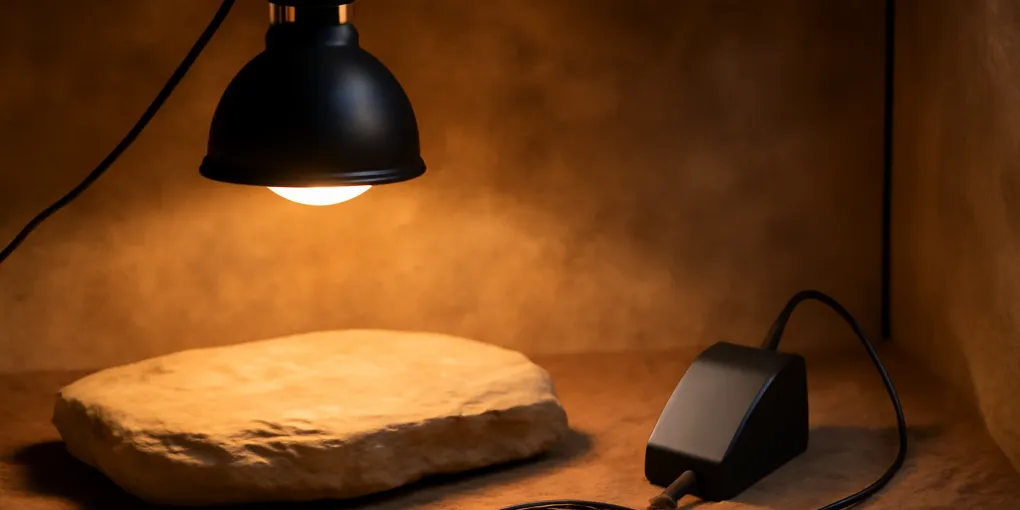
Bearded Dragon Thermostat Setup Protocol: Probe Placement, Basking Heat, and Backup Checks
ProtocolQuick picks
| Product | Key Specs |
|---|---|
| See price on Amazon |
|
| See price on Amazon |
|
| See price on Amazon |
|
Product availability, certifications, and retailer details can change; check the current Amazon page before buying.
The Core Rule
A bearded dragon thermostat is a control layer, not the only temperature measurement. The thermostat can reduce overheating risk, but you still need a warm-side check, a cool-side check, and a basking-surface check after bulb, room, or decor changes.
This protocol is different from our bearded dragon travel carrier setup because the enclosure has stable heat equipment, longer exposure time, and a thermal gradient the dragon can use. It also differs from a simple food or salad setup because heat affects digestion, activity, and safety every day.
Product Starting Points
- Search Amazon for dimming reptile thermostats if you use a compatible heat bulb and want smoother control than on/off cycling.
- Search Amazon for reptile probe thermometers for fixed warm-side and cool-side checks.
- Search Amazon for reptile temperature guns to check the actual basking surface after changes.
How We Evaluated the Setup
| Factor | Weight | Score | Weighted | Why it matters for bearded dragons |
|---|---|---|---|---|
| Research | 30% | 8.0 | 2.40 | Reptile husbandry guidance consistently treats correct heat gradients as foundational. |
| Evidence Quality | 25% | 7.5 | 1.88 | Exact target ranges vary by age, source, and enclosure design, but gradient and verification principles are consistent. |
| Value | 20% | 8.5 | 1.70 | A thermostat plus independent thermometer checks is cheaper than replacing bulbs randomly after behavior changes. |
| User Signals | 15% | 8.0 | 1.20 | Owner problems often involve probe displacement, wrong thermostat mode, overheated basking spots, and cold cool sides. |
| Transparency | 10% | 9.0 | 0.90 | The protocol avoids claiming a controller can diagnose appetite, lethargy, or disease. |
| Composite Score | 8.08/10 | Strong safety setup when the owner verifies the gradient instead of trusting one display. |
Step 1: Confirm the Heat Source
Identify what your thermostat is controlling: halogen basking bulb, incandescent heat bulb, ceramic heat emitter, heat projector, or under-tank heater. Many bearded dragon basking setups use overhead heat, and a dimming thermostat may be a better fit for visible basking bulbs than a basic on/off controller. Read the thermostat manual for bulb compatibility and wattage limits.
Do not plug UVB lighting into the heat thermostat unless the product manual specifically says the device is meant for that use. UVB scheduling and heat control are different jobs.
Step 2: Place the Probe Where It Controls the Right Zone
The probe should sense the basking zone without becoming a toy, perch, or loose wire. Secure it with reptile-safe routing outside chewing and clawing paths. If the probe hangs in open air far from the basking surface, the thermostat may run the bulb too hard. If the dragon sits directly on the probe, the reading may stop representing the basking surface.
After placing the probe, compare the thermostat reading with a separate probe thermometer and an infrared surface reading. A mismatch is a setup problem, not a reason to ignore the independent tools.
Step 3: Verify the Gradient
A bearded dragon needs a warm basking area and a cooler area where it can retreat. Check the basking surface, warm side air, and cool side. If the cool side rises too high in a small enclosure, lowering the basking set point may not solve the problem; you may need better ventilation, a different bulb wattage, or a larger enclosure.
Measure at the times the room changes: morning warm-up, afternoon sun on the room, evening HVAC shift, and after the door is opened for feeding. One perfect reading after setup does not prove the whole day is safe.
Step 4: Build a Daily Check
Each morning, confirm that the lamp turns on, the thermostat display looks normal, and the dragon can reach both warm and cool zones. Each evening, check that timers and thermostat settings still match the schedule. Weekly, inspect the probe mount, bulb socket, cord path, and any tape or clips.
Record unexpected set-point swings; they can reveal a loosened probe before the enclosure overheats.
Keep a spare bulb if your enclosure depends on one heat source. A broken bulb on a cold day is easier to handle if the replacement is already in the house.
Step 5: Know What the Thermostat Cannot Explain
Low appetite, black beard, glass surfing, lethargy, abnormal stool, weight loss, open-mouth breathing outside normal basking, or repeated hiding can involve temperature, but they can also involve diet, parasites, stress, brumation, reproductive disease, respiratory disease, or other medical problems. Fix obvious setup errors, then contact a reptile veterinarian if signs persist or are severe.
Bearded Dragon Thermostat FAQ
Is an infrared temperature gun enough?
No. It is useful for surface checks, but it does not control heat and it does not continuously track the cool side. Use it with fixed thermometers and the thermostat.
Should the basking lamp turn completely off during the day?
That depends on the thermostat type, bulb, room temperature, and enclosure. Frequent on/off cycling can be a sign that the bulb wattage, probe position, or thermostat mode needs adjustment.
Can I use the same thermostat for a heat mat?
Only if the thermostat is rated for that device and the heat mat is appropriate for the enclosure. Overhead basking heat is usually the central heat source for bearded dragon basking behavior.
Sources
- RSPCA, bearded dragon environment and care guidance: https://www.rspca.org.uk/adviceandwelfare/pets/other/beardeddragon
- VCA Animal Hospitals, bearded dragon care and husbandry basics: https://vcahospitals.com/know-your-pet/bearded-dragons-owning
- Merck Veterinary Manual, reptile husbandry and environmental management: https://www.merckvetmanual.com/exotic-and-laboratory-animals/reptiles/management-of-reptiles
Frequently Asked Questions
- A thermostat is a safety control, especially when room temperature, bulb output, or enclosure ventilation changes. It should be paired with independent thermometers rather than trusted alone.
- Place it near the basking zone where it can sense the heat being controlled, but secure it so the dragon cannot pull it away or sit directly on it. Verify the actual basking surface with a separate thermometer or infrared temperature gun.
- No. A bearded dragon needs a warm basking area and a cooler retreat. Check both zones because one display cannot prove the gradient is safe.