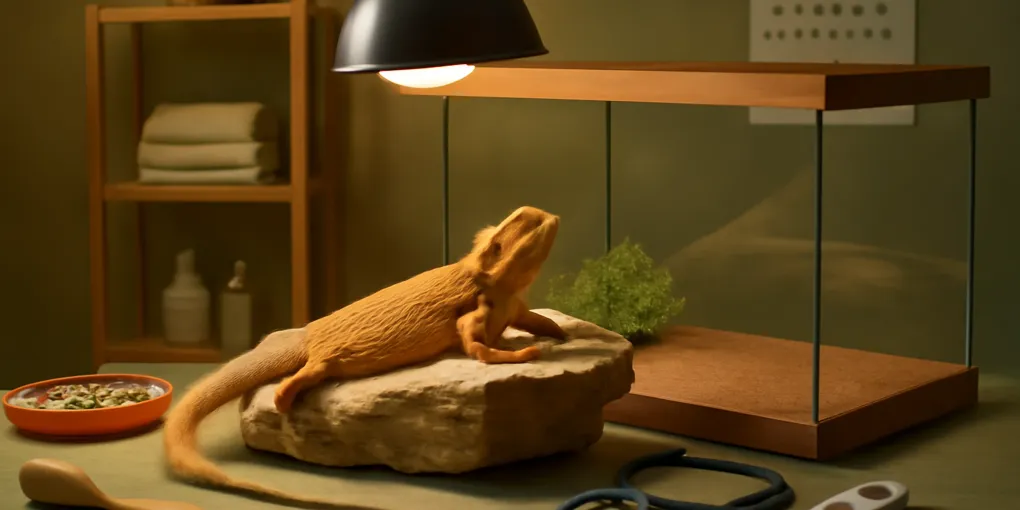
Bearded Dragon Basking Setup Protocol: Heat, UVB, and Safer Measurement
ProtocolQuick picks
Infrared temperature gun
★ Top pick- Best for: Checking the actual basking surface
- Check first: Shiny surfaces can read inaccurately; use matte stone, slate, or tile and compare with a probe.
- Rationale: Surface temperature matters more than the warm-side air number when a dragon is flattening on the basking rock.
Linear T5 HO UVB fixture
- Best for: Even UVB exposure across the basking zone
- Check first: Bulb strength and distance depend on brand, mesh, and enclosure height. Follow the bulb chart.
- Rationale: A linear fixture makes it easier to give the dragon UVB while it thermoregulates.
Dimming thermostat or lamp dimmer
- Best for: Reducing heat spikes from basking bulbs
- Check first: Do not use a simple on-off thermostat with every lamp type unless the manufacturer allows it.
- Rationale: Heat lamps change with room temperature. Control prevents the basking surface from drifting too hot.
Medical Disclaimer
Bearded dragons with weakness, twitching, swollen limbs, jaw softness, poor appetite, black beard, open-mouth breathing at rest, burns, or repeated falls need an exotic-animal veterinarian. Lighting setup helps prevention, but it is not a treatment plan.
The goal
A good basking setup lets a bearded dragon do three things at once: warm its body, receive usable UVB, and move away when it has had enough. The unsafe version is a hot bulb over a single perch with no surface-temperature measurement and a compact UVB bulb in the wrong place.
The protocol below focuses on repeatable measurements. If you are choosing gear for broader reptile habitat monitoring, compare this setup with our reptile habitat controller guide.
Heat and UVB setup score
| Criterion | Weight | Score | Why it matters here |
|---|---|---|---|
| Research | 30% | 8.5 | Heat, UVB, calcium metabolism, and behavior are linked in reptile husbandry. |
| Evidence quality | 25% | 8.0 | The protocol relies on veterinary and specialist husbandry guidance, not owner folklore. |
| Value | 20% | 8.5 | A temperature gun and correct UVB fixture prevent more mistakes than decorative accessories. |
| User signals | 15% | 8.0 | Owners often search after poor appetite, glass surfing, or confusing thermometer readings. |
| Transparency | 10% | 8.5 | Exact target numbers vary by bulb, mesh, and enclosure, so measurement method is emphasized. |
| Composite | 8.3/10 | High-value setup work for a species where small lighting errors can matter. |
Recommended products for this setup
Start with the three product cards above: an infrared temperature gun, a linear T5 HO UVB fixture, and a safe way to control or tune heat output. Add a digital probe thermometer on the warm side and another on the cool side. A single stick-on dial is not enough.
Skip colored bulbs, tiny coil UVB as the only source over a large enclosure, and decorative basking branches that are too narrow for the dragon to support all four feet.
Step 1: Build a stable basking platform
Use a flat, stable surface under the heat lamp: slate, tile, a broad rock, or a secured platform. The dragon should be able to lie flat without wobbling. A narrow branch can create one hot stripe across the back while the belly and limbs stay cooler.
Place the platform so the dragon can climb down to a warm zone and then to a cooler zone. Basking is not a trap. The animal should have choices.
Step 2: Measure surface temperature, not vibes
Turn the lamps on and let the enclosure run for at least 45 to 60 minutes. Then measure the basking surface with an infrared temperature gun. Check the center and edges of the platform.
For many adult bearded dragon setups, owners use a basking surface around the high 90s to low 100s Fahrenheit. Younger dragons are often kept with slightly warmer basking opportunities, but the exact range should match current veterinary or breeder guidance and the animal’s behavior. If the dragon is gaping constantly, hiding all day, or never basking, the setup needs adjustment.
Use probe thermometers to confirm the warm and cool air zones. A hot surface paired with a cool side in the 70s to low 80s Fahrenheit gives the dragon more control than one uniformly warm tank.
Step 3: Put UVB where basking happens
A linear UVB fixture should overlap the basking zone so the dragon receives UVB while choosing heat. Follow the bulb manufacturer’s distance chart. Mesh lids can reduce UVB, glass blocks it, and old bulbs can keep glowing after useful UVB output has dropped.
Record the install date on the fixture or in your phone. Replace the bulb according to manufacturer guidance, not when it visually burns out.
Search Amazon for T5 HO UVB bearded dragon fixture
Step 4: Control heat drift
Room temperature changes the basking surface. A lamp that is correct in April can become too hot in July. Use a dimming thermostat, a compatible dimmer, or bulb-wattage changes to tune the surface.
Do not place the thermostat probe in a random corner and assume the rock is safe. Put measurement where the animal actually basks, then cross-check with the temperature gun.
Search Amazon for reptile dimming thermostat heat lamp
Step 5: Watch the dragon, not just the numbers
Good behavior looks like moving between warm, UVB, and cooler areas. Warning signs include staying dark and inactive all day, refusing the basking platform, frantic glass surfing, resting with mouth open away from the basking spot, or climbing dangerously close to the lamp.
If a change in lighting is followed by poor appetite or weakness, revert to a safe baseline and call an exotic vet.
Maintenance schedule
- Daily: confirm lamps turn on, water is clean, and the dragon can move normally.
- Twice weekly: spot-check basking surface with the IR gun.
- Monthly: clean dust from fixtures and confirm the platform has not shifted.
- At bulb interval: replace UVB according to the maker’s schedule.
- After room-season changes: remeasure everything.
Bearded dragon basking setup FAQ
Is a heat rock safe for bearded dragons?
Avoid electric heat rocks. They can create contact burns. Overhead heat with measured surface temperatures is easier to control and more natural for basking behavior.
Can I use sunlight through a window?
No. Window glass blocks much UVB and can create overheating risk. Supervised outdoor time requires secure containment, shade, and weather judgment.
Why does my thermometer say the tank is fine but the dragon avoids the basking spot?
The thermometer may be measuring air in the wrong place. Check the actual surface, UVB distance, glare, platform stability, and whether the dragon can retreat easily.
Sources
- VCA Animal Hospitals: Bearded dragons - feeding
- VCA Animal Hospitals: Bearded dragons - common diseases
- RSPCA: Bearded dragon care
Frequently Asked Questions
- Many adult setups target roughly the high 90s to low 100s Fahrenheit on the basking surface, but age, health, enclosure, and source guidance matter. Measure the surface, not just the air.
- No. Standard glass blocks much UVB, so the UVB fixture needs to be inside the enclosure or mounted through appropriate mesh according to the bulb maker's distance chart.
- Usually no. Bearded dragons need a dark night cycle. If nighttime heat is medically or seasonally needed, ask an exotic vet about a ceramic heat emitter or radiant heat panel setup.